CAIIB Elective Choice: Which Paper Suits Your Branch
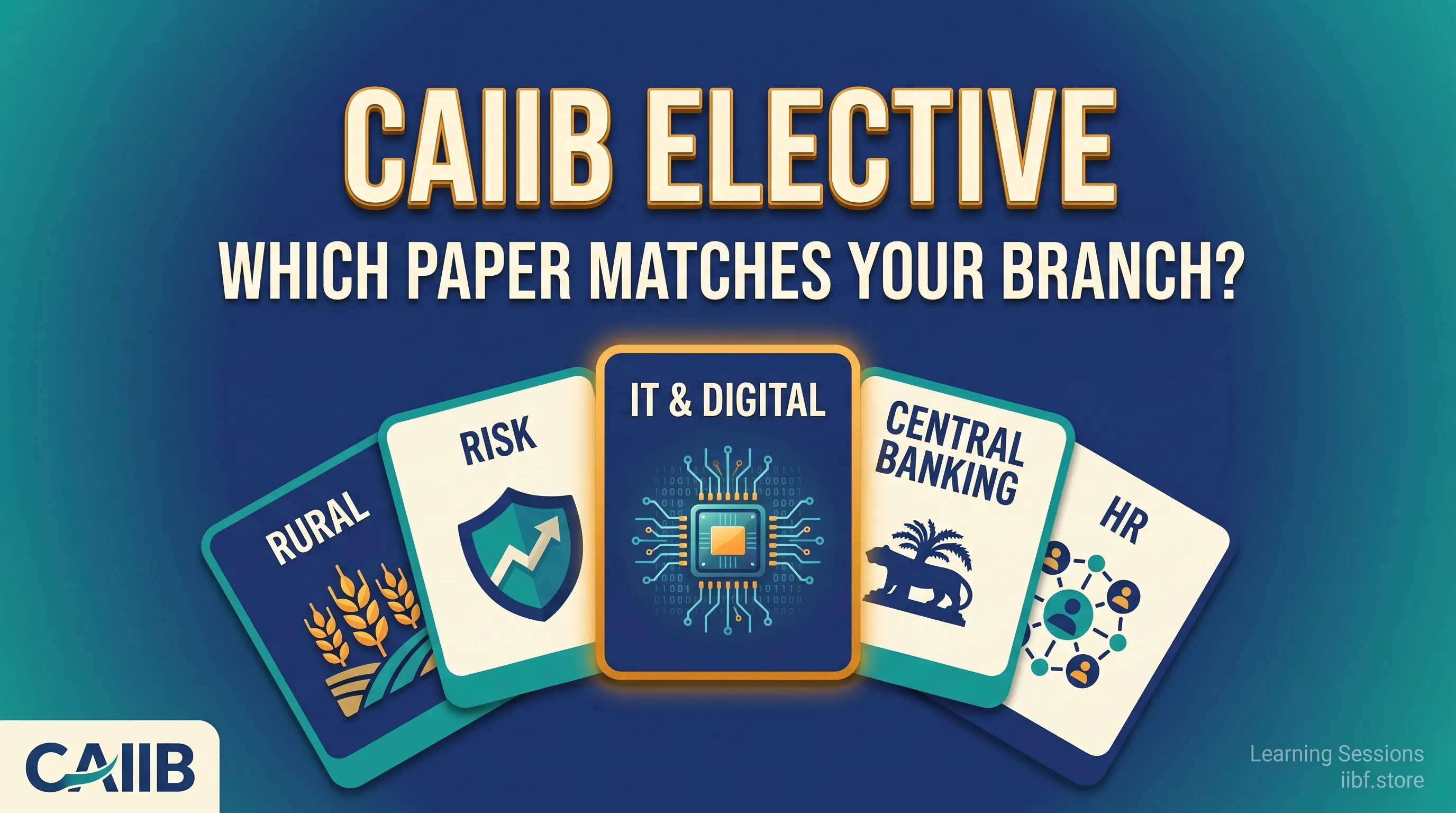
Your CAIIB elective choice is the single decision on the registration form that quietly decides whether you pass in the first attempt, yet most working bankers spend less than a minute on it. You see a drop-down labelled "Elective Paper", five options that all sound relevant to a banking career, and you tick whichever feels appealing in the moment. Then you forget about it until the exam is barely two months away, by which point the elective has become the biggest single threat to your result.
This guide is a clear-headed decision framework for the CAIIB elective choice. No marketing gloss, no pretending all five papers are equally easy. Just an honest matrix that maps each elective to a real branch posting, explains what every paper actually tests, and shows you how to lock in your choice early so the last fortnight is calm instead of frantic.
Key takeaways
- The CAIIB elective is one of the papers in the qualification and is graded like any other, so you must clear it individually and a wrong choice can sink an otherwise strong attempt.
- Pick the elective that matches where you work today, not where you hope your career goes. The papers test applied, on-the-job knowledge.
- Risk Management is the most efficient pick for a non-specialist because it overlaps heavily with Bank Financial Management (BFM) Module B.
- None of the CAIIB papers, elective included, carry negative marking, so you attempt every question.
- Commit on Day 1 and study a little daily; breadth is earned through consistent contact, not a week-12 cram.
Start with your branch posting, not your career dream
The biggest mistake in the CAIIB elective choice is selecting a paper based on the role you want rather than the desk you occupy. The CAIIB electives are deliberately applied: the questions presume you already speak the domain's language and have handled its products. A retail home-loan officer who picks Rural Banking because they "want to move into agri" is volunteering for a full-length paper on processes they have never touched.
Treat the choice as a matching exercise against your current posting. Here is the honest matrix that most working bankers should follow.
- Posted at a rural or semi-urban branch handling Kisan Credit Cards, self-help groups, FPOs, microfinance and agri-allied lending? Choose Rural Banking, because the terminology and customer types are your daily life.
- Working in card products, internet and mobile banking, digital wallets or IT support? Choose IT and Digital Banking, because the questions assume you have actually operated the systems.
- Sitting in treasury, credit underwriting, risk monitoring, internal audit or compliance? Choose Risk Management, because a large slice doubles up with what you prepared for BFM.
- In HR, learning and development, branch staff management or industrial relations? Choose Human Resources Management; otherwise approach it with caution, because the case studies reward genuine HR exposure.
- In research, an RBI-facing function or regulatory liaison, or simply fascinated by monetary policy? Choose Central Banking, because it is theory-rich and rewards readers.
If you honestly fit none of these, say you are a customer-service officer at a small branch with no specialisation, the safest defaults are Risk Management (if you prepared BFM thoroughly) or Central Banking (if you enjoy reading-heavy papers). Before you decide, it is worth skimming the official paper structure on the CAIIB course hub, where the compulsory subjects such as Advanced Bank Management and Bank Financial Management are mapped chapter by chapter.

CAIIB elective choice at a glance
Before the deep dives, here is the five-paper comparison most candidates wish they had seen before registering. Use it to shortlist, then read the section for your top one or two.
| Elective | Best suited to | Question style | Effort-to-score |
|---|---|---|---|
| Rural Banking | Rural / semi-urban branch staff | Scheme identification, parameters | Low effort if posted rural |
| IT & Digital Banking | Card / digital / IT-ops staff | Contemporary, system-aware | Moderate; cyber rules are tough |
| Risk Management | Treasury, credit, audit, compliance, or any non-specialist who prepped BFM | Conceptual plus some numerical | Most efficient via BFM overlap |
| Central Banking | Readers, research / RBI-facing roles | Descriptive, comparative | Moderate; little to calculate |
| HR Management | HR / L&D / branch-management staff | Judgement-led case studies | Hard for non-HR bankers |
Rural Banking, the easiest paper if your branch is rural
For the CAIIB elective choice, Rural Banking offers the best score-to-effort ratio to anyone who lives this world daily. The paper tests Priority Sector Lending classification, agriculture finance schemes such as the Kisan Credit Card and NABARD refinance, SHG and JLG bank-linkage, microfinance institutions, financial inclusion, regional rural banks, and the major government schemes such as PMJDY, PM-KISAN and MUDRA in their rural context.
Pros: The question style is largely identification and scheme parameters, which is easy to drill. A banker with a rural posting can often clear the threshold with light, steady preparation because the content mirrors the working day.
Cons: If you have only ever worked in metro or urban branches, the sheer number of schemes is overwhelming. There are roughly a couple of dozen rural credit programmes, each with its own eligibility quirks, and memorising them cold is a slog. The deeper structure of these programmes is laid out in our Microfinance and SHG-Bank Linkage Programme guide for CAIIB Rural Banking.
IT & Digital Banking, easiest if you have lived the tech
This paper covers Core Banking System architecture, the payment rails (NEFT, RTGS, IMPS and UPI), NPCI products, card networks such as Visa, Mastercard and RuPay, digital wallets, cyber-security frameworks including the RBI cyber-security directions and ISO 27001, plus data protection, biometric authentication, and emerging themes like AI, machine learning, blockchain and open-banking APIs.
Pros: It is highly contemporary, and much of it overlaps with what you already read in the news or use every day, so retention is easier. If you have deepened your understanding of the UPI stack, our UPI Ecosystem Explained: A Complete CAIIB ITDB Guide is built exactly for this paper, and a chunk of the syllabus already feels familiar.
Cons: Cyber-security questions can be brutal if you have not read the underlying RBI directions, and the field moves so fast that older material can feel dated. Always cross-check against the latest released IIBF syllabus before you assume a topic is in or out.
Risk Management, the smart overlap pick
If there is one default answer to the CAIIB elective choice for a non-specialist, it is Risk Management. The paper tests credit risk, market risk, operational risk and liquidity risk, the asset-liability management framework, RBI's risk-based supervision, Basel III in greater depth than the compulsory BFM paper goes, and topics such as stress testing, ICAAP, business continuity management and fraud risk management.
Pros: The overlap with BFM Module B is substantial. If you prepared BFM well, you have already covered a large share of this elective, and much of the remainder is structured reading. That makes it the single most efficient elective for a banker without a strong domain match elsewhere.
Cons: The Basel and ICAAP material runs deeper than BFM. You will need to genuinely internalise the capital buffers, including CET1, the capital conservation buffer and the countercyclical buffer, rather than the lighter treatment you may have gotten away with in BFM Module B.
Central Banking, the reading-heavy theory paper
Central Banking examines the functions of central banks worldwide, a comparative view of major institutions such as the Federal Reserve, ECB, Bank of England, Bank of Japan and the RBI, the RBI's history and evolution, monetary-policy frameworks across regimes such as inflation targeting and exchange-rate targeting, foreign-exchange management, balance-of-payments issues and the financial-stability mandate.
Pros: It is conceptual and narrative-driven. If you enjoy reading economic essays and can retain the names of governors and policy regimes, the paper is genuinely engaging. Two of our most-used resources for it are the LAF Corridor explainer covering Repo, SDF and MSF and the broader RBI Monetary Policy guide on Repo Rate, CRR, SLR and inflation targeting.
Cons: Very little of the paper asks you to calculate. Almost everything is "describe" and "compare", so if your strength is numericals rather than prose-heavy MCQs, this is a weaker fit.
Human Resources Management, pick only if HR is your day job
The HRM elective tests HR planning, recruitment, training and development, compensation, performance management, industrial relations, employee engagement, organisational behaviour, change management and ethics in HR. It is the most posting-dependent paper of the five.
Pros: If you have worked in HR functions or branch staff management, the case studies feel familiar and intuitive, and our guide to the performance management system in banks maps closely to what the paper expects.
Cons: It leans heavily on case studies that demand nuanced judgement, where several options look plausible and only one is "most correct". For a banker who has never managed people, those case-lets quickly become guessing exercises.
A 12-week study plan that works for every elective
Whichever way your CAIIB elective choice lands, the operating model is identical: commit on Day 1 and study a focused half-hour a day for about three months, rather than attempting four-hour marathons in the final week. These papers reward breadth, and breadth is built only through daily contact with the material.
Here is a practical opening sequence you can start tonight:
- Days 1 to 3: Read the elective's syllabus index in the IIBF courseware from end to end. Do not try to absorb everything; just map the territory so nothing surprises you later.
- Days 4 to 10: Read Chapter 1 in 30-minute slots, then attempt a chapter quiz using the free CAIIB mock tests to convert reading into recall.
- Week 2 onwards: One chapter per week, a daily 30-minute slot, and a weekly chapter mock. To make revision stick, drill the scheme names and definitions with the CAIIB matching games.
By week 12 you will have covered the syllabus once, taken roughly a dozen chapter mocks, and you will walk in calm. Compare that with the candidate who opens the book on day 80, and there is no contest. For a worked example of the stakes-and-schedule mindset, see how we frame the CAIIB ABFM exam-date countdown.
Common mistakes to avoid
- Choosing by ambition, not posting. The most expensive error is picking the paper that fits the job you want instead of the desk you sit at today.
- Ignoring the BFM overlap. Bankers who have already prepared BFM but skip Risk Management leave the easiest efficiency gain on the table.
- Treating the elective as an afterthought. It is graded like every other paper, so neglect it and a strong attempt can still fail on this one component.
- Leaving questions blank. With no negative marking, an unanswered question is simply marks discarded.
- Cramming in the final fortnight. Breadth-based papers punish last-minute study; a little daily contact beats a panic finish every time.
- Assuming the syllabus is static. Especially for the digital paper, confirm inclusions against the latest released IIBF notification before you skip a topic, and always verify on the official IIBF page.
Frequently Asked Questions
Can I change my CAIIB elective after registration?
In some cycles IIBF permits an elective change through a re-registration request before a stated cut-off, but the rules vary from cycle to cycle. Always confirm the current window and procedure on the official IIBF notification before you count on switching. The safer mindset is to choose once, deliberately, and then prepare consistently.
Does the elective have negative marking like the compulsory papers?
No, CAIIB papers, including the elective, carry no negative marking. That means you should attempt every single question. Even after eliminating two clearly wrong options, an informed guess has a positive expected value, so leaving anything blank only costs you marks.
Which CAIIB elective has the highest pass rate?
IIBF does not publish elective-wise pass rates, so any ranking is anecdotal. By common experience, Risk Management tends to do well among candidates who picked it because of the BFM overlap, while HR Management is hardest for non-HR bankers owing to its judgement-led case studies. Treat these as tendencies, not guarantees.
How much does the elective count towards CAIIB?
The elective is one of the papers in the qualification and is weighted like the others, and you must clear it individually on its own pass mark. Failing only the elective generally means re-appearing for that single paper in a later cycle, which is annoying but far from catastrophic. Confirm the exact marks and pass criteria on the latest IIBF notification.
Is Risk Management really the easiest CAIIB elective?
It is rarely the easiest in absolute terms, but it is usually the most efficient for a non-specialist because a large portion overlaps with BFM Module B. If you prepared BFM seriously, you have already done much of the groundwork, and the remaining Basel and ICAAP depth is structured reading rather than new territory.
I have no specialisation at all, what should I pick?
Default to Risk Management if you prepared BFM thoroughly, or Central Banking if you genuinely enjoy reading-heavy, descriptive papers. Then validate the decision quickly: attempt fifteen questions from a free chapter mock tonight and let your accuracy tell you whether the fit is right while the registration window is still open.
Final word
Your CAIIB elective choice is not a career conversation; it is a strategic decision driven by your current job exposure. Match the paper to your daily branch reality, commit on Day 1, and study a steady thirty minutes a day, and the elective stops being a hidden landmine and becomes a buffer that lifts your overall score.
Start tonight: pick the paper that fits your posting, take fifteen questions from a free chapter mock, and let the result confirm your call. Full chapter PDFs, video classes and mocks across every CAIIB paper, compulsory subjects and all electives, are free on the CAIIB guides hub, and you can always cross-check official rules on the IIBF website.
Related Guides
📚 Free Learning Sessions resources — connect & crack your exam
- 📝 Free mock tests — chapter-wise, exam-pattern, with instant solutions
- 🎮 Matching games — gamified revision of key terms & concepts
- 📄 Study notes & PDFs — downloadable chapter material
- 🎥 Video classes on YouTube — subscribe to @learningsessions
💬 Want the full course? WhatsApp your course name to 8360944207 and our team will set you up.
📱 Study on the go — get our iOS & Android app at iibf.store/app.
Prefer revising from a printed book?
Chapter-wise books with MCQs after every chapter — minimal pages, complete coverage, delivered anywhere in India. Every book has a free sample to read first.
148 pages · 478 MCQs
Learning Sessions · Ashish Sir
151 pages · 465 MCQs
Learning Sessions · Ashish Sir
148 pages · 375 MCQs
Learning Sessions · Ashish Sir
216 pages · 895 MCQs
Learning Sessions · Ashish Sir
109 pages · 300 MCQs
Learning Sessions · Ashish Sir
104 pages · 360 MCQs
Learning Sessions · Ashish Sir
82 pages · 297 MCQs
Learning Sessions · Ashish Sir
151 pages · 600 MCQs
Learning Sessions · Ashish Sir
98 pages · 282 MCQs
Learning Sessions · Ashish Sir
131 pages · 672 MCQs
Learning Sessions · Ashish Sir
221 pages · 831 MCQs
Learning Sessions · Ashish Sir
128 pages · 524 MCQs
Learning Sessions · Ashish Sir
107 pages · 445 MCQs
Learning Sessions · Ashish Sir
132 pages · 225 MCQs
Learning Sessions · Ashish Sir
188 pages · 435 MCQs
Learning Sessions · Ashish Sir
117 pages · 236 MCQs
Learning Sessions · Ashish Sir
Learning Sessions · Ashish Sir
118 pages · 299 MCQs
Learning Sessions · Ashish Sir
Learning Sessions · Ashish Sir
Learning Sessions · Ashish Sir
Learning Sessions · Ashish Sir
115 pages · 255 MCQs
Learning Sessions · Ashish Sir
Learning Sessions · Ashish Sir
334 pages · 936 MCQs
Learning Sessions · Ashish Sir
Learning Sessions · Ashish Sir
115 pages · 344 MCQs
Learning Sessions · Ashish Sir
107 pages · 240 MCQs
Learning Sessions · Ashish Sir
90 pages · 150 MCQs
Learning Sessions · Ashish Sir
Learning Sessions · Ashish Sir
Quick quiz on this topic
5 exam-style questions from our free test bank — check yourself before you move on.
Practice this topic
Take a free mock test, download chapter PDFs, or watch a video class — all included on iibf.store.
Keep reading