Monetary Policy Committee Structure: CAIIB Guide (2026)
The Monetary Policy Committee structure is one of the most frequently tested topics in the CAIIB Central Banking elective, because it sits at the heart of how interest-rate decisions are actually made in India today. Before 2016, the Governor of the Reserve Bank held sole discretion over the policy rate, advised only informally by a Technical Advisory Committee. That changed when the RBI Act, 1934 was amended to create a statutory, six-member committee with a legal mandate — a shift that examiners love to probe.
Understanding the Monetary Policy Committee structure means knowing three things cold: who sits on it, how they vote, and what target binds them. In this guide we break down the composition, tenure, quorum, voting mechanics and the inflation-target accountability that together make the MPC the single most important decision-making body in Indian central banking. For the broader context of how the RBI operates, revisit the chapter on Functions Of Central Banks.
🏛️ Legal Basis and Why the MPC Exists
The MPC was constituted under Section 45ZB of the Reserve Bank of India Act, 1934, inserted by the Finance Act, 2016. This statutory footing matters: it means the committee is not an internal RBI convenience but a body created by Parliament, with defined powers and defined accountability. The reform flowed from the recommendations of the Urjit Patel Committee (2014), which argued that a committee-based, rule-bound approach would improve credibility and anchor inflation expectations better than the discretion of a single individual.
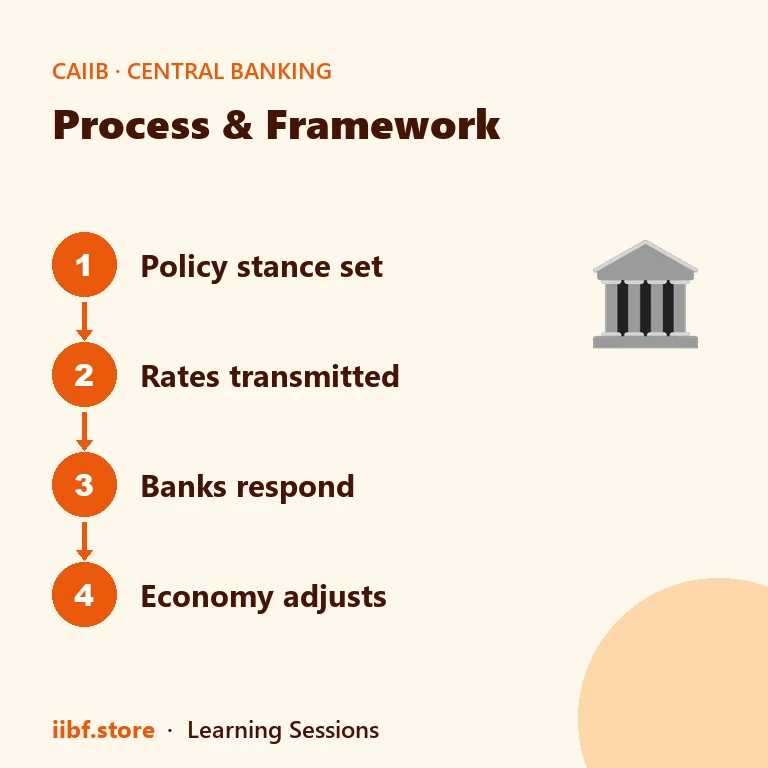
The core idea is flexible inflation targeting. The government, in consultation with the RBI, sets a numerical inflation target; the MPC then decides the policy repo rate needed to achieve it while supporting growth. Because the decision is collective and published — with minutes and individual votes released — the framework is far more transparent than the pre-2016 arrangement. This transparency and the diffusion of responsibility across six members is exactly why the committee model was chosen, and why it forms a recurring theme in the Theory And Practice Of Central Banking chapter.
💡 Exam Tip: Remember the exact section — Section 45ZB of the RBI Act, 1934 constitutes the MPC. Section 45ZN deals with the failure-to-maintain-target report. Distinct sections are classic MCQ traps.
👥 Composition: The Six Members
The Monetary Policy Committee has exactly six members, split evenly between the Reserve Bank and external experts. Three come from within the RBI: the Governor (who chairs the committee ex officio), the Deputy Governor in charge of monetary policy, and one officer of the Bank nominated by its Central Board. The other three are external members appointed directly by the Central Government — typically economists or academics chosen for their expertise in monetary policy.
This 3+3 split is deliberate. It prevents the RBI from having an automatic numerical majority on paper, while the Governor's casting vote preserves the central bank's decisive role when opinion is split. External members bring independent perspectives and shield decisions from any perception of internal groupthink. Candidates should be able to reproduce this composition instantly, since a common exam question asks how many members are RBI insiders versus government appointees.
📌 Remember: 3 RBI + 3 Government-appointed external members = 6 total. The Governor is Chairperson; the external members are NOT eligible for reappointment.
🗳️ Tenure, Quorum and Voting Mechanics
The three external members hold office for a period of four years and are not eligible for re-appointment — a design choice that insulates them from political pressure to seek a second term. The RBI members serve by virtue of their office. The committee must meet at least four times a year, though in practice it meets bi-monthly, producing six scheduled reviews annually.
The quorum for a meeting is four members, at least one of whom must be the Governor or, in the Governor's absence, the Deputy Governor who is a member. Each member has one vote. Decisions are taken by majority; in the event of a tie, the Governor exercises a second, casting vote. Every member must also submit a written statement of the reasons for their vote, which is published — reinforcing individual accountability. These voting rules echo the collective decision-making principles discussed under Contemporary Issues In Central Banking.
⚠️ Common Mistake: Students often say the quorum is three. It is FOUR, and the Governor (or the member Deputy Governor) must be present. Do not confuse the four-year tenure of external members with the meeting frequency of four times a year.
🎯 The Inflation Target and Accountability
The MPC operates against a Consumer Price Index (CPI) inflation target set by the Central Government every five years in consultation with the RBI. That target is 4%, with a tolerance band of +/- 2% — meaning inflation is to be kept between 2% and 6%. The government retained this 4% target for the five-year cycle running up to March 2031, keeping India's flexible inflation-targeting regime intact.
Accountability is built in. Under Section 45ZN, if average CPI inflation breaches the 2%-6% band for three consecutive quarters, the RBI is deemed to have failed and must send the Government a report setting out the reasons, the remedial actions proposed, and the estimated time to bring inflation back within the band. This "failure clause" is what gives the numerical target real teeth. To see how policy rates and reserve tools work alongside the target, study our guide to CRR and SLR Reserve Requirements and the mechanics of variable rate repo auctions used to steer liquidity toward the target.
📊 MPC at a Glance: Key Facts Table
| Feature | Details | Statutory / Fixed? |
|---|---|---|
| Total members | 6 (3 RBI + 3 external) | ✅ Yes (Sec 45ZB) |
| Chairperson | RBI Governor (ex officio) | ✅ Yes |
| External members' tenure | 4 years, no re-appointment | ✅ Yes |
| Quorum | 4 members (Governor/DG must attend) | ✅ Yes |
| Casting vote in a tie | Governor | ✅ Yes |
| External member re-appointment | Allowed for a second term | ❌ No |
| Inflation target | 4% CPI (+/- 2% band) | Reviewed every 5 years |
This comparison is a ready reckoner for revision. For a full picture of how the MPC's rate decisions ripple through the economy, browse more explainers on our Central Banking topic hub, and understand the wider financial architecture in the chapter on Constituents Of Indian Financial System Structure.
🔬 A Note on Evidence and Testing
Whether the MPC's framework "works" is ultimately an empirical question — economists test whether inflation expectations have become better anchored since 2016 using statistical significance tests. If you want to sharpen that analytical muscle for the ABM paper too, our companion guide on hypothesis testing explains null and alternative hypotheses and the errors involved in exactly this kind of evaluation. Central banking and quantitative methods overlap more than most candidates expect.
🧠 Practice MCQs: Monetary Policy Committee Structure
Q1. Under which section of the RBI Act, 1934 is the Monetary Policy Committee constituted? (a) Section 45ZA (b) Section 45ZB (c) Section 45ZN (d) Section 24
Answer: (b) — Section 45ZB, inserted by the Finance Act, 2016, constitutes the MPC.
Q2. How many members does the Monetary Policy Committee have, and how are they split? (a) 6 members: 4 RBI + 2 external (b) 5 members: 3 RBI + 2 external (c) 6 members: 3 RBI + 3 external (d) 7 members: 4 RBI + 3 external
Answer: (c) — Six members: three from the RBI (including the Governor) and three government-appointed external members.
Q3. What is the tenure of the external members of the MPC? (a) 3 years, renewable (b) 4 years, not eligible for re-appointment (c) 5 years, renewable once (d) Until age 65
Answer: (b) — External members serve four years and cannot be re-appointed, protecting their independence.
Q4. What is the quorum for a meeting of the MPC? (a) 3 members (b) 4 members including the Governor or the member Deputy Governor (c) 5 members (d) All 6 members
Answer: (b) — The quorum is four members, and the Governor (or the member Deputy Governor in his absence) must be present.
Q5. If CPI inflation stays outside the tolerance band for how long is the RBI deemed to have failed to maintain the target? (a) One quarter (b) Two consecutive quarters (c) Three consecutive quarters (d) One full year
Answer: (c) — Under Section 45ZN, breaching the 2%-6% band for three consecutive quarters triggers a report to the Government.
Want chapter-wise mock tests with 100+ MCQs? Start practising free →
❓ Frequently Asked Questions
Who is the Chairperson of the Monetary Policy Committee?
The Governor of the Reserve Bank of India chairs the MPC ex officio and also holds a casting vote in the event of a tie.
How often does the MPC meet?
The MPC must meet at least four times a year; in practice it meets bi-monthly, holding six scheduled policy reviews each year.
What is India's current inflation target?
The target is 4% CPI inflation with a tolerance band of +/- 2% (i.e., 2% to 6%), retained by the Government for the five-year cycle up to March 2031.
Can external MPC members be re-appointed?
No. External members hold office for four years and are expressly not eligible for re-appointment, a rule designed to preserve their independence.
The Monetary Policy Committee structure rewards precise recall — six members, four-year non-renewable external tenure, a quorum of four, the Governor's casting vote, and the Section 45ZN failure clause. Lock these facts in, then test yourself under exam conditions. Ready to attempt a full Central Banking mock? Explore the CAIIB course and start your free tests →
Prefer revising from a printed book?
Chapter-wise books with MCQs after every chapter — minimal pages, complete coverage, delivered anywhere in India. Every book has a free sample to read first.
98 pages · 282 MCQs
Learning Sessions · Ashish Sir
148 pages · 478 MCQs
Learning Sessions · Ashish Sir
151 pages · 465 MCQs
Learning Sessions · Ashish Sir
148 pages · 375 MCQs
Learning Sessions · Ashish Sir
216 pages · 895 MCQs
Learning Sessions · Ashish Sir
109 pages · 300 MCQs
Learning Sessions · Ashish Sir
104 pages · 360 MCQs
Learning Sessions · Ashish Sir
82 pages · 297 MCQs
Learning Sessions · Ashish Sir
151 pages · 600 MCQs
Learning Sessions · Ashish Sir
131 pages · 672 MCQs
Learning Sessions · Ashish Sir
221 pages · 831 MCQs
Learning Sessions · Ashish Sir
128 pages · 524 MCQs
Learning Sessions · Ashish Sir
107 pages · 445 MCQs
Learning Sessions · Ashish Sir
132 pages · 225 MCQs
Learning Sessions · Ashish Sir
188 pages · 435 MCQs
Learning Sessions · Ashish Sir
117 pages · 236 MCQs
Learning Sessions · Ashish Sir
Learning Sessions · Ashish Sir
118 pages · 299 MCQs
Learning Sessions · Ashish Sir
Learning Sessions · Ashish Sir
Learning Sessions · Ashish Sir
Learning Sessions · Ashish Sir
115 pages · 255 MCQs
Learning Sessions · Ashish Sir
Learning Sessions · Ashish Sir
334 pages · 936 MCQs
Learning Sessions · Ashish Sir
Learning Sessions · Ashish Sir
115 pages · 344 MCQs
Learning Sessions · Ashish Sir
107 pages · 240 MCQs
Learning Sessions · Ashish Sir
90 pages · 150 MCQs
Learning Sessions · Ashish Sir
Learning Sessions · Ashish Sir
Quick quiz on this topic
5 exam-style questions from our free test bank — check yourself before you move on.
Practice this topic
Take a free mock test, download chapter PDFs, or watch a video class — all included on iibf.store.
Keep reading