RBI Monetary Policy Tools Explained: CAIIB Central Banking

For anyone preparing the CAIIB Central Banking elective, a firm grasp of RBI monetary policy is essential, because almost every chapter and a large share of exam questions flow from it. RBI monetary policy is the set of actions taken by the Reserve Bank of India to manage the supply of money, the cost of credit, and liquidity in the banking system so as to achieve price stability while keeping in mind the objective of growth. Since 2016 it has operated under a formal inflation-targeting framework, and its decisions ripple through every loan rate, deposit rate, and bond yield in the economy. This article explains the framework, the key instruments, and the exam points you must master.
The Framework and Objectives of RBI Monetary Policy
The cornerstone of modern RBI monetary policy is the flexible inflation-targeting (FIT) framework, given statutory backing by the amended Reserve Bank of India Act. Under this framework the government, in consultation with the central bank, sets a Consumer Price Index (CPI) inflation target with a tolerance band on either side. The primary objective is price stability — keeping inflation around the target — while supporting growth as a secondary consideration.
Decisions are made not by an individual but by the six-member Monetary Policy Committee (MPC), comprising three members from the RBI (including the Governor, who chairs it and holds a casting vote in a tie) and three external members appointed by the government. The MPC meets at least four times a year and decides the policy repo rate by majority vote. If inflation breaches the tolerance band for three consecutive quarters, the RBI must submit a report to the government explaining the failure and the corrective steps. For the exam, remember the composition, the voting mechanism, the casting vote, and the accountability provision. Candidates building this base through the structured CAIIB central banking course find these institutional details easier to retain.

The Liquidity Adjustment Facility: Repo and Reverse Repo
The most actively used arm of RBI monetary policy is the Liquidity Adjustment Facility (LAF), the channel through which the central bank injects or absorbs short-term liquidity. Its two pillars are:
- Repo rate: The rate at which banks borrow short-term funds from the RBI against eligible government securities. It is the policy rate the MPC sets; raising it makes borrowing costlier and cools demand, while lowering it stimulates credit.
- Reverse repo rate: The rate at which banks park surplus funds with the RBI. It absorbs excess liquidity from the system.
Around these sit the Marginal Standing Facility (MSF), an emergency overnight borrowing window priced slightly above the repo rate, and the Standing Deposit Facility (SDF), introduced to absorb liquidity without the RBI having to offer collateral. Together the MSF (upper bound) and SDF (lower bound) form the LAF corridor, with the repo rate near its centre — a structure examiners frequently ask you to sketch. Understanding how a change in the repo rate transmits to lending and deposit rates is core, and you can test your command of these linkages on iibf.store mock tests and reinforce them with the rapid recall on the match game.
Reserve Requirements: CRR and SLR
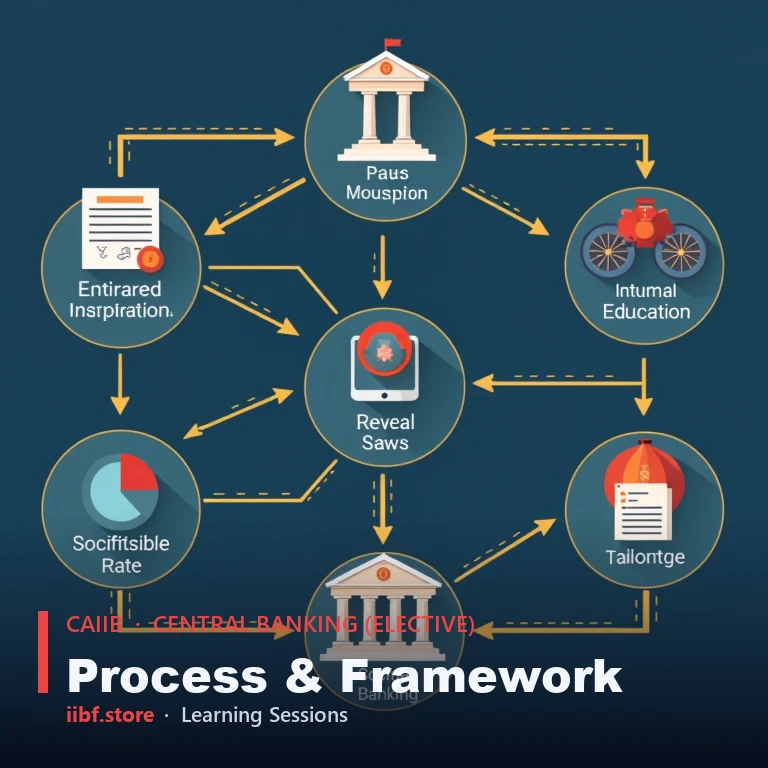
Alongside rate instruments, RBI monetary policy uses two reserve requirements that act as quantitative levers on liquidity and credit creation:
- Cash Reserve Ratio (CRR): The percentage of a bank's Net Demand and Time Liabilities (NDTL) that must be maintained as cash balances with the RBI. CRR earns no interest, and raising it withdraws lendable resources from the system, tightening liquidity; lowering it does the opposite.
- Statutory Liquidity Ratio (SLR): The percentage of NDTL that banks must hold in safe, liquid assets such as government securities, cash, and gold. Unlike CRR, SLR assets remain with the bank and earn returns, but they cannot be used for normal lending.
The key exam distinctions are: CRR is held with the RBI in cash and earns nothing, whereas SLR is held by the bank in approved securities and earns a return; CRR directly affects liquidity, while SLR also supports the government securities market and prudential safety. Open market operations (OMOs) — the outright purchase or sale of government securities — and the now-discretionary use of these tools round out the toolkit. Staying current on rate actions is easy through the live RBI rates resource, while the latest IIBF news tracks policy shifts.

Transmission, Recent Tools, and Exam Relevance
The ultimate aim of RBI monetary policy is effective transmission — ensuring that a change in the policy repo rate actually flows through to the interest rates that households and businesses face. To improve this, the RBI mandated the external benchmark lending rate (EBLR) system, under which banks link many retail and small-business loans to an external benchmark such as the repo rate, so that policy changes pass through faster than under the older internal MCLR regime. Complementary tools include OMOs, foreign-exchange operations, and forward guidance through the MPC's communication. The authoritative source for the framework, the policy statements, and current rates is the Reserve Bank of India, which you should rely on for accuracy. For the Central Banking paper, anchor your revision on the FIT framework and MPC, the LAF corridor (repo, reverse repo, MSF, SDF), the CRR versus SLR contrast, and the transmission mechanism. Pairing these with the structured CAIIB classes gives you both conceptual depth and exam-ready recall.
Frequently Asked Questions
What is the difference between the repo rate and the reverse repo rate?
The repo rate is the rate at which banks borrow short-term funds from the RBI against government securities; it is the main policy rate the MPC sets. The reverse repo rate is the rate at which banks park their surplus funds with the RBI. Repo injects liquidity into the system, while reverse repo absorbs excess liquidity from it.
How is CRR different from SLR?
CRR is the portion of a bank's NDTL kept as cash with the RBI; it earns no interest and directly controls liquidity. SLR is the portion held in liquid assets such as government securities, cash, and gold, retained by the bank and earning a return. CRR is a pure liquidity tool, whereas SLR also ensures solvency and supports the G-Sec market.
Who decides the repo rate in India?
The repo rate is decided by the six-member Monetary Policy Committee (MPC), comprising three RBI members including the Governor as chair and three external members appointed by the government. The MPC meets at least four times a year and decides by majority vote; in a tie, the Governor exercises a second, casting vote.
What is the LAF corridor?
The Liquidity Adjustment Facility corridor is the band within which overnight money-market rates move. Its ceiling is the Marginal Standing Facility (MSF) rate, at which banks borrow in emergencies, and its floor is the Standing Deposit Facility (SDF) rate, at which banks park surplus funds. The repo rate sits near the centre, anchoring short-term interest rates.
Conclusion and Next Steps
RBI monetary policy is the engine that drives interest rates, liquidity, and price stability across the Indian economy, and it is among the highest-yielding topics in the CAIIB Central Banking paper. Lock in the inflation-targeting framework, the MPC, the LAF corridor, the CRR–SLR distinction, and the transmission mechanism, and you will handle most questions with ease. To convert this into marks, attempt a topic-focused quiz on iibf.store practice tests and consolidate the concepts through the structured CAIIB central banking classes before your exam.
Quick quiz on this topic
5 exam-style questions from our free test bank — check yourself before you move on.
Practice this topic
Take a free mock test, download chapter PDFs, or watch a video class — all included on iibf.store.