The performance management system in banks: CAIIB HRM

A modern bank lives or dies by the quality of its people. And the performance management system is the engine that aligns individual effort with organisational strategy. For CAIIB Human Resources Management (HRM) candidates. This is one of the highest-yield topics: examiners love to test the difference between a simple performance appraisal and a full performance management system, the stages of the appraisal cycle, and the modern methods banks use to measure output. This guide gives you exam-ready, factually grounded notes you can revise the night before the paper.
Put simply, a performance management system is a continuous, forward-looking process that plans, monitors, reviews and rewards employee performance against agreed goals. It is far broader than the once-a-year appraisal form. In Indian public-sector and private banks it underpins promotions. Increments, training nominations and even succession decisions, which is why the IIBF syllabus treats it as a core HRM competency for the CAIIB elective.

What a Performance Management System Really Means
Students often confuse performance appraisal with performance management. A performance management system is the umbrella; appraisal is only one event inside it. Appraisal is backward-looking measurement at a point in time, whereas performance management is a year-round cycle of dialogue, coaching and course-correction. The distinction is a favourite CAIIB question.
The accepted definition treats it as an integrated approach to delivering sustained organisational success by improving the performance of the people who work in the bank and by developing the capabilities of teams and individual contributors. Key features the examiner expects you to list include:
- Goal alignment - individual key result areas (KRAs) flow down from the bank's business plan.
- Continuity - it runs all year, not just at appraisal time.
- Two-way dialogue - the appraisee participates, sets goals and self-rates.
- Development focus - poor scores trigger training, not just punishment.
- Linkage to rewards - outcomes feed pay, promotion and posting decisions.
In short, a healthy performance management system makes expectations explicit at the start of the year, measures progress fairly, and closes the loop with feedback and development. When any one of these elements is missing, the system degenerates into a paperwork ritual that demotivates staff - a common real-world failure the syllabus warns against. Strengthen your basics with the structured notes in our CAIIB course before attempting mock papers.
The Performance Management Cycle: Four Stages
The CAIIB HRM paper expects you to reproduce the cycle in order. Memorise these four stages because direct questions often ask you to arrange or name them:
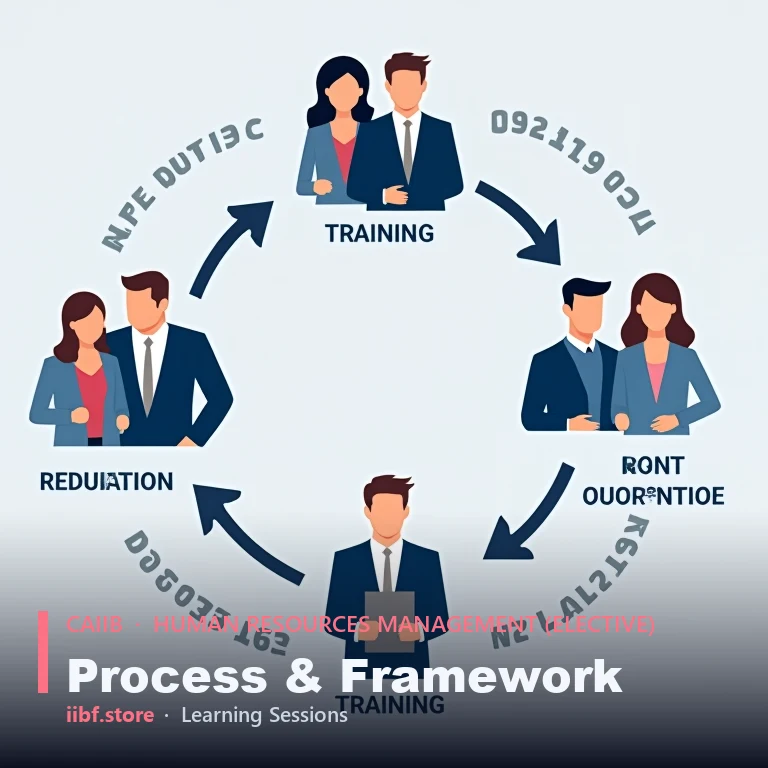
- Performance planning - at the start of the appraisal year, the manager and employee jointly set KRAs, targets and competencies. This is where SMART goals (Specific, Measurable, Achievable, Relevant, Time-bound) are agreed.
- Performance monitoring - throughout the year the manager observes, records critical incidents and gives interim feedback. Continuous monitoring prevents the dreaded recency error.
- Performance review and appraisal - the formal mid-year and year-end assessment, self-appraisal, rating and the appraisal interview.
- Performance rewarding and development - linking results to increments, incentives, promotions, and to training or counselling for the under-performers.
A good way to remember the flow is the loop Plan to Monitor to Review to Reward, then back to Plan. Each rating year feeds the next year's goals, which is why the cycle is drawn as a circle rather than a line. Banks increasingly run this on HRMS software so that KRAs, evidence and ratings are captured digitally and audited centrally.
Examiners also test the players in the cycle: the appraisee (the employee), the reporting officer (first appraiser), the reviewing officer (second appraiser) and the accepting authority. Knowing this hierarchy helps you answer questions on appeals and grievance handling. Practise these recall questions on our CAIIB mock tests to lock the sequence into memory.
| Stage | Core Activity | Output |
|---|---|---|
| Planning | Set KRAs and SMART targets | Agreed appraisal form |
| Monitoring | Record critical incidents, coach | Interim feedback notes |
| Review | Self-appraisal, rating, interview | Final rating |
| Rewarding | Link to pay, promotion, training | Development plan |
Methods of Performance Appraisal Banks Use
Inside any performance management system sits a chosen appraisal method. CAIIB expects you to classify these into traditional and modern techniques and to know one line about each. Traditional methods include:
- Ranking and paired comparison - employees are ordered best to worst.
- Graphic rating scales - traits scored on a 1 to 5 scale.
- Checklist and forced distribution - the bell-curve approach that forces a fixed percentage into each band.
- Critical incident method - recording specific good and poor behaviours.
Modern methods are more developmental and are increasingly common in banks:
- Management by Objectives (MBO) - Peter Drucker's approach where manager and subordinate jointly set objectives and measure results against them. This is the backbone of most banking KRA systems.
- 360-degree feedback - performance is assessed by superiors, peers, subordinates and sometimes customers, giving a rounded view. Banks often use it for leadership development rather than pay.
- Behaviourally Anchored Rating Scales (BARS) - combines critical incidents with rating scales for objectivity.
- Assessment centres - used heavily for promotion to scale and for succession planning.
For the exam, link the method to its purpose: MBO for result orientation, 360-degree feedback for development, BARS for objectivity, assessment centres for potential appraisal. The Reserve Bank of India and the IIBF both stress objectivity and transparency in any appraisal method - you can read more about banking HR standards on the RBI website and the institute's mandate on the official IIBF site. Reinforce these terms with our quick-recall match game.
Common Errors and How Banks Fix Them
A whole sub-section of the syllabus deals with rater errors that distort a performance management system. Be ready to define and give an example of each:
- Halo effect - one strong trait colours every rating upward.
- Horn effect - the opposite; one weakness drags all scores down.
- Central tendency - the rater parks everyone in the middle band to avoid conflict.
- Leniency or strictness error - consistently over- or under-rating.
- Recency error - judging the whole year on the last few weeks.
- Similar-to-me bias - favouring people like the rater.
Banks counter these errors through structured training of appraisers, BARS-style anchored scales, multi-rater 360-degree feedback, a reviewing-officer layer, and forced-distribution checks. A robust appeal and grievance mechanism is equally important so that an aggrieved employee can contest an unfair rating. For the CAIIB answer, always pair the error with its remedy - that earns full marks.
Finally, the performance management system does not end at the rating. Outcomes must feed into compensation, promotion and training decisions, otherwise the exercise loses credibility with staff. Effective feedback during the appraisal interview - specific, balanced and future-focused - is what converts measurement into improvement. Keep your terminology sharp by browsing related explainers on our banking exam blog, and follow regulatory updates through the official IIBF notifications.

Frequently Asked Questions
What is the difference between performance appraisal and a performance management system?
Performance appraisal is a single, backward-looking event that rates past performance at a point in time. A performance management system is the continuous, year-round cycle that plans goals, monitors progress, reviews results and rewards or develops the employee. Appraisal is one stage inside the larger management system.
What are the four stages of the performance management cycle?
The four stages are performance planning (setting KRAs and SMART targets). Performance monitoring (continuous observation and feedback), performance review and appraisal (self-rating, formal rating and the appraisal interview), and performance rewarding and development (linking results to pay, promotion and training). The cycle then repeats for the next year.
What is 360-degree feedback in banking HRM?
360-degree feedback is a modern appraisal method where an employee is assessed by superiors, peers, subordinates and sometimes customers, instead of by a single boss. Banks mainly use it for leadership and competency development rather than for pay decisions. Because the multi-source view reduces individual bias and gives a well-rounded picture of behaviour.
Which rater errors does CAIIB HRM commonly test?
The most tested errors are the halo effect, horn effect, central tendency, leniency or strictness error, recency error and similar-to-me bias. For full marks. Define each error, give a one-line example, and state the remedy such as appraiser training, anchored BARS scales, multi-rater feedback or a reviewing-officer layer.
Conclusion: Lock In the Marks on PMS
The performance management system ties together goal-setting, appraisal methods, rater errors and reward linkage - a cluster of topics that reliably appears in the CAIIB HRM paper. Revise the four-stage cycle, the traditional-versus-modern methods, and the error-remedy pairs, and you can comfortably bag this section. Ready to test yourself under exam conditions? Attempt a full mock now through our CAIIB HRM classes and tests and turn these notes into a confident score.
Quick quiz on this topic
5 exam-style questions from our free test bank — check yourself before you move on.
Practice this topic
Take a free mock test, download chapter PDFs, or watch a video class — all included on iibf.store.
Keep reading