CBDC e-Rupee Digital Currency: IIBF Digital Banking Guide
CBDC e-Rupee digital currency is one of the most exam-relevant ideas in the Digital Banking module today. It is the Reserve Bank of India's own digital money, built to sit alongside cash and bank deposits rather than replace them overnight. For JAIIB and CAIIB candidates, the topic matters because it links payment systems, monetary policy, and technology design into one compact exam theme. This article walks through what CBDC actually is, how the retail and wholesale versions differ, the token-based and account-based models behind it, and where CBDC fits next to UPI in the wider digital banking landscape. Keep this page open while you revise the Overview of Digital Banking chapter, since the two topics overlap heavily in recent papers.
📊 What Is CBDC? Understanding the e-Rupee
A Central Bank Digital Currency, or CBDC, is a digital form of a country's official currency, issued and backed directly by the central bank. In India this is called the e-Rupee, sometimes written as e₹. Unlike the balance you see in your savings account, which is a liability of your commercial bank, CBDC is a direct liability of the Reserve Bank of India. That single fact is the most tested distinction in exam questions on this topic.
CBDC is not the same as a cryptocurrency. Bitcoin and similar tokens have no issuer, no central authority, and no legal tender status. The e-Rupee, by contrast, is sovereign money. It carries the same legal tender status as a currency note, which means any person or business in India must accept it as valid payment when offered. It also is not the same as the balance in a UPI-linked bank account, because that balance still sits on a commercial bank's books, while CBDC sits directly on the central bank's balance sheet.
Students preparing for the exam should also connect this topic to the broader digital banking syllabus, including chapters on Retail Banking - Digital Banking Class 12, where payment system evolution is discussed in more detail. CBDC is best understood as the newest layer added to a payments stack that already includes cash, cards, and account-based transfers.
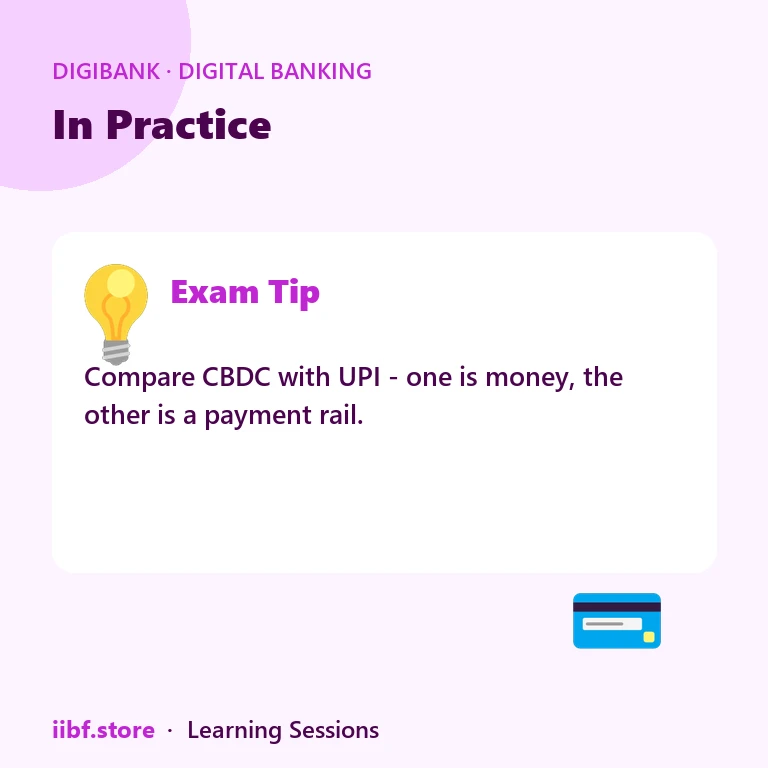
💡 Exam Tip: If a question asks who bears the liability for CBDC, the answer is always the Reserve Bank of India, not the commercial bank through which it was distributed.
🏦 Retail e₹-R vs Wholesale e₹-W: Two Tracks of CBDC
India's CBDC framework is split into two distinct tracks, and exam questions often test whether candidates can tell them apart. Retail CBDC, written as e₹-R, is meant for use by the general public and businesses for everyday payments such as buying groceries or paying a shopkeeper. It behaves much like digital cash held in a mobile wallet app provided by a participating bank.
Wholesale CBDC, written as e₹-W, is meant for a narrower set of users: banks and other regulated financial institutions. Its main use case is settlement of interbank transactions, including the secondary market for government securities. Because wholesale CBDC settles directly on the central bank's books, it can reduce settlement risk and shorten settlement cycles compared with older mechanisms.
Both tracks were rolled out in pilot mode starting in late 2022, first for the wholesale segment and shortly after for the retail segment, with a small set of banks and cities included at launch. The pilot has since been expanded in stages to more banks and more use cases, including offline transactions and programmable payments for specific purposes. Candidates should remember that both tracks remain under RBI's direct oversight even though commercial banks act as the distribution channel to end users.
This two-track design mirrors ideas covered in the Financial Inclusion chapter, where the goal of reaching unbanked and underbanked users through low-cost digital channels is a recurring exam theme. CBDC is often positioned as a financial inclusion tool because it does not require a full bank account to hold a balance.
⚠️ Common Mistake: Do not confuse wholesale CBDC with a corporate bank account. Wholesale CBDC is used only for interbank and institutional settlement, never for retail customer transactions.
🔐 Token-Based vs Account-Based: The Technology Behind e-Rupee
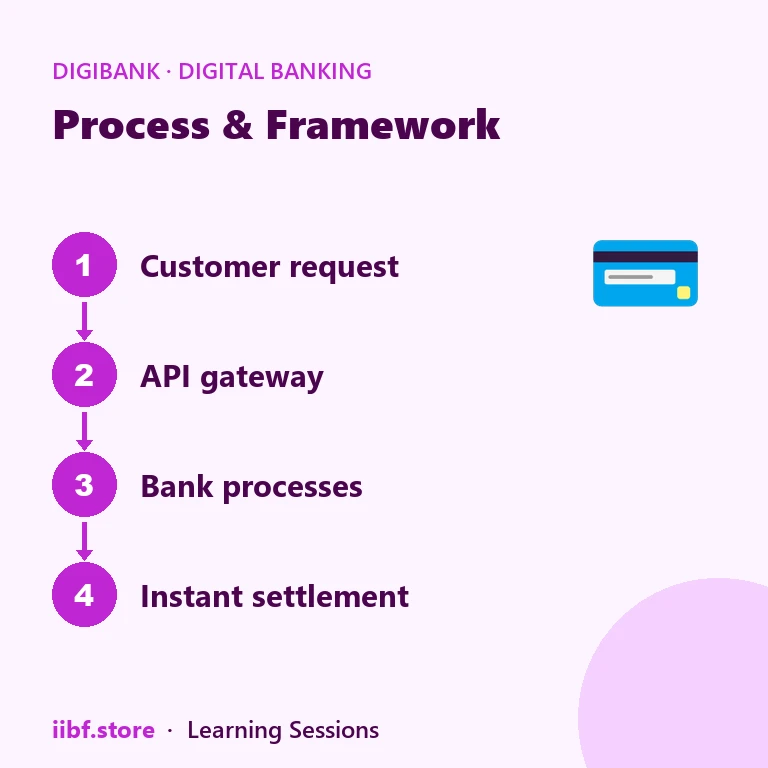
Every CBDC design has to answer one core question: how is ownership verified? There are two broad models, and India's retail e-Rupee uses the token-based approach. In a token-based system, the digital token itself carries the value, and verification focuses on confirming the token is genuine, much like checking a currency note is not counterfeit. Whoever holds the token holds the value, with no separate identity check needed at the moment of payment.
In an account-based system, by contrast, value is tied to an account, and every transaction requires verifying the identity of the account holder. Most CBDC academic proposals for wholesale use lean toward account-based design because institutional participants are already fully identified and onboarded through existing banking relationships.
The token-based choice for retail e-Rupee matters for exam purposes because it explains why CBDC wallets can, at least in pilot design, support offline payments. If value lives in the token rather than in a central ledger entry, two phones can in principle exchange CBDC without a live network connection, similar to handing over cash. This offline capability is still being tested and expanded, so candidates should describe it as a design goal under active rollout rather than a fully matured, universally available feature.
Distribution itself follows a two-tier model. The Reserve Bank of India issues CBDC to banks, and banks then distribute it to individual customers through their own apps, exactly as physical cash flows from the RBI through banks to the public today. This structure keeps commercial banks central to the payments system even as the underlying money becomes digital. It is worth revisiting the Mobile Banking chapter alongside this section, since CBDC wallets are delivered through the same mobile banking infrastructure banks already operate.
📈 CBDC vs UPI vs Cash: Where Each One Fits
A frequent exam question style asks candidates to compare CBDC against other payment instruments. The clearest way to remember the differences is to separate what is being moved from how it is being moved. UPI moves existing bank deposits between accounts almost instantly. Cash is physical central bank money. CBDC is digital central bank money. Each has a distinct place in the payments landscape, and none is designed to fully replace the others in the near term.
| Feature | Cash | UPI | Retail CBDC (e₹-R) |
|---|---|---|---|
| Issuer / liability | Reserve Bank of India | Commercial bank (deposit) | Reserve Bank of India |
| Form | Physical note or coin | Bank account entry | Digital token in a wallet |
| Works offline | ✅ | ❌ | ✅ (pilot feature) |
| Earns interest | ❌ | ❌ (savings interest is separate) | ❌ |
| Needs a bank account | ❌ | ✅ | ❌ |
| Legal tender status | ✅ | ❌ (payment rail only) | ✅ |
The table above is a common source of featured-snippet style exam questions, so it is worth memorising row by row rather than just the general idea. Notice in particular that UPI itself is not legal tender; it is a payment rail that moves legal tender-backed bank deposits. CBDC, being sovereign money, does carry legal tender status. This is one of the most commonly confused points among candidates who have studied UPI in depth but treat CBDC as just another payment app.
For a closer look at how card-based payment rails compare with these newer models, the sibling article on RuPay and card payment networks is a useful companion read, since it covers a third major settlement mechanism sitting alongside cash, UPI, and CBDC.
📌 Remember: CBDC and cash share legal tender status; UPI and card rails do not, because they merely move existing bank money rather than being money themselves.
🌍 India's CBDC Pilot Journey and the Road Ahead
India's CBDC pilots began with a small group of participating banks and a limited set of use cases, then expanded gradually to include more banks, more cities, and additional features such as programmability for targeted welfare payments and offline transactions in low-connectivity areas. This staged approach lets the RBI test technology, user behaviour, and financial stability implications before any wider rollout decision is made.
Globally, dozens of central banks are exploring or piloting their own digital currencies, ranging from small pilot programmes to a few live retail launches. India's approach has been deliberately cautious, prioritising financial stability and data privacy safeguards over speed, which is a point worth remembering for exam answers that ask about RBI's overall stance on CBDC rollout.
CBDC adoption also connects to the same infrastructure used for other digital banking initiatives, such as those covered under Digital Banking Units, which are branded physical touchpoints set up to help customers access purely digital banking services, including CBDC wallets, without needing a traditional branch visit. Similarly, back-end settlement rails discussed in the article on Payment Aggregators and Gateways illustrate how multiple digital payment systems now coexist under a common regulatory umbrella.
Security remains a live concern across all of these digital rails, and banks are expected to run continuous checks on the systems that support them. If you want to see how banks stress-test these systems from a security angle, the related piece on vulnerability assessment and penetration testing is a useful cross-subject read, since digital currency infrastructure faces the same categories of cyber risk as any other digital banking channel. You can browse more coverage of this theme on the digital banking tag hub. For the official regulatory position and updates on CBDC, refer directly to the Reserve Bank of India website, which remains the primary source for any figures or scheme changes.
🧠 Practice MCQs: CBDC e-Rupee Digital Currency
Q1. What does CBDC stand for? (a) Central Bank Digital Currency (b) Certified Bank Data Custodian (c) Core Banking Digital Channel (d) Central Board of Digital Compliance
Answer: (a) — CBDC is the acronym for Central Bank Digital Currency, a digital form of central bank money.
Q2. Which statement best describes the legal status of India's e-Rupee? (a) It is a private virtual currency (b) It is legal tender issued by the Reserve Bank of India (c) It is a prepaid instrument issued by banks (d) It is a cryptocurrency regulated by SEBI
Answer: (b) — e-Rupee is issued by the RBI and carries the same legal tender status as physical currency, unlike private cryptocurrencies.
Q3. Retail CBDC (e₹-R) is primarily meant for which use? (a) Interbank settlement of government securities (b) Everyday transactions by individuals and businesses (c) Cross-border wholesale trade settlement only (d) Recording land registry transactions
Answer: (b) — Retail CBDC is designed for use by the general public and businesses for day-to-day payments, while wholesale CBDC serves interbank settlement.
Q4. What is the key structural difference between a token-based and an account-based CBDC model? (a) Token-based CBDC verifies the instrument itself, account-based verifies the identity of the holder (b) Token-based CBDC can only be used by banks (c) Account-based CBDC works only offline (d) There is no technical difference, only branding
Answer: (a) — A token-based model centres verification on the authenticity of the digital token, similar to cash, while an account-based model verifies the identity linked to an account.
Q5. How is CBDC distributed to end users under India's model? (a) Directly by the RBI to every citizen (b) Through a two-tier model where the RBI issues to banks who distribute to customers (c) Only through cryptocurrency exchanges (d) Through NBFC-only wallets
Answer: (b) — India follows a two-tier distribution model in which the RBI issues CBDC to intermediary banks, which then distribute it to end users, similar to physical currency.
Want chapter-wise mock tests with 100+ MCQs? Start practising free →
Is CBDC the same as cryptocurrency?
No, CBDC is issued and backed by the central bank and carries legal tender status, whereas cryptocurrencies are private digital assets with no sovereign backing.
Can CBDC be used without internet access?
The RBI has been piloting offline functionality for the e-Rupee so it can work in low-connectivity areas, though most current pilot activity still happens online.
Does CBDC earn interest like a savings account?
No, retail CBDC held in a digital wallet does not earn interest, much like holding physical cash.
How is CBDC different from UPI?
UPI is a payment rail that moves money between existing bank accounts, while CBDC is itself a new form of central bank money held directly in a digital wallet.
CBDC e-Rupee digital currency is still an evolving pilot, but it is already a settled exam topic, and questions on legal tender status, the retail-wholesale split, and token-based design come up regularly across JAIIB and CAIIB papers. Revise this alongside the related chapters linked above, then test yourself with full-length chapter-wise mock tests to lock in the distinctions before exam day.
Quick quiz on this topic
5 exam-style questions from our free test bank — check yourself before you move on.
Practice this topic
Take a free mock test, download chapter PDFs, or watch a video class — all included on iibf.store.