Ethics in Banking Study Plan for Working Bankers: 14 Days
It is 9:40 pm. The branch closed late, the day-end balancing took longer than it should have, and your IIBF study material is lying on the table, untouched since Sunday. You open it, read one page, and your eyes start closing. If this sounds familiar, you do not need more motivation. You need a smaller, more honest plan.
This article gives you exactly that: an Ethics in Banking study plan that fits around a full-time bank job. It is built on one idea: a short paper is cleared by consistency, not by marathon weekends. Even if you never buy anything from us, the day-wise table below will work with whatever material you already have.
Why a tired banker needs a different kind of plan
Most study plans online are written for people who can give four clean hours a day. You cannot. Between customer queues, audits, targets and the commute, what you really have is 60 to 90 minutes on a good weekday and a few longer slots on weekends.
So the plan has to follow three rules:
- One chapter at a time. Never open two new chapters in the same sitting. Tired minds blur them together.
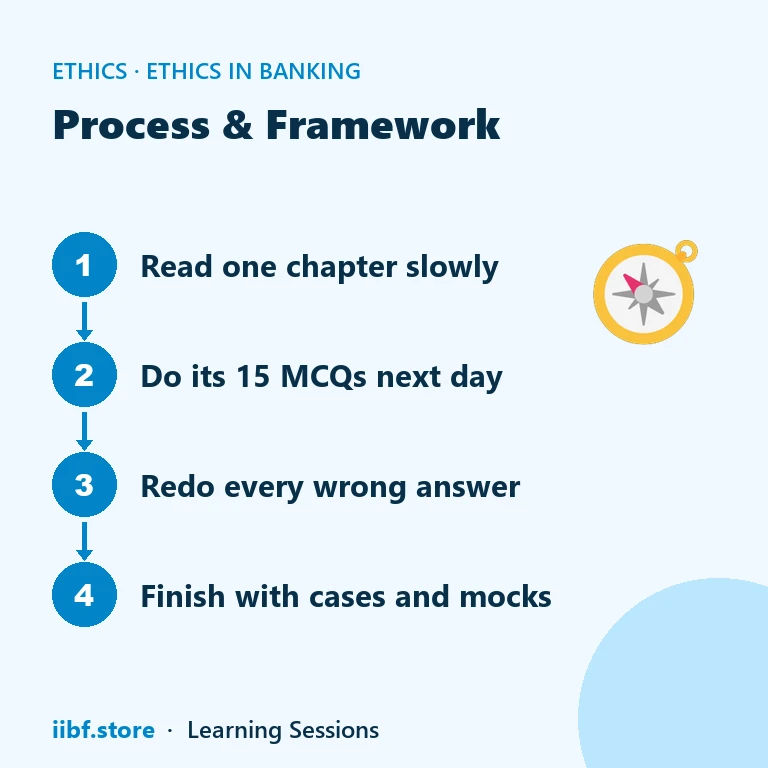
- Questions the next day, not the same night. Reading and testing in one sitting feels productive but fades by morning. A next-day test shows what actually stayed.
- Wrong answers are the real syllabus. The questions you miss tell you where the paper will hurt you. Keep a small list of them.
Ethics is also a paper where reading alone can mislead you. The concepts feel familiar because you live them at work, so you assume you know them. Then the exam asks for the precise framing, such as the difference between individual and organisational levels, or what a governance principle actually requires. That gap is why you must test yourself early.
What the Ethics in Banking syllabus looks like
Before planning days, plan the territory. The paper is organised into four modules, and knowing their shape stops the syllabus from feeling endless.
The four modules in plain words
- Module 1 — Understanding Ethics: introduction to ethics, the integrated view of ethics, business ethics and banking, normative ethics and management decisions, and ethics in financial services with the regulatory framework.
- Module 2 — Different Operational Levels of Ethics in Banking: the individual level, the organisational level, marketing, employees, and CSR with ESG.
- Module 3 — Workplace Ethics and an Ethical Organisation: work ethic, building an ethical organisation, and the changing dynamics of banking ethics.
- Module 4 — Wider Aspects of Ethics in Practice: corporate governance, environmental ethics, globalisation, corruption, bribery and white-collar crime, and a holistic closing view.
That is 17 chapters in total. Module 1 gives you the vocabulary, Module 2 and 3 apply it inside a bank, and Module 4 widens the lens. Studied in this order, each module makes the next one easier.
One caution: for the official syllabus, exam pattern and schedule of the upcoming exam cycle, always check the IIBF website. Do not rely on anyone's summary, including ours, for dates or rules.
Where the book fits into this plan
A plan needs material that matches its structure. The Ethics in Banking book is a printed 2026 edition of 135 pages across the same 17 chapters, grouped into the four modules above. Each chapter comes with its own MCQs, 255 in all, which works out to 15 questions per chapter. That ratio is what makes this Ethics in Banking study plan so simple to run.
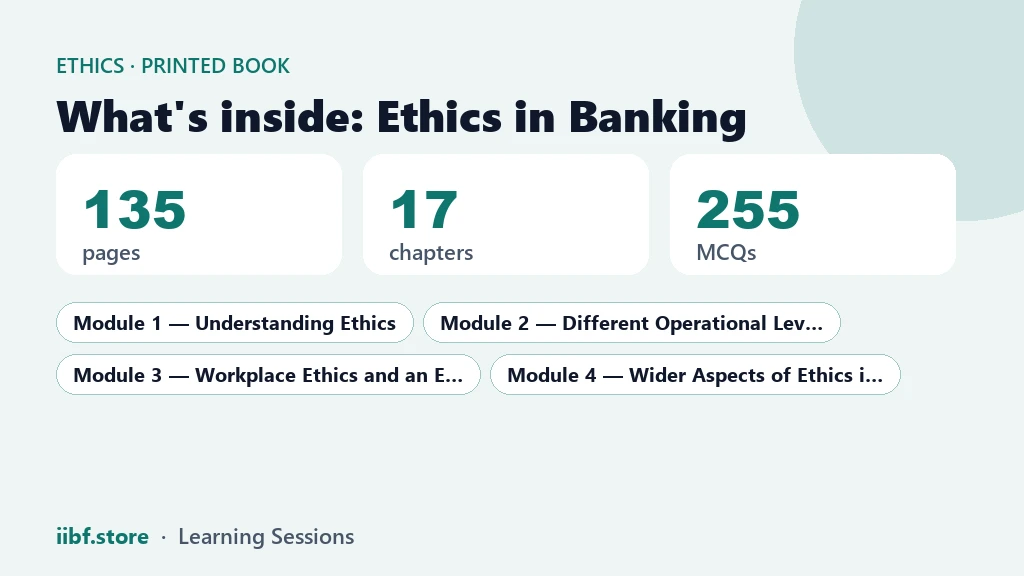
Beyond the chapters, the book also lists 40 case studies (160 questions) and 5 mega tests (500 questions). These matter in the final stretch, when you move from learning to exam-style practice. The price shown on the book page is currently ₹925 against an MRP of ₹2,398. Prices can change, so treat the book page as the current source.
An honest limit: a printed book will not give you exam-hall speed on its own. Pair it with timed practice, such as the free mock tests at iibf.store/tests, so that you are comfortable with the clock as well as the content.
The 14-day Ethics in Banking study plan
Here is the core of the article. The table assumes 60 to 90 minutes on weekdays. Each block pairs a few chapters with the MCQs from those same chapters, which you attempt the next day as a warm-up before reading anything new.
| Days | What to read | MCQs to attempt |
|---|---|---|
| 1-2 | Module 1: Introduction to Ethics; Ethics, Business Ethics and Banking | 30 (chapters 1-2) |
| 3-4 | Module 1: Normative Ethics; Ethics in Financial Services and the Regulatory Framework | 30 (chapters 3-4) |
| 5-6 | Module 2: Individual Level; Organisational Level | 30 (chapters 5-6) |
| 7-8 | Module 2: Marketing; Employees; CSR and ESG | 45 (chapters 7-9) |
| 9-10 | Module 3: Work Ethic; Building an Ethical Organisation; Changing Dynamics | 45 (chapters 10-12) |
| 11-12 | Module 4: Corporate Governance; Environmental Ethics | 30 (chapters 13-14) |
| 13-14 | Module 4: Globalisation; Corruption, Bribery and White-Collar Crime; Holistic Approach | 45 (chapters 15-17) |
The MCQ column adds up to all 255 chapter questions. If you only manage 45 minutes on some days, stretch that block by a day rather than skipping the questions.
How to run each two-day block
Day one: read the chapter once, slowly, with a pencil. Underline definitions and lists, and write one line in the margin explaining each concept in your own words. Stop when your time is over. Do not try to finish the second chapter on a night you are exhausted.
Day two: begin with the 15 MCQs from yesterday's chapter, without opening the book. Then check every answer, and for each wrong one write the correct point on a small card or in a notebook. Only after that, read the next chapter.
This is the entire method. It is deliberately boring, and that is why it survives a bad week at work.
After day 14: cases, mocks and revision
Fourteen days gets you through the content once. The marks, however, are made in the stage after it. Use the next week, or whatever you have before the exam, to extend your Ethics in Banking study plan like this:
- Re-read your wrong-answer list every morning for ten minutes. By now it holds your personal weak spots, which is far more useful than any generic summary.
- Work through the case studies. Ethics questions are often situational: a customer, a target, a colleague, a conflict of interest. The 40 case studies train you to pick the answer that fits the principle, not the one that merely sounds polite.
- Take the mega tests under time. Sit down once, with a timer, and treat it as the real paper. Review the result the next day, not the same night.
If you want extra practice material that costs nothing, browse the free study material and the free mock tests as well. And for the wider picture on how your certificate preparation can fit with other IIBF papers, the blog has more guides.
Common mistakes that waste your 14 days
Reading everything twice before testing
Second reading feels safe, but it is passive. One slow read plus a question session beats two quick reads every time.
Answering from experience instead of the principle
You may have seen a situation handled loosely at your branch. The exam wants the principle, not the local practice. When an MCQ option matches what people usually do, pause and ask what the framework actually says.
Skipping the weak chapters
Governance, ESG and the regulatory framework chapters usually feel drier than the individual-level ones. That is exactly why they cost marks. Give them their full two days.
Studying only on weekends
A single Sunday marathon is forgotten by Thursday. Even 40 minutes on a weekday keeps the thread alive, and the next-day question habit does the rest.
Putting your Ethics in Banking study plan into action
Pick your start date tonight, and write the table above on one sheet of paper. Tomorrow evening, read only chapter 1. That is it. Fourteen small, repeatable evenings are far easier than one heroic month you will not actually keep.
If you would like the chapters and the questions in one printed place, the Ethics in Banking book page shows the full contents and a free sample, and our books section lists the other papers. Whichever material you use, keep the loop: read, test next day, redo your wrong answers.
Frequently asked questions
Can I finish this paper in 14 days while working full time?
For a short paper like this one, 14 days of 60 to 90 minutes is a realistic target if you stay consistent and keep the next-day question habit. If your branch workload is heavy, simply stretch each block by a day.
How many MCQs should I do per chapter?
The book has 255 chapter MCQs across 17 chapters, which is 15 per chapter. Attempt them the day after reading, then redo the ones you got wrong a few days later.
Is a printed book enough to clear the exam?
A book gives you structure and practice questions, but exam-hall speed comes from timed mocks. Use the book for learning and the free mock tests for pace, and confirm the exam pattern on the official IIBF website.
Where do I find the exam dates and rules?
Always check the official IIBF website at iibf.org.in for the schedule, eligibility and syllabus of the upcoming exam cycle. We do not quote dates here because they change.
Prefer revising from a printed book?
Chapter-wise books with MCQs after every chapter — minimal pages, complete coverage, delivered anywhere in India. Every book has a free sample to read first.





Quick quiz on this topic
5 exam-style questions from our free test bank — check yourself before you move on.
Practice this topic
Take a free mock test, download chapter PDFs, or watch a video class — all included on iibf.store.