CTP Exam Study Plan: 30 Days Alongside Your Bank Job
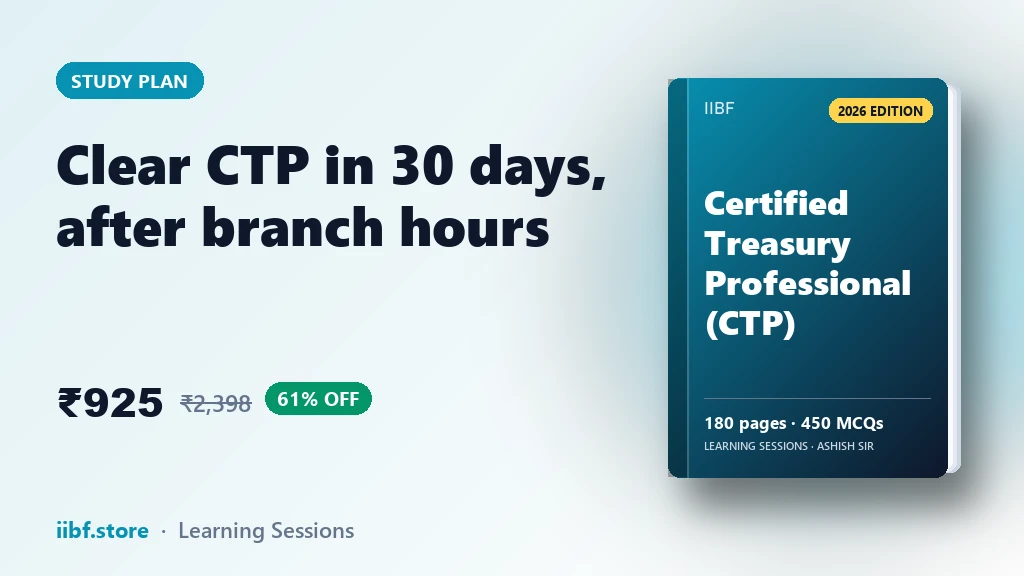
It is 9:40 pm. The branch closed hours ago, the vouchers are tallied, and you are finally home. The Certified Treasury Professional syllabus is open in front of you, and it looks endless: money markets, bond pricing, duration, convexity, forex, swaps, options. You are not lazy. You are tired, and nobody has told you how much to do tonight. That is exactly what a good CTP exam study plan fixes.
This article gives you one plan, in plain numbers. You can follow it with any material you trust. If you want one printed book to build it around, we will show how the CTP book fits in. Either way, you should be able to close this page and start tonight.
Why your CTP exam study plan must be small, not heroic
Most working bankers fail a plan, not a paper. They start with four hours a day on a Sunday, miss Monday and Tuesday because of a late audit or a branch visit, and then quietly drop the whole thing. A plan that needs a perfect week will break in the first week.
So build the plan on the minimum you can do on your worst day. For most of us that is 60 to 90 minutes on weekdays and a longer block on Saturday or Sunday. Treasury is also a subject where small, regular sessions beat marathons, because the calculation chapters (bond pricing, duration, forex valuation) need practice more than reading.
Three ground rules before Day 1
- One chapter, one sitting. Do not leave a chapter half-read overnight. Your memory of it fades by morning.
- Questions the same night. Reading feels productive but tells you nothing. Ten to fifteen MCQs tell you what you actually retained.
- Keep two buffer days. Life will interrupt. We have built them into the plan below.
The shape of the CTP syllabus: seven modules, 30 chapters
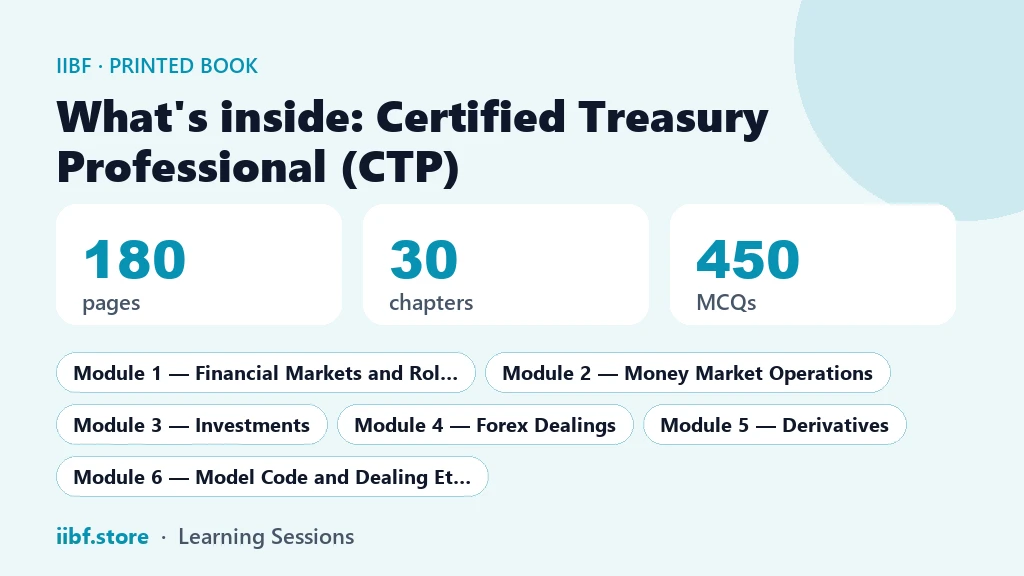
Before planning days, plan weight. The Certified Treasury Professional content is not evenly spread, and your time should not be either. The printed Certified Treasury Professional (CTP) book from iibf.store follows the paper in seven modules:
- Module 1 - Financial Markets and Role of Treasury: 3 chapters (Financial Markets, Treasury, Scope and Functions of Treasury Management).
- Module 2 - Money Market Operations: 3 chapters (Liquidity Management, Integrated Treasury, Treasury Instruments).
- Module 3 - Investments: 13 chapters, from interest rate quotations and fixed income securities to bond pricing, duration and convexity, accounting and valuation, exposure norms, audit, IT and regulation.
- Module 4 - Forex Dealings: 5 chapters (Foreign Exchange Market, Exchange Rate Mechanism, Forex Valuation, Risk Analysis and Control, Multi-currency Balance Sheets).
- Module 5 - Derivatives: 4 chapters (Derivative Market, Swaps, Options, Interest Rate Futures, Caps, Floors and Credit Derivatives).
- Module 6 - Model Code and Dealing Ethics: 1 chapter.
- Module 7 - Time Value of Money and Interest Rate Calculations: 1 chapter.
Notice that Module 3 alone holds 13 of the 30 chapters. If you treat all modules equally you will run out of time exactly where the paper is heaviest. Also notice Module 7: time value of money sits at the end of the book, but every bond and forex calculation quietly depends on it. In our plan you will read it early.
How the CTP book is organised for a plan like this
The book is 180 pages, 30 chapters and 450 questions, in the 2026 edition. Do the arithmetic and you get roughly 6 pages and 15 questions per chapter. That is a deliberate size for our purpose: one chapter is about the amount a tired person can read, and one set of questions is about the amount that fits into the rest of the evening. You do not need to decide how much to do each night, because the book has already cut the syllabus into daily portions.
The listing also mentions two extras: 60 case studies (240 questions) and 5 mega tests (500 questions). Those are what we use in the last stretch of the plan, once the chapters are behind you. If you want to see the writing style and layout before paying anything, there is a free sample on the CTP book page.
The 30-day CTP exam study plan, day by day
Here is the full plan. Each row gives the days, what to read, and your MCQ target. The MCQ numbers assume about 15 per chapter, which matches the 450 questions across 30 chapters.
| Days | What to read | MCQs to solve |
|---|---|---|
| 1-3 | Module 1: Financial Markets, Treasury, Scope and Functions of Treasury Management | About 45 (15 a day) |
| 4-6 | Module 2: Liquidity Management, Integrated Treasury, Treasury Instruments | About 45 |
| 7 | Module 7: Time Value of Money and Interest Rate Calculations (read early, redo the sums by hand) | About 15 |
| 8-10 | Module 3, first three chapters: Interest Rate Quotations, Fixed Income Securities, Other Capital Market Instruments | About 45 |
| 11-14 | Module 3: Fixed Income Types and Risks, Bond Pricing and Yield, Duration and Convexity, Bond Portfolio Management | About 60 |
| 15-18 | Module 3: Global Scenario, Accounting and Valuation, Exposure Norms, Internal and External Audit | About 60 |
| 19-20 | Module 3: Role of IT, Regulations, Supervision and Compliance | About 30 |
| 21-24 | Module 4: Forex Market, Exchange Rate Mechanism, Forex Valuation, Risk Analysis, Multi-currency Balance Sheets | About 75 |
| 25-27 | Module 5: Derivative Market, Swaps, Options, Futures, Caps, Floors and Credit Derivatives | About 60 |
| 28 | Module 6: Ethics, Morals and Code of Conduct for the Dealing Room | About 15 |
| 29-30 | Buffer, redo every wrong answer, start case studies and a first mega test | Case studies and mock |
If your week is brutal, stretch each row rather than skipping it. A 45-day version of this plan is perfectly respectable. What matters is the order and the daily habit.
The four-step nightly loop
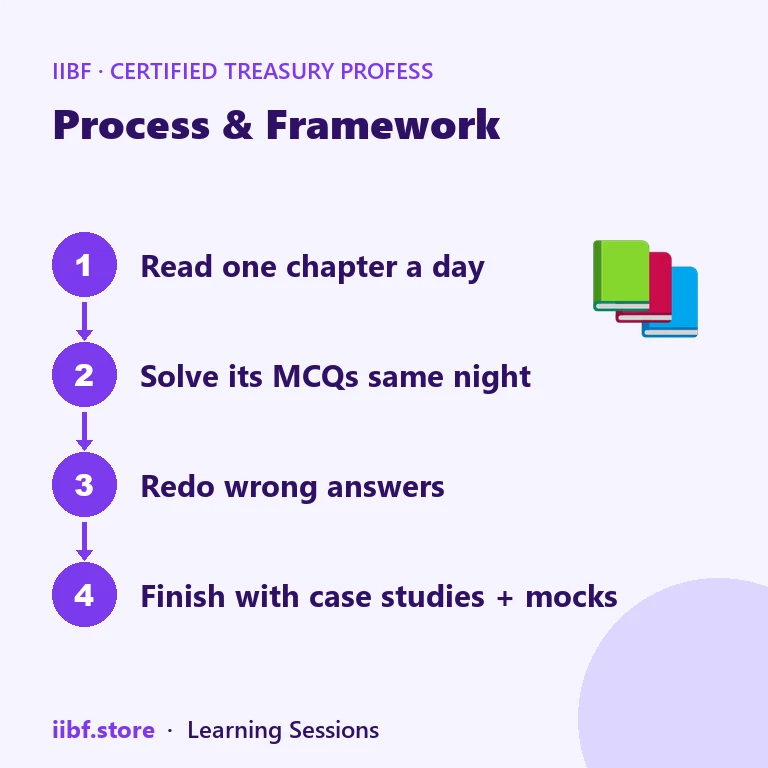
Every weekday night, whatever the chapter, run the same loop. It takes the guesswork out of a tired evening.
- Read the chapter once, with a pencil. Underline definitions and every formula. Do not copy notes in full; you will not have time.
- Solve the chapter's MCQs without looking back. Mark the ones you guessed, not just the ones you got wrong.
- Redo wrong and guessed answers. Write the reason in one line. This notebook becomes your last-week revision.
- Close with a two-minute recall. Without the book, say aloud what the chapter was about.
Handling the heavy parts: bonds, duration and forex
Three clusters of chapters decide most candidates' fate in treasury papers: bond pricing and yield, duration and convexity, and forex valuation. These are calculation-heavy. Reading them once is not enough.
Bond pricing and duration (days 11-14)
Give these four days a double slot if you can. Spend the first half of the evening on the chapter and the second half on rework. The Time Value of Money chapter you read on Day 7 pays off here, because bond price is only the present value of cash flows. If the formulas feel foreign, go back to that chapter for fifteen minutes before continuing.
Forex valuation and risk (days 21-24)
Treasury and forex learning feels easy to a branch banker who handles remittances, until the questions turn to cross rates, forward premium and open position limits. Do small numerical drills each night. Five worked examples are worth more than one extra reading.
Derivatives (days 25-27)
Swaps and options confuse people because the vocabulary is new. Make a one-page glossary as you go. By the time you reach the interest rate futures, caps, floors and credit derivatives chapter, you will find the words already familiar.
Using the last stretch: case studies and mock tests
After the chapters, switch from learning to testing. Case studies train you to read a situation and pick the right treasury action, which is different from remembering a definition. The book lists 60 case studies carrying 240 questions, so treat them as your second pass, a few each evening in the days after Day 30.
Then attempt the mega tests under timed conditions. The book lists five, with 500 questions in all. For extra free practice, the free mock tests on iibf.store are a good way to check your speed, and the free material library has PDFs you can use for quick revision. A printed book gives you structure; a mock gives you exam-hall speed. You need both, and one honest limit is that no book can replace sitting a timed paper.
When you finish a mock, do not just note the score. Go through every wrong answer, tag it by module, and spend the next two evenings only on your weakest module. This is the most efficient revision you can do in a working week.
What to do on the days you cannot study
You will miss days. Everyone does. The rule is simple: do not try to catch up by doubling the next day. Instead, protect the habit with a minimum version.
- Fifteen-minute floor: on a terrible day, solve 10 MCQs from the chapter you last read. That alone keeps the streak.
- Weekend catch-up: use Saturday or Sunday for the lost chapter, not both days.
- Use the buffer: Days 29 and 30 exist for this. If you did not lose any days, spend them on redo.
Before you commit your calendar, check the official exam schedule for the upcoming exam cycle at iibf.org.in. Then count backward from the exam date, and start the plan early enough to include a buffer week. Your CTP exam study plan should always end a week or more before the paper.
Is the printed book worth building this plan around?
Be honest with yourself about how you study. If you read better on paper, if your phone is a distraction at night, or if you want one fixed set of 30 chapters instead of scattered PDFs, a printed book keeps the plan simple. The CTP book is priced at ₹925 against an MRP of ₹2,398 at the time of writing; prices may change, so check the book page for the current figure. You can also browse other titles at iibf.store/books, and more preparation articles are on the iibf.store blog.
If you prefer to study entirely from free material, the plan above still works: replace the book with whatever notes you have and keep the 30-day rhythm. The method is what clears the paper, not the binding.
Your first three nights
Do not wait for a perfect Monday. Tonight, read Chapter 1 of Module 1 and solve its questions. Tomorrow, repeat. On the third night, you will have a record of 45 questions and a feel for how much time a chapter really takes. Adjust the table to your own pace after that. A modest CTP exam study plan followed for thirty days beats an ambitious one abandoned in the first week.
Frequently asked questions
Can I finish CTP preparation in 30 days while working full time?
It is possible if you can give 60 to 90 minutes on weekdays and a longer block on weekends. If your branch is under pressure, stretch the plan to 45 days. The order of chapters matters more than the number of days.
Which CTP module should I give the most time?
Module 3 (Investments) carries 13 of the 30 chapters, including bond pricing, duration and convexity. It deserves roughly a third of your total time. Forex and derivatives come next.
How many MCQs should I solve every day?
About 15 a day, one chapter's worth. The book has 450 questions over 30 chapters, which works out to roughly 15 each, so the plan matches the book's layout naturally.
Is a book enough, or do I also need mock tests?
A book gives structure and practice, but it will not give you exam-hall speed. Pair it with timed mocks in the last week. Free mock tests are available at iibf.store/tests, and the book lists 5 mega tests as well.
Prefer revising from a printed book?
Chapter-wise books with MCQs after every chapter — minimal pages, complete coverage, delivered anywhere in India. Every book has a free sample to read first.












Practice this topic
Take a free mock test, download chapter PDFs, or watch a video class — all included on iibf.store.