Certified Treasury Professional Exam: TIRM Guide 2026
If you are preparing for the certified treasury professional exam, you already know the syllabus is wide and the terminology is dense. This guide lays out eligibility, syllabus modules, exam pattern and a realistic study plan for IIBF's Treasury, Investment and Risk Management (TIRM) certification, the course most bankers mean when they search for this certification.
Whether you are a branch officer moving into treasury operations or a CAIIB candidate choosing TIRM as an elective, the path is the same: understand what the exam actually tests, then build a module-wise revision plan around it. We will cover exactly that below, with links to the chapter material you need.
🎓 What Is the Certified Treasury Professional (TIRM) Exam?
The certified treasury professional exam, run under IIBF's Treasury, Investment and Risk Management framework, certifies that a banker understands how a bank's treasury desk manages liquidity, investments, foreign exchange and market risk. It is aimed at officers who work in or want to move into treasury, risk, or investment functions at a bank or financial institution.
TIRM can be taken as a standalone certificate course or chosen as a CAIIB elective, depending on how your bank has enrolled you. Either way, the question bank draws from the same core areas: treasury operations, risk management process, foreign exchange markets, derivatives and investment portfolio management. You can browse the full risk management process chapter to see the depth expected.
Because the exam sits at the intersection of theory and desk practice, rote memorisation alone will not carry you through. Examiners like to test whether you can apply a concept, such as picking the right hedge for a given exposure, rather than just define it.
📋 Eligibility for the CTP/TIRM Certification
IIBF periodically updates who can register for a given certificate course, so always check the live notification before you pay the exam fee. As a general rule, working professionals in banks, NBFCs and financial institutions, along with current IIBF members, are the primary audience for the certified treasury professional exam.
Many candidates sit for TIRM as part of their CAIIB elective choice rather than as a separate certificate. If your bank has nominated you for CAIIB, confirm with your HR or training team whether TIRM has already been selected as your elective subject, since the registration process differs slightly from a standalone certificate enrolment.
There is no fixed minimum banking experience mandated for most IIBF certificate exams, but candidates with at least a year on a lending, forex or operations desk tend to grasp the syllabus faster because they have already seen terms like duration, hedging and mark to market in daily work. For the authoritative, current eligibility notification, always check the official IIBF website rather than a secondary summary.
📌 Remember: Eligibility rules and fee structures change between exam cycles. Always confirm the current criteria on IIBF's official site before registering.
📚 Syllabus Modules You Must Master
The TIRM syllabus is organised into broad content areas rather than a handful of isolated topics. Module A generally covers treasury operations and markets, including foreign exchange markets and the mechanics of how a treasury desk prices and settles currency deals.
Module A also brings in risk analysis and control, where you learn to identify treasury risk types, set limits and read exposure reports. Module B shifts focus to the risk management process itself: how a bank identifies, measures, monitors and mitigates market and credit risk at a portfolio level.
Beyond these two, expect coverage of derivatives, capital markets, debt markets and fixed income securities, plus a growing emphasis on the role of information technology in treasury management, since most desks now run on straight-through-processing systems. Treat each content area as a mini-subject with its own formulas, definitions and case examples.
📝 Exam Pattern You Should Expect
Like most IIBF certificate examinations, the certified treasury professional exam is delivered as an objective, multiple-choice test on a computer at a designated test centre. Exact question count, duration, marks and the pass threshold are set by IIBF for each exam cycle, so treat any number you see online as indicative and verify it against the current exam information handout before you plan your last-mile revision.
What stays consistent across cycles is the style of questioning: a mix of direct recall (definitions, formulas), numerical problems (yield, duration, exposure calculations) and applied case-style questions where you pick the best treasury or risk response to a scenario. Case-style questions carry disproportionate weight in most candidates' experience, so practice reasoning through scenarios, not just memorising terms.
Negative marking policy, if any, is also notified per exam, so do not assume it works the same way as your last CAIIB paper. When in doubt, attempt every question in an MCQ-only paper rather than leaving items blank.
⚠️ Common Mistake: Candidates often assume TIRM's exam pattern is identical to CAIIB's core papers. Always cross-check the specific notification for the certificate or elective you are registered for.
🗓️ A Practical Study Strategy for TIRM
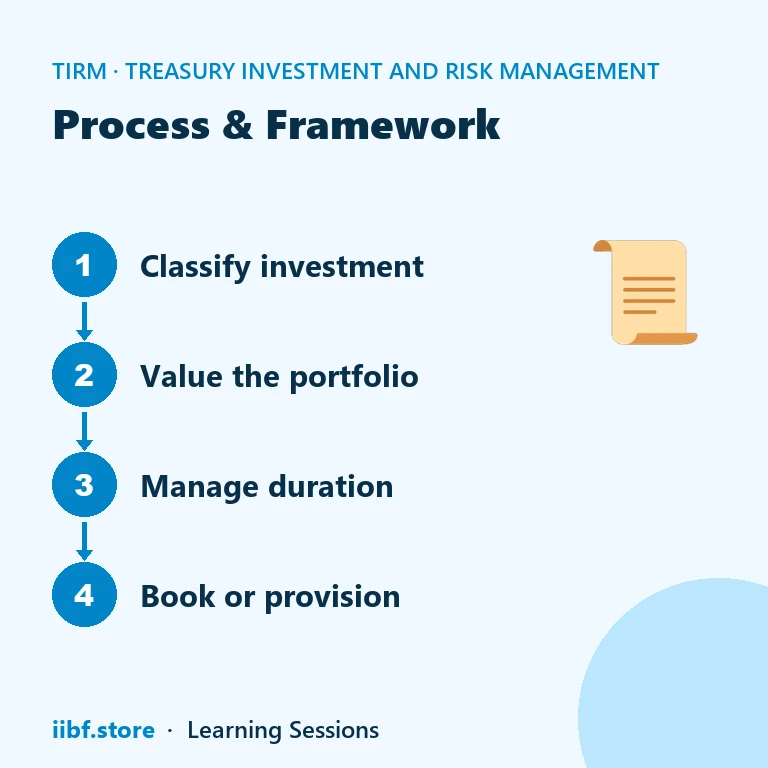
Start by mapping the syllabus into weekly blocks: one week for treasury and forex markets, one for risk management process, one for investment and debt markets, and a final week purely for derivatives and revision. This keeps your TIRM exam prep from turning into an unstructured re-read of the workbook.
Numerical topics deserve daily, short practice rather than one long session. Ten minutes on duration or yield calculations every day beats a three-hour cram the night before, because these concepts are cumulative and rusty formulas cost easy marks.
Once you have covered a topic conceptually, pair it with related reading. For instance, after Module B's risk process, read our guide on interest rate futures for banks to see how a hedging decision is actually made on a live book, and our note on corporate bond investment norms to connect risk theory with portfolio construction rules.
💡 Exam Tip: Build a one-page formula sheet for duration, yield and PV01 style calculations and revise it daily in the final two weeks — numerical slip-ups are the most avoidable marks lost.
💼 Why This Certification Boosts Your Banking Career
Clearing the certified treasury professional exam signals to your bank that you can be trusted with treasury, investment or risk desk responsibilities, which are among the better-paying and more specialised tracks in Indian banking. It also complements CAIIB, since TIRM as an elective adds depth exactly where general banking papers stay surface-level.
Treasury roles increasingly overlap with middle-office and technology functions, so understanding how front, mid and back office roles interact matters even if your day job is purely on the dealing desk. Our related read on treasury middle office operations is a useful companion once you have the TIRM basics down.
For candidates funding themselves rather than through a bank nomination, the certificate also stands on its own resume as evidence of specialised knowledge, useful when applying for treasury, risk or investment banking-adjacent roles outside your current employer. Browse more TIRM-focused study material on our Treasury, Investment and Risk Management tag page.
Here is a quick-reference snapshot of the main TIRM content areas so you can see where to focus first.
| Content Area | What It Covers | Typical Question Style | Practice MCQs Available |
|---|---|---|---|
| Treasury & FX Markets | Spot/forward deals, treasury operations, currency risk | Definitions, numericals | ✅ |
| Risk Management Process | Identification, measurement, monitoring, mitigation | Applied case questions | ✅ |
| Investment & Debt Markets | Fixed income securities, portfolio basics | Numericals, concept-based | ✅ |
| Derivatives | Forwards, futures, swaps, options on rates/FX | Scenario-based hedging | ✅ |
| Technology in Treasury | STP systems, dealing platforms, controls | Concept recall | ❌ |
🧠 Practice MCQs: Certified Treasury Professional Exam
Q1. TIRM, as an IIBF certification, primarily prepares a banker for which function? (a) Retail loan processing (b) Treasury, investment and risk management roles (c) Branch cash management (d) HR and payroll
Answer: (b) — TIRM is designed specifically for treasury, investment and market-risk functions in banks and financial institutions.
Q2. In most IIBF certificate exams, the question format is best described as: (a) Long-form essay (b) Objective, multiple-choice (c) Oral viva only (d) Group discussion
Answer: (b) — IIBF certificate exams, including TIRM, are conducted as objective, multiple-choice tests at designated centres.
Q3. Which TIRM content area deals with identifying, measuring and mitigating market and credit risk in a treasury portfolio? (a) Foreign exchange markets (b) Risk management process (c) Derivatives pricing (d) Information technology
Answer: (b) — The risk management process module covers the full cycle of identifying, measuring, monitoring and mitigating treasury risk.
Q4. When a candidate is unsure whether TIRM's exact exam duration or pass mark has changed for the current cycle, the correct action is to: (a) Assume it matches last year's CAIIB paper (b) Check the current IIBF exam information handout (c) Skip verifying and attempt the exam anyway (d) Ask a fellow candidate informally
Answer: (b) — IIBF updates exam parameters per cycle, so the official current notification is the only reliable source.
Q5. A treasury officer wants to hedge an anticipated rise in interest rates on a bond holding. Which broad content area of TIRM would this scenario be tested under? (a) Technology in treasury (b) Derivatives (c) Branch operations (d) HR policy
Answer: (b) — Hedging interest rate exposure using instruments like futures or swaps falls under the derivatives content area of TIRM.
Want chapter-wise mock tests with 100+ MCQs? Start practising free →
❓ Frequently Asked Questions
Who can register for the certified treasury professional exam?
Working professionals in banks, NBFCs and financial institutions, along with current IIBF members, form the primary eligible group. CAIIB candidates who select TIRM as their elective register through their CAIIB enrolment instead. Always confirm current criteria on IIBF's official notification before applying.
Is TIRM the same certification as CAIIB's TIRM elective?
They share the same syllabus content, but TIRM can be taken either as a standalone IIBF certificate course or as one of the elective subject choices within CAIIB. Check with your bank's training team to see which registration route applies to you.
What topics carry the most weight in the TIRM exam?
Risk management process, foreign exchange markets, derivatives and investment or debt market fundamentals are consistently emphasised. Numerical topics such as yield and duration calculations also appear frequently, so daily practice on these pays off.
How long should I prepare for the certified treasury professional exam?
Most working candidates find four to six weeks of structured, module-wise study sufficient, provided they practice numericals daily rather than only in the final week. Pair each topic with mock questions to confirm you can apply the concept, not just recall it.
The certified treasury professional exam rewards candidates who combine conceptual clarity with steady numerical practice rather than last-minute cramming. Build your module-wise plan today, work through the chapter material linked above, and when you are ready to test yourself, head over to IIBF CAIIB course resources to access structured TIRM practice sets and mock papers.
Prefer revising from a printed book?
Chapter-wise books with MCQs after every chapter — minimal pages, complete coverage, delivered anywhere in India. Every book has a free sample to read first.





Practice this topic
Take a free mock test, download chapter PDFs, or watch a video class — all included on iibf.store.