Corporate Bond Investment Norms for Banks: TIRM Guide (2026)
Every bank treasury eventually looks beyond G-Secs and money market paper into corporate bonds. Corporate bond investment norms for banks sit inside a dense stack of RBI prudential rules. Most JAIIB/CAIIB candidates skip past these rules until an exam question forces the issue. This article breaks down what a treasury desk must satisfy before a single corporate debenture lands on the balance sheet:
- Rating floors.
- Board-approved investment policy requirements.
- Exposure ceilings.
- Accounting treatment.
This is exactly the kind of applied detail TIRM examiners like to test.
📜 Regulatory Framework Governing Corporate Bond Investments
Corporate bonds and debentures fall under the "non-SLR" bucket of a bank's investment portfolio. RBI regulates this bucket through its Master Direction on Classification, Valuation and Operation of the Investment Portfolio of Commercial Banks. Banks must read this Master Direction together with their own board-approved investment policy. Every scheduled commercial bank must frame this policy document afresh — or at minimum review it — at least once a year. The policy must spell out:
- Permissible instruments.
- Issuer-wise and industry-wise ceilings.
- Rating floors and tenor limits.
- Delegation of dealing authority within the treasury.
Candidates preparing for TIRM should study this alongside the broader regulations, supervision and compliance of treasury operations chapter. Corporate bond investment is one of the clearest examples of a treasury activity that sits at the intersection of business strategy and regulatory guardrail.
Unlike SLR securities, corporate bonds carry issuer-specific credit risk. The instrument universe for SLR securities is narrow and largely standardised, so corporate bonds need a policy framework that does more work. This framework typically sets a minimum acceptable rating grade, caps unrated paper, and fixes sub-limits within the overall non-SLR ceiling. It also builds in a review mechanism for whenever a rating migrates downward mid-holding. The treasury middle office must monitor these breaches independently of the front office. This idea ties directly into the risk management process framework tested extensively in TIRM Module B.
💡 Exam Tip: Questions often test whether you know that the investment policy is a board-level document reviewed at least annually, not a treasury-desk circular that can be amended informally.
⭐ Credit Rating and Due Diligence Requirements
Before a treasury desk books a corporate bond, RBI norms require the instrument to carry an investment-grade rating. This rating must come from a SEBI-registered Credit Rating Agency (CRA) such as CRISIL, ICRA, CARE or India Ratings. RBI discourages banks from building meaningful unrated exposure. Sometimes a bank's own policy permits a small unrated allocation. Even then, rigorous internal credit appraisal must back it — not just reliance on the issuer's balance sheet. This is a deliberate design choice. Rating agencies are private entities regulated by SEBI, so a bank cannot outsource its own credit judgement entirely to an external rating. Internal due diligence, covenant monitoring and periodic re-assessment of the issuer's financials remain the bank's own responsibility throughout the life of the bond.
Pricing discipline matters just as much as rating discipline. A desk that buys or sells a corporate bond mid-coupon must price it correctly. This means separating the accrued interest component from the underlying value of the security. The sibling article on clean price vs dirty price of bonds covers this distinction in depth. Getting this wrong doesn't just cost the desk money. It also distorts the yield calculation used to check whether the investment still clears the portfolio's return hurdle. Banks don't only buy bonds from manufacturing companies or standalone NBFCs, either. Instruments issued by non-banking financial companies in India form a meaningful slice of the corporate bond universe banks invest in. NBFC paper often carries its own sectoral exposure sub-limit within the investment policy.
📊 Exposure Limits and Risk Management
Concentration risk is the single biggest reason corporate bond norms exist. RBI's Large Exposures Framework caps a bank's aggregate exposure to a single counterparty or connected group, as a proportion of its eligible capital base. Corporate bond holdings count toward that ceiling alongside loans and other credit exposures to the same issuer. On top of the regulatory ceiling, the bank's own investment policy usually layers tighter internal sub-limits:
- Issuer-wise limits.
- Industry-wise limits.
- Rating-band-wise limits.
These sub-limits exist so a single downgrade or default cannot meaningfully dent the treasury's P&L. Building and monitoring these limits is a direct application of the concepts taught in risk analysis and control.
Credit risk isn't the only risk in play. Corporate bonds are typically far less liquid than G-Secs. A treasury desk must also factor in liquidity risk when sizing a position. A large corporate bond holding can be hard to exit quickly without a significant price concession. Sometimes the unthinkable happens: an issuer defaults, or its rating collapses below investment grade. When that happens, the investment gets reclassified as a non-performing investment, and the bank must set aside provisioning exactly as IRAC norms require. This topic is explored fully in the sibling guide on provisioning norms for non-performing investments.
⚠️ Common Mistake: Candidates often confuse the SLR maintenance requirement with non-SLR investment limits — corporate bonds sit entirely within the non-SLR sleeve and are governed by a separate set of issuer and industry caps, not the SLR ratio.
🧾 Accounting, Classification and Reporting
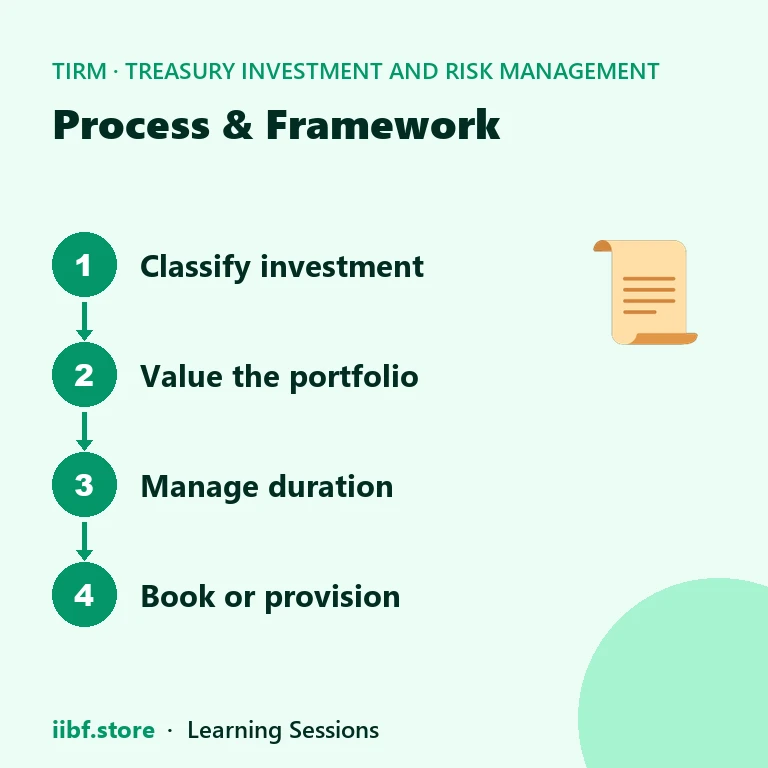
Once a corporate bond is on the books, it must go into one of three standard categories: Held to Maturity, Available for Sale, or Held for Trading. This classification decides how the bond gets valued going forward. A position parked in the trading book gets marked to market frequently, and any depreciation flows straight through the profit and loss account. A genuinely long-term hold, by contrast, can sit in the held-to-maturity bucket, largely insulated from daily price swings. This is subject to the ceilings RBI allows for that category. Treasury desks must also disclose their non-SLR investment composition, including the corporate bond book, in periodic returns to RBI. Internal audit periodically tests whether actual holdings match the policy's stated limits.
Corporate bonds sit alongside G-Secs, treasury bills and other instruments in the same portfolio. So secondary-market liquidity providers matter a great deal to how easily a desk can rebalance this book. Primary dealers in India have a core mandate that centres on government securities. Even so, understanding their role helps candidates see how market-making infrastructure supports price discovery across the wider debt market, corporate bonds included. For a deeper dive into how classification and reporting obligations interact with day-to-day treasury compliance, revisit the broader Treasury, Investment and Risk Management topic hub. It collects every related TIRM article in one place.
📌 Remember: Classification (HTM/AFS/HFT) determines valuation treatment, but it does not change the underlying credit exposure limit that applies to the issuer — both frameworks apply simultaneously.
| Investment Category | Marked to Market? | Provision for Diminution | Typical Treasury Use |
|---|---|---|---|
| Held to Maturity (HTM) | ❌ No (ceiling-linked) | Only if downgraded to NPI | Long-term core holding |
| Available for Sale (AFS) | ✅ Yes, periodically | Charged to P&L on depreciation | Medium-term, liquidity-linked |
| Held for Trading (HFT) | ✅ Yes, frequently | Charged to P&L on depreciation | Short-term trading book |
🧠 Practice MCQs: Corporate Bond Investment Norms for Banks
Q1. As per RBI norms, a bank's exposure to unrated corporate bonds/debentures is generally: (a) unrestricted and left to the dealer's discretion (b) approved only after the investment is booked (c) discouraged and subject to strict prudential limits with enhanced internal due diligence (d) routed compulsorily through primary dealers
Answer: (c) — RBI's investment framework discourages meaningful unrated non-SLR exposure and requires any permitted unrated allocation to be backed by rigorous internal appraisal.
Q2. The credit rating for a corporate bond a bank proposes to invest in should ideally be assigned by: (a) the issuing company's internal audit team (b) a SEBI-registered Credit Rating Agency (c) the bank's treasury front office (d) the stock exchange listing department
Answer: (b) — Only ratings from SEBI-registered CRAs such as CRISIL, ICRA, CARE or India Ratings are acceptable for investment-grade screening.
Q3. A bank's exposure to a single corporate bond issuer is primarily constrained by: (a) the repo rate prevailing on the trade date (b) the Large Exposures Framework together with the bank's board-approved investment policy (c) the issuer's market capitalisation alone (d) RBI's bi-monthly monetary policy statement
Answer: (b) — Regulatory large-exposure ceilings and internal policy sub-limits together cap issuer and group-wise concentration.
Q4. If a corporate bond investment turns into a non-performing investment (NPI), the bank must: (a) keep accruing income until maturity (b) make provisioning as per IRAC norms applicable to non-performing investments (c) shift the bond to the HFT category automatically (d) write it off immediately without any provisioning process
Answer: (b) — Income recognition stops and provisioning follows the IRAC framework for non-performing investments.
Q5. Corporate bonds classified under Available for Sale (AFS) are: (a) exempt from periodic valuation (b) marked to market at the prescribed periodicity, with depreciation charged to the P&L account (c) valued only at the point of sale (d) shifted to HTM automatically after one year
Answer: (b) — AFS securities are periodically marked to market, and any net depreciation is charged to the profit and loss account.
Want chapter-wise mock tests with 100+ MCQs? Start practising free →
Can a bank invest in corporate bonds without a board-approved investment policy?
No. RBI requires every scheduled commercial bank to operate under a board-approved investment policy that is reviewed at least annually, and it must explicitly cover permissible corporate bond exposure, rating floors and issuer-wise limits before any such investment is booked.
Do corporate bonds count toward SLR maintenance?
No. Corporate bonds are non-SLR investments and are governed by separate issuer, industry and rating-based limits; they cannot be used to meet the statutory SLR requirement.
What happens to a corporate bond investment if the issuer's rating is downgraded?
The bank's investment policy typically triggers a review, tighter monitoring, and in severe cases an exit decision; if the issuer defaults or the investment turns non-performing, IRAC-based provisioning norms apply.
Which agencies rate corporate bonds for bank investment purposes?
SEBI-registered Credit Rating Agencies such as CRISIL, ICRA, CARE and India Ratings assign the ratings banks rely on, though the bank must also perform its own independent due diligence.
Practising These Concepts for TIRM
Corporate bond investment norms for banks bring together credit assessment, prudential limits, valuation rules and reporting discipline into one applied topic. That's exactly why TIRM examiners return to it repeatedly across sittings. Reading the regulatory text is a start. But scenario-based practice is what cements the difference between HTM, AFS and HFT treatment, or between a rating floor and an exposure ceiling. Build that muscle with chapter-wise mock tests at iibf.store/tests before exam day.
Prefer revising from a printed book?
Chapter-wise books with MCQs after every chapter — minimal pages, complete coverage, delivered anywhere in India. Every book has a free sample to read first.

















Practice this topic
Take a free mock test, download chapter PDFs, or watch a video class — all included on iibf.store.