
Chatbots and Conversational Banking: AI Assistants in Indian Banks
Every large Indian bank now routes a chunk of its daily service volume through chatbots and conversational banking rather than a human agent or a phone tree. For CAIIB ITDB candidates, this is not a marketing buzzword — it is an examinable system made of NLP intent engines, channel migration from IVR to voicebots, tight integration with the Core Banking Solution (CBS), and hard regulatory guardrails. This article walks through how these assistants are built, connected, controlled, and measured, so you can answer both conceptual and scenario-based questions with confidence.
🤖 How NLP Intent Engines Power Bank Chatbots
A banking chatbot is only as good as its Natural Language Processing (NLP) intent engine. When a customer types "why did my EMI bounce" or says it aloud to a voicebot, the engine performs three steps: tokenisation and normalisation of the input, intent classification (mapping the utterance to a known task such as "loan-emi-status"), and entity extraction (pulling out the loan account number, date, or amount mentioned).
Modern engines combine a trained intent classifier with a fallback layer — if confidence falls below a threshold, the bot asks a clarifying question instead of guessing, which protects accuracy on ambiguous or mixed-language (Hinglish) queries common in Indian retail banking. Intent coverage is deliberately narrow at launch and expanded iteratively using logged, anonymised transcripts, because a bot that over-promises on untrained intents damages customer trust faster than one that politely defers to an agent.
Candidates studying the fundamentals of computing and software design will find this pattern-matching-plus-fallback approach easier to place in context after revisiting the basics in Introduction to Computing, which covers how structured input is processed before any business logic runs.
📞 From IVR to Voicebot: The Channel Shift
Before conversational AI, phone banking meant Interactive Voice Response (IVR) — a keypad-driven menu tree ("press 1 for balance, press 2 for mini statement"). IVR is deterministic and cheap to run, but it forces the customer to navigate a rigid hierarchy and cannot handle an open-ended query.
A voicebot replaces the keypad tree with speech recognition feeding the same NLP intent engine used by the text chatbot. The customer speaks naturally, the engine converts speech to text, classifies intent, and either resolves the query through CBS lookup or reads out a scripted disclosure before transferring to an agent. This channel convergence — one intent engine serving web chat, app chat, WhatsApp banking, and voice — is a recurring theme in current IT and digital banking syllabi and a favourite exam scenario.
💡 Exam Tip: If a question describes "one NLP engine, multiple front-end channels," think channel convergence, not separate bots per channel — banks avoid duplicating intent logic across IVR, chat and app.
The shift also changes cost economics: IVR minutes are billed per call, while chatbot and voicebot sessions scale on compute and API calls, which is why containment rate (queries fully resolved without escalation) matters so much to the business case — a theme picked up later in this article's metrics section.
🔗 Integration with Core Banking Systems (CBS)
A chatbot that cannot see live account data is just a glorified FAQ page. Real utility comes from integrating chatbots and conversational banking assistants directly with the CBS — typically through secure, authenticated APIs rather than direct database access, so the bot inherits the same authorisation, audit trail, and transaction limits as internet banking.
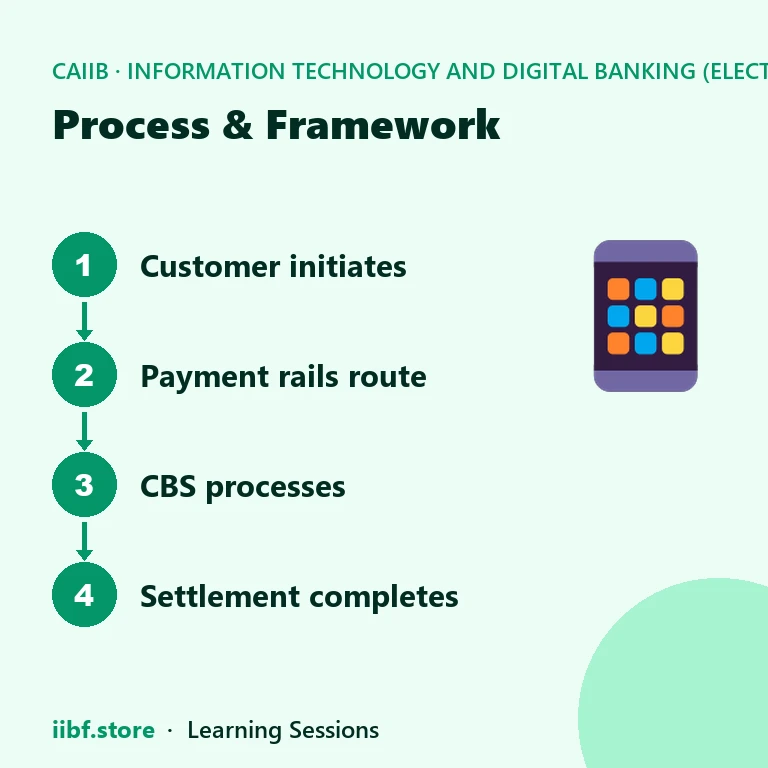
A typical resolved query — "what is my available balance" — flows as: channel captures input, NLP engine resolves intent to "balance-inquiry," the bot's middleware calls a CBS API with the authenticated customer ID, CBS returns the balance from the core ledger, and the bot formats a natural-language response. For a transactional intent like "pay my credit card bill," the same path runs through additional steps — OTP or biometric step-up authentication, fraud and limit checks, and a CBS posting call — before confirmation.
This is where the architectural groundwork from the CAIIB ITDB syllabus becomes directly relevant: revisiting how modules are structured in core banking solution architecture makes it much easier to see exactly where a chatbot's API call plugs into the CBS stack, and how Networking Systems concepts govern the secure channel the bot uses to reach the core.
For sensitive transactions, most deployments also layer in stronger identity checks before allowing the CBS write; the design choices there overlap heavily with what is covered in biometric authentication in digital banking.
🛡️ Guardrails, Escalation and Compliance
Because a chatbot can move money and disclose account data, banks build explicit guardrails around it. Common controls include a confidence threshold below which the bot must not attempt a transactional action, a hard stop on out-of-scope requests (loan restructuring advice, investment recommendations), mandatory human handoff for complaints and disputes, and full conversation logging for audit.
Escalation design matters as much as intent design. If the bot cannot resolve a grievance, it must offer a clear path to a human agent or the bank's grievance redressal desk, not a dead end. Under the RBI's Integrated Ombudsman Scheme (RB-IOS 2026, effective 1 July 2026), a customer who remains dissatisfied after a chatbot-assisted or human resolution attempt can escalate the complaint to the Banking Ombudsman within the scheme's filing window, with compensation available for proven financial loss. Candidates should treat the Reserve Bank of India website as the authoritative source for the current scheme text and timelines rather than memorising figures that change with each revision.
⚠️ Common Mistake: Assuming a chatbot can be the final word on a grievance. Regulatory guardrails require an escalation path to a human and, ultimately, to the Ombudsman — a bot cannot close a genuine complaint on its own.
Just as credit teams quantify exposure using the internal rating based approach for capital calculation, digital banking teams size chatbot risk exposure by transaction value, intent criticality, and blast radius of a wrong answer — the highest-risk intents get the tightest guardrails and the earliest human handoff.
📊 Service Metrics That Examiners and Banks Both Track
Once a chatbot is live, it is judged on a small set of operational metrics, not just uptime. Containment rate measures the share of conversations resolved without human escalation. Average handling time (AHT) compares bot resolution speed against agent-assisted resolution. First contact resolution (FCR) checks whether the customer's issue was solved in a single session. Customer satisfaction (CSAT) is typically captured through a post-chat rating.
| Channel | Interaction Mode | Handles Complex Queries | Typical Containment Rate* |
|---|---|---|---|
| IVR (keypad/DTMF) | Scripted menu tree | ❌ No | 20-30% |
| Rule-based chatbot | Text, decision-tree | ❌ No | 40-55% |
| NLP-driven voicebot/chatbot | Natural language, intent-based | ✅ Within trained domain | 60-75% |
*Indicative industry ranges; actual containment varies with intent coverage and depth of CBS integration.
📌 Remember: Containment rate and FCR are not the same — a bot can contain a chat (no escalation) yet still fail to fully resolve the query on the first attempt.
These metrics feed back into intent-engine tuning: low-confidence or frequently-escalated intents are flagged for retraining, closing the loop between chatbots and conversational banking analytics and the underlying Database Management Systems that store conversation logs for analysis.
Conclusion: Why This Topic Matters for CAIIB ITDB
Chatbots and conversational banking sit at the intersection of NLP, systems integration, and regulatory guardrails — exactly the mix CAIIB ITDB examiners like to test with scenario-based questions. Know the intent-to-CBS request flow, the difference between IVR and voicebot channels, the mandatory human-escalation and Ombudsman safety net, and the four core service metrics, and you can handle most variations the exam throws at you. For deeper integration patterns behind the bot's middleware layer, see enterprise service bus in banking, and browse more chapter notes on the Information Technology and Digital Banking tag hub.
Ready to test yourself? Attempt chapter-wise mocks on the CAIIB course page and reinforce the fundamentals in Essentials of Information Technology before exam day.
🧠 Practice MCQs: Chatbots and Conversational Banking
Q1. In a banking chatbot's NLP pipeline, what is the primary purpose of "entity extraction"? (a) Converting speech to text (b) Pulling structured details like account number or amount from the user's message (c) Encrypting the customer's session (d) Selecting which CBS server to call
Answer: (b) — Entity extraction identifies structured data points (account number, amount, date) within the recognised intent so the bot can act on them.
Q2. What is the main functional limitation of a traditional IVR system compared to an NLP-driven voicebot? (a) IVR cannot play pre-recorded audio (b) IVR requires internet connectivity (c) IVR follows a fixed, scripted menu and cannot interpret free-form natural language (d) IVR cannot connect to a telephone network
Answer: (c) — IVR is a deterministic, keypad-driven menu tree, while a voicebot uses an NLP intent engine to interpret open-ended natural speech.
Q3. Why do banks typically route chatbot transactions through CBS APIs rather than direct database queries? (a) APIs are faster to code (b) APIs preserve authentication, authorisation and audit-trail controls consistent with other banking channels (c) Direct database access is not technically possible (d) APIs remove the need for OTP verification
Answer: (b) — API-based integration ensures the chatbot inherits the same authentication, limit checks, and audit logging as other CBS-connected channels.
Q4. If a customer remains dissatisfied with a chatbot-led grievance resolution, what is the correct escalation path under current RBI norms? (a) The complaint automatically closes after one bot response (b) The customer can escalate to the Banking Ombudsman under the RBI's Integrated Ombudsman Scheme (c) The bank is not obligated to offer any further escalation (d) The customer must file a new account instead
Answer: (b) — Regulatory guardrails require a human escalation path and, if unresolved, access to the RBI Integrated Ombudsman Scheme.
Q5. Which metric specifically measures the share of chatbot conversations resolved WITHOUT escalation to a human agent? (a) Customer Satisfaction (CSAT) (b) Average Handling Time (AHT) (c) Containment Rate (d) First Contact Resolution (FCR)
Answer: (c) — Containment rate is the proportion of conversations the bot fully handles without transferring to a human agent.
Want chapter-wise mock tests with 100+ MCQs? Start practising free →
What is the difference between a chatbot and a voicebot in banking?
A chatbot handles text-based conversations on web, app or messaging channels, while a voicebot handles spoken conversations, typically replacing or supplementing IVR. Both usually share the same underlying NLP intent engine and CBS integration.
How does a bank chatbot verify a customer's identity before a transaction?
Most banks require step-up authentication — such as an OTP, PIN, or biometric check — before allowing the bot to execute a transactional intent like a fund transfer or bill payment, in addition to the initial login authentication.
What happens when a chatbot cannot understand a customer's query?
A well-designed bot recognises low confidence in intent classification and either asks a clarifying question or hands the conversation off to a human agent rather than guessing or providing an incorrect response.
Why is containment rate important for banks deploying chatbots?
Containment rate reflects how many queries are fully resolved without human involvement, directly affecting service cost and agent workload, which is why it is tracked alongside CSAT, AHT and FCR as a core operational metric.
Quick quiz on this topic
5 exam-style questions from our free test bank — check yourself before you move on.
Practice this topic
Take a free mock test, download chapter PDFs, or watch a video class — all included on iibf.store.
Keep reading



