Cloud Security in Banks: IIBF IT Security Exam Guide 2026
As banks migrate core workloads, analytics and customer-facing apps to public and hybrid clouds, cloud security in banks has moved from an optional add-on to a board-level priority — and a favourite examiner topic in the IIBF IT Security (ITSEC) paper. This guide breaks down exactly how the shared-responsibility model works, what controls a bank must own, how RBI's outsourcing and IT governance expectations map onto cloud, and the practice questions you need to walk into the exam confident. If you have been treating "the cloud is the provider's problem," this is the myth the exam wants you to unlearn.
☁️ Why Cloud Security Is a Distinct Exam Topic
Traditional IT security assumes the bank controls the perimeter — the data centre, the racks, the network switches, the physical door. Cloud dissolves that perimeter. The moment a bank consumes Infrastructure-as-a-Service (IaaS), Platform-as-a-Service (PaaS) or Software-as-a-Service (SaaS), it hands physical and hypervisor control to a Cloud Service Provider (CSP) while remaining fully accountable to the regulator, the customer and the law. This split is why the ITSEC syllabus treats cloud as its own discipline rather than a footnote to network security.
The exam wants you to reason about three things at once: data (where it physically sits, who can read it, how it is encrypted), identity (who authenticates and with what privileges), and accountability (which party is answerable when something breaks). A bank cannot outsource accountability. Even where the CSP suffers the breach, the RBI-regulated entity remains liable for customer data and for any consequent operational or reputational loss. Before you tackle cloud, it helps to have the fundamentals of access and network controls fresh — revise network controls and asset classification and controls, because both carry over directly into how you segment and label data in the cloud.
💡 Exam Tip: When a question asks "who is responsible for X in the cloud," the answer is almost never "only the provider." Look for the shared-responsibility split by service model (IaaS vs PaaS vs SaaS).
🔐 The Shared Responsibility Model
The single most examined concept in cloud security is the shared-responsibility model. It states that security of the cloud (physical facilities, hardware, the virtualisation layer, the CSP's global network) belongs to the provider, while security in the cloud (data, identity, configuration, application logic) belongs to the customer bank. What shifts is how much the bank owns, and that depends entirely on the service model.
With IaaS, the bank rents raw compute and storage and must secure the operating system, middleware, runtime, application and data itself. With PaaS, the provider manages the OS and runtime, so the bank focuses on the application and data. With SaaS — say a cloud-hosted loan-origination product — the provider runs almost everything, but the bank still owns its data, its user access and its configuration choices. The overwhelming majority of real-world cloud breaches trace back not to the provider being hacked, but to the customer misconfiguring a storage bucket, leaving default credentials, or granting excessive IAM privileges.
⚠️ Common Mistake: Assuming SaaS means "zero security work." Data classification, access reviews and audit-log monitoring stay with the bank regardless of service model.
The exam frequently pairs this with the principle that controls in software and its lifecycle do not disappear in the cloud — they change hands. Reinforce this by reviewing controls in software development and maintenance, since secure DevOps (often called DevSecOps) is how banks bake security into cloud-native pipelines.
📋 RBI and Regulatory Expectations
Indian banks cannot adopt cloud in a regulatory vacuum. Cloud consumption is, in RBI's framing, a form of outsourcing of IT services, and so it inherits every expectation the regulator places on outsourcing: a documented board-approved policy, robust due diligence of the service provider, enforceable contractual clauses, a right-to-audit, defined exit and data-portability arrangements, and clarity on where data physically resides. Data localisation is a recurring theme — payment-system data, under the RBI directive, must be stored within India, and banks must be able to demonstrate to the regulator exactly where customer information lives.
The regulator also expects continuity and concentration-risk thinking. If a single CSP outage could take down a bank's core services, that concentration is itself a risk to be managed — through multi-region design, tested backups and a credible exit plan that avoids vendor lock-in. Incident-reporting obligations do not pause because the workload is in someone else's data centre; a breach at the CSP that affects the bank's customers is reportable by the bank within the prescribed timelines.
📌 Remember: In the cloud, the bank retains accountability to RBI and to customers. You can outsource the operation, never the responsibility.
For a certification-level view of how these standards fit together, the security standards and best practices chapter is essential reading — ISO 27001, ISO 27017/27018 (cloud-specific extensions) and the CSP's own attestations all feed the bank's due-diligence checklist.
🛡️ Core Cloud Security Controls — Provider vs Bank
The practical heart of the topic is knowing which controls sit where. The table below maps common controls across the two parties for a typical IaaS deployment. In the exam, a "who owns it" column with a clear yes/no is exactly the kind of side-by-side the paper tests.
| Control | Provider (CSP) owns | Bank (customer) owns |
|---|---|---|
| Physical data-centre security | ✅ | ❌ |
| Hypervisor / virtualisation layer | ✅ | ❌ |
| Guest OS patching (IaaS) | ❌ | ✅ |
| Data encryption & key management | ❌ | ✅ |
| Identity & access management (IAM) config | ❌ | ✅ |
| Network segmentation / security groups | ❌ | ✅ |
| Data classification & localisation | ❌ | ✅ |
| Underlying global network availability | ✅ | ❌ |
Beyond the split, four controls carry the most marks. First, encryption — data at rest and in transit, with the bank ideally holding its own keys (BYOK / customer-managed keys) so the CSP cannot read plaintext. Second, identity — least-privilege IAM, multi-factor authentication for privileged access, and no long-lived root credentials. Third, configuration and posture management — automated checks that flag public buckets, open ports and drift. Fourth, logging and monitoring — centralised audit trails feeding the bank's Security Operations Centre so anomalies are caught in near real time. Physical and environmental safeguards remain the provider's job, but you should still be able to describe them; revise physical and environmental security controls to see what the CSP is attesting to on the bank's behalf. For deeper monitoring context, our guide to the security operations centre explains how cloud logs are correlated with on-prem telemetry.
🔗 How Cloud Ties Into the Rest of Your Syllabus
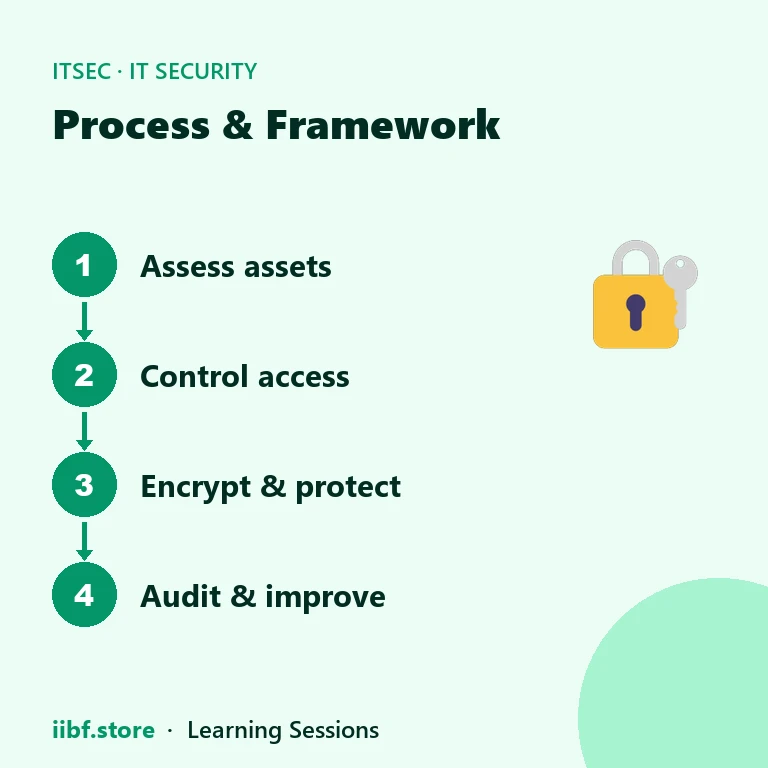
Cloud security is not an island. It borrows encryption directly from the bank's data-protection stack — brush up on data encryption in banks to answer key-management questions with confidence. It borrows perimeter thinking from network security controls in banks, since virtual private clouds, security groups and micro-segmentation are just network controls re-expressed for a software-defined environment. And because attackers target cloud consoles with phishing and credential theft, understanding computer hacking techniques tells you why MFA on the cloud management plane is non-negotiable.
For a consolidated revision hub across every ITSEC topic — cloud, network, encryption, standards and threats — bookmark the IT Security topic hub. And if you are stacking certifications, cloud governance overlaps heavily with the operational-risk and IT-governance material you will meet in higher papers, so time spent here compounds. When you are ready to convert reading into recall, move straight into timed mock tests rather than re-reading notes.
📚 Official reference: Always verify the latest rules, circulars and thresholds on the Reserve Bank of India (RBI) website before your exam — regulations change and only primary sources are authoritative.
🧠 Practice MCQs: Cloud Security in Banks
Q1. Under the shared-responsibility model for an IaaS deployment, which task is the BANK responsible for? (a) Securing the physical data centre (b) Maintaining the hypervisor (c) Patching the guest operating system (d) Ensuring global network hardware availability
Answer: (c) — In IaaS the provider secures the facility, hardware and hypervisor, but the customer bank must patch and harden the guest OS upward.
Q2. RBI most closely treats a bank's adoption of cloud services as a form of: (a) Capital expenditure only (b) Outsourcing of IT services (c) A tax-exempt investment (d) An interbank settlement
Answer: (b) — Cloud is regulated as outsourcing, inheriting due-diligence, right-to-audit, data-localisation and exit-plan obligations.
Q3. Which practice best protects data confidentiality even from the cloud provider's staff? (a) Storing data in a single region (b) Using customer-managed encryption keys (BYOK) (c) Disabling audit logs (d) Sharing root credentials across teams
Answer: (b) — With customer-managed keys the CSP stores only ciphertext and cannot read plaintext, preserving confidentiality.
Q4. The single most common root cause of real-world cloud data breaches is: (a) The provider's data centre being physically broken into (b) Hypervisor zero-day exploits (c) Customer misconfiguration such as public storage buckets (d) Failure of undersea cables
Answer: (c) — Most breaches stem from customer-side misconfiguration and excessive privileges, not provider compromise.
Q5. When a bank's payment-system data is processed in the cloud, RBI's data-localisation directive requires that the data be: (a) Encrypted but stored anywhere globally (b) Stored within India (c) Stored only by the provider's head office (d) Deleted after 24 hours
Answer: (b) — RBI mandates that payment-system data be stored within India, and the bank must be able to evidence its location.
Want chapter-wise mock tests with 100+ MCQs? Start practising free →
Is the cloud provider or the bank responsible for a data breach?
Both share technical duties, but accountability to RBI and customers always stays with the bank. The provider secures the infrastructure; the bank secures its data, identities and configuration, and remains legally answerable for outcomes.
Does using SaaS mean the bank has no security work to do?
No. Even with SaaS, the bank owns its data classification, user access management, configuration choices and audit-log monitoring. Only the underlying platform and infrastructure move to the provider.
Which ISO standards are relevant to cloud security for banks?
ISO 27001 provides the ISMS baseline, while ISO 27017 adds cloud-specific controls and ISO 27018 addresses protection of personal data in the cloud. Banks use these plus the CSP's attestations during due diligence.
What is data localisation and why does it matter for cloud?
Data localisation requires certain data — notably payment-system data under RBI's directive — to be stored within India. In the cloud, banks must choose regions and contractual terms that keep regulated data inside the country and prove it on demand.
✅ Conclusion
Cloud security in banks rewards a simple mental model: the provider secures the cloud, the bank secures what it puts in the cloud, and accountability never leaves the bank. Master the shared-responsibility split, the four core controls (encryption, identity, posture, monitoring) and RBI's outsourcing-and-localisation lens, and the ITSEC cloud questions become easy marks. Now turn theory into a score — take a free ITSEC mock test or explore the full certification course path to lock in your preparation.
Practice this topic
Take a free mock test, download chapter PDFs, or watch a video class — all included on iibf.store.