Compensation Management in Banks: CAIIB HRM Guide
Compensation management in banks is the HRM function that decides what a banker is paid, how that pay is structured, and how much of that pay is placed at risk against future performance. For CAIIB HRM candidates the topic is examiner-friendly because it sits at the junction of industrial relations, regulation and finance: the salary of an award-staff employee is settled at industry level between the Indian Banks' Association and the unions, while the package of a whole-time director in a private bank is governed by the Reserve Bank of India's compensation guidelines and needs supervisory approval before it can be paid. This guide works through pay structure, job evaluation, variable pay, malus and clawback, share-linked pay and pay equity in the sequence the syllabus follows.
💰 What Compensation Management in Banks Covers
Compensation is the total return an employee receives for work done. It is usually split into direct financial pay (basic pay, dearness allowance, house rent allowance, city compensatory allowance, bonus, incentives), indirect financial pay or benefits (provident fund, pension or NPS contribution, gratuity, leave fare concession, staff housing and vehicle loans at concessional rates, medical cover) and non-financial rewards (job security, designation, posting preference, recognition). In banking, the indirect component is unusually large: concessional staff loans and defined retirement benefits often carry more economic value than the cash allowances an employee sees each month.
The objectives of a compensation system are standard across industries but take a specific colour in banking. The system must be externally competitive enough to stop experienced credit and treasury officers leaving for private banks, internally equitable so that jobs of comparable worth are paid comparably, cost-controlled because staff cost is the single largest head of operating expenditure for most banks, and compliant, because a bank cannot design pay freely the way a manufacturing firm can. Before you attempt numerical or applied questions, revise the basics in the chapter on fundamentals of HRM and the bank-specific treatment in HRM in banks.
Two constraints make bank compensation different. First, in public sector banks the wage bill is negotiated collectively for the whole industry, so an individual bank has almost no discretion over the pay of clerical and subordinate staff. Second, for senior management in private and foreign banks, the regulator prescribes the shape of the package — the fixed-variable mix, deferral, and recovery mechanisms — not merely the ceiling.
💡 Exam Tip: Distinguish "wage determination" (who fixes the pay — settlement, board, or regulator) from "wage structure" (what the pay is made of). Most CAIIB questions on compensation actually test the first.
🏦 Pay Structure: Bipartite Settlement Versus CTC in Private Banks
In public sector banks, pay for workmen staff and for officers up to the top scale is revised roughly every five years through an industry-level settlement signed with the IBA — a bipartite settlement for workmen and a corresponding joint note for officers. The 12th such settlement, signed in March 2024 and given effect from 1 November 2022, revised pay scales, merged dearness allowance at a specified level of the All India Consumer Price Index for Industrial Workers, and continued the performance-linked incentive introduced in the previous round. The essential point for the exam is structural, not arithmetical: pay is scale-based with pre-defined annual increments, dearness allowance is slab-linked to the price index and revised quarterly, and allowances are prescribed by the settlement rather than negotiated by the individual.
Private banks follow a cost-to-company model. A package is built as fixed pay plus a flexible allowance basket plus an annual performance bonus, with retirement contributions and share-linked instruments layered on top. There is no dearness allowance, salary is band-linked and individually negotiable, and the annual revision depends on a merit matrix rather than a settlement. That flexibility is exactly why the regulator stepped in to shape senior packages.
| Pay element | Public sector bank (bipartite settlement) | Private bank (CTC model) | Treated as variable pay under RBI guidelines? |
|---|---|---|---|
| Basic pay | Fixed scale with annual increments; revised by settlement | Board-approved band; individually negotiated | ❌ (fixed pay) |
| Dearness allowance | Slab-linked to CPI-IW, revised quarterly | Not paid separately; subsumed in fixed pay | ❌ (fixed pay) |
| HRA and other allowances | Rates and area classification prescribed by the settlement | Flexible benefit basket inside CTC | ❌ (fixed pay) |
| Performance-linked incentive / bonus | PLI linked to the bank's profit growth, paid across staff | Annual bonus on individual plus bank scorecard | ✅ |
| Share-linked instruments (ESOPs) | Rare; only a few schemes attempted | Common for senior and critical talent | ✅ |
| Retirement benefits (pension/NPS, gratuity) | Governed by settlement, rules and statute | Employer contribution inside CTC | ❌ (fixed pay) |
Because the two regimes produce very different reward experiences, movement between them is one of the standard drivers of attrition and employee retention in banks, and any comparison question should be answered on structure and risk-sharing rather than on headline salary alone.
📊 Job Evaluation Methods and Internal Pay Equity
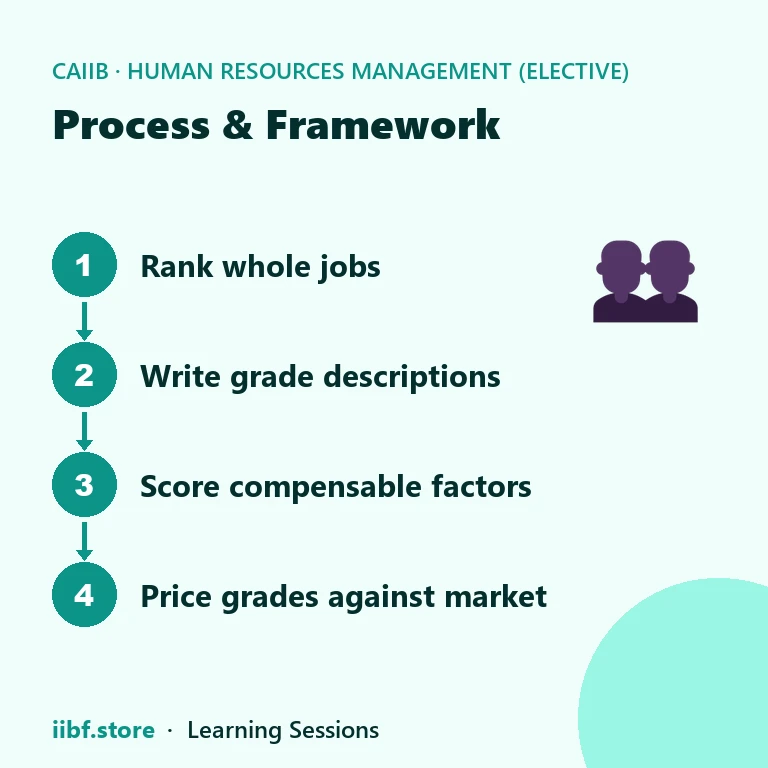
Job evaluation is the systematic process of establishing the relative worth of jobs so that internal pay relativities can be defended. It evaluates the post, never the person occupying it — that distinction is the single most common source of lost marks. The four classical methods fall into two families. The non-analytical family compares whole jobs: the ranking method simply orders jobs from most to least valuable, and the job classification or grading method writes grade descriptions first and then slots jobs into the grades — the logic behind clerical, officer Scale I to Scale VII structures in banks.
The analytical family breaks jobs into compensable factors. The point rating method selects factors such as skill, effort, responsibility and working conditions, weights them, awards points on defined degrees, and converts total points into a pay grade; the widely used Hay plan is a proprietary variant built on know-how, problem solving and accountability. The factor comparison method ranks jobs factor by factor against benchmark jobs and allocates a money value to each factor. Analytical methods cost more and take longer, but they produce the audit trail a bank needs when a pay differential is challenged.
Job evaluation feeds pay equity in two directions. Internal equity means comparable jobs are graded and paid comparably; external equity means grades are priced against a relevant market through salary surveys. Gender pay equity rests on the statutory principle of equal remuneration for work of equal value, now carried into the consolidated wage law — describe the principle rather than quoting a section number that may have shifted with the labour codes. Grade design also underpins competency mapping in banks, since role bands and competency levels have to align if pay progression is to look credible.
⚠️ Common Mistake: Treating job evaluation and performance rating as the same exercise. Job evaluation fixes the pay range for a post; individual rating decides where a person sits inside that range and what bonus they earn.
⚖️ Variable Pay, Malus and Clawback Under RBI Guidelines
For private sector and foreign banks operating in India, the compensation of whole-time directors, chief executive officers, material risk takers and control function staff is governed by RBI's compensation guidelines, first issued in comprehensive form in November 2019 and applicable from the following financial year. Material risk takers are employees whose decisions can materially commit the bank's capital or expose it to significant risk; control function staff — risk, compliance, internal audit — must be paid principally on the achievement of their own control objectives, so that they are not rewarded for the very business they police.
The guidelines shape the package rather than capping it outright. Variable pay must form a meaningful share of total compensation for these roles and is subject to a ceiling expressed as a multiple of fixed pay, with a substantial portion required to be delivered through share-linked instruments once variable pay crosses defined thresholds. A large share of variable pay must be deferred over a period of at least three years and vest on a staggered basis, so that reward follows the risk horizon of the decisions taken. Guaranteed bonuses are not permitted except for a joining or sign-on bonus limited to the first year. Every such package needs the board's Nomination and Remuneration Committee behind it, and, for a banking company, prior approval of the Reserve Bank under Section 35B of the Banking Regulation Act, 1949. Because thresholds and disclosure requirements have been amended more than once, verify the current numbers against the latest RBI circular before quoting them.
Two recovery tools complete the design. Malus prevents the vesting of deferred variable pay that has not yet been paid. Clawback goes further and recovers amounts already vested or paid. Both are triggered by later evidence of misconduct, material supervisory findings, restatement of accounts, or a deterioration in the risk position the individual created. Public sector banks operate a parallel but lighter regime: pay is set by government-notified schemes, with performance incentives linked to the bank's results. Reinforce all of this with the chapter on HRM in Indian banks.
📌 Remember: Malus stops money that has not yet been paid; clawback pulls back money already received. Deferral is the mechanism that keeps enough variable pay unpaid for malus to bite.
🎯 Conclusion: Turning Compensation Theory Into Marks
Sound compensation management in banks balances four pressures at once — attracting scarce skills, containing the largest line in operating expenditure, keeping internal relativities defensible, and satisfying a regulator that treats pay design as a risk-control instrument. For the CAIIB HRM elective, build your answers around three anchors: who determines pay (industry settlement, board policy or regulator), what the pay is made of (fixed, variable, benefits, share-linked), and how risk is shared over time (deferral, malus, clawback). The same discipline of structuring an answer around determinants and mechanisms works equally well on the credit side, as you will see in supply chain finance for banks. Pair this reading with the learning and development function in banks and browse the full Human Resources Management elective article hub. Then apply it: take a timed chapter test on the CAIIB course page or start free practice at iibf.store tests.

🧠 Practice MCQs: Compensation Management in Banks
Q1. Under RBI's compensation guidelines for private sector banks, the total variable pay of a whole-time director or CEO is subject to a ceiling expressed as: (a) a fixed rupee amount notified each year (b) a multiple of the individual's fixed pay (c) a percentage of the bank's net profit (d) a multiple of the median employee salary
Answer: (b) — The ceiling is set as a multiple of fixed pay, so a higher fixed salary mechanically permits a larger variable component.
Q2. Which arrangement allows a bank to recover variable pay that has already vested or been paid to an executive? (a) Malus (b) Deferral (c) Sign-on bonus (d) Clawback
Answer: (d) — Clawback recovers amounts already paid; malus only cancels amounts not yet vested.
Q3. Which job evaluation method assigns weighted numerical scores to compensable factors such as skill, effort, responsibility and working conditions? (a) Point rating method (b) Ranking method (c) Job classification method (d) Market pricing
Answer: (a) — The point rating method is analytical: factors are weighted, degrees are scored, and total points map to a pay grade.
Q4. In public sector banks, the basic pay, dearness allowance and most allowances of workmen staff are determined primarily by: (a) RBI's compensation guidelines for material risk takers (b) each bank's Nomination and Remuneration Committee (c) the industry-level bipartite settlement negotiated with the IBA (d) the individual bank's board-approved CTC policy
Answer: (c) — Workmen pay in public sector banks is settled collectively at industry level, leaving the individual bank almost no discretion.
Q5. Malus differs from clawback because malus: (a) recovers a bonus already credited to the employee (b) cancels unvested or unpaid deferred variable pay (c) applies only to share-linked instruments (d) applies only to control function staff
Answer: (b) — Malus operates prospectively on deferred amounts that have not yet vested, which is why a meaningful deferral period is essential.
Want chapter-wise mock tests with 100+ MCQs? Start practising free →
❓ Frequently Asked Questions
Is compensation management in banks tested in the CAIIB HRM elective?
Yes. It appears both as direct theory questions on wage structure and job evaluation methods, and as applied questions on variable pay, deferral, malus and clawback for senior bank executives.
What is the difference between a bipartite settlement and a joint note?
Both flow from the same industry-level wage negotiation with the IBA. The bipartite settlement covers workmen staff, while the joint note records the corresponding revision for officers, who are not covered by the workmen settlement.
Who are material risk takers in a bank?
Employees whose individual or collective decisions can materially commit the bank's capital or expose it to significant risk — typically senior business, treasury and large-exposure credit roles identified by the bank under criteria in RBI's compensation guidelines.
Why must control function staff be paid differently?
Risk, compliance and internal audit staff must be rewarded mainly on their own control objectives, not on the profits of the businesses they oversee, so that their independence and challenge function are not compromised by their pay.
Source and further reading: Reserve Bank of India and the Indian Institute of Banking & Finance.
Quick quiz on this topic
5 exam-style questions from our free test bank — check yourself before you move on.
Practice this topic
Take a free mock test, download chapter PDFs, or watch a video class — all included on iibf.store.
Keep reading