Motivation Theories in Banks: Maslow to Herzberg for CAIIB HRM 2026

Every CAIIB HRM elective paper carries at least one question built around motivation theories in banks, because branch managers cannot run a profitable, low-attrition team without understanding what actually drives a teller, a loan officer, or a relationship manager to perform. IIBF does not want rote definitions — it wants you to apply Maslow, Herzberg, McGregor and Vroom to real branch situations: a clerk who stops taking initiative after a transfer, a young RM chasing incentive-linked targets, or a back-office team that is technically well-paid but disengaged. This guide walks through each classical theory with a banking lens, shows you where examiners twist the options, and closes with practice MCQs so you walk into the exam hall ready.
🎯 What Are Motivation Theories in Banks and Why CAIIB HRM Tests Them
Motivation theory is the study of why employees direct effort toward organisational goals, and in a bank the stakes are unusually concrete: a demotivated credit officer delays sanctions, a demotivated cashier makes counter errors, and a demotivated RM stops cross-selling. CAIIB HRM does not test motivation as abstract psychology — it tests it as a management tool a branch head or HR manager actually uses.
The paper draws from four families of theory: content theories (Maslow, Herzberg, McGregor) that explain what motivates people, and process theories (Vroom, and briefly Adams' equity theory) that explain how the motivation process unfolds. Both families appear inside the Fundamentals of HRM chapter, which is the natural starting point before you attempt any HRM elective mock test.
Banks are unusual test cases for these theories because pay is largely standardised by scale and union settlements, promotions are seniority-heavy, and job rotation is frequent. That constrains which motivators HR can actually pull, which is exactly why examiners like to frame MCQs around "which theory best explains why a well-paid officer is still disengaged after a transfer" — a Herzberg-flavoured question dressed as an HR scenario.
🧩 Maslow's Hierarchy of Needs on the Bank Branch Floor
Abraham Maslow's five-tier hierarchy — physiological, safety, social (belongingness), esteem, and self-actualisation — remains the most quoted framework in CAIIB HRM because it is intuitive and maps cleanly onto a bank career. A new probationary officer worries first about salary regularity and job security (physiological and safety needs). Once those are met, she starts caring about team acceptance and a friendly branch culture (social needs), then about recognition, appraisal ratings and a corner cabin (esteem needs), and finally, at senior scale, about mentoring juniors or shaping policy (self-actualisation).
The exam-relevant nuance is that a satisfied need stops motivating — Maslow's "satisfaction-progression" principle. A bank cannot motivate a comfortably placed AGM with another increment; it must offer a self-actualisation lever such as a strategic project, a committee role, or a leadership development assignment. This is precisely the gap that a well-designed appraisal and career-path system, covered in the Human Resource Development Strategies and Systems chapter, is meant to close.
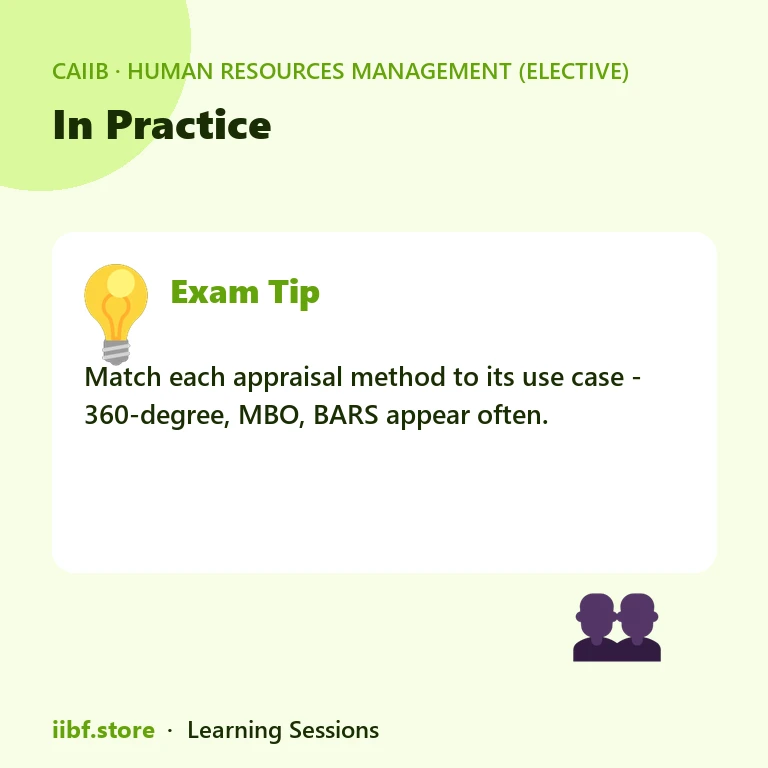
💡 Exam Tip: If an MCQ describes an employee whose lower-order needs are already met and asks "what should HR offer next", the answer is almost always an esteem or self-actualisation lever — not a pay hike.
Critics note the hierarchy is rigid and culturally Western — in Indian public sector banks, security and belongingness needs (job permanence, union protection) often stay dominant even at mid-career, which is why IIBF sometimes pairs Maslow with Indian workplace context questions rather than testing it in isolation.
🔥 Herzberg's Two-Factor Theory: Hygiene Factors vs Motivators
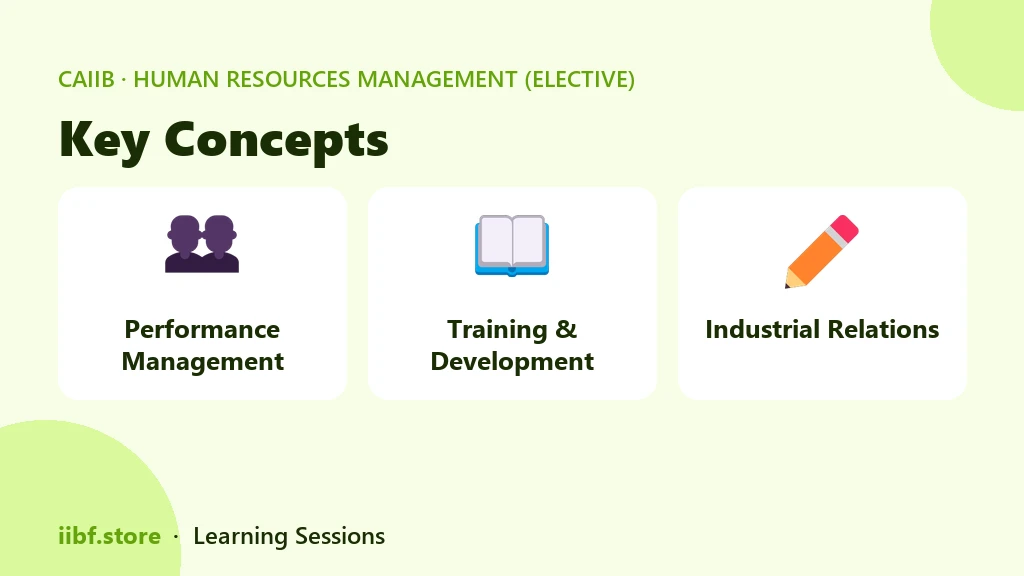
Frederick Herzberg split workplace factors into two independent sets. Hygiene factors — salary, job security, working conditions, bank policy, and supervision quality — do not motivate when present; they only prevent dissatisfaction when absent. Motivators — achievement, recognition, responsibility, growth, and the work itself — are what actually push performance upward. This is the single most exam-tested distinction in the whole motivation-theory syllabus area.
Apply it to a real branch scenario: a bank raises everyone's DA and improves the staff canteen (hygiene factors) and attrition briefly dips, but six months later engagement scores are back to where they started. Herzberg predicts exactly this — hygiene improvements remove complaints, they do not build lasting drive. To actually motivate the same staff, the branch needs job enrichment: letting a senior clerk own a full loan file end-to-end instead of one repetitive step, or giving a teller ownership of a small customer segment.
⚠️ Common Mistake: Students often call salary a "motivator" because more money clearly changes behaviour short-term. In Herzberg's framework salary is a hygiene factor — its absence causes dissatisfaction, but its presence does not sustain motivation. Examiners plant this exact trap in options.
Job enrichment — vertically loading a role with more autonomy and responsibility — is Herzberg's practical prescription and differs from job enlargement, which merely adds more tasks at the same level. CAIIB loves this pairing as a distractor: expect an MCQ that asks you to tell enrichment apart from enlargement inside a bank job-redesign example.
⚖️ McGregor's Theory X and Theory Y in Branch Management
Douglas McGregor argued that a manager's underlying assumptions about human nature shape the management style chosen, independent of what employees are actually like. Theory X assumes staff are inherently lazy, avoid responsibility, and must be closely supervised and controlled — leading to tight monitoring, rigid targets, and punitive appraisal. Theory Y assumes staff find work as natural as rest, will exercise self-direction toward accepted goals, and seek responsibility — leading to delegation, participative goal-setting, and trust-based supervision.
In a bank, a branch head who insists on countersigning every small-value voucher personally and treats leave applications with suspicion is operating on Theory X assumptions. A branch head who lets a senior officer own the SME lending desk with periodic review, not daily check-ins, is applying Theory Y. Neither theory is universally "correct" — McGregor's own point was that most Indian PSU branches historically leaned Theory X because of vigilance and audit culture, and CAIIB questions often ask you to identify which style fits a described control environment.
📌 Remember: Theory X and Theory Y are about management's beliefs, not employee reality — the same team can be managed under either assumption with very different outcomes.
William Ouchi's later Theory Z, blending Japanese consensus-based practices with Western structure, is sometimes tacked onto this section — expect it as a distractor option describing lifetime employment and collective decision-making rather than a testable theory in its own right.
📊 Vroom's Expectancy Theory and Other Contemporary Models
Victor Vroom's expectancy theory is the process theory CAIIB tests most, because unlike Maslow or Herzberg it gives you a formula: Motivation = Expectancy × Instrumentality × Valence. Expectancy is the employee's belief that effort will lead to performance ("if I work harder, will I actually hit the sanction target?"). Instrumentality is the belief that performance will lead to a reward ("if I hit the target, will I actually get the incentive?"). Valence is how much the employee values that reward.
The multiplicative structure is the exam trap: if any one factor is zero, total motivation is zero — even if the other two are strong. A bank can promise a generous quarterly incentive (high valence) tied clearly to sales numbers (high instrumentality), but if the target is set so high the officer believes it is unachievable (near-zero expectancy), the incentive scheme fails completely. This is a favourite scenario-based MCQ setup.
Adams' Equity Theory rounds out the process-theory set: employees compare their input-to-output ratio against a reference colleague, and perceived inequity — not absolute pay level — drives dissatisfaction. Two officers on identical CTC can have very different motivation if one believes the other is rewarded more for similar effort. The table below is a quick revision snapshot before you move to the topic covered in the HRM in Banks chapter.
| Theory | Proposed By | Core Idea | Money Alone Sustains It? |
|---|---|---|---|
| Hierarchy of Needs | Abraham Maslow | Needs progress physiological → safety → social → esteem → self-actualisation | Only at lower tiers |
| Two-Factor Theory | Frederick Herzberg | Hygiene factors prevent dissatisfaction; motivators drive performance | ❌ No |
| Theory X and Theory Y | Douglas McGregor | Manager's assumptions about staff nature shape supervision style | Not applicable |
| Expectancy Theory | Victor Vroom | Motivation = Expectancy × Instrumentality × Valence | ✅ If linked clearly to achievable performance |
| Equity Theory | J. Stacy Adams | Perceived fairness of input-output ratio versus peers drives effort | Only if perceived as fair |
For a broader view of how motivation design connects to pay structure, read the sibling guide on compensation management in banks, and for how these theories feed into identifying the right person for a role, see the companion piece on competency mapping in banks. Motivation gaps are also a leading trigger for workplace friction, which the article on conflict management in banks covers in detail. If you are also preparing the ITDB elective, the parallel guide on API banking and open banking is worth a look for cross-subject revision balance.
🧠 Practice MCQs: Motivation Theories in Banks
Q1. As per Herzberg's Two-Factor Theory, which of the following is classified as a hygiene factor rather than a motivator? (a) Recognition for closing a difficult recovery case (b) Salary and job security (c) Increased responsibility in a new role (d) A sense of achievement after target completion
Answer: (b) — Salary and job security prevent dissatisfaction but do not sustain motivation; they sit in Herzberg's hygiene category, not the motivator category.
Q2. A branch manager insists on personally approving every leave application and reviewing each voucher, believing staff will shirk work if unsupervised. This reflects which McGregor assumption? (a) Theory Y (b) Theory Z (c) Theory X (d) Equity Theory
Answer: (c) — Assuming employees are inherently lazy and need close control is the defining assumption of McGregor's Theory X.
Q3. In Vroom's Expectancy Theory, if an employee believes a sales target is completely unachievable no matter how hard they work, which component of the motivation formula falls to near zero? (a) Valence (b) Instrumentality (c) Expectancy (d) Equity
Answer: (c) — Expectancy is the belief that effort will lead to performance; an unachievable target destroys expectancy even if the reward is attractive.
Q4. According to Maslow's hierarchy, once a bank officer's salary, job security and team acceptance needs are met, which need is she most likely to seek next? (a) Physiological needs (b) Safety needs (c) Esteem needs (d) Social needs
Answer: (c) — After physiological, safety and social needs are satisfied, Maslow places esteem needs — recognition, status, appraisal — as the next tier sought.
Q5. A bank redesigns a clerk's role so she owns an entire loan file end-to-end instead of a single repetitive step, with no increase in pay. This is best described as (a) Job enlargement (b) Job rotation (c) Job enrichment (d) Job evaluation
Answer: (c) — Adding depth, autonomy and responsibility to a role is job enrichment, Herzberg's prescription for building intrinsic motivators; job enlargement only adds more tasks at the same level.
Want chapter-wise mock tests with 100+ MCQs? Start practising free
Which motivation theory is most frequently tested in CAIIB HRM?
Herzberg's Two-Factor Theory and Maslow's Hierarchy of Needs appear most often, usually as scenario-based questions asking you to classify a workplace factor as a hygiene factor, a motivator, or a specific need tier.
What is the key difference between Maslow and Herzberg for exam purposes?
Maslow ranks needs in a five-tier progression from physiological to self-actualisation, while Herzberg splits workplace factors into two independent categories — hygiene factors and motivators — rather than a ranked hierarchy.
How do Indian public sector banks typically apply Theory X or Theory Y?
Many PSU branches historically lean toward Theory X style controls because of vigilance and audit requirements, though HR reforms increasingly push branches toward Theory Y practices such as delegated lending authority and participative target-setting.
Is job enrichment the same as job enlargement?
No. Job enlargement adds more tasks at the same responsibility level, while job enrichment adds depth — greater autonomy, ownership and responsibility — and is Herzberg's specific prescription for building intrinsic motivation.
🏁 Conclusion: Turn Theory Into Exam Marks
Motivation theories in banks are not abstract psychology for CAIIB HRM — they are a scenario-recognition skill. Once you can reliably tell a hygiene factor from a motivator, a Theory X branch from a Theory Y branch, and spot when expectancy rather than valence is the broken link in an incentive scheme, this entire section stops being a weak spot. Revisit the underlying concepts in the HRM elective's foundational material, browse more elective coverage on the HRM elective tag hub, and cross-check every 2026 regulatory reference against the IIBF syllabus documents before your attempt. When you are ready to test recall under timed conditions, enrol for full-length practice through the CAIIB course page and keep attempting HRM elective mocks until the theory-to-scenario mapping becomes automatic.
Quick quiz on this topic
5 exam-style questions from our free test bank — check yourself before you move on.
Practice this topic
Take a free mock test, download chapter PDFs, or watch a video class — all included on iibf.store.
Keep reading