Competency Mapping in Banks: A CAIIB HRM Framework Guide
Competency mapping in banks is the discipline of identifying, defining and measuring the specific behaviours that separate an average officer from a consistently high performer in a given role — and then using that map to recruit, post, rotate, train and promote. For CAIIB Human Resources Management (Elective) candidates, competency mapping in banks is one of the most reliably examinable areas in the paper, because it sits at the junction of job analysis, performance management and succession planning.
The examiner rarely asks "what is a competency?" in isolation. Questions test whether you can tell a competency from a qualification, place a trait correctly on the iceberg, match a mapping method to a situation, and spot why a 60-competency framework fails in a 4,000-branch bank.
🧩 What Actually Counts as a Competency
A competency is an observable, measurable cluster of knowledge, skill, attitude and behaviour that causes superior performance in a defined role. Three of those four words matter for the exam: it must be observable, it must be role-specific, and it must be causally linked to performance — not merely correlated with it.
The standard decomposition used in HRM textbooks and in bank HR manuals runs:
- Knowledge — what the officer knows. Credit appraisal norms, KYC/AML rules, the applicable RBI directions on income recognition and asset classification.
- Skill — what the officer can do repeatedly. Spreading a balance sheet, structuring a working-capital limit, handling an irate customer at the counter.
- Attitude — the disposition brought to the work: ownership, risk sensitivity, service orientation.
- Behavioural indicator — the sentence that makes the above auditable. "Escalates a suspicious transaction within the same working day without being prompted" is an indicator; "has integrity" is not.
The behavioural indicator is the piece most candidates lose marks on. Without indicators written at graded proficiency levels, a competency framework is a wish list, and two assessors rating the same officer will disagree. Indicators also connect the framework to motivation theory — an officer will only display a behaviour repeatedly if the reward system reinforces it, which is why the chapter on employee motivation is examined alongside competency questions.
💡 Exam Tip: A qualification (MBA, CAIIB, JAIIB) is an input. A competency is an output behaviour. Any option describing a degree, a certificate or years of service is almost always the distractor.
🧊 The Iceberg Model and Why Banks Misread It
The iceberg model, associated with David McClelland and later Spencer & Spencer, is the single most examinable diagram in this topic. It divides competencies into what is visible above the waterline and what is submerged.
Above the waterline — surface competencies
Knowledge and skill. These are visible, easy to assess in an interview or written test, and — critically — relatively easy to develop through training. A probationary officer who cannot read a cash-flow statement can be taught to in three weeks.
Below the waterline — core competencies
Self-concept, traits and motives. Self-image, values, achievement orientation, need for affiliation, risk appetite, resilience under audit pressure. These are hidden, hard to measure in a 30-minute interview, and hard and expensive to develop. They are best selected for, not trained for.
The examinable inference is a hiring rule: select on the submerged part, train on the visible part. A bank that recruits a relationship manager purely on product knowledge and then discovers he has no service orientation has inverted the model. Conversely, a bank that rejects a candidate for not knowing a specific circular has wasted a good hire.
Competency mapping in banks becomes distorted when HR treats the submerged layer as trainable and loads the annual training calendar with "attitude modules" that no one can evaluate. The realistic lever for deep traits is culture and role modelling, not classroom hours — which is why the material on organisational culture and creativity is a companion read for this section.
⚠️ Common Mistake: Placing "communication skill" below the waterline. Communication is a skill — visible and trainable. Motives, traits and self-concept are what sit below.
📚 The Competency Dictionary and the Role-Wise Matrix
Competency mapping in banks produces two deliverables. The competency dictionary is the bank-wide master list: each competency named once, defined once, with four or five graded proficiency levels and behavioural indicators at each level. The role-wise competency matrix then maps roles against that dictionary, specifying the threshold level required for each role and each competency.
Dictionaries are conventionally split into three families:
- Core competencies — expected of every employee (integrity, customer orientation, compliance discipline).
- Functional/technical competencies — role-specific (credit appraisal, treasury dealing, forex documentation, recovery negotiation).
- Managerial/leadership competencies — scale up with grade (team building, delegation, strategic thinking).
A workable matrix for a mid-sized bank looks like the table below. Proficiency is graded 1 (awareness) to 5 (expert/coach); the final column flags whether the competency is a selection screen or a develop-on-the-job item.
| Competency | Branch Head | Credit Officer | Treasury Dealer | Screen at selection? |
|---|---|---|---|---|
| Credit appraisal & financial analysis | 3 | 5 | 2 | ❌ trainable |
| Market risk judgement under time pressure | 2 | 3 | 5 | ✅ select |
| Customer/service orientation | 5 | 3 | 2 | ✅ select |
| Compliance & KYC/AML discipline | 4 | 4 | 4 | ❌ trainable |
| Team building & delegation | 5 | 2 | 2 | ✅ select |
| Digital channel & product literacy | 4 | 3 | 3 | ❌ trainable |
The gap between an officer's assessed level and the threshold level in his cell is the competency gap. Aggregate those gaps across a cadre and you have a defensible training needs analysis rather than a wish list — the mechanics of converting gaps into calendars and measured returns are covered in the note on the learning and development function in banks.
🔍 Mapping Methods: BEI, Repertory Grid, 360-Degree and Assessment Centres
Four methods dominate the syllabus of competency mapping in banks, and the examiner tests fit, not preference.
Behavioural Event Interview (BEI)
Derived directly from McClelland's work. High and average performers in the same role are interviewed about specific critical incidents — what happened, what you thought, what you did, what resulted. The differentiating behaviours found in the high-performer group become the competency definitions. BEI is the method of choice for building the dictionary, because it is empirical rather than opinion-driven. It is also slow and interviewer-skill dependent.
Repertory grid
Kelly's personal construct technique. The subject-matter expert is given three job holders and asked how two are alike and different from the third. Repeated across triads, this surfaces the constructs a manager actually uses to judge performance — including ones he cannot articulate on a blank sheet. Useful for eliciting tacit criteria in specialised roles.
360-degree feedback
Ratings on defined behavioural indicators from supervisor, peers, subordinates and sometimes customers. Its correct use is development, not promotion. Once linked to increments, rating inflation and reciprocal trading destroy the data within one cycle.
Assessment and development centres
Multiple exercises — in-basket, group discussion, role play, case analysis, psychometrics — scored by multiple trained assessors against defined competencies. The defining features are multiple exercises and multiple assessors; a single interview panel is not an assessment centre. An assessment centre feeds a selection or promotion decision; a development centre feeds an individual development plan and its output is not used punitively.
📌 Remember: BEI builds the dictionary. Assessment centres measure people against it. 360-degree develops. Repertory grid elicits the constructs. Matching the method to the purpose is the recurring MCQ pattern.
🎯 Putting the Map to Work Across the HR Cycle
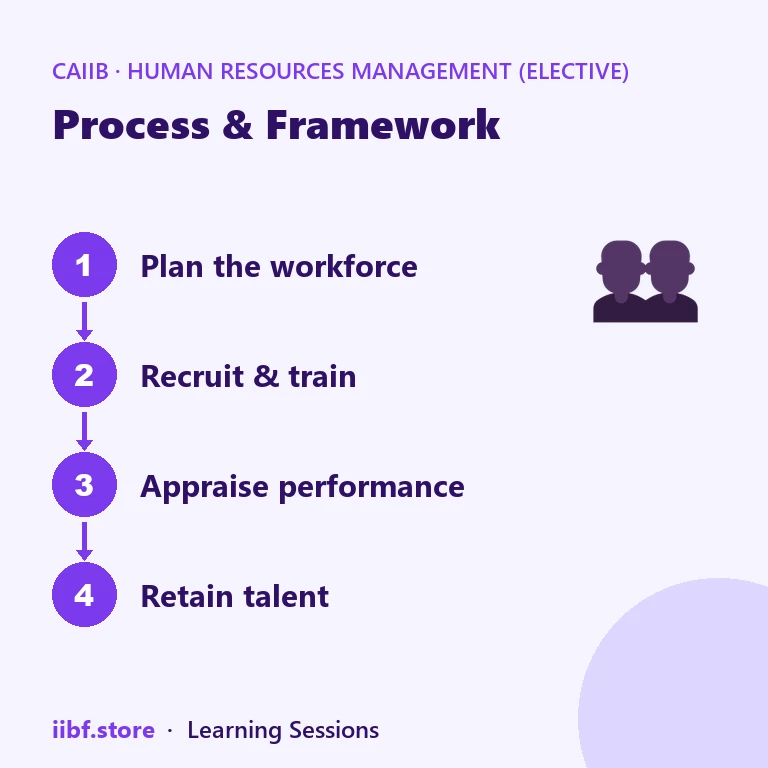
Competency mapping in banks earns its cost only when the map feeds decisions in more than one HR sub-system.
Recruitment and selection. Job advertisements and interview guides are written from the matrix, and interviewers are trained to probe behavioural evidence rather than opinions. Structured competency-based interviews measurably outperform unstructured ones on predictive validity.
Job rotation and posting. Rotation stops being an administrative reshuffle and becomes a planned exposure: an officer short on credit appraisal proficiency is posted to a credit-processing cell for a defined period with a named mentor and a review at exit. Banks also use rotation as a control — mandatory transfer and leave policies exist for fraud prevention, and competency data lets HR rotate without hollowing out a branch.
Training needs analysis. Aggregated gaps replace nominations-by-availability. This is the largest single efficiency gain from mapping.
Succession planning. The matrix defines what the next role demands; the assessment output shows who is within one level of it. That produces a ready-now / ready-in-two-years pipeline instead of a seniority list — the governance side of which is set out in the piece on succession planning in banks, and the leadership-team dimension in the chapter on the CEO and his/her team.
Retention. Competency data explains why people leave a role, not just how many. A dealer stuck at threshold with no development path is a predictable exit; the drivers are unpacked in the discussion of attrition and employee retention in banks. The same behavioural vocabulary also travels into customer-facing strategy — service-quality competencies map directly onto the frameworks covered in marketing of banking services in the ABM paper.
⚠️ Where Competency Frameworks Break Down
Failed attempts at competency mapping in banks fail for the same handful of reasons, and the exam does ask about limitations.
- Over-engineering. A dictionary with 50–60 competencies and five levels each generates hundreds of cells per role. Line managers stop using it within a year. A working framework typically carries a single-digit number of core competencies plus a small technical set per job family.
- Copy-paste dictionaries. Importing a global consultancy's generic dictionary without a BEI-based validation on the bank's own high performers produces definitions that describe no one in the organisation.
- Indicator drift. Indicators written as adjectives ("proactive", "dynamic") rather than observable acts cannot be rated consistently, and inter-assessor reliability collapses.
- No refresh cycle. Digital lending, analytics-led underwriting and outsourced back offices change role content faster than dictionaries get revised. An unrevised framework is worse than none, because it directs training budget at yesterday's role.
- Punitive drift. The fastest way to kill honest self-assessment is to feed development-centre output into disciplinary or promotion decisions it was never designed for. The boundary between developmental HR data and formal proceedings is dealt with in the chapter on employee discipline and discipline management.
- Union and IR sensitivity. In a unionised banking environment, a framework introduced without consultation is read as a back-door performance rating system and stalls.
The honest position for an exam answer: competency mapping improves the quality of HR decisions, but it does not remove judgement, and its cost rises faster than its benefit once the dictionary grows beyond what line managers will actually read.
🧠 Practice MCQs: Competency Mapping
Q1. In the iceberg model, which set of elements lies below the waterline? (a) Knowledge and skill (b) Skill and communication ability (c) Self-concept, traits and motives (d) Qualifications and certifications
Answer: (c) — Knowledge and skill are visible and trainable; self-concept, traits and motives are submerged, hard to assess and hard to develop.
Q2. A bank wants to build its competency dictionary by studying what its best-performing credit officers actually did in critical incidents. The most appropriate method is: (a) Behavioural Event Interview (b) 360-degree feedback (c) Psychometric testing alone (d) Annual appraisal review
Answer: (a) — BEI compares high and average performers on specific past incidents and yields the differentiating behaviours that become competency definitions.
Q3. Which is the defining feature of an assessment centre? (a) A single structured panel interview (b) A written test followed by an interview (c) One assessor observing across a full day (d) Multiple exercises assessed by multiple trained assessors against defined competencies
Answer: (d) — Multiplicity of both exercises and assessors is what distinguishes an assessment centre from an ordinary selection interview.
Q4. 360-degree feedback is most appropriately used for: (a) Deciding annual increments (b) Individual development planning (c) Disciplinary proceedings (d) Fixing branch business targets
Answer: (b) — Tying 360-degree ratings to pay or promotion triggers inflation and reciprocal rating; its sound use is developmental.
Q5. The difference between an officer's assessed proficiency and the threshold level specified for his role in the competency matrix is termed the: (a) Performance variance (b) Appraisal differential (c) Competency gap (d) Role deficit ratio
Answer: (c) — Aggregated competency gaps across a cadre form the evidence base for training needs analysis.
Want chapter-wise mock tests with 100+ MCQs? Start practising free →
❓ Frequently Asked Questions
Is competency mapping the same as job analysis?
No. Job analysis describes the job — duties, responsibilities, reporting lines and working conditions — and produces the job description and job specification. Competency mapping describes the person side: the behaviours that produce superior performance in that job. Job analysis is usually the input to competency mapping, not a substitute for it.
How many competencies should a bank's dictionary contain?
There is no prescribed number. The practical guidance in HRM literature is a small core set applying to everyone, plus a limited technical set per job family, kept to what a line manager can hold in mind during an appraisal discussion. Frameworks that run to several dozen competencies with five levels each are abandoned in practice because the rating burden outweighs the decision value.
What is the difference between an assessment centre and a development centre?
The exercises can be identical; the purpose and the use of output differ. An assessment centre produces a decision — selection, promotion or placement. A development centre produces an individual development plan, the participant receives detailed feedback, and the results are deliberately kept out of promotion or disciplinary decisions so that participants behave honestly.
How is competency mapping examined in CAIIB HRM?
Mostly as concept-discrimination MCQs and short case vignettes: place an element correctly on the iceberg, match a method to a stated purpose, identify the competency gap, or select the limitation that fits a described failure. Learn the four KSAB components, the iceberg split, the four mapping methods with their purposes, and two or three limitations, and the topic is fully covered.
Competency mapping in banks is not a documentation exercise — it is the mechanism that turns vague statements about "talent" into role-specific, observable behaviours that recruitment, rotation, training and succession can all act on. For the CAIIB HRM elective, master the KSAB decomposition, the iceberg split between trainable and selectable, the dictionary-plus-matrix architecture, and the purpose-fit of BEI, repertory grid, 360-degree feedback and assessment centres. That is where the marks are.
Revise the surrounding topics through the Human Resources Management elective article hub, then test yourself chapter by chapter on the CAIIB course page before your next attempt.
Quick quiz on this topic
5 exam-style questions from our free test bank — check yourself before you move on.
Practice this topic
Take a free mock test, download chapter PDFs, or watch a video class — all included on iibf.store.
Keep reading