Competency Mapping in Banks: A CAIIB HRM Guide 2026
Competency mapping in banks is a structured process. It identifies the knowledge, skills and behaviours an employee needs to do a role well. HR then measures how each person compares with that profile. For CAIIB HRM aspirants, this is a highly exam-relevant topic. It is also useful in real bank HR work, because it links recruitment, training, career paths and rewards into one evidence-based framework. That beats treating each area as a separate HR silo.
🎯 What Is Competency Mapping in Banks?
A competency is an underlying trait — knowledge, skill, self-image, trait or motive. It leads to effective performance in a job. Competency mapping in banks means listing these traits for every role, from a branch teller to a chief credit officer. HR then builds a "competency profile" to assess each employee against. Public sector, private and cooperative banks all use these profiles. They help with hiring panels, internal job postings, promotion boards and training-needs identification. The concept links to the broader HR architecture in the HRM in Banks chapter, which explains how HR functions are structured across large branch networks. Competency mapping is not just a skills checklist, though. It also captures softer traits — customer orientation, ethical judgement, and resilience under regulatory pressure — that matter as much as technical know-how in a banking career.
🧩 The Competency Mapping Process, Step by Step
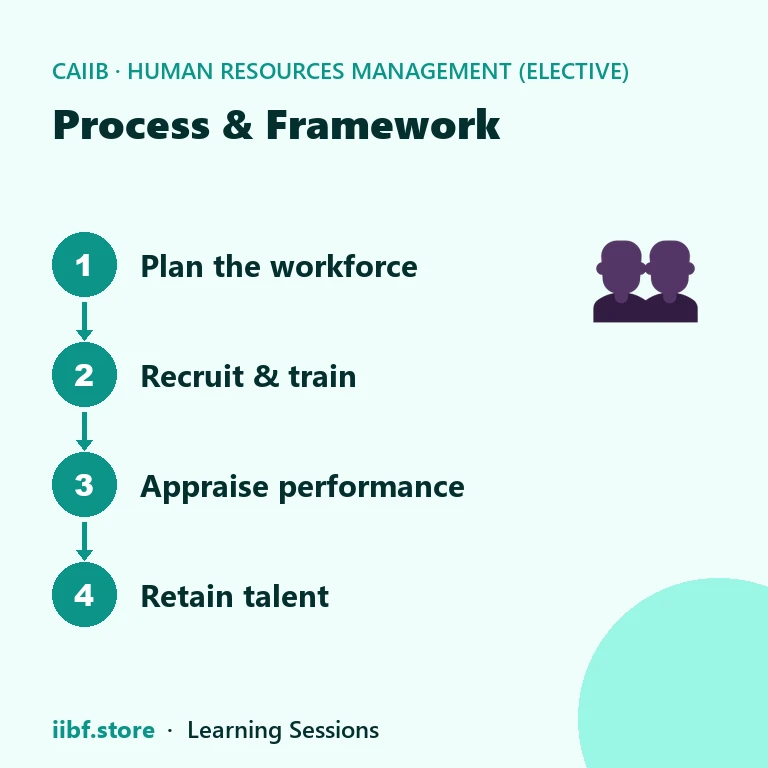
A sound competency mapping exercise follows five stages. First is role or job analysis. HR and line managers document the real tasks, decisions and outcomes a role needs. Second is competency identification. Interviews, focus groups and Behavioural Event Interviews (BEI) with high performers reveal what separates strong performers from average ones. Third is building a competency dictionary. Each competency gets a clear definition and 3–5 proficiency levels, so "stakeholder communication" at a junior officer level looks different from the same competency at a zonal manager level. Fourth is assessment. Staff are rated against the dictionary using 360-degree feedback, assessment centres, psychometric tools or manager ratings. Fifth is gap analysis. The gap between required and actual proficiency feeds directly into individual development plans. This method is grounded in the ideas taught under Fundamentals of Human Resource Management. Every CAIIB HRM candidate should revise that chapter before scenario-based questions on this topic.
💡 Exam Tip: Remember the distinction between a "threshold" competency (minimum needed to do the job) and a "differentiating" competency (what separates star performers) — this pairing is a favourite in CAIIB HRM objective questions.
📊 Competency Types Used in Bank HRM Frameworks
Most bank competency frameworks group competencies into a few clusters. This keeps them usable across thousands of roles. The table below lists the common types. It shows what each one focuses on, how it is assessed, and whether training can realistically build it.
| Competency Type | Focus Area | Assessed Through | Easily Trainable? |
|---|---|---|---|
| Threshold | Baseline job knowledge (KYC basics, documentation, systems) | Written tests, on-the-job checklists | ✅ |
| Technical / Functional | Credit appraisal, treasury, trade finance operations | Certification exams, case-based tests | Yes |
| Behavioural | Communication, teamwork, customer orientation | 360-degree feedback, BEI | Partly |
| Differentiating | Strategic thinking, influencing senior stakeholders | Assessment centres, simulations | ❌ |
| Managerial / Leadership | Decision-making, delegation, change management | Psychometric tools, leadership panels | No |
🏦 Why Competency Mapping Matters for Indian Banks
Banking is changing fast. Branch-led service is shifting to digital-first delivery. Generalist officers are giving way to specialist credit and risk roles. A well-designed competency map helps HR plan succession pipelines and design targeted learning journeys. It also supports promotion decisions that stay consistent across zones, not just one manager's opinion. It feeds into the broader HRD architecture in Knowledge Management, since a bank's competency dictionary is itself organisational knowledge that must be captured, updated and shared. Competency data also explains behaviour patterns studied under Organisational Behaviour. For example, it shows why two officers with similar technical scores perform very differently once traits like stress tolerance are factored in. Some banks are now digitising this further, testing tamper-proof digital certificates for verified skills. This idea sits alongside the wider shifts covered in our guide to blockchain in banking.
⚠️ Common Pitfalls When Banks Implement Competency Mapping
The most common mistake is building an over-engineered dictionary. Some banks list 30–40 competencies per role. Managers cannot realistically assess that many, and employees cannot remember them — best practice caps this at 8–10 per role. A second pitfall is treating the exercise as a one-time HR project rather than a living framework. Job content in banking changes with regulation and technology, so competency dictionaries need periodic revalidation. A third issue is disconnecting the map from actual HR decisions. If ratings do not visibly influence training nominations, lateral moves or promotion shortlists, employees quickly stop taking the assessment seriously. Competency data overlaps with sensitive career decisions. So it must also be read alongside statutory protections that bank employees enjoy at work, covered separately in our piece on labour laws for bank employees. Once gaps are identified, closing them requires structured succession pipelines, a theme explored in our article on succession planning for banks.
⚠️ Common Mistake: Candidates often confuse competency mapping with a simple skills inventory — a skills list is just "can do X," while a competency framework also captures behavioural and motivational drivers behind performance.
📌 Remember: Competency mapping outputs feed multiple HR processes — recruitment, training needs analysis, job rotation and promotion — it is never an end in itself.
If you are preparing across the CAIIB HRM elective, browse more CAIIB HRM articles. They show how competency mapping connects with training design, organisational change and knowledge systems within a single coherent HR strategy for banks.
Official sources: cross-check the latest syllabus, circulars and rates on the IIBF official website and the Reserve Bank of India.
🧠 Practice MCQs: Competency Mapping in Banks
Q1. Which competency type reflects the baseline knowledge every employee in a role must possess, such as KYC basics and documentation? (a) Differentiating competency (b) Threshold competency (c) Managerial competency (d) Emotional competency
Answer: (b) — Threshold competencies are the minimum knowledge/skills needed just to perform the job adequately.
Q2. A Behavioural Event Interview (BEI) is primarily used in competency mapping to: (a) audit ledger entries (b) elicit real incidents that reveal actual on-the-job behaviour (c) calculate provisioning norms (d) assess balance sheet ratios
Answer: (b) — BEI draws out specific past incidents to identify the real competencies behind strong performance.
Q3. A "competency dictionary" in a bank's HR framework typically contains: (a) a list of RBI circulars (b) a structured set of defined competencies with proficiency levels for each role (c) customer complaint logs (d) branch profitability statements
Answer: (b) — The dictionary standardises definitions and proficiency levels so ratings are consistent across the bank.
Q4. The first step in a robust competency mapping exercise is usually: (a) conducting a job/role analysis (b) fixing incentive pay (c) issuing a show-cause notice (d) drafting the annual budget
Answer: (a) — Role analysis establishes what the job actually requires before any competencies can be defined.
Q5. Competency gap analysis in banks is mainly used to: (a) determine dividend payout (b) identify differences between required and actual competency levels to guide learning interventions (c) calculate CRAR (d) set the repo rate
Answer: (b) — The gap between required and actual proficiency directly drives individual development plans and training nominations.
Want chapter-wise mock tests with 100+ MCQs? Start practising free →
What is the difference between competency mapping and performance appraisal?
Competency mapping identifies the underlying skills and behaviours a role requires and measures readiness against that profile, while a separate performance review evaluates results and output over a review period; the two use different inputs even though HR often uses one to inform the other.
How many competencies should a typical bank role have?
Most practitioners recommend 6–10 well-defined competencies per role. Longer lists become difficult for managers to assess consistently and for employees to internalise.
Who conducts competency mapping in a bank — HR or the business function?
It is usually a joint exercise: HR provides the methodology and facilitation while line managers and subject-matter experts from the business function validate the actual competencies required for each role.
Is competency mapping relevant to CAIIB HRM exam questions?
Yes, it is a recurring topic under the HRD systems and organisational behaviour portions of the CAIIB HRM elective syllabus, often tested through scenario-based and definition-matching questions.
Take This Further
Competency mapping ties together nearly every other HR process a bank runs, from hiring to promotion boards, and CAIIB HRM examiners like to test it through applied scenarios rather than plain definitions. Reinforce these concepts with topic-wise mocks on the CAIIB course page or attempt a timed set on iibf.store/tests to see how well you can apply the competency-mapping framework under exam conditions.
Quick quiz on this topic
5 exam-style questions from our free test bank — check yourself before you move on.
Practice this topic
Take a free mock test, download chapter PDFs, or watch a video class — all included on iibf.store.
Keep reading