Corporate Insolvency Resolution Process: CAIIB BRBL Guide 2026
The corporate insolvency resolution process (CIRP) under the Insolvency and Bankruptcy Code, 2016 is one of the most heavily tested areas of Module B in CAIIB Banking Regulations and Business Laws. It replaced a fragmented recovery landscape with a single, time-bound, creditor-in-control mechanism supervised by the National Company Law Tribunal. For a lending banker, knowing exactly when the corporate insolvency resolution process begins, what it freezes and how recoveries are finally ranked decides whether a stressed exposure is salvaged or written down.
⚖️ Who Can Trigger CIRP and at What Default Threshold
CIRP applies only to corporate persons — companies incorporated under the Companies Act, limited liability partnerships, and other entities incorporated with limited liability. Financial service providers are carved out and follow a separate route notified under Section 227. Individuals and partnership firms fall under Part III of the Code, where the Debt Recovery Tribunal is the adjudicating authority.
Three doors lead into the process. A financial creditor may file under Section 7 the moment a default occurs, without any prior notice to the borrower. An operational creditor must first serve a demand notice under Section 8 and wait ten days for payment or for notice of a pre-existing dispute before filing under Section 9. The corporate debtor itself may file under Section 10 as a corporate applicant.
Section 4 fixes the minimum default at ₹1 crore, raised from ₹1 lakh by the Ministry of Corporate Affairs notification dated 24 March 2020. Where a financial creditor belongs to a class — debenture holders, deposit holders or real-estate allottees — the provisos to Section 7(1) require the application to be filed jointly by at least 100 such creditors or 10% of the class, whichever is less.
The NCLT is the adjudicating authority under Section 60 and is expected to admit or reject an application within 14 days. Because an LLP is a corporate person, borrowers studied in the Limited Liability Partnership Act, 2008 chapter come within CIRP, while a proprietorship exposure stays with the machinery covered in The Recovery Of Debts And Bankruptcy Act, 1993. All application formats and regulations are published by the Insolvency and Bankruptcy Board of India.
🗓️ The CIRP Clock: From Day 1 to the 330-Day Outer Limit
The date of admission is the insolvency commencement date, and every deadline runs from it. The NCLT appoints an interim resolution professional within 14 days, and the IRP issues a public announcement within three days of appointment, calling for claims. Claims are verified, the committee of creditors is constituted, and the first CoC meeting must be held within seven days of that constitution under Section 22.
Section 12 gives the process 180 days. The CoC may resolve, by a 66% voting share, to seek a one-time extension of up to 90 days, which the NCLT may grant on being satisfied that the process cannot be completed within the original period. The third proviso adds an outer ceiling of 330 days, expressly including any extension and the time spent in legal proceedings.
In the Essar Steel judgment of 2019 the Supreme Court read down the word "mandatorily" in that proviso, so the NCLT retains a narrow discretion to extend beyond 330 days in genuinely exceptional cases where the delay is not attributable to the parties. Two shorter variants also exist: the fast-track process under Sections 55 to 58 runs for 90 days with a 45-day extension, and the pre-packaged insolvency resolution process for MSMEs, inserted in 2021, works to a 120-day outer limit.
💡 Exam Tip: The 180+90 arithmetic gives 270 days, but 330 is the statutory ceiling because litigation time is counted in. Questions frequently offer 270 as the trap option.
Missed timelines are a classic source of legal risk in banking, since a bank that files late claims or delays its CoC vote can lose both value and standing in the process.
🛡️ Moratorium Under Section 14: What Freezes and What Does Not
On admission the NCLT declares a moratorium under Section 14, which is the single most examined provision of the Code. Its purpose is to preserve the corporate debtor as a going concern by creating a calm period in which no creditor can dismember the asset pool. The moratorium lasts until the resolution plan is approved under Section 31 or a liquidation order is passed under Section 33.
Crucially, the moratorium protects the corporate debtor and its assets — not the people who stood behind the debt. Section 14(3)(b) expressly keeps a surety in a contract of guarantee outside its protection, so a bank may continue to sue promoters and corporate guarantors even while CIRP is running. Section 14(2A) also prevents suppliers from cutting off goods or services the resolution professional considers critical, unless dues for the CIRP period go unpaid.
| Action during CIRP | Barred by the moratorium? | Provision |
|---|---|---|
| Fresh or pending suits and arbitral proceedings against the corporate debtor | ✅ Barred | Sec 14(1)(a) |
| Transfer or disposal of the corporate debtor's assets by management | ✅ Barred | Sec 14(1)(b) |
| Enforcement of security interest under the SARFAESI Act | ✅ Barred | Sec 14(1)(c) |
| Recovery of leased property occupied by the corporate debtor | ✅ Barred | Sec 14(1)(d) |
| Proceedings against a surety or guarantor of the corporate debtor | ❌ Not barred | Sec 14(3)(b) |
Pending Section 138 NI Act cheque dishonour proceedings against the corporate debtor are covered by the moratorium, though the signatory directors remain personally liable under Section 141. Similarly, a reference to arbitration and conciliation in banking disputes cannot be continued against the corporate debtor once the moratorium is in force.
🏛️ Committee of Creditors: Composition and Voting Thresholds
Section 21 places the committee of creditors at the centre of the process, and it comprises only financial creditors, weighted by the value of their admitted debt. A financial creditor who is a related party of the corporate debtor has no right of representation, participation or voting, which prevents promoters from controlling the outcome. Where a corporate debtor has no financial creditors at all, the regulations allow a CoC of the largest operational creditors.
Operational creditors whose aggregate dues are at least 10% of total debt are entitled under Section 24 to attend CoC meetings, but they carry no vote. For large homogeneous classes such as allottees or deposit holders, Section 21(6A) provides an authorised representative who votes for the whole class on the basis of the majority preference within it.
The thresholds themselves are pure marks. A 66% voting share is required to appoint or replace the resolution professional, to extend the process, to approve the resolution plan under Section 30(4), to resolve for liquidation, and to authorise the material actions listed in Section 28. Withdrawal of an admitted application under Section 12A needs a much higher 90%, while routine matters are decided by a simple majority of 51%.
⚠️ Common Mistake: Candidates still write 75% for approval of a resolution plan. That was the pre-2018 threshold; the Second Amendment Act, 2018 reduced it to 66%.
💰 Resolution Plan, Section 29A and the Liquidation Waterfall
The resolution professional invites expressions of interest, issues a request for resolution plans, and places compliant plans before the CoC. Every applicant must clear Section 29A, which disqualifies undischarged insolvents, wilful defaulters, persons whose accounts have been non-performing for a year or more without cure, and connected persons. Section 240A relaxes two of these disqualifications for MSME debtors so that genuine promoters are not shut out.
Section 30(2)(b) guarantees a floor: operational creditors and dissenting financial creditors must receive at least the amount they would have got under the Section 53 waterfall in a liquidation. Once the NCLT approves a plan under Section 31, it binds the corporate debtor, all creditors, employees, guarantors and every government authority, and the Supreme Court's clean-slate ruling in Ghanashyam Mishra (2021) extinguishes all claims not part of the plan.
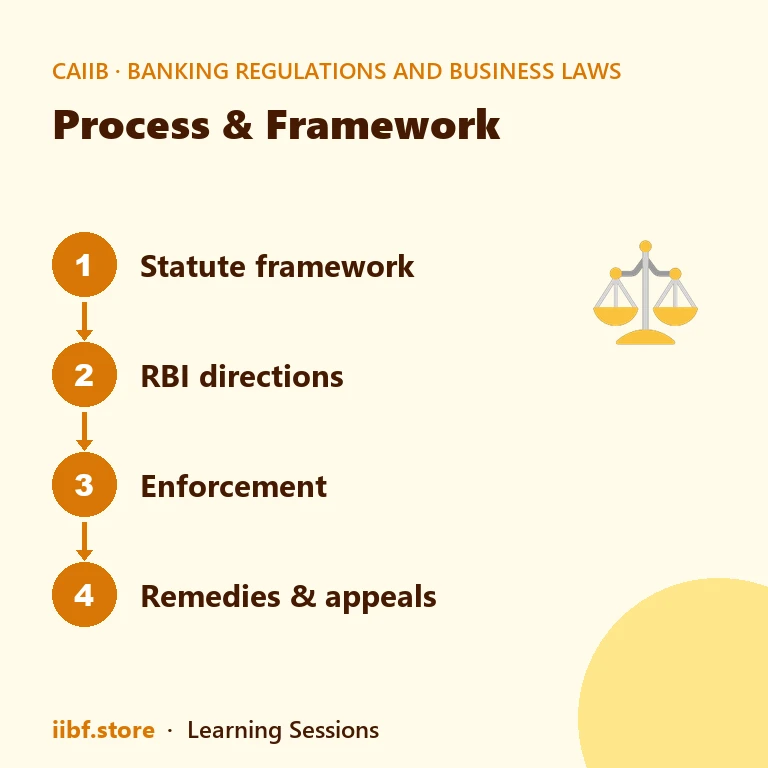
If no plan is approved, Section 33 orders liquidation and Section 53 fixes the priority: process and liquidation costs first; then workmen's dues for 24 months together with secured creditors who relinquish security, pari passu; then other employee dues for 12 months; then unsecured financial creditors; then government dues for two years along with the unpaid balance of secured creditors who enforced their own security; then remaining debts, preference shareholders and equity holders. A secured creditor who stays outside the pool therefore falls below unsecured financial creditors for any shortfall — the practical reason most banks relinquish. Charges and priority are developed further in Law Relating to Securities and Modes of Charge - II.
📌 Remember: Section 238 gives the Code overriding effect, so IBC prevails over the SARFAESI Act and the RDB Act wherever they conflict.
Before an account reaches the tribunal, the RBI's Prudential Framework for Resolution of Stressed Assets requires a 30-day review period from default and a 180-day window to implement a resolution plan, failing which additional provisions bite. Those haircuts and provisions feed directly into margin management, which is why the CAIIB syllabus pairs this with cost of deposits and deposit pricing.
🧠 Practice MCQs: Corporate Insolvency Resolution Process
Q1. What is the minimum amount of default required to file an application under Section 7 or Section 9 of the IBC, 2016? (a) ₹1 lakh (b) ₹10 lakh (c) ₹50 lakh (d) ₹1 crore
Answer: (d) — Section 4 was amended by the MCA notification of 24 March 2020 to raise the threshold from ₹1 lakh to ₹1 crore.
Q2. Which of the following is NOT prohibited by the moratorium under Section 14? (a) Enforcement of security interest under SARFAESI against the corporate debtor (b) Institution of a fresh suit against the corporate debtor (c) Recovery proceedings against a surety who guaranteed the corporate debtor's loan (d) Transfer of the corporate debtor's assets by its management
Answer: (c) — Section 14(3)(b) expressly excludes a surety in a contract of guarantee from the moratorium.
Q3. A resolution plan is approved by the committee of creditors under Section 30(4) by a minimum voting share of (a) 51% (b) 66% (c) 75% (d) 90%
Answer: (b) — The Second Amendment Act, 2018 reduced the approval threshold from 75% to 66% of voting share.
Q4. In the Section 53 liquidation waterfall, unsecured financial creditors rank (a) above workmen's dues for 24 months (b) below government dues for two years (c) above government dues and above the unpaid balance of secured creditors who enforced security (d) at par with liquidation costs
Answer: (c) — Unsecured financial creditors sit at clause (d), ahead of the clause (e) bracket that covers government dues and enforcement shortfalls.
Q5. Withdrawal of an admitted CIRP application under Section 12A requires approval of the CoC with a voting share of at least (a) 66% (b) 75% (c) 90% (d) 100%
Answer: (c) — Section 12A sets a deliberately high 90% bar so that an admitted proceeding is not withdrawn casually.
Want chapter-wise mock tests with 100+ MCQs? Start practising free →
❓ Frequently Asked Questions
Who can initiate CIRP against a company?
A financial creditor under Section 7, an operational creditor under Section 9 after a Section 8 demand notice, or the corporate debtor itself under Section 10. In every case the default must be at least ₹1 crore.
Can a bank proceed against the guarantor during the moratorium?
Yes. Section 14(3)(b) keeps a surety in a contract of guarantee outside the moratorium, so recovery action against promoters and corporate guarantors may continue. Only the corporate debtor and its assets are protected.
What happens if no resolution plan is approved within 330 days?
The NCLT ordinarily passes a liquidation order under Section 33 and distribution follows the Section 53 waterfall. After the Essar Steel ruling, a limited extension beyond 330 days is possible in exceptional circumstances.
Are LLPs and partnership firms covered by CIRP?
An LLP is a corporate person, so it is covered by Part II and CIRP applies. Ordinary partnership firms and individuals are dealt with under Part III of the Code, where the Debt Recovery Tribunal is the adjudicating authority.
Take This Into the Exam
Fix four numbers in memory — ₹1 crore, 14 days, 66% and 330 days — and most CIRP questions answer themselves. Work through more Banking Regulations and Business Laws explainers, then test yourself with the full CAIIB preparation course before your attempt.
Quick quiz on this topic
5 exam-style questions from our free test bank — check yourself before you move on.
Practice this topic
Take a free mock test, download chapter PDFs, or watch a video class — all included on iibf.store.
Keep reading