Cost of Capital for JAIIB AFM: A WACC Question Solved Step by Step
A short question, a long silence, and then a wrong option. That is how most candidates meet the cost of capital in the exam hall. The clip below puts one such JAIIB AFM question on screen and asks you to answer it before the timer runs out. Try it honestly, then come back, because the rest of this page rebuilds the whole topic from the first formula to the final weighted average.
The good news is that this chapter is mechanical. Once you know which cost belongs to which source of funds, the arithmetic is school level.
A JAIIB AFM cost of capital question · Watch on YouTube
What the cost of capital means
Money is never free. A company raises funds from lenders, from preference shareholders and from equity shareholders. Each of them expects a return. The cost of capital is simply the return the company must earn to keep all of them satisfied.
Put it another way. It is the minimum rate a project must give before it is worth doing. Earn more than that rate and value is created. Earn less and value is destroyed, even if the profit and loss account still shows a profit.
This is why the topic matters far beyond the paper. Every credit officer who looks at a term loan proposal is, without saying so, comparing the project return with the borrower cost of capital.
The component costs, one by one
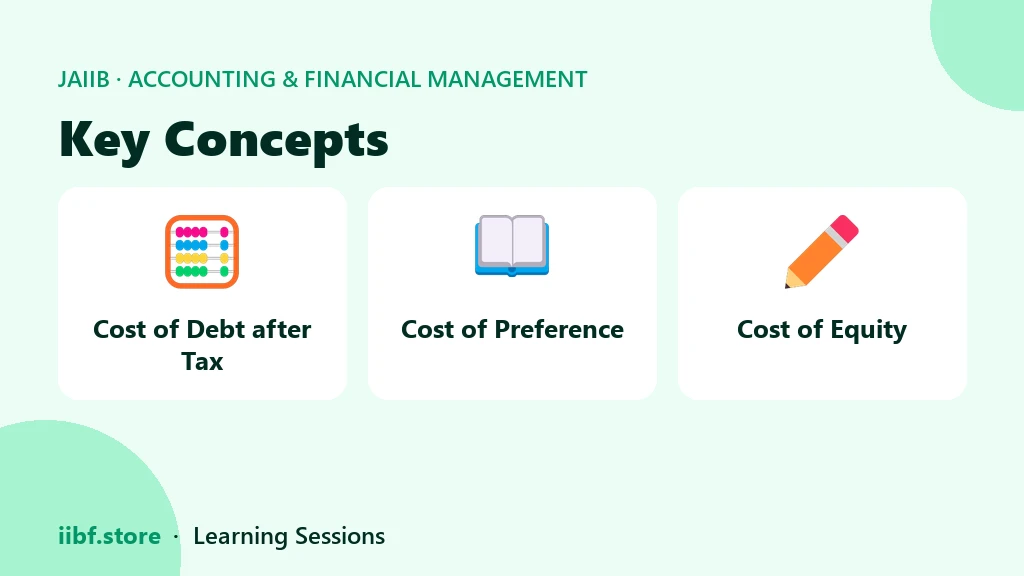
Cost of debt. Interest is allowed as a deduction while computing tax. So debt is cheaper than it looks. The after tax cost of debt is the interest rate multiplied by one minus the tax rate. If a company issues 12 per cent debentures at par and the tax rate is 30 per cent, the cost of debt is 12 multiplied by 0.70, which is 8.4 per cent. If the debentures are issued at a discount, divide the interest by the net proceeds instead of the face value.
Cost of preference shares. Preference dividend is not deductible for tax. So there is no tax shield here. The cost is the preference dividend divided by the net proceeds. A 10 per cent preference share of Rs 100 issued at par costs 10 per cent, plain and simple.
Cost of equity. This is the one that costs candidates marks, because there are two accepted routes and the question decides which one you use.
- The dividend growth route. Divide next year dividend by the current market price, then add the growth rate. A share priced at Rs 200 with an expected dividend of Rs 20 and steady growth of 4 per cent gives 10 plus 4, that is 14 per cent.
- The capital asset pricing route. Take the risk free rate, add beta multiplied by the market risk premium. With a risk free rate of 7 per cent, a beta of 1.2 and a premium of 6 per cent, the answer is 7 plus 7.2, that is 14.2 per cent.
Cost of retained earnings. Retained profit is not free either. Shareholders gave up a dividend for it, so its cost is treated as the cost of equity. Some questions reduce it slightly for tax and brokerage. Read the wording before you adjust anything.
Putting it together: the weighted average
The weighted average cost of capital, written as WACC, is the average of the component costs weighted by how much of each source the company uses. Weights may be taken on book values or on market values. The question always tells you which.
Here is a clean example. Solve it once and the pattern sticks.
| Source of funds | Amount (Rs lakh) | Weight | Component cost | Weighted cost |
|---|---|---|---|---|
| Equity share capital | 50 | 0.50 | 14.0 per cent | 7.00 |
| Preference share capital | 10 | 0.10 | 10.0 per cent | 1.00 |
| Debentures (after tax) | 40 | 0.40 | 6.0 per cent | 2.40 |
| Total | 100 | 1.00 | 10.40 |
The answer is 10.4 per cent. Any project this company takes up must return more than 10.4 per cent, otherwise the shareholders are worse off than before.
Two things trip people up in this table. First, the debenture cost must already be after tax before it enters the weighting. Do not apply the tax adjustment twice. Second, the weights must add up to one. If they do not, you have missed a source of funds or mixed book and market values.
The four moves that solve any question
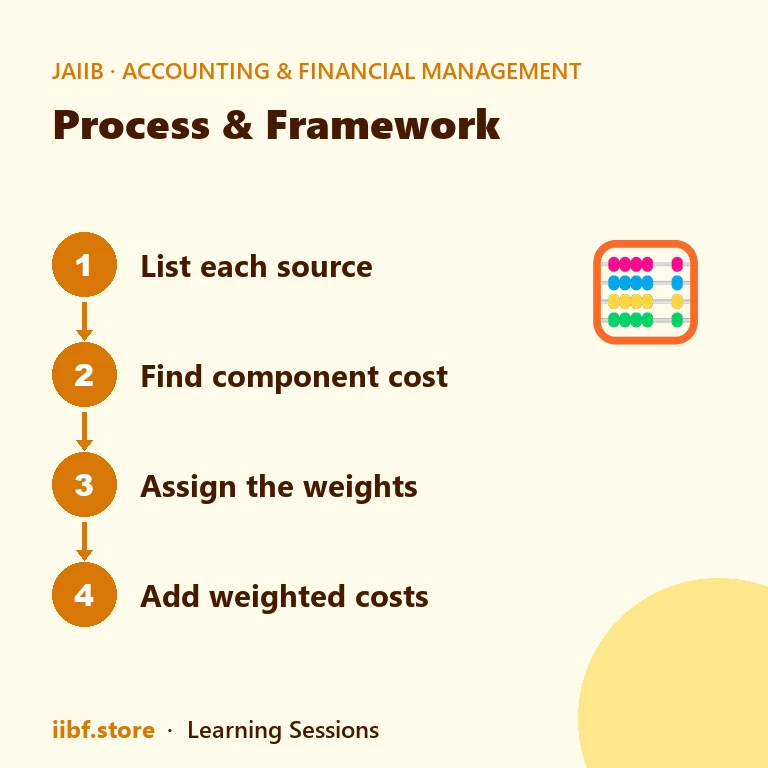
Whatever the wording, the method never changes.
- List every source of funds given in the question.
- Find the component cost of each one, remembering the tax shield on debt only.
- Work out the weight of each source, using the basis the question names.
- Multiply, add, and state the answer as a percentage.
Draw the five column table every single time, even when the numbers look easy. It takes fifteen seconds and it stops the one error that ruins the answer, which is a missing weight.
Watch out for the marginal cost of capital as well. That is the cost of the next rupee raised, not the average of what has already been raised. If a question says the company plans to raise fresh funds in a stated proportion, use those proportions as the weights.
Where this connects in the syllabus
The cost of capital is not an island. It feeds straight into capital budgeting, because the discount rate you use for net present value is usually the weighted average you just calculated. It also links to capital structure, since changing the mix of debt and equity changes the average.
Revise the three chapters together and the financial management portion of AFM becomes far lighter. Our JAIIB course sequences them in that order for exactly this reason. When you want timed practice, the mock tests carry numericals in the same style as the video. Build the schedule on the planner, keep an eye on current rates through the RBI rates page, and read more revision notes on the blog. Candidates moving on to the next level will find the same logic extended in Advanced Bank Management.
Frequently asked questions
Why is debt cheaper than equity?
Interest on debt is deductible while computing tax, so the government effectively pays part of it. Dividends carry no such deduction. Lenders also take less risk than shareholders, so they demand a lower return.
Should I use book value weights or market value weights?
Use whatever the question states. If it is silent, book value weights are the usual convention in the paper because the balance sheet figures are given. Market value weights are more realistic but need share prices.
Is the cost of retained earnings zero?
No. Shareholders forgo a dividend when profits are retained, so the company must still earn the equity return on that money. It is normally taken as equal to the cost of equity unless the question adjusts for tax or brokerage.
What is the difference between average and marginal cost of capital?
The average is calculated on the funds already in the balance sheet. The marginal cost applies to the next block of funds the company intends to raise, and it uses the proposed financing mix as the weights.
Prefer revising from a printed book?
Chapter-wise books with MCQs after every chapter — minimal pages, complete coverage, delivered anywhere in India. Every book has a free sample to read first.




















Quick quiz on this topic
5 exam-style questions from our free test bank — check yourself before you move on.
Practice this topic
Take a free mock test, download chapter PDFs, or watch a video class — all included on iibf.store.