Leasing for JAIIB AFM: Finance Lease vs Operating Lease Explained
If a firm can simply rent the machine, why would it ever buy one? That is the doubt the short video below opens with, and it is exactly what JAIIB AFM leasing questions are built on. Leasing looks like a two-page topic. It is not. It sits where accounting meets financial management, so the examiner can ask it as theory, as a journal entry, or as a plain numerical worth two marks.
Watch the clip first. Then read on, because this article takes the same idea and pushes it all the way to exam level.
Leasing concept for JAIIB AFM · Watch on YouTube
What a lease really is
A lease is a contract. One party owns an asset. The other party uses it and pays rent for a fixed period. That is the whole idea.
The owner is called the lessor. The user is called the lessee. The rent is called the lease rental. Legal ownership stays with the lessor unless the agreement says something different.
So why does a company lease instead of buying? There are three plain reasons, and the exam expects all three.
- It saves cash on day one. No large outflow, no big loan.
- It shifts the risk of the asset becoming outdated to the lessor.
- Lease rent is a business expense, so it reduces taxable profit.
You meet this every day at a branch counter. A transport operator leases his trucks. A hospital leases its scanners. A young company leases almost everything because it cannot lock up capital. When you appraise such a borrower, you have to know whether the lease sits on the balance sheet or hides inside the profit and loss account. That single check changes the debt-equity ratio you report.
Finance lease versus operating lease
One line decides most of the marks here. Read it twice.
A finance lease transfers substantially all the risks and rewards of ownership to the lessee. The legal title may pass at the end, or it may not. That is not the test. The test is who carries the risk and who enjoys the reward.
An operating lease does the opposite. The lessor keeps the risk. The lessee simply uses the asset for a while and hands it back. Think of a car hired for a month.
Accounting Standard 19 on leases sets out this split, and it is the standard the AFM syllabus follows. Companies that report under Ind AS follow Ind AS 116 instead, where almost every lease comes on to the books of the lessee. For your paper, stay with the classic split unless the question clearly says Ind AS.
| Point of difference | Finance lease | Operating lease |
|---|---|---|
| Risk and reward | Passes to the lessee | Stays with the lessor |
| Lease period | Covers most of the useful life | Much shorter than the useful life |
| Cancellable | Normally not cancellable | Usually cancellable |
| Asset in lessee books | Shown as an asset with a matching liability | Not shown at all |
| Depreciation charged by | Lessee | Lessor |
| Repairs and insurance | Lessee bears them | Lessor bears them |
| Typical example | Machinery taken for its full working life | A car or a photocopier hired for a year |
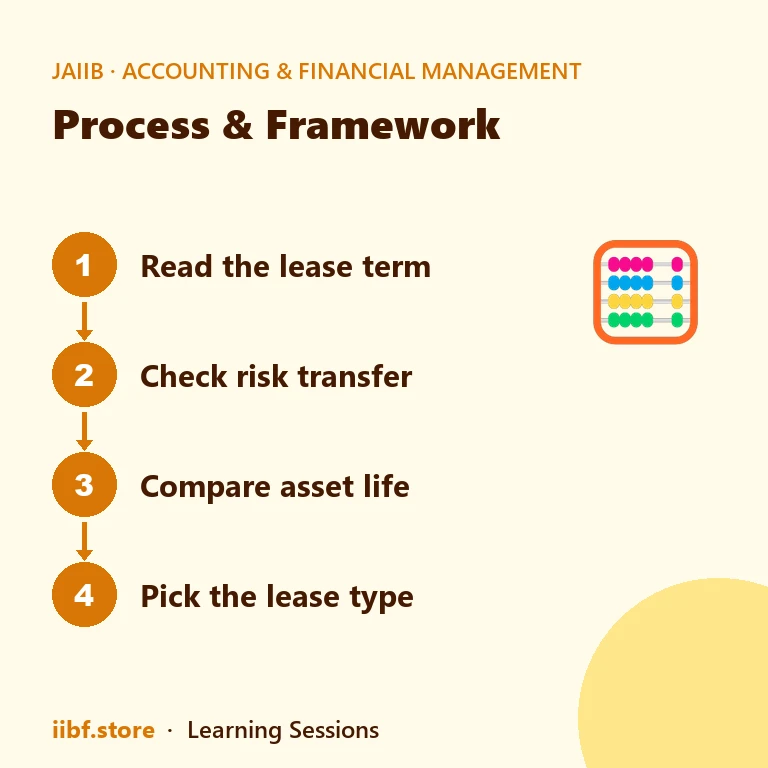
Notice the pattern. Once you decide the lease is a finance lease, the lessee behaves almost like an owner. It records the asset, it charges depreciation, and it splits every rental into interest and principal. In an operating lease the lessee does none of that. It just debits rent.
A worked example you can copy in the hall
Take a simple case. A firm leases a machine on 1 April. The fair value of the machine is Rs 5,00,000. The lease runs for five years, which is also the useful life of the machine. The firm pays Rs 1,30,000 at the end of each year and keeps the machine at the end for a token amount.
Is this a finance lease? Yes. The term covers the entire useful life, the firm keeps the asset, and the firm carries every risk. So the treatment follows.
- The lessee records the machine at Rs 5,00,000 and records a lease liability of the same amount.
- Depreciation is charged by the lessee. On a straight line basis that is Rs 1,00,000 a year.
- Total payments are Rs 6,50,000. The excess of Rs 1,50,000 over the recorded value is finance charge, spread across the five years.
- Each rental is therefore split. Part reduces the liability. Part goes to the profit and loss account as interest.
Change one fact and the answer flips. Say the same machine is taken for only one year and returned. Now it is an operating lease. The lessee shows nothing on the balance sheet. It simply debits Rs 1,30,000 as lease rent. The lessor keeps the asset and charges the depreciation.
That flip is the favourite trick in JAIIB AFM leasing questions. The numbers stay the same. Only the term changes. If you read the term and the risk carefully, you will never lose these marks.
Other lease terms the paper likes
A few more names turn up in objective questions. Learn them once and move on.
Sale and lease back. A company sells an asset and immediately takes it back on lease. It raises cash without losing the use of the asset. Branches see this with commercial property.
Leveraged lease. Three parties are involved. The lessee, the lessor, and a lender who funds most of the purchase price for the lessor.
Direct lease. The lessor buys the asset and leases it out directly to the user.
Wet lease and dry lease. Common in aviation. A wet lease includes crew, maintenance and insurance. A dry lease is the bare aircraft.
Hire purchase. Not a lease at all, though it is always asked alongside. In hire purchase the buyer owns the asset once the last instalment is paid, and the buyer charges depreciation from the start. In a lease, ownership normally stays with the lessor.
How to revise this in ten minutes
Do not read the chapter again. Do this instead.
Most JAIIB AFM leasing questions reward clean recall rather than long calculation, so build the recall first.
Write the seven rows of the comparison table on one card. Then write the four step classification method under it. Then solve two numericals, one finance and one operating, using the same figures. When both give you the right answer without a pause, the topic is done.
Pair it with the ratio chapter, because a finance lease adds to both assets and liabilities and therefore moves the debt-equity ratio. Examiners enjoy that link. Our full JAIIB course keeps these two chapters next to each other for the same reason. When you want to check yourself under time pressure, run a set on the mock test page, and build the rest of your week on the study planner. For quick term recall, the match game works better than rereading notes, and more revision write-ups sit on the blog.
Frequently asked questions
Is leasing an important topic for JAIIB AFM?
Yes. JAIIB AFM leasing is short, it is formula light, and it repeats. Most papers carry at least one question on the difference between a finance lease and an operating lease, and often a small numerical on lease rentals or depreciation.
Who charges depreciation on a leased asset?
In a finance lease the lessee charges depreciation, because the lessee carries the risks and rewards of ownership. In an operating lease the lessor charges it, since the asset stays in the lessor books.
What is the difference between a lease and hire purchase?
In hire purchase the user becomes the owner after paying the final instalment and claims depreciation from the beginning. In a lease the ownership normally remains with the lessor, and the lessee claims the rent as an expense.
Which accounting standard covers leases in the AFM syllabus?
Accounting Standard 19 deals with leases and gives the finance lease and operating lease classification used in the paper. Companies reporting under Ind AS apply Ind AS 116, where the lessee brings almost every lease on to the balance sheet.
Prefer revising from a printed book?
Chapter-wise books with MCQs after every chapter — minimal pages, complete coverage, delivered anywhere in India. Every book has a free sample to read first.























Quick quiz on this topic
5 exam-style questions from our free test bank — check yourself before you move on.
Practice this topic
Take a free mock test, download chapter PDFs, or watch a video class — all included on iibf.store.