Minimum Amount Due on a Credit Card: Why Paying It Is Not Enough
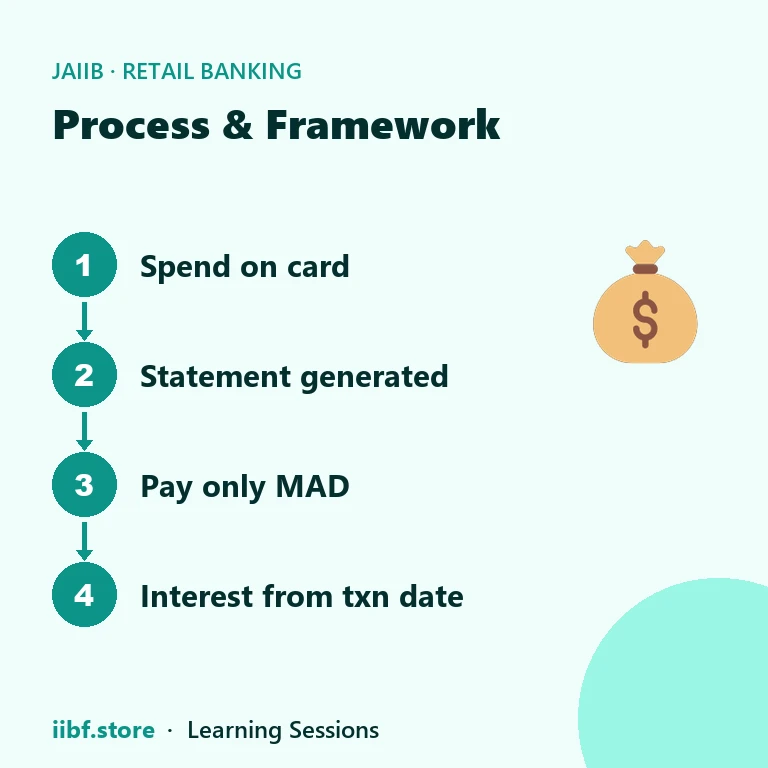
Ramesh is a farmer. His crop has not been sold yet, money is needed at home, and he has a credit card lying in his wallet. So he spends ₹50,000 on the card and tells himself he will settle it once the crop money arrives. A month later the statement lands and it carries two numbers: a total amount due of ₹50,000 and a minimum amount due of ₹2,500. Ramesh pays the ₹2,500 on time, feels rather responsible about it, and then opens the next statement to find a large interest charge staring back at him. That single moment is where most cardholders learn — expensively — what the minimum amount due actually buys you.
Spend ₹50,000, pay ₹2,500 — the credit card trap explained · Watch on YouTube
What the minimum amount due really is
The Reserve Bank of India's Master Direction – Credit Card and Debit Card – Issuance and Conduct Directions, 2022, in force since 1 July 2022, defines it plainly. The minimum amount due is "the minimum amount of money, as a part of the total bill amount, that a cardholder has to pay to not be treated as an overdue bill." Read that definition twice, because every word in it is doing work. It says the bill will not be classified as overdue. It says nothing at all about the debt being settled, and it says nothing about interest being waived.
Ramesh read the phrase the way almost everyone reads it: as the amount the bank is asking him for this month. In reality it is the amount the bank needs to keep his account out of the delinquency bucket while the remaining ₹47,500 quietly converts into an interest-bearing loan. The card issuer is not being deceptive — the figure is disclosed exactly as the regulator requires. The misreading happens in the customer's head, and it happens because the smaller number is printed right next to the larger one.
Where the interest-free credit period disappears
A credit card's headline attraction is the interest-free credit period — the stretch from the date of a transaction to the payment due date during which you can borrow the bank's money at zero cost. The Master Direction is precise about the condition attached to it: that free period applies "subject to the payment of entire outstanding on or before the payment due date by the cardholder."
Miss that condition and the consequence is not proportionate, it is total. In the RBI's own words, if a cardholder does not clear the total amount due within the payment due date, the interest-free credit period is lost, and interest may be levied from the date of the transaction on the outstanding amount, adjusted for payments, refunds and reversed transactions as and when credited — and not on the total amount due. Two details in that sentence are worth memorising. First, interest is backdated to the day you swiped, not the day you defaulted. Second, it is charged on the running outstanding, which is why the arithmetic never matches the rough estimate people make in their heads.
Apply it to Ramesh. He spent ₹50,000 on, say, the 3rd of the month and paid ₹2,500 on the due date. His interest clock did not start on the due date; it started on the 3rd, on the full ₹50,000, and then continued on roughly ₹47,500 after his payment landed. If his card's Most Important Terms and Conditions disclose a rate of 3.5% per month — a rate you must check on your own card rather than assume — the first partial cycle alone costs him a four-figure sum before he has bought anything new. Nobody sold him a loan. He wrote himself one.
Ramesh versus Suresh: same spend, different behaviour
Suresh, Ramesh's friend, spends the identical ₹50,000 in the identical billing cycle and receives a statement with the identical ₹2,500 minimum amount due printed on it. Suresh pays the whole ₹50,000 before the due date. Same card, same limit, same merchant, same regulator. The only variable is behaviour, and the outcome gap is enormous.
| Particular | Ramesh (pays MAD) | Suresh (pays TAD) |
|---|---|---|
| Amount spent | ₹50,000 | ₹50,000 |
| Minimum amount due on statement | ₹2,500 | ₹2,500 |
| Amount actually paid by due date | ₹2,500 | ₹50,000 |
| Interest-free credit period | Lost | Retained in full |
| Interest charged from | Date of transaction | Nil |
| Fresh spends next cycle | Also attract interest immediately | Interest-free again |
| Reported as overdue | No | No |
| Effective nature of the card | High-cost revolving loan | Free 30–50 day payment tool |
Notice the last row of that table. The card was not the villain and the bank did not cheat anybody. As the video puts it, the defect was not in the card — it was in the behaviour. The same plastic behaves as a free payment mechanism for Suresh and as one of the most expensive unsecured loans in the retail market for Ramesh.
What the RBI makes your card issuer print
The regulator anticipated this misunderstanding and built consumer protections directly into the Master Direction. A few of them are worth knowing, both as a customer and as a candidate:
- The compulsory warning. Every billing statement must prominently display the legend that "making only the minimum payment every month would result in the repayment stretching over months/years with consequential compounded interest payment on your outstanding balance." If you have never noticed it, look again — it is on your statement.
- No capitalisation of charges. "The unpaid charges/levies/taxes shall not be capitalized for charging/compounding of interest." Fees and GST cannot be folded into the principal and then charged interest on.
- A three-day cushion before reporting. Card issuers report a credit card account as 'past due' to credit information companies only when it remains past due for more than three days. A payment that slips by a day is not automatically a credit-bureau event.
- Billing cycle flexibility. Cardholders must be given a one-time option to modify the billing cycle of the card as per their convenience — useful if your salary credit and your due date are permanently out of sync.
- Activation consent. If a card is not activated for more than 30 days from issuance, the issuer must seek OTP-based consent, and failing confirmation, close the account free of cost within seven working days.
Why this matters for JAIIB and for the counter
Card conduct sits squarely inside Retail Banking and Wealth Management, and the examiner's favourite trick on this topic is exactly the trap Ramesh fell into: a question that describes a partial payment and asks from which date interest is levied. The answer is the date of the transaction, not the due date and not the statement date. A second frequent variant asks whether paying the minimum amount due keeps the account out of 'overdue' classification — it does — while a third asks whether it preserves the interest-free credit period — it does not. Candidates who blur those three dates lose marks that require no calculation at all.
There is a customer-facing dimension too. A branch officer who can explain, in one clean sentence, that the minimum amount due protects your credit record but not your wallet will prevent more grievances than any amount of after-the-fact complaint handling. If you want to build that habit systematically, work through the retail banking modules on the JAIIB course page, then pressure-test yourself with the topic-wise sets in the practice test section. Candidates preparing the associate level alongside it will find the same conduct rules echoed in the CAIIB syllabus, and the study planner is the easiest way to slot a short revision block for card and payment-system rules into a working banker's week. Current policy rates that feed into pricing discussions are tracked on the RBI rates page, and the primary text itself is always available on the RBI website.
The one-line rule worth remembering
Treat the total amount due as your bill and the minimum amount due as an emergency brake you pull only when you genuinely cannot pay in full — and even then, pay as much above the minimum amount due as you can, because interest runs on whatever is left. Used that way, a credit card is a 30-to-50 day interest-free line that costs nothing. Used the other way, it is a loan you never consciously applied for, priced far above anything a bank would have formally sanctioned to you. Ramesh and Suresh had the same card. Only one of them read the statement properly. More explainers like this one are published regularly on the iibf.store blog.
Does paying the minimum amount due mean my credit card bill is paid?
No. It only means the bill is not treated as overdue. The unpaid balance stays outstanding, the interest-free credit period is lost, and interest can be levied from the date of each transaction on the outstanding amount.
From which date does interest start if I pay only the minimum amount due?
From the date of the transaction, not from the payment due date. RBI's Master Direction on Credit Card and Debit Card Issuance and Conduct, 2022, states that interest may be levied from the transaction date on the outstanding amount, adjusted for payments, refunds and reversed transactions.
Will my credit score drop if a card payment slips by one day?
Not automatically. Card issuers report a credit card account as 'past due' to credit information companies only when the account remains past due for more than three days. That said, the interest consequence begins the moment the total amount due is not cleared by the due date.
Can the bank charge interest on the GST and fees on my card statement?
No. The Master Direction is explicit that unpaid charges, levies and taxes shall not be capitalised for charging or compounding of interest. If your statement shows otherwise, raise it with the card issuer and escalate through the internal grievance channel.
Quick quiz on this topic
5 exam-style questions from our free test bank — check yourself before you move on.
Practice this topic
Take a free mock test, download chapter PDFs, or watch a video class — all included on iibf.store.
Keep reading