Estate Planning for Bank Customers: Wills, Nomination, Succession
Estate planning for bank customers is the corner of JAIIB RBWM Module D that separates candidates who memorise from candidates who understand, because it forces you to keep three ideas apart: who holds the money, who receives the money, and who owns the money. A survivor holds. A nominee receives. Only a legatee under a will or a legal heir under succession law owns.
Almost every RBWM question on wills, nomination, succession certificates, trusts, gift deeds and HUF is a disguised test of that hierarchy. This guide walks the branch-level reality — the forms, the sections, the documents a claimant actually puts on your desk — and then gives you five exam-standard MCQs.
🏦 What Estate Planning Covers in Retail Banking
Estate planning for bank customers is the ordered transfer of a person's assets and liabilities to intended beneficiaries, during life or on death, at the lowest cost in tax, time and litigation. For a retail bank the customer's estate is rarely just a savings balance — it is term deposits, a locker, mutual fund and demat holdings, insurance policies, PPF and NPS balances, a house, and often an outstanding loan.
The four objectives you should be able to list in an exam answer are:
- Transmission without dispute — a clear, documented route from the deceased to the beneficiary.
- Liquidity for dependants — cash available in the weeks after death, not after a two-year suit.
- Tax efficiency — India has no estate duty today, but income from inherited assets, clubbing rules and Section 56(2)(x) on gifts still bite.
- Continuity — for a business, an HUF or a minor beneficiary.
The bank's own role sits under trusteeship, executorship and wealth advisory, which the syllabus treats under other financial services provided by banks. Note the boundary carefully: a bank may act as executor or trustee where its constitution permits, may safe-keep a will, and may advise — but it cannot itself decide who inherits.
Estate planning also interacts with protection products. A term policy or a family floater bought alongside the account is part of the plan, which is why health insurance products for bank customers and estate documentation are examined in the same module.
📝 Wills, Codicils and Probate
A will is a legal declaration of a person's intention regarding their property, taking effect on death and revocable until then. It is governed by the Indian Succession Act, 1925 for Hindus, Buddhists, Sikhs, Jains, Christians and Parsis. Muslims are governed by personal law, under which testamentary power is limited to one-third of the net estate unless the other heirs consent.
Execution requirements you must remember
- The testator must be of sound mind and not a minor (Section 59).
- Under Section 63, an unprivileged will must be signed by the testator and attested by two or more witnesses, each of whom has seen the testator sign.
- A beneficiary should not be an attesting witness — the bequest to that witness can fail even though the will survives.
- Registration is optional under the Registration Act, 1908. An unregistered will is perfectly valid; registration only adds evidentiary comfort.
- Stamp duty is not payable on a will.
A codicil is an instrument that explains, alters or adds to a will and must be executed with the same formalities. A later will revokes an earlier inconsistent one; marriage revokes a will for Christians and Parsis but not for Hindus.
Probate is a certified copy of the will granted by a competent court with a grant of administration to the executor. It is compulsory only in limited situations — broadly, wills made by Hindus, Buddhists, Sikhs and Jains within the territories of the erstwhile presidency towns of Kolkata, Chennai and Mumbai, or relating to immovable property there. Where there is a will but no named executor, the court issues letters of administration with the will annexed; where there is no will at all, plain letters of administration.
💡 Exam Tip: Probate authenticates a will; letters of administration appoint someone to administer an estate; a succession certificate only authorises collection of debts and securities. Three different instruments, three different triggers — questions are usually built on that confusion.

⚖️ Nomination vs Succession: The Distinction That Decides Marks
This is the single highest-yield idea in estate planning for bank customers. Nomination for bank deposits flows from the Banking Regulation Act, 1949 — Sections 45ZA and 45ZB for deposit accounts, 45ZC and 45ZD for articles in safe custody, and 45ZE and 45ZF for locker contents.
A nominee is a trustee and receiver, not an owner. Payment to the nominee gives the bank a valid discharge; it does not extinguish the rights of legal heirs, who may recover from the nominee. The Supreme Court settled this for deposits in Ram Chander Talwar v. Devender Kumar Talwar (2010) and reiterated the principle for securities in Shakti Yezdani v. Jayanand Jayant Salgaonkar (2023): a nomination cannot displace succession law.
The Banking Laws (Amendment) Act, 2025 widened the facility, allowing a depositor to make up to four nominations — simultaneously with declared percentage shares for deposits, and successively for lockers and safe custody articles. Confirm your bank's notified date and the revised nomination forms before quoting it at a counter; the trusteeship principle itself is unchanged.
| Instrument | Governing law | Confers ownership? | What the bank gets |
|---|---|---|---|
| Nomination (deposits, lockers) | BR Act, 1949 — Sections 45ZA–45ZF | ❌ | Valid discharge on payment to nominee |
| Survivorship mandate (E or S, F or S) | Contract + RBI customer service norms | ❌ | Valid discharge to the surviving holder |
| Succession certificate | Indian Succession Act, 1925 — Sections 370–390 | ❌ (collection only) | Indemnity for paying the holder |
| Will with probate / letters of administration | Indian Succession Act, 1925 | ✅ | Court-authenticated title to distribute |
| Legal heir certificate | State revenue rules (Tahsildar) | ❌ | Identification of heirs for small claims |
Contrast insurance sharply: under Section 39 of the Insurance Act, 1938 as amended, where the nominee is the spouse, parent or child of the life assured, that person is a beneficial nominee and takes the proceeds absolutely. Same word, opposite consequence — deposits create a trusteeship, life insurance can create ownership.
⚠️ Common Mistake: Writing that "the nominee becomes the owner of the deposit". The nominee only obtains a good receipt. Ownership follows the will, or intestate succession under the Hindu Succession Act, 1956 / Indian Succession Act, 1925 / applicable personal law.
Customers can now register or change nominations through net banking and mobile apps, one of the quieter service wins covered under delivery channels in retail banking.
🏛️ Trusts, Gift Deeds and the HUF
Where nomination and wills are reactive, trusts and gifts move assets during the customer's lifetime — the proactive half of estate planning for bank customers.
Private and public trusts
A private trust — settlor, trustee, beneficiary, trust property, objects — is governed by the Indian Trusts Act, 1882. It is the standard answer for a special-needs child, a spendthrift heir or a minor, because the corpus is ring-fenced from the settlor's creditors and from probate delay. A public charitable or religious trust falls outside the 1882 Act and is governed by state public trust legislation and general charity law, with tax exemption depending on registration and compliance with the charitable-trust provisions of the Income Tax Act.
Gifts
Under Section 122 of the Transfer of Property Act, 1882, a gift is a voluntary transfer without consideration, requiring acceptance during the donor's lifetime. Section 123 is the operative rule for bankers: a gift of immovable property must be by a registered instrument attested by two witnesses; movable property may pass by registered instrument or by delivery. Muslim law recognises hiba on declaration, acceptance and delivery of possession, without registration.
Tax follows Section 56(2)(x) — gifts received from non-relatives beyond the prescribed threshold are taxable in the recipient's hands, while gifts from specified relatives, on the occasion of marriage, or under a will or inheritance are exempt. Where the gifted asset is a property, an independent valuation matters, which links directly to mortgage advice and valuation of real property. Always check for a subsisting charge first — a house financed through a loan against property in retail banking cannot be gifted free of the lender's mortgage.
HUF
A Hindu Undivided Family is created by operation of law, not by contract, and consists of all persons lineally descended from a common ancestor. The coparcenary is the inner circle holding a right by birth. After the Hindu Succession (Amendment) Act, 2005 — confirmed in Vineeta Sharma v. Rakesh Sharma (2020) — a daughter is a coparcener by birth on the same footing as a son, irrespective of whether her father was alive on the amendment date. The HUF holds its own PAN and files its own return; the Karta operates the bank account, and the mandate must record the Karta and adult coparceners correctly.
🧾 Death of a Depositor: The Banker's Documentation Drill
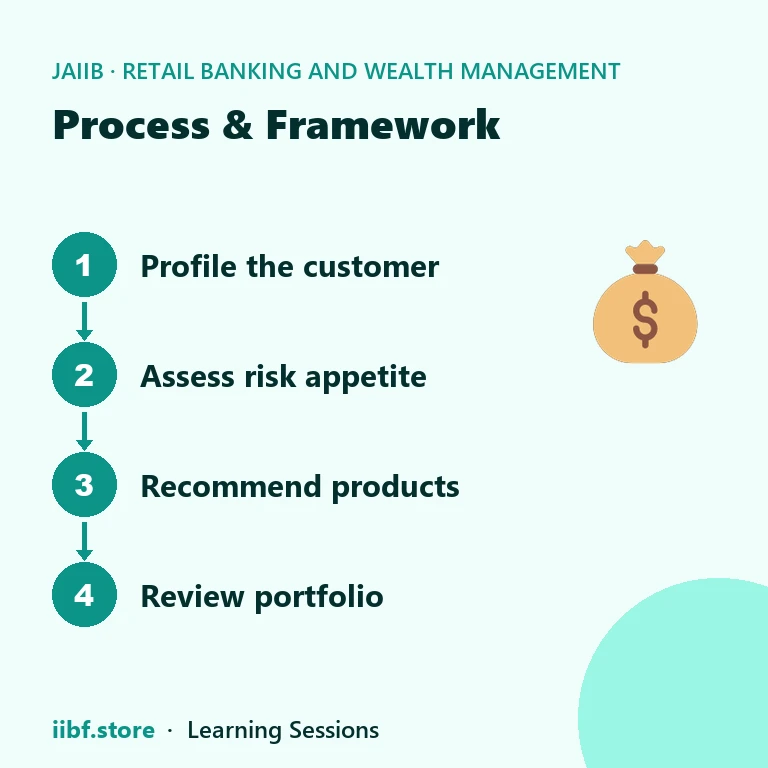
This is where estate planning for bank customers stops being theory. When a death is reported, the branch stops all debits except standing instructions already matured, records the date of death, and identifies which of three routes applies.
- Survivorship — for joint accounts with an "either or survivor", "former or survivor", "latter or survivor" or "anyone or survivor" mandate, the balance is paid to the survivor against proof of death and identification. A survivorship mandate also permits premature closure of a term deposit if the depositors so authorised.
- Nomination — where a valid nomination exists, payment goes to the nominee, again as a receiver. For a locker, the bank prepares an inventory in the presence of the nominee and two independent witnesses before handing over contents.
- Legal representation — where there is neither survivorship nor nomination, the bank looks for a will with probate, letters of administration, or a succession certificate. Below a threshold fixed by the bank's own Board, claims may be settled on an indemnity plus a legal heir declaration, without insisting on legal representation.
RBI's customer service framework expects claims of deceased depositors to be settled within 15 days of receipt of the claim with complete documents; banks must also pay interest on term deposits for the overdue period as per their policy. Unclaimed balances lying idle for ten years move to the Depositor Education and Awareness Fund, and heirs can trace them through RBI's UDGAM portal — a practical point examiners now expect you to know.
📌 Remember: A loan does not die with the borrower. The estate remains liable to its extent, guarantors stay bound, and the account continues to be classified per prudential norms — a fact worth pairing with your reading on credit scoring models in retail banking.
Document discipline here is exactly the same instinct that drives budgetary control in banks: a defined limit, a named approver, and a variance that gets reported rather than buried.
📌 Before the exam: estate planning for bank customers is examined as a documentation and duty-of-care topic, not as legal drafting. You are expected to separate a nominee's trusteeship from an heir's ownership, name the correct proof of title for each account type, and apply the death-claim settlement rules your bank has adopted under the customer-service directions issued by the Reserve Bank of India. In branch practice, estate planning for bank customers succeeds or fails on paperwork captured while the customer is alive - a registered will, a clean nomination, correct joint holding instructions. Candidates who can walk through estate planning for bank customers from account opening to claim settlement usually collect easy marks in the wealth-management module.
🧠 Practice MCQs: Wills, Nomination and Succession
Q1. Nomination in respect of bank deposit accounts is provided under which sections of the Banking Regulation Act, 1949? (a) Sections 45ZC–45ZD (b) Sections 45ZA–45ZB (c) Sections 45ZE–45ZF (d) Sections 370–390
Answer: (b) — 45ZA/45ZB cover deposits, 45ZC/45ZD safe custody articles and 45ZE/45ZF lockers; 370–390 belong to the Indian Succession Act.
Q2. Which instrument is granted by a District Judge and authorises the holder to collect the debts and securities of a deceased person, without by itself conferring ownership? (a) Probate (b) Letters of administration (c) Legal heir certificate (d) Succession certificate
Answer: (d) — a succession certificate under Sections 370–390 protects the debtor who pays, but does not adjudicate title.
Q3. Under Section 63 of the Indian Succession Act, 1925, an unprivileged will must be attested by at least how many witnesses? (a) Two (b) One (c) Three (d) Four
Answer: (a) — two or more witnesses, each having seen the testator sign or affix his mark.
Q4. As per RBI's customer service norms, claims in respect of deceased depositors should ordinarily be settled within how many days of receipt of the claim with complete documents? (a) 7 days (b) 10 days (c) 15 days (d) 30 days
Answer: (c) — 15 days, subject to proof of death and satisfactory identification of the claimant.
Q5. Under Section 39 of the Insurance Act, 1938, a nominee who is the spouse, parent or child of the life assured is: (a) required to obtain probate before claiming (b) a mere trustee for the legal heirs (c) entitled to only one-third of the proceeds (d) a beneficial nominee entitled to the proceeds
Answer: (d) — insurance creates a beneficial nomination for close family, unlike a bank deposit nomination, which is only a trusteeship.
Want chapter-wise mock tests with 100+ MCQs? Start practising free →
❓ Frequently Asked Questions
Does a nomination override a will?
No. A nomination decides who the bank may pay; a will decides who owns. If the nominee and the legatee differ, the bank still gets a valid discharge by paying the nominee, but the legatee can recover the amount from the nominee.
Is an unregistered will valid in India?
Yes. Registration of a will is optional under the Registration Act, 1908. Validity depends on the testator's capacity and on execution under Section 63 — signature plus attestation by two witnesses. Registration only strengthens evidence of genuineness.
When will a bank insist on a succession certificate?
Typically when there is no survivorship mandate and no nomination, and the claim exceeds the threshold that the bank's Board has fixed for settlement on indemnity. Within that threshold, a legal heir declaration with indemnity and surety is usually enough.
Can a depositor appoint more than one nominee?
The Banking Laws (Amendment) Act, 2025 permits up to four nominations — simultaneous with declared shares for deposits, and successive for lockers and safe custody articles. Use the nomination forms and effective date notified by your own bank.
🎯 Conclusion: Score This Chapter on Definitions, Not Feelings
Estate planning for bank customers rewards precision, not intuition. Fix the ladder in your head — survivorship pays, nomination receives, succession certificate collects, probate confirms title — and then attach the correct statute to each rung. Add the exceptions that examiners love: the beneficial nominee under insurance law, the Muslim one-third testamentary limit, the daughter's coparcenary right, and the registration requirement for gifts of immovable property.
Revise the full module through our retail banking and wealth management notes, then test yourself chapter by chapter on the JAIIB course. Twenty focused minutes on this topic is usually worth two or three marks in the paper.
Quick quiz on this topic
5 exam-style questions from our free test bank — check yourself before you move on.
Practice this topic
Take a free mock test, download chapter PDFs, or watch a video class — all included on iibf.store.
Keep reading