National Pension System for retail customers: JAIIB RBWM Guide
The National Pension System for retail customers is the one long-term product a branch officer is expected to explain end to end, because the bank is not merely selling it but is registered as a Point of Presence under the Pension Fund Regulatory and Development Authority (PFRDA). For the JAIIB Retail Banking and Wealth Management paper, questions on the National Pension System for retail customers rarely ask for returns. They ask about structure: which account is locked in, which asset classes exist, which section gives which deduction, and how much of the corpus must be converted into an annuity at exit. This guide walks through the architecture, the choices a subscriber makes, the tax treatment, and the exit rules, in the order an examiner tends to test them.
🏦 How the NPS Architecture Works and Where the Bank Sits
NPS is an unbundled, defined-contribution scheme. No single institution holds all the functions; each is separated so that record-keeping, fund management and custody stay independent. PFRDA is the regulator. The NPS Trust holds the assets on behalf of subscribers. Pension Funds (PFMs) manage the money under a scheme-wise mandate. A Central Recordkeeping Agency (CRA) maintains individual accounts and issues the Permanent Retirement Account Number (PRAN), a unique number that stays with the subscriber for life across employers, cities and banks. More than one CRA is licensed, and a subscriber may shift between them.
The bank enters this chain as a Point of Presence (POP), with branches acting as POP Service Providers. The POP performs KYC, on-boards the subscriber, uploads contributions, processes switch and withdrawal requests, and earns regulated fees for each. This is exactly the fee-based, low-capital income stream that the introduction of retail banking module treats as the core of the retail model, and it is why NPS sits on almost every branch's third-party product list alongside insurance and mutual funds.
Entry is open to Indian citizens, resident or non-resident, within the age band notified by PFRDA, which was widened some years ago to allow entry up to age 70 and continuation up to 75. A separate variant, NPS Vatsalya, allows a guardian to open an account for a minor, which converts into a regular Tier I account on the child attaining majority.
📌 Remember: PRAN is issued by the CRA, not by the bank. The bank is only the POP, the customer-facing distribution and servicing arm.
📊 Tier I and Tier II Compared With APY and EPF
Every subscriber has a Tier I account. It is the pension account proper: contributions are locked in until the normal exit age, withdrawals are restricted, and all the headline tax deductions attach to it. Tier II is a voluntary, add-on investment account that can only be opened by someone who already holds an active Tier I. It has no lock-in and no exit load, money can be withdrawn on demand, and it carries no tax deduction for the general subscriber. Central government employees get a narrow exception through a separate Tier II variant with its own lock-in.
Candidates constantly confuse NPS with the Atal Pension Yojana and with provident fund, so it helps to hold the four side by side. All three are retirement vehicles, but only NPS is fully market-linked and voluntary in contribution amount.
| Feature | NPS Tier I | NPS Tier II | Atal Pension Yojana | EPF |
|---|---|---|---|---|
| Who can join | Indian citizen within PFRDA age band | Only existing Tier I holders | Bank account holder aged 18-40, income-tax payers barred | Employees of covered establishments |
| Lock-in till retirement age | ✅ Yes | ❌ No | ✅ Yes, till 60 | ✅ Largely yes |
| Deduction on subscriber's own contribution | ✅ Yes, 80CCD(1) and 80CCD(1B) | ❌ No, for general subscribers | ❌ No dedicated section | ✅ Yes, under 80C |
| Returns | Market-linked, NAV based | Market-linked, NAV based | Defined pension amount | Rate declared each year |
| Annuity purchase compulsory at exit | ✅ Yes, minimum share of corpus | ❌ No | ✅ Built into the design | ❌ No |
| Contribution amount | Voluntary, above a small minimum | Fully flexible | Fixed slab by auto-debit | Statutory percentage of wages |
Minimum contribution amounts for Tier I and Tier II are small and are revised by PFRDA from time to time, so quote the current circular rather than an old figure at the counter. A broader view of where such long-horizon savings products fit into household security is set out in our note on poverty and unemployment in India, which explains why a largely informal workforce needs a portable pension at all. More RBWM explainers are collected on the retail banking and wealth management tag page.
📈 Asset Classes E, C, G, A and the Auto Versus Active Choice
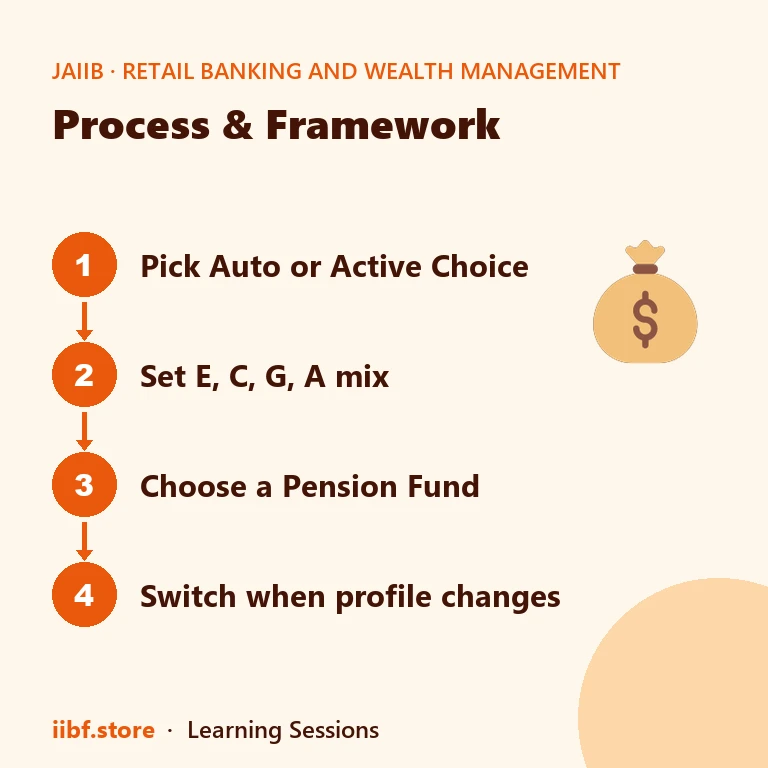
NPS money is invested across four asset classes. Class E is equity, largely index-linked. Class C is corporate debt. Class G is government securities. Class A is alternative investment funds, which is available only under Active Choice in Tier I and carries a small cap. The subscriber picks both a Pension Fund and an investment approach, and may change either within the frequency permitted by PFRDA.
Under Active Choice, the subscriber sets the percentage split himself, subject to ceilings: equity exposure in Tier I is capped well below 100 per cent, and that cap tapers with age beyond the fifties so that a subscriber approaching exit is not fully exposed to market risk. Class A carries the tightest ceiling of the four.
Under Auto Choice, allocation follows a lifecycle formula. Three lifecycle funds are offered, usually described as aggressive, moderate and conservative, distinguished by the starting equity percentage. In each, equity is highest at younger ages, and from the mid-thirties the system automatically shifts money from E and C into G every year, so the portfolio de-risks without the customer doing anything.
For a branch, the advisory point is simple: a customer who cannot articulate an asset-allocation view should be steered to Auto Choice. This is the same suitability discipline that applies when a branch sells any market-linked or contingent product, including health insurance products for bank customers, where the recommendation must follow the customer's profile and not the counter's incentive.
⚠️ Common Mistake: Assuming the equity cap applies to the whole NPS corpus. The ceilings are prescribed scheme-wise for Tier I; Tier II allocation rules differ, and Class A is not available in Tier II.
💰 Tax Treatment Under 80CCD(1), 80CCD(1B) and 80CCD(2)
Three sub-sections do the work, and mixing them up is the single most common error in this chapter.
Section 80CCD(1) covers the subscriber's own contribution to Tier I. The deduction is capped as a percentage of salary for the salaried and of gross total income for the self-employed, and it sits inside the overall Section 80C ceiling. It is therefore not additional money if the customer has already exhausted 80C with life insurance premia, provident fund and principal on a housing loan.
Section 80CCD(1B) is the additional deduction available exclusively for Tier I contributions, over and above the 80C ceiling. This is the genuinely incremental benefit, and it is the strongest selling argument for the National Pension System for retail customers who are already at their 80C limit.
Section 80CCD(2) covers the employer's contribution to the employee's Tier I account. It is not counted within the 80C ceiling, is capped as a percentage of salary, and the permitted percentage for central government employees is higher than for others, with the limit for private-sector employees having been raised in a recent Finance Act. Aggregate employer contributions to provident fund, superannuation and NPS above a prescribed annual ceiling become taxable in the employee's hands.
Regime choice matters. Under the concessional personal tax regime, deductions under 80CCD(1) and 80CCD(1B) are not available, but the employer contribution deduction under 80CCD(2) continues. At exit, the lump-sum portion of the Tier I corpus is exempt up to the prescribed share, while annuity income is taxed as income in the year of receipt. Because the slabs and percentages have moved more than once, confirm them against the current Finance Act before advising a customer, exactly as you would when discussing estate planning for bank customers.
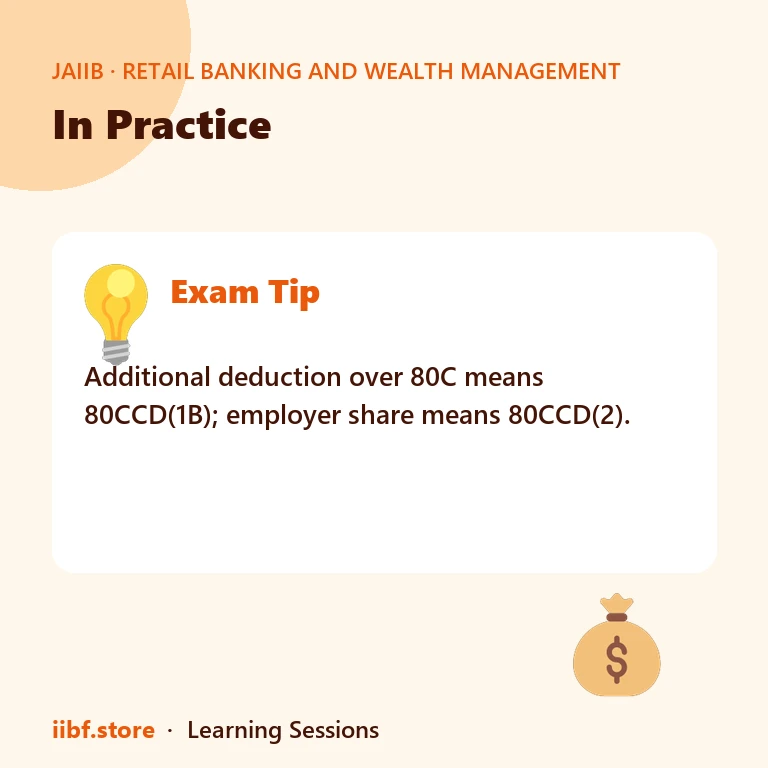
💡 Exam Tip: If the question says "over and above Rs 1.5 lakh" or "additional deduction", the answer is 80CCD(1B). If it says "employer's contribution", the answer is 80CCD(2).
🚪 Exit, Partial Withdrawal and the Annuity Requirement
On normal exit at the age of superannuation, only a minority share of the Tier I corpus can be taken as a lump sum; the balance must compulsorily buy an annuity from an Annuity Service Provider empanelled by PFRDA. The standard split requires at least 40 per cent of the corpus to go into an annuity, with up to 60 per cent withdrawable. A small-corpus relaxation allows full withdrawal without annuitisation where the accumulated amount is below a threshold notified by PFRDA.
Premature exit before the normal age reverses the proportions sharply: the compulsory annuity share rises to 80 per cent and only 20 per cent may be withdrawn, again subject to a lower small-corpus relaxation. Subscribers may also continue beyond 60, defer withdrawal, or draw the lump sum in instalments through a systematic lump-sum withdrawal facility up to the maximum permitted age.
Partial withdrawal is a separate right and is frequently tested. It is allowed only from the subscriber's own contributions, not from employer contributions or accumulated returns, only after a minimum period of membership, only for specified purposes such as higher education, marriage of children, purchase or construction of a house, or treatment of specified illnesses, and only a limited number of times over the life of the account.
On death of the subscriber, the nominee or legal heir receives the accumulated pension wealth, subject to the option rules applicable to government subscribers. Handling nomination correctly here is the same operational discipline that branch staff apply to deposits, as covered in the customer requirements chapter, and it decides whether a claim settles smoothly. NPS servicing volumes also feed fee income, which is why retail banking concepts treats third-party distribution as part of branch profitability, much like the credit card business in retail banking.
🧠 Practice MCQs: National Pension System
Q1. Which of the following is the mandatory pension account under NPS, carrying a lock-in and attracting the main tax deductions? (a) Tier II (b) Tier I (c) Tier III (d) The APY sub-account
Answer: (b) — Tier I is the pension account; Tier II is a voluntary, withdrawable investment account with no deduction for general subscribers.
Q2. Which asset class under NPS represents alternative investment funds and is available only under Active Choice in Tier I? (a) Class E (b) Class C (c) Class A (d) Class G
Answer: (c) — Class A is the alternative investment fund class, carries the tightest ceiling and is not offered in Tier II.
Q3. An additional deduction for Tier I contributions, over and above the overall Section 80C ceiling, is available under which provision? (a) Section 80C (b) Section 80CCD(1) (c) Section 80CCD(2) (d) Section 80CCD(1B)
Answer: (d) — 80CCD(1B) is the exclusive additional deduction; 80CCD(1) sits inside the 80C ceiling and 80CCD(2) covers employer contribution.
Q4. On normal exit at superannuation, what is the minimum share of the Tier I corpus that must be used to purchase an annuity, subject to the small-corpus relaxation? (a) 40 per cent (b) 20 per cent (c) 60 per cent (d) 80 per cent
Answer: (a) — At least 40 per cent must be annuitised and up to 60 per cent may be withdrawn as a lump sum.
Q5. A bank branch that completes KYC, on-boards an NPS subscriber and uploads contributions is functioning as the (a) Central Recordkeeping Agency (b) Pension Fund (c) NPS Trust (d) Point of Presence
Answer: (d) — The bank acts as a Point of Presence; the PRAN is issued by the CRA and the assets are held by the NPS Trust.
Want chapter-wise mock tests with 100+ MCQs? Start practising free →
Can a customer open an NPS Tier II account without a Tier I account?
No. Tier II is an add-on facility. The customer must first have an active Tier I account and a valid PRAN, after which Tier II can be activated through the bank as Point of Presence.
Does the subscriber lose the PRAN on changing jobs or banks?
No. The PRAN is portable across employers, sectors and locations, and the account continues with the same number. The subscriber can also shift the servicing Point of Presence or move between Central Recordkeeping Agencies.
Is NPS better than the Atal Pension Yojana for a customer?
They serve different segments. APY offers a defined pension amount to lower-income, non-taxpaying customers within a narrow entry age band, while NPS is market-linked, open to a wider age range and allows the subscriber to choose the fund and asset mix.
Are the withdrawal proceeds from NPS taxable?
The lump-sum portion of the Tier I corpus permitted at exit is exempt up to the prescribed share, while the annuity received later is taxed as income in the year of receipt. Confirm the current position against the latest Finance Act before advising.
🎯 Conclusion and Study Plan
For the RBWM paper, treat the National Pension System for retail customers as four blocks: the unbundled architecture with PFRDA, NPS Trust, CRA, PFM and the bank as POP; the Tier I versus Tier II distinction; the E, C, G, A asset classes with Auto and Active Choice; and the 80CCD family with the exit and annuity rules. Learn the proportions at exit, because those are the numbers examiners set questions on. Then test yourself against the full chapter bank on iibf.store mock tests and revise the surrounding syllabus through the JAIIB course before the exam.
Source and further reading: PFRDA and the Indian Institute of Banking & Finance.
Quick quiz on this topic
5 exam-style questions from our free test bank — check yourself before you move on.
Practice this topic
Take a free mock test, download chapter PDFs, or watch a video class — all included on iibf.store.
Keep reading