Data Analytics for Customer Segmentation: CAIIB ITDB Guide
Banks today sit on mountains of data. This includes transaction records, demographic details, and behavioural patterns. Data analytics for customer segmentation turns that raw information into products people actually want. This is a high-yield topic for CAIIB's Information Technology and Digital Banking (Elective) paper. Examiners test the statistical techniques — RFM, clustering, and decision trees. They also test how segmentation feeds cross-sell, retention, and risk-based pricing. This guide walks through the models. It also covers the data pipeline behind them and the governance rules banks must follow when they group customers.
📊 What Is Customer Segmentation Analytics in Banking?
Customer segmentation analytics divides a bank's entire customer base into smaller groups. Each group shares common traits, such as income, transaction behaviour, product holding, digital-channel usage, or life stage. A bank should not treat a salaried millennial and a retired pensioner the same way. Instead, it builds distinct segments — mass retail, mass affluent, NRI, MSME, and senior citizen. It then designs offers, service levels, and even branch staffing around each segment.
This discipline sits at the intersection of statistics, IT infrastructure, and business strategy. That is exactly why CAIIB's ITDB elective tests it alongside core IT concepts. A solid grounding in the Essentials of Information Technology chapter helps here. Segmentation models are only as good as the systems that capture and structure the underlying data. This data includes core banking transaction logs, card-swipe records, UPI payment history, net-banking clickstreams, and CRM notes from branch staff.
Segments are typically built along four axes. Demographic axes cover age, income, and occupation. Behavioural axes cover spend pattern, channel preference, and product usage. Geographic axes cover urban, semi-urban, or rural location, along with state and pin code. Value-based axes cover profitability, lifetime value, and risk grade. Most modern banks combine two or more axes. For example, a "high-value, digital-first, urban" segment gets different marketing treatment than a "low-balance, branch-dependent, rural" one. Exam questions often test whether you can classify a scenario into one of these four bases. So memorise the distinctions, not just the definitions.
🧮 Segmentation Techniques: RFM, Clustering, and Predictive Models
The oldest and still most widely tested technique is RFM analysis. It scores each customer on three factors: Recency (how recently they transacted), Frequency (how often), and Monetary value (how much). RFM is rule-based and easy to explain to business teams. That is why it remains popular for quick campaign targeting, even in 2026.
Modern banks layer machine-learning methods on top of RFM. K-means clustering is an unsupervised technique. It groups customers into clusters purely from patterns in the data, without predefined rules. This is useful when a bank does not yet know what segments exist. Decision-tree and CHAID-based segmentation work differently. These are supervised techniques that split customers based on a target outcome, such as likelihood to close a fixed deposit. They produce rules a relationship manager can act on directly. This topic overlaps closely with the sibling topic of data analytics for fraud detection. That topic uses similar algorithms — clustering, decision trees, anomaly scoring — but points them at suspicious behaviour instead of buying behaviour.
Every technique depends on structured, queryable data underneath it. This is the role of the Database Management Systems chapter. A bank's data warehouse normalises transaction, KYC, and product data from dozens of source systems. It organises this data into tables that segmentation models can query efficiently. Without a well-designed DBMS layer, even the best clustering algorithm produces unreliable segments.
The table below compares the four techniques. A CAIIB candidate should be able to tell them apart at a glance:
| Technique | Type | Basis | Best For | Real-Time Capable |
|---|---|---|---|---|
| RFM Analysis | Rule-based | Recency, Frequency, Monetary value | Quick campaign targeting | ✅ |
| K-Means Clustering | Unsupervised ML | Pattern similarity across variables | Discovering unknown segments | ❌ |
| Decision Tree / CHAID | Supervised ML | Split against a target outcome | Actionable RM-facing rules | ❌ |
| Predictive/Behavioural Scoring | Supervised ML | Propensity models on live transaction feed | Next-best-offer, real-time nudges | ✅ |
💡 Exam Tip: A question may ask which technique needs no predefined labels or target variable. The answer is almost always K-means, or another clustering method. It is unsupervised by definition.
🌐 Building the Data Pipeline: Core Banking, Networking, and Cloud
Segmentation models are only as fresh as the pipeline feeding them. Data originates in the core banking system. It is then captured across the bank's Networking Systems as it moves between branches, data centres, and payment switches. The data is loaded into an analytics environment — often nightly, and increasingly in near-real-time. UPI, card, and net-banking logs add high-frequency behavioural signals. RFM and clustering models consume these signals directly. Many banks now run this pipeline on managed cloud infrastructure rather than on-premise servers. Elastic compute makes it cheaper to retrain clustering models weekly instead of quarterly. For the fuller picture of how banks structure this shift, see the sibling guide on cloud computing in banking. It covers the deployment models — public, private, and hybrid — that examiners expect you to know.
A practical pipeline typically has four stages. Extraction pulls data from core banking, CRM, and channel logs. Transformation cleans, deduplicates, and standardises the formats. Loading moves the data into a warehouse or data lake. Modelling then runs RFM, clustering, or predictive scoring on top. Data engineers monitor pipeline latency closely. A model trained on stale data — say, transaction history that is three weeks old — will misclassify customers. This happens when a customer has recently changed behaviour, such as getting a salary hike or closing an account.
API banking plays a growing role too. Many banks now pull enriched third-party signals through partner APIs. These signals include bureau scores, GST filings for MSME segments, and even utility-payment history. Together, they feed a wider and more accurate feature set into the segmentation model than transaction data alone could provide.
🎯 Business Impact: Cross-Sell, Retention, and Risk-Based Pricing
Segmentation is not an academic exercise. It drives measurable outcomes. Cross-sell teams use segments to decide who gets offered a credit card, a gold loan, or a mutual-fund SIP. This lifts conversion rates dramatically compared to blanket campaigns. Retention teams use "at-risk" segments to trigger proactive outreach before attrition happens. These are customers showing declining transaction frequency, a classic RFM signal.
Risk-based pricing is another major application. Segments built on repayment behaviour and bureau data feed directly into loan pricing decisions. This area overlaps with the broader credit management lifecycle taught under CAIIB's Advanced Bank Management paper. A "low-risk, high-value" segment might get a preferential interest rate. A "new-to-credit" segment gets a smaller ticket size with closer monitoring instead. In this way, segmentation output becomes an input to underwriting policy.
Branch and channel strategy also leans on segmentation. A bank might staff wealth-management RMs against the mass-affluent segment. It might route the mass-retail segment toward self-service digital channels instead. This optimises cost-to-serve across the customer base. Marketing spend is allocated the same way. A segment with high digital engagement and low branch visits gets app push notifications instead of a physical mailer. This cuts acquisition and retention cost per customer meaningfully.
⚠️ Common Mistake: Candidates often confuse segmentation with credit scoring. Segmentation groups existing customers for targeting. Credit scoring assesses an individual's creditworthiness. The two use overlapping data and techniques, but they answer different business questions. Don't conflate them in the exam.
🔐 Data Governance, Privacy, and RBI Expectations
Segmentation depends on profiling individuals using personal and transactional data. This places it squarely inside India's data-protection framework. Banks must collect and process customer data only with consent. This use must be limited to a specified purpose, and banks must be able to prove this if audited. Profiling a customer for a loan offer using data collected for a different, unrelated purpose is a compliance red flag. Examiners like to test this with scenario-based questions.
On the IT-governance side, the RBI's Master Directions on IT Governance, Risk, Controls and Assurance Practices apply here. They require banks to maintain data-quality controls, access logging, and model-validation processes. This applies to any analytics system that influences customer-facing decisions, including segmentation-driven pricing and offers. Internal audit teams periodically review two things. First, whether segmentation models are re-trained on schedule. Second, whether their outputs are free of proxy bias — for example, a pin-code variable acting inadvertently as a proxy for a protected characteristic.
Data lineage and storage design also matter here. A well-structured warehouse, built on the same database management systems principles covered in the ITDB syllabus, makes it far easier to prove which data fed which segment. This satisfies both RBI auditors and data-protection requirements at the same time.
📌 Remember: Every segmentation model needs three things in place before go-live: a documented consent basis, a data-quality check, and a periodic bias/accuracy review. Skipping any one is an audit finding waiting to happen.
For the full spread of ITDB topics — from networking to blockchain to RPA — browse the ITDB article archive on iibf.store.
🧠 Practice MCQs: Data Analytics for Customer Segmentation
Q1. RFM analysis segments customers based on which three parameters? (a) Recency, Frequency, Monetary value (b) Risk, Fraud, Margin (c) Region, Family, Metrics (d) Revenue, Feedback, Merger
Answer: (a) — RFM stands for Recency, Frequency, and Monetary value of a customer's transactions.
Q2. Which of the following is an unsupervised machine-learning technique commonly used for customer segmentation? (a) Linear regression (b) K-means clustering (c) A/B testing (d) Waterfall model
Answer: (b) — K-means clustering groups customers into clusters based on data patterns without pre-defined labels.
Q3. In a bank's analytics pipeline, the DBMS layer primarily supports customer segmentation by: (a) Encrypting UPI PINs (b) Storing and structuring transaction/customer data for query and analysis (c) Routing SWIFT messages (d) Rendering the mobile app UI
Answer: (b) — the database management system organises and stores the structured data that segmentation models query.
Q4. Segmenting customers by income, occupation, and life stage is an example of: (a) Behavioural segmentation (b) Demographic segmentation (c) Geographic segmentation (d) Psychographic segmentation
Answer: (b) — this is demographic segmentation, based on measurable population characteristics.
Q5. Under India's data-protection framework, banks profiling customers for segmentation must primarily ensure: (a) Segmentation models run only on weekends (b) Consent-based, purpose-limited processing of personal data (c) Free data sharing with fintech partners (d) Segmentation results are published publicly
Answer: (b) — consent and purpose limitation are core data-protection principles that apply to any customer profiling activity.
Want chapter-wise mock tests with 100+ MCQs? Start practising free →
What is customer segmentation analytics in banking?
It is the use of transaction, demographic, and behavioural data to divide a bank's customer base into distinct groups so that products, pricing, and communication can be tailored to each group instead of using a one-size-fits-all approach.
Which CAIIB paper covers customer segmentation analytics?
It is covered under the Information Technology and Digital Banking (Elective) paper, within the data analytics and management information systems portions of the syllabus.
What is the difference between RFM analysis and clustering?
RFM is a rule-based scoring method using recency, frequency, and monetary value, while clustering techniques such as k-means are machine-learning methods that group customers algorithmically from patterns in the data, without predefined rules.
Do banks need customer consent before using data for segmentation?
Yes. Under India's data-protection framework, banks must collect, process, and use personal data for segmentation only with consent and for a specified, legitimate purpose, and must be able to demonstrate this on audit.
Customer segmentation analytics turns scattered transaction and behavioural data into a working map. It shows who a bank's customers are and what they need next. CAIIB examiners return to this topic often, across MCQs and case-study questions. Build your command of RFM, clustering, and predictive scoring with structured practice. Take a free ITDB mock test or explore the complete CAIIB course on iibf.store to see how this topic connects to the rest of the syllabus.
Prefer revising from a printed book?
Chapter-wise books with MCQs after every chapter — minimal pages, complete coverage, delivered anywhere in India. Every book has a free sample to read first.
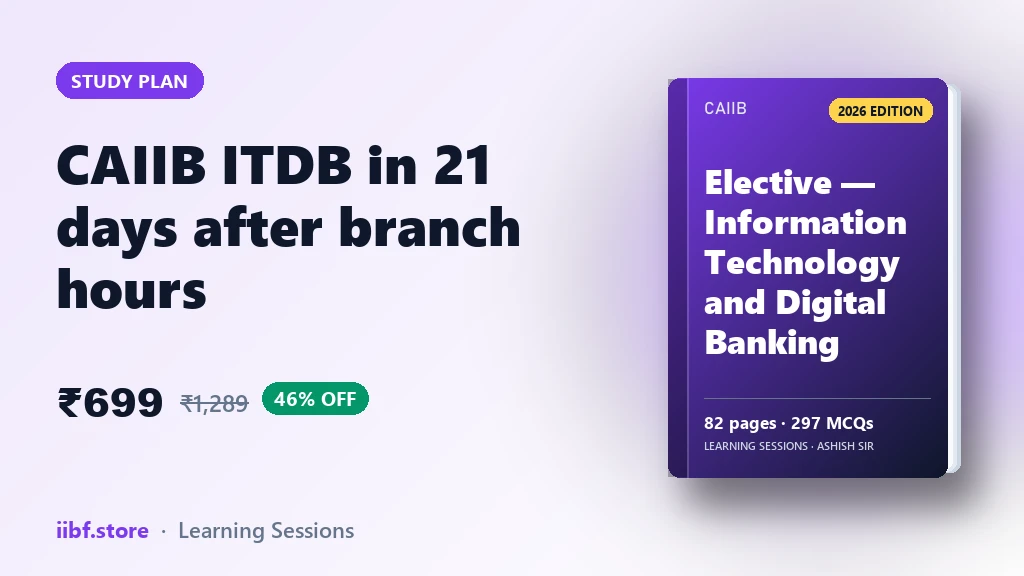
82 pages · 297 MCQs
Learning Sessions · Ashish Sir
148 pages · 478 MCQs
Learning Sessions · Ashish Sir
151 pages · 465 MCQs
Learning Sessions · Ashish Sir
148 pages · 375 MCQs
Learning Sessions · Ashish Sir
216 pages · 895 MCQs
Learning Sessions · Ashish Sir
109 pages · 300 MCQs
Learning Sessions · Ashish Sir
104 pages · 360 MCQs
Learning Sessions · Ashish Sir
151 pages · 600 MCQs
Learning Sessions · Ashish Sir
98 pages · 282 MCQs
Learning Sessions · Ashish Sir
131 pages · 672 MCQs
Learning Sessions · Ashish Sir
221 pages · 831 MCQs
Learning Sessions · Ashish Sir
128 pages · 524 MCQs
Learning Sessions · Ashish Sir
107 pages · 445 MCQs
Learning Sessions · Ashish Sir
132 pages · 225 MCQs
Learning Sessions · Ashish Sir
188 pages · 435 MCQs
Learning Sessions · Ashish Sir
117 pages · 236 MCQs
Learning Sessions · Ashish Sir
Learning Sessions · Ashish Sir
118 pages · 299 MCQs
Learning Sessions · Ashish Sir
Learning Sessions · Ashish Sir
Learning Sessions · Ashish Sir
Learning Sessions · Ashish Sir
115 pages · 255 MCQs
Learning Sessions · Ashish Sir
Learning Sessions · Ashish Sir
334 pages · 936 MCQs
Learning Sessions · Ashish Sir
Learning Sessions · Ashish Sir
115 pages · 344 MCQs
Learning Sessions · Ashish Sir
107 pages · 240 MCQs
Learning Sessions · Ashish Sir
90 pages · 150 MCQs
Learning Sessions · Ashish Sir
Learning Sessions · Ashish Sir
Quick quiz on this topic
5 exam-style questions from our free test bank — check yourself before you move on.
Practice this topic
Take a free mock test, download chapter PDFs, or watch a video class — all included on iibf.store.