Ethical Dilemmas in Banking: Types, Framework & IIBF Guide
Every banker eventually meets a moment where the rulebook goes quiet and judgment has to take over — that is the space where ethical dilemmas in banking live. IIBF's Ethics in Banking paper tests candidates not just on definitions but on how they reason through situations where customer interest, bank profitability, and personal integrity pull in different directions. This guide breaks down the common dilemma types, the institutional guardrails that exist, and a repeatable resolution framework you can apply both in the exam hall and at the branch counter.
🧭 What Are Ethical Dilemmas in Banking?
An ethical dilemma is not the same as a rule violation. A violation is a clear right-vs-wrong situation — taking a bribe, falsifying a KYC form, or hiding a loss. A dilemma is a right-vs-right (or right-vs-less-right) situation, where two legitimate values compete and no option is fully clean. A relationship manager who must choose between meeting a quarterly sales target and recommending a genuinely unsuitable product to a senior citizen is facing a dilemma: sales performance and customer welfare are both legitimate organisational goals, but they conflict in that moment.
IIBF's syllabus frames this distinction carefully in Work Ethics and the Workplace (Chapter 10), which covers how individual conduct interacts with organisational pressure, and in Ethics: A Holistic Approach, which situates banking ethics within broader moral reasoning frameworks. Exam questions frequently present a short scenario and ask candidates to identify whether it is a compliance breach, an ethical dilemma, or both — so the distinction is worth memorising, not just reading once.
⚖️ Common Types of Ethical Dilemmas Indian Bankers Face
Five patterns recur across IIBF case studies and real branch situations. First, suitability versus targets — cross-selling insurance or mutual funds to customers who don't need them, driven by incentive structures. Second, fair treatment versus profitability, the exact tension the Fair Practices Code for Banks was designed to resolve through disclosure and transparency norms. Third, gifts and objectivity — a vendor or loan applicant offering hospitality that could subtly bias a credit decision; the Gifts and Hospitality Rules for Bank Employees lay out the acceptable thresholds. Fourth, confidentiality versus disclosure, where a banker must weigh customer privacy against a legitimate reporting obligation. Fifth, data use versus consent, increasingly relevant as cross-sell analytics push against data-minimisation principles.
None of these are settled by a single rule. They require weighing stakeholders, checking the applicable code, and documenting the reasoning — which is exactly what the table below maps out.
| Dilemma Type | Competing Values | Typical Trigger | Governed By |
|---|---|---|---|
| Suitability vs targets | Sales performance vs customer welfare | Incentive-linked cross-selling | Yes — Fair Practices Code |
| Fair treatment vs profitability | Margin vs transparent pricing | Fee/charge disclosure gaps | Yes — RBI customer service norms |
| Gifts vs objectivity | Goodwill vs unbiased judgement | Vendor/borrower hospitality | Yes — internal gift thresholds |
| Confidentiality vs disclosure | Privacy vs reporting duty | Suspicious transaction review | Yes — AML/KYC reporting rules |
| Data use vs consent | Analytics value vs minimisation | Unconsented cross-sell data use | No — often unaddressed internally |
💡 Exam Tip: If a question scenario has two legitimate values pulling in opposite directions, it's a dilemma — pick the option that best balances disclosure and customer welfare, not the one that simply avoids paperwork.
🏛️ Regulatory and Institutional Guardrails
Indian banks don't leave dilemma resolution purely to individual conscience — several structures exist to narrow the grey zone. The Reserve Bank of India's customer service and fair-practice circulars set minimum disclosure standards; see the RBI's official portal for current master directions on customer protection and internal ombudsman schemes. Boards are expected to embed these standards into internal codes, a process covered in Building an Ethical Organization (Chapter 11), which explains how tone-from-the-top, escalation channels, and training convert policy into behaviour on the ground.
Where dilemmas tip into misconduct — bribery, kickbacks, or white-collar crime — a separate enforcement layer applies, discussed in Ethical Issues of Corruption, Bribery and White-Collar Crime. Internal vigilance mechanisms, audit committees, and statutory reporting to regulators all sit downstream of the same principle: a dilemma handled transparently rarely becomes a violation, but a dilemma buried quietly often does.
⚠️ Common Mistake: Candidates often label every dilemma scenario as "fraud" in exam answers. Fraud requires intent to deceive; most dilemma scenarios involve a genuine, good-faith conflict between two acceptable choices — grading rewards recognising that nuance.
🧩 A Practical Framework to Resolve Ethical Dilemmas
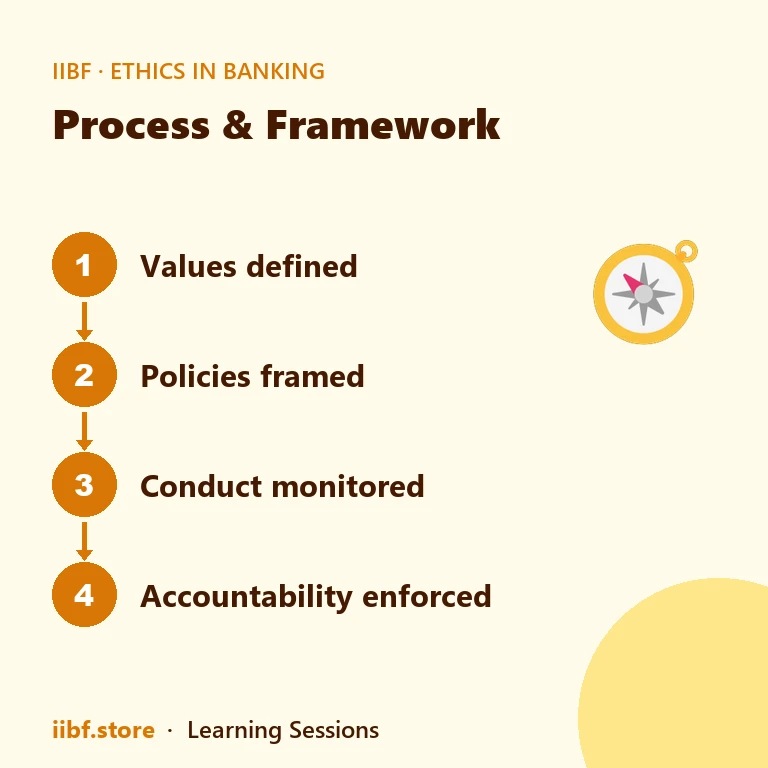
A usable four-step approach works for both exam scenarios and real decisions. First, identify every stakeholder affected — the customer, the bank, co-workers, and the regulator all have a stake in most branch-level dilemmas. Second, check the applicable code or law before relying on personal judgement; most dilemmas already have a partial answer written into an internal policy or RBI circular. Third, weigh consequences against principles — a purely consequence-based choice (what maximises this quarter's numbers) often fails the fairness test that examiners and regulators apply. Fourth, escalate and document when the answer isn't obvious; a written note explaining the reasoning protects both the employee and the customer.
This sequence is explored in far more depth, with worked scenarios, in our companion piece on the Ethical Decision-Making Framework for Bankers. Pair that framework with the conduct baseline set out in the Code of Conduct for Bankers, and most exam scenario questions become far more predictable — the "correct" option is almost always the one that documents the conflict and escalates rather than the one that quietly resolves it in the bank's favour.
📌 Remember: Escalation channels only work if employees trust them. IIBF exam scenarios frequently reward the option that routes an unresolved dilemma upward rather than the option that lets a junior employee decide alone.
🌍 Learning from Real Banking Case Patterns
Case-based questions in the Ethics in Banking paper draw on recurring, anonymised patterns rather than named incidents. A recovery agent under pressure to hit NPA-reduction targets during a tight economic quarter may resort to aggressive tactics that breach the fair practices code — a dynamic that gets sharper whenever macro conditions (worth revisiting via our note on types of inflation in India) squeeze household repayment capacity. A branch manager accepting a festive gift hamper from a large corporate borrower during a renewal review is a textbook gifts-and-objectivity dilemma. A compliance officer who spots a suspicious transaction from a long-standing, high-value client faces the classic confidentiality-versus-disclosure tension.
What separates candidates who score well from those who don't is rarely knowledge of the rulebook — it's the ability to name the competing values correctly and pick the response that a regulator, not just a manager, would defend. For more scenario practice and the full syllabus map, browse our Ethics in Banking article hub, and pair it with structured preparation through the JAIIB course if you're sitting the foundation-level exam this cycle.
🧠 Practice MCQs: Ethical Dilemmas in Banking
Q1. What primarily distinguishes an ethical dilemma from a compliance violation? (a) A dilemma always involves money (b) A dilemma pits two legitimate values against each other while a violation breaches a clear rule (c) A dilemma is always reported to the RBI (d) There is no difference
Answer: (b) — A dilemma is a right-vs-right conflict; a violation is a clear breach of an established rule.
Q2. A relationship manager is pressured to sell an unsuitable insurance product to meet targets. This is best classified as: (a) Fraud (b) A suitability-vs-targets ethical dilemma (c) A criminal offence (d) Not an ethics issue
Answer: (b) — Sales performance and customer welfare are both legitimate goals in conflict here, making it a dilemma, not fraud.
Q3. Which step should come first in resolving a workplace ethical dilemma? (a) Escalate to the media (b) Identify all affected stakeholders (c) Ignore the issue (d) Resign immediately
Answer: (b) — Stakeholder identification frames the conflict correctly before any policy check or decision is made.
Q4. A bank employee accepts a lavish gift from a loan applicant during underwriting. This mainly risks: (a) Improved customer service (b) Compromised objectivity in the credit decision (c) Higher deposit growth (d) No real risk
Answer: (b) — Gifts during an active decision process can bias judgement, which is why internal gift thresholds exist.
Q5. When a dilemma has no clear answer under existing policy, the recommended action is to: (a) Decide alone and stay silent (b) Escalate and document the reasoning (c) Delay indefinitely (d) Ask the customer to decide
Answer: (b) — Escalation with documentation protects the employee, the customer, and the institution.
Want chapter-wise mock tests with 100+ MCQs? Start practising free →
What is an ethical dilemma in banking?
It is a situation where two legitimate values — such as customer welfare and sales performance, or confidentiality and disclosure — conflict, and no available option is fully free of trade-offs.
How is an ethical dilemma different from fraud?
Fraud involves intent to deceive and is a clear rule violation. An ethical dilemma is a good-faith conflict between two acceptable choices, with no deceptive intent involved.
Which IIBF chapters cover ethical dilemmas in banking?
Work Ethics and the Workplace (Chapter 10), Building an Ethical Organization (Chapter 11), and Ethics: A Holistic Approach are the core chapters, supplemented by the corruption and white-collar crime chapter for cases that escalate beyond a dilemma.
What framework should I use to resolve an ethical dilemma at work?
Identify stakeholders, check the applicable code or regulation, weigh consequences against fairness principles, and escalate with documentation if the answer isn't clear-cut.
Ethical dilemmas in banking rarely have a textbook-perfect answer, but they do have a defensible process — name the competing values, check the code, and document the call. Build that instinct now with full-length, chapter-wise practice tests on iibf.store before exam day.
Prefer revising from a printed book?
Chapter-wise books with MCQs after every chapter — minimal pages, complete coverage, delivered anywhere in India. Every book has a free sample to read first.
132 pages · 225 MCQs
Learning Sessions · Ashish Sir
188 pages · 435 MCQs
Learning Sessions · Ashish Sir
117 pages · 236 MCQs
Learning Sessions · Ashish Sir
Learning Sessions · Ashish Sir
118 pages · 299 MCQs
Learning Sessions · Ashish Sir
Learning Sessions · Ashish Sir
Learning Sessions · Ashish Sir
Learning Sessions · Ashish Sir
115 pages · 255 MCQs
Learning Sessions · Ashish Sir
Learning Sessions · Ashish Sir
334 pages · 936 MCQs
Learning Sessions · Ashish Sir
Learning Sessions · Ashish Sir
115 pages · 344 MCQs
Learning Sessions · Ashish Sir
107 pages · 240 MCQs
Learning Sessions · Ashish Sir
90 pages · 150 MCQs
Learning Sessions · Ashish Sir
Learning Sessions · Ashish Sir
131 pages · 672 MCQs
Learning Sessions · Ashish Sir
221 pages · 831 MCQs
Learning Sessions · Ashish Sir
128 pages · 524 MCQs
Learning Sessions · Ashish Sir
107 pages · 445 MCQs
Learning Sessions · Ashish Sir
148 pages · 478 MCQs
Learning Sessions · Ashish Sir
151 pages · 465 MCQs
Learning Sessions · Ashish Sir
148 pages · 375 MCQs
Learning Sessions · Ashish Sir
216 pages · 895 MCQs
Learning Sessions · Ashish Sir
109 pages · 300 MCQs
Learning Sessions · Ashish Sir
104 pages · 360 MCQs
Learning Sessions · Ashish Sir
82 pages · 297 MCQs
Learning Sessions · Ashish Sir
151 pages · 600 MCQs
Learning Sessions · Ashish Sir
98 pages · 282 MCQs
Learning Sessions · Ashish Sir
Quick quiz on this topic
5 exam-style questions from our free test bank — check yourself before you move on.
Practice this topic
Take a free mock test, download chapter PDFs, or watch a video class — all included on iibf.store.