Credit Management Lifecycle Explained: CAIIB ABM Module C Guide
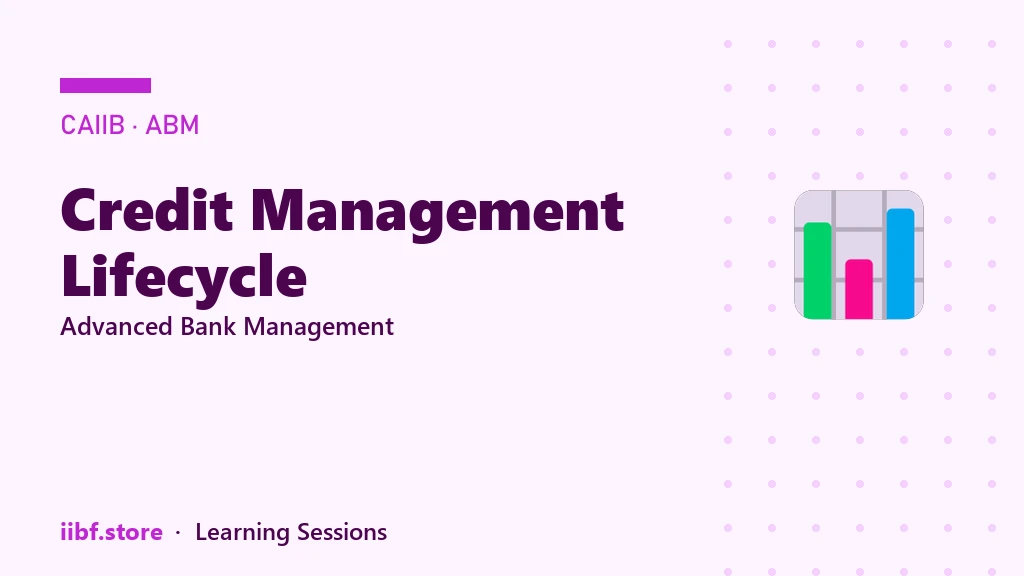
Ever wondered how a single loan travels from a customer's first enquiry all the way to full repayment — or, in the worst case, to recovery? That end-to-end journey is the credit management lifecycle, and it is the backbone of CAIIB ABM Module C. The short revision video below walks through the complete lifecycle in a few minutes; this guide then slows it right down, stage by stage, so you can answer every ABM credit question with confidence.
CAIIB ABM: Credit Management Complete Lifecycle · Watch on YouTube
What the credit management lifecycle actually means
The credit management lifecycle is the structured sequence a bank follows to source, evaluate, sanction, disburse, monitor and finally close or recover a credit facility. For CAIIB ABM, examiners rarely ask you to define a single term in isolation — they hand you a scenario ("a borrower has slipped into SMA-1, what next?") and expect you to place it correctly within the lifecycle. Get the sequence right and the marks follow almost automatically.
Think of it as a loop rather than a straight line. Every account that a bank creates re-enters the credit management lifecycle at review time, and a healthy account is simply one that keeps cycling through monitoring without ever touching the recovery stage. That is the mental model the video builds, and it is the one the ABM paper rewards.
Stage 1 to 3: Sourcing, appraisal and credit assessment
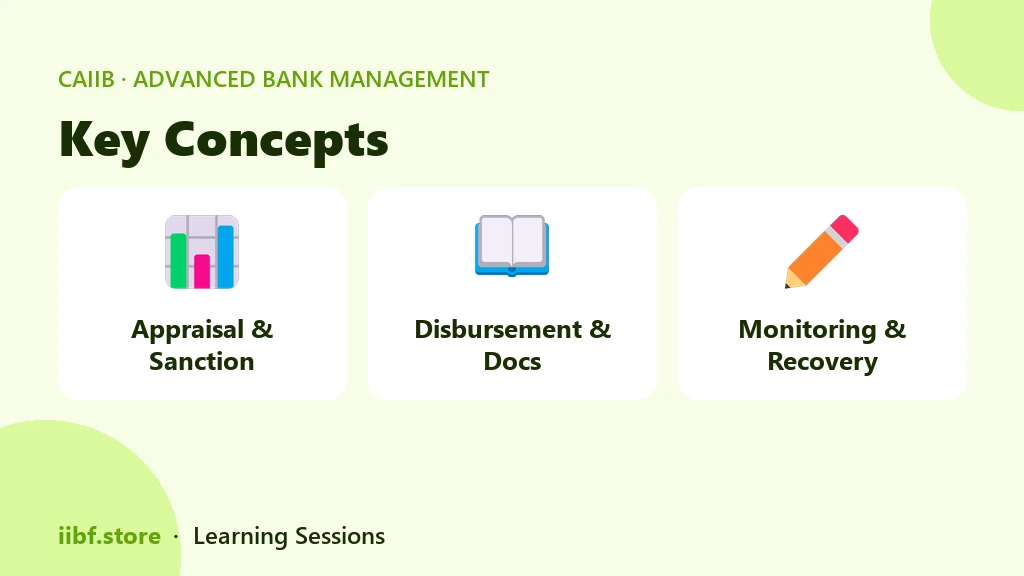
The lifecycle opens well before any money moves. A bank first sources the proposal — through branch walk-ins, relationship managers, digital leads or government-sponsored schemes — and completes KYC and preliminary eligibility screening. Only then does credit appraisal begin, and this is where most ABM marks live.
Appraisal tests the borrower against the classic 5 Cs of credit: Character (intent and track record), Capacity (cash flows to service the loan), Capital (the borrower's own stake), Collateral (security cover) and Conditions (the economic and industry backdrop). Alongside the 5 Cs, the officer runs financial-statement analysis, computes key ratios (current ratio, DSCR, debt-equity), assigns an internal credit rating, and, for working-capital limits, applies assessment methods such as the Turnover Method for smaller units or the MPBF/Tandon Committee norms for larger ones.
A quick memory aid: appraisal answers "should we lend, and how much?" while assessment answers "how much working capital does this specific business genuinely need?" Examiners love to blur the two, so keep them distinct.
Stage 4 to 5: Sanction, documentation and disbursement
Once appraisal clears, the proposal moves to sanction by the appropriate authority under the bank's delegation of powers. The sanction letter fixes the amount, rate, margin, security, repayment schedule and covenants. Nothing can be disbursed until documentation is complete — loan agreements executed, charges created and registered (hypothecation, mortgage or pledge), guarantees obtained and, where required, the charge filed with the Registrar of Companies or on the CERSAI portal.
Disbursement follows, and good banks disburse in tranches linked to milestones rather than in one lump sum, especially for project and term loans. This single discipline — releasing money against verified end-use — prevents a large share of future stress, which is exactly why the syllabus places it inside the same continuous lifecycle rather than treating it as a one-off event.
Stage 6 to 7: Monitoring, review and recovery
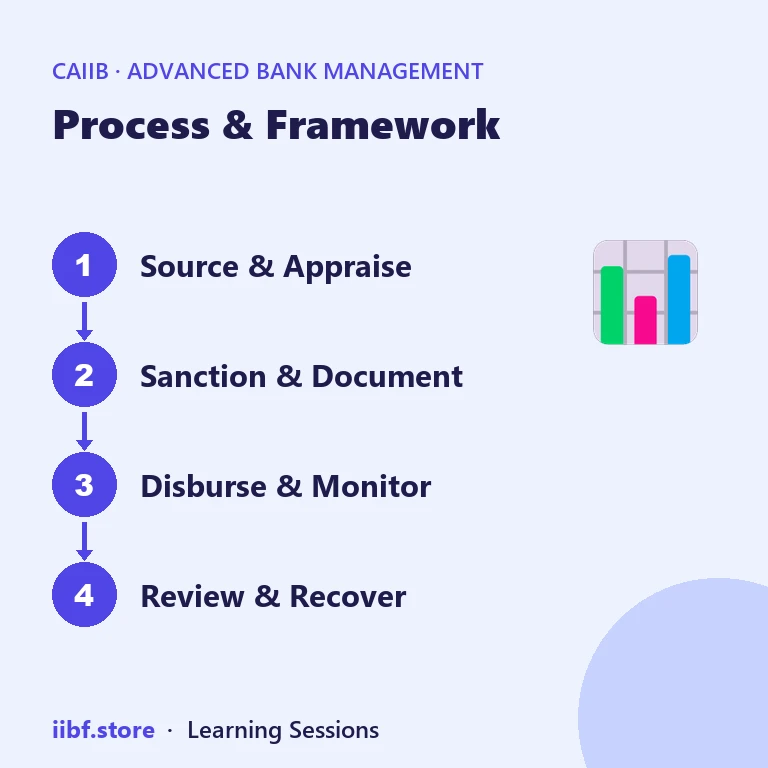
After disbursement the account enters continuous monitoring. The bank tracks operations in the account, stock and receivable statements, covenant compliance and early-warning signals. RBI's Special Mention Account (SMA) framework flags stress before default: SMA-0 (overdue up to 30 days), SMA-1 (31–60 days) and SMA-2 (61–90 days). Cross the 90-day line and the account becomes a Non-Performing Asset, triggering the IRAC asset-classification and provisioning rules that ABM tests almost every cycle.
Where an account slips, the bank chooses between rehabilitation/restructuring (if the unit is viable) and recovery (if it is not) through SARFAESI action, DRT/DRAT, the Insolvency and Bankruptcy Code, Lok Adalats or compromise settlement. Closing a fully repaid account — releasing securities and issuing a No-Dues certificate — is the quiet, happy end of the credit management lifecycle that candidates often forget to mention.
Credit management lifecycle at a glance
| Stage | Core activity | Key ABM concept |
|---|---|---|
| Sourcing & KYC | Lead generation, eligibility | KYC/AML screening |
| Appraisal | Evaluate the borrower | 5 Cs of credit, credit rating |
| Assessment | Size the limit | MPBF / Turnover Method |
| Sanction & documentation | Approve and secure | Delegation of powers, charge creation |
| Disbursement | Release funds against end-use | Tranche-linked release |
| Monitoring | Track health | SMA-0/1/2, early-warning signals |
| Review & recovery | Renew, restructure or recover | IRAC norms, SARFAESI, IBC |
Learn the table above cold and you have essentially mapped the entire Module C credit management lifecycle. Pair it with regular practice: run a set of scenario MCQs on our CAIIB mock tests, revise the linked concepts through the full Advanced Bank Management course, and slot two focused revision blocks into your study planner this week. You can also cross-check the regulatory definitions on the RBI website and explore the wider CAIIB preparation hub for the remaining modules.
Frequently asked questions
Is the credit management lifecycle only in CAIIB ABM Module C?
The full lifecycle sits in ABM Module C, but its building blocks appear across the paper — ratio analysis in the accounting portion, risk in the risk-management module and recovery law in banking regulation. Learning it once pays off everywhere.
What are the 5 Cs of credit again?
Character, Capacity, Capital, Collateral and Conditions. They form the qualitative and quantitative core of the appraisal stage and are among the most repeated one-mark questions in ABM.
When does an account become an NPA in the lifecycle?
When principal or interest stays overdue for more than 90 days for a term loan, or the account remains out of order beyond 90 days for cash credit/overdraft. Before that, it passes through the SMA-0, SMA-1 and SMA-2 warning buckets.
How should I revise this topic in the last week?
Memorise the seven-stage table, watch the linked revision video once a day, and attempt at least 30 scenario MCQs so you can place any situation in the right stage instantly. That recall speed is what separates a 55 from a 65 in ABM.
Prefer revising from a printed book?
Chapter-wise books with MCQs after every chapter — minimal pages, complete coverage, delivered anywhere in India. Every book has a free sample to read first.
148 pages · 478 MCQs
Learning Sessions · Ashish Sir
151 pages · 465 MCQs
Learning Sessions · Ashish Sir
148 pages · 375 MCQs
Learning Sessions · Ashish Sir
216 pages · 895 MCQs
Learning Sessions · Ashish Sir
109 pages · 300 MCQs
Learning Sessions · Ashish Sir
104 pages · 360 MCQs
Learning Sessions · Ashish Sir
82 pages · 297 MCQs
Learning Sessions · Ashish Sir
151 pages · 600 MCQs
Learning Sessions · Ashish Sir
98 pages · 282 MCQs
Learning Sessions · Ashish Sir
131 pages · 672 MCQs
Learning Sessions · Ashish Sir
221 pages · 831 MCQs
Learning Sessions · Ashish Sir
128 pages · 524 MCQs
Learning Sessions · Ashish Sir
107 pages · 445 MCQs
Learning Sessions · Ashish Sir
132 pages · 225 MCQs
Learning Sessions · Ashish Sir
188 pages · 435 MCQs
Learning Sessions · Ashish Sir
117 pages · 236 MCQs
Learning Sessions · Ashish Sir
Learning Sessions · Ashish Sir
118 pages · 299 MCQs
Learning Sessions · Ashish Sir
Learning Sessions · Ashish Sir
Learning Sessions · Ashish Sir
Learning Sessions · Ashish Sir
115 pages · 255 MCQs
Learning Sessions · Ashish Sir
Learning Sessions · Ashish Sir
334 pages · 936 MCQs
Learning Sessions · Ashish Sir
Learning Sessions · Ashish Sir
115 pages · 344 MCQs
Learning Sessions · Ashish Sir
107 pages · 240 MCQs
Learning Sessions · Ashish Sir
90 pages · 150 MCQs
Learning Sessions · Ashish Sir
Learning Sessions · Ashish Sir
Quick quiz on this topic
5 exam-style questions from our free test bank — check yourself before you move on.
Practice this topic
Take a free mock test, download chapter PDFs, or watch a video class — all included on iibf.store.