Talent Management in Banks: A CAIIB HRM Guide 2026
Banks compete for the same small pool of skilled bankers. That is why talent management in banks has moved from an HR buzzword to a board-level priority. CAIIB HRM candidates must understand how banks identify, develop and retain high-potential employees. They must also know how this differs from succession planning and from a performance appraisal cycle. This is a recurring exam theme. This guide breaks the concept down with bank-specific examples, a comparison table, and five practice MCQs.
🎯 What Is Talent Management in Banking?
Talent management is a continuous process. It covers attracting, identifying, developing, engaging and retaining employees who have the highest potential to add value. It is not a one-time HR activity. It spans the entire employee lifecycle — from workforce planning and recruitment through learning and career pathing, and eventually exit or retirement. This matters more in banking than in most sectors. A branch manager's decisions carry direct credit and reputational risk. A poor hire, or a badly managed exit of a critical officer, can disrupt an entire zone's operations.
The Fundamentals of HRM chapter frames talent management as a strategic HR function. It moves HR from a transactional, compliance-driven role to a business-partnering role. Banks that treat talent management strategically link it directly to business goals. For example, they tag "high-potential" credit officers early. This lets the bank groom them for regional credit committees within five to seven years.
🏦 How Indian Banks Operationalise Talent Management
Public sector banks once ran seniority-linked promotions. Competition from private and foreign banks after liberalisation forced a shift toward merit- and potential-based talent systems. Today, most large banks run a structured talent cycle. This includes workforce and role-criticality mapping, assessment centres for potential (not just past performance), individual development plans, job rotation across credit, operations and treasury verticals, and mentoring by senior leadership for identified talent pools.
The HRM in Banks chapter and the HRM in Indian Banks chapter both cover how nationalised banks responded after the Khandelwal Committee recommendations. They introduced structured HR planning, competency-based selection and leadership development streams. The goal was to close the talent gap from mass retirements. Private banks, meanwhile, run tighter "top talent pool" lists. The CHRO and business heads review these lists every quarter.
💡 Exam Tip: A question may ask for the "broadest" HR concept covering the full employee lifecycle. The answer is usually talent management. Performance management and succession planning are narrower components within it.
🔄 Talent Management vs Succession Planning vs Performance Management
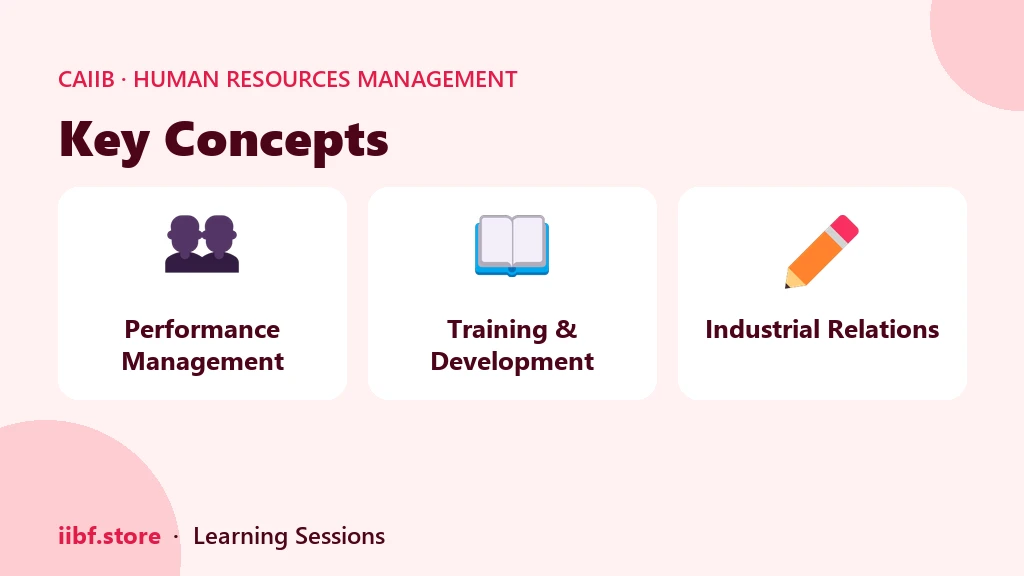
CAIIB HRM questions often test whether candidates can tell overlapping terms apart. Talent management is the umbrella process. Succession planning is a subset that focuses on readiness for critical or leadership roles. Performance management is a subset that focuses on measuring and improving current-period output against set goals. A bank can have excellent performance management, with accurate appraisals, and still have weak talent management. This happens if it never builds bench strength for tomorrow's roles.
Competency mapping is the diagnostic tool that feeds both talent management and succession decisions. It identifies the skills and behaviours a role needs, and how far an employee currently is from that bar. Banks that skip competency mapping often end up promoting on tenure alone. Talent management frameworks are designed to correct exactly this problem. For a deeper look at how banks build these skill frameworks, see this guide on competency mapping in banks.
⚠️ Common Mistake: Candidates often treat "talent management" and "succession planning" as synonyms in exam answers. They overlap, but are not the same. Succession planning is narrower and role-specific. Talent management is organisation-wide and continuous.
📈 Building a Talent Management Framework
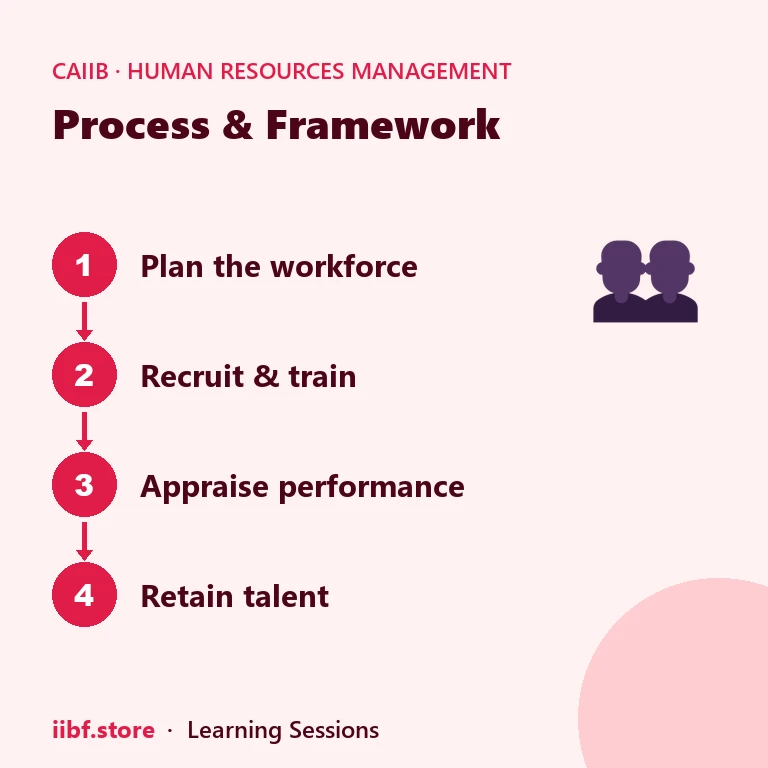
A typical bank-wide talent management framework has four connected stages. The first is workforce and talent-gap planning. This maps current headcount and skills against the bank's three-to-five-year business strategy, including digital and credit-risk roles. The second is identification and assessment. Banks use performance data, potential ratings, and assessment centres to segment employees into talent pools. These centres often plot performance against potential on a 9-box grid. The third is development. This covers individual development plans, stretch assignments, cross-functional rotation, and structured leadership programmes, closely linked to Human Resource Development Strategies and Systems. The fourth is engagement and retention. This stage keeps identified talent motivated so it doesn't exit to competitors once developed.
This last stage overlaps heavily with day-to-day engagement practices. Banks that invest in talent pipelines but ignore engagement often lose their best people right after developing them. It is worth reading how banks structure employee engagement practices in banks alongside this framework, since the two reinforce each other. Compensation design also plays a supporting role. Talent pools are usually mapped to differentiated reward structures, which is covered in this piece on compensation management in banks.
📌 Remember: Talent management frameworks usually fail at the development stage, not at identification. Banks tag "high-potential" employees and then give them no stretch roles. This defeats the purpose.
⚖️ Talent Management and Organisational Change
Banks undergoing mergers, digital transformation, or branch rationalisation lean heavily on talent management. It helps them decide who moves into new-age roles, such as analytics, cybersecurity and digital lending, versus legacy roles. This connects directly to the Organisational Change chapter. There, HR's role in change management includes re-skilling and redeploying talent rather than simply downsizing. A bank sequences a structured process for something like a credit management lifecycle to control risk at every stage of a loan. Talent management applies the same lifecycle discipline to human capital: plan, assess, develop, deploy, and review.
| HR Function | Primary Focus | Typical Bank Example | Feeds Talent Management? |
|---|---|---|---|
| Talent Management | Entire employee lifecycle, high-potential pools | Bank-wide leadership pipeline programme | ✅ Umbrella function |
| Succession Planning | Readiness for specific critical/leadership roles | Naming a successor for a Zonal Manager post | Yes |
| Performance Management | Current-cycle goal-setting and appraisal | Annual PMS rating of a branch officer | Yes |
| Competency Mapping | Defining skill/behaviour benchmarks per role | Credit-role competency dictionary | Yes |
| Payroll Administration | Salary processing and statutory compliance | Monthly salary disbursal, PF/TDS filing | ❌ Not part of it |
🧠 Practice MCQs: Talent Management in Banks
Q1. What is the primary objective of talent management in banks? (a) Minimising training budgets (b) Attracting, developing and retaining high-potential employees (c) Processing monthly payroll (d) Conducting statutory audits
Answer: (b) — Talent management exists to build a sustainable pipeline of capable employees for current and future roles.
Q2. Which of the following is NOT a core pillar of a talent management framework? (a) Talent acquisition (b) Talent development (c) Branch cash reconciliation (d) Talent retention
Answer: (c) — Branch cash reconciliation is an operations function, unrelated to the talent lifecycle.
Q3. In talent management, the "buy vs build" decision refers to: (a) Choosing between external lateral hiring and internal development (b) Purchasing HR software licences (c) Deciding on new branch construction (d) Buying group insurance for staff
Answer: (a) — Banks must decide whether to fill critical roles by hiring externally ("buy") or developing existing staff ("build").
Q4. A 9-box grid commonly used in talent management plots employees on which two axes? (a) Salary vs age (b) Performance vs potential (c) Tenure vs department (d) Branch vs region
Answer: (b) — The 9-box grid segments talent by current performance and future potential to guide development decisions.
Q5. How does talent management primarily differ from succession planning? (a) Succession planning covers all staff, talent management covers only clerks (b) Talent management is the broader, continuous process across the whole employee lifecycle, while succession planning specifically targets readiness for critical roles (c) They are identical concepts used interchangeably (d) Succession planning applies only to private sector banks
Answer: (b) — Succession planning is a focused subset of the wider, ongoing talent management process.
Want chapter-wise mock tests with 100+ MCQs? Start practising free →
Frequently Asked Questions
Is talent management the same as HR planning?
No. HR planning (workforce/manpower planning) forecasts headcount and skill needs; talent management goes further by actively identifying, developing and retaining the specific high-potential employees needed to meet that plan.
Why is talent management important for public sector banks specifically?
PSBs faced large-scale retirements after 2010-2015 and needed structured pipelines to replace experienced officers quickly, which is why post-Khandelwal Committee reforms pushed competency-based, potential-driven talent systems into nationalised banks.
What tools do banks use to identify high-potential employees?
Common tools include assessment/development centres, 360-degree feedback, competency mapping against role dictionaries, performance-potential (9-box) grids, and structured interviews by senior panels.
Does talent management apply only to senior management roles?
No. While leadership pipelines get the most visibility, sound talent management also covers frontline and mid-level roles such as credit officers, relationship managers and branch operations staff, since attrition at any level disrupts service delivery.
Talent management ties together nearly every other HRM topic in the CAIIB syllabus. Competency mapping, performance management, succession planning and engagement all feed into it. According to the Indian Institute of Banking & Finance, HR competence is a core banking skill area, not a side subject. That is exactly why this theme recurs across CAIIB HRM papers. Strengthen your recall with topic-wise practice on iibf.store/tests. Browse every article in the Human Resources Management tag hub, or explore the full CAIIB course for structured chapter coverage.
Prefer revising from a printed book?
Chapter-wise books with MCQs after every chapter — minimal pages, complete coverage, delivered anywhere in India. Every book has a free sample to read first.
104 pages · 360 MCQs
Learning Sessions · Ashish Sir
148 pages · 478 MCQs
Learning Sessions · Ashish Sir
151 pages · 465 MCQs
Learning Sessions · Ashish Sir
148 pages · 375 MCQs
Learning Sessions · Ashish Sir
216 pages · 895 MCQs
Learning Sessions · Ashish Sir
109 pages · 300 MCQs
Learning Sessions · Ashish Sir
82 pages · 297 MCQs
Learning Sessions · Ashish Sir
151 pages · 600 MCQs
Learning Sessions · Ashish Sir
98 pages · 282 MCQs
Learning Sessions · Ashish Sir
131 pages · 672 MCQs
Learning Sessions · Ashish Sir
221 pages · 831 MCQs
Learning Sessions · Ashish Sir
128 pages · 524 MCQs
Learning Sessions · Ashish Sir
107 pages · 445 MCQs
Learning Sessions · Ashish Sir
132 pages · 225 MCQs
Learning Sessions · Ashish Sir
188 pages · 435 MCQs
Learning Sessions · Ashish Sir
117 pages · 236 MCQs
Learning Sessions · Ashish Sir
Learning Sessions · Ashish Sir
118 pages · 299 MCQs
Learning Sessions · Ashish Sir
Learning Sessions · Ashish Sir
Learning Sessions · Ashish Sir
Learning Sessions · Ashish Sir
115 pages · 255 MCQs
Learning Sessions · Ashish Sir
Learning Sessions · Ashish Sir
334 pages · 936 MCQs
Learning Sessions · Ashish Sir
Learning Sessions · Ashish Sir
115 pages · 344 MCQs
Learning Sessions · Ashish Sir
107 pages · 240 MCQs
Learning Sessions · Ashish Sir
90 pages · 150 MCQs
Learning Sessions · Ashish Sir
Learning Sessions · Ashish Sir
Quick quiz on this topic
5 exam-style questions from our free test bank — check yourself before you move on.
Practice this topic
Take a free mock test, download chapter PDFs, or watch a video class — all included on iibf.store.