Depreciation Accounting for Banks: A CAAP Exam Guide (2026)
Getting depreciation accounting for banks right is one of those quiet exam topics that trips up otherwise well-prepared CAAP candidates — because banks don't follow one neat, universal rate table the way many company-law questions assume. Instead, a bank's depreciation policy is a board-approved mix of AS 10 / Ind AS 16 principles, useful-life estimates, and disclosure requirements that show up directly in Schedule 10 of the balance sheet. This guide walks through the methods, the asset-class nuances, and the audit checks examiners love to test.
🏦 Depreciation Methods Used by Banks (WDV vs SLM)
Banks are free to adopt either the Written Down Value (WDV) method or the Straight Line Method (SLM), but the choice must be applied consistently across an asset class and disclosed as an accounting policy in the notes to accounts. Most public sector banks historically used WDV for premises and SLM for computers and vehicles, purely because WDV front-loads the depreciation charge in the early years of an asset's life — useful when assets are expected to lose utility faster in year one than in year ten. The core chapter on depreciation accounting works through both formulae with worked examples, which is the fastest way to internalise the arithmetic difference before attempting numerical questions in the exam.
A change in method is treated as a change in accounting policy, not an accounting estimate, and must be applied retrospectively with the cumulative effect disclosed separately — a distinction examiners like to test because it is so easily confused with a mere change in useful life (which is prospective only).
💡 Exam Tip: If a question describes a bank switching from WDV to SLM, remember it needs retrospective restatement and disclosure of the resulting surplus or deficit — not just a note for future years.
📉 Asset Classes, Useful Life and Schedule 10 Disclosure
Bank balance sheets present fixed assets under Schedule 10, split broadly into Premises and Other Fixed Assets (furniture, fixtures, vehicles, computers, and computer software). Since RBI does not itself prescribe depreciation rates for banks, the useful life is estimated by the bank's own accounting policy, informed by AS 10 (Accounting for Fixed Assets) or Ind AS 16 for banks migrating to the Ind AS framework, and cross-checked against the residual value and expected economic life of each class. This is exactly the disclosure trail examiners expect you to trace back to the chapter on preparation of final accounts of banks, where Schedule 10 is built up line by line alongside the other balance sheet schedules.
Premises typically carry the longest useful life (often 50-60 years under a straight-line policy), furniture and fixtures a mid-range life of around 10 years, and computers/computer software the shortest — usually 3 years — reflecting rapid technology obsolescence. Leasehold improvements are amortised over the lease term or useful life, whichever is shorter.
| Asset Class | Typical Method | Typical Useful Life | Board Policy Disclosure Required? |
|---|---|---|---|
| Premises (owned) | SLM or WDV | 50-60 years | ✅ Yes |
| Furniture & Fixtures | WDV (common) | ~10 years | ✅ Yes |
| Computers & Software | SLM (common) | 3 years | ✅ Yes |
| Vehicles | WDV or SLM | 8-10 years | ✅ Yes |
| Fully depreciated but in-use assets | N/A — nil charge | — | ❌ No further charge, only disclosure of gross block |
🖥️ Depreciation on Computers, Software and the Audit Angle
Because banks now run almost every core function through CBS platforms, computers and computer software form a disproportionately large slice of the fixed-asset schedule relative to their book value — and a disproportionately large slice of exam questions. Application software with an enduring benefit is capitalised and amortised (typically over 3 years), while software that is merely a minor upgrade or an annual licence renewal is expensed. Distinguishing a capitalisable upgrade from a routine licence fee is precisely the kind of judgment call tested under the chapter on audit in computerized environment, since auditors must trace the capitalisation entry back to the vendor invoice and verify it wasn't merely an AMC renewal misclassified as a capital addition.
Auditors performing a bank's concurrent audit in banks routine will typically test a sample of fixed-asset additions each quarter specifically for this misclassification, because it directly inflates reported profit by understating the current year's revenue expense.
⚠️ Common Mistake: Candidates often assume all IT spend is capital expenditure. AMC charges, minor patches, and subscription-based SaaS licences are revenue expenditure and must be expensed in the year incurred.
📊 Revaluation, Capital Reserve and Depreciation Interplay
When a bank revalues its premises upward, the incremental value is credited to a Revaluation Reserve, which sits under Capital Reserve in Schedule 2. From that point on, depreciation must be charged on the revalued (higher) carrying amount, and RBI guidance permits — subject to board policy — transferring an amount equal to the incremental depreciation from the Revaluation Reserve to the Profit & Loss account, so that the P&L is not unfairly burdened by depreciation on a paper revaluation gain. This interaction between the reserves side of the balance sheet and the depreciation charge is covered in depth in the chapter on capital reserves and surplus, and examiners frequently combine a revaluation scenario with a depreciation computation in the same numerical question.
Getting the sequencing right matters: revalue first, then depreciate the revalued figure, then transfer the incremental depreciation portion out of the Revaluation Reserve — doing these steps out of order is the single most common error in practice numericals on this topic.
📌 Remember: Incremental depreciation transferred out of Revaluation Reserve does not reduce the depreciation charge in the P&L — it only offsets the reserve, keeping the P&L charge based on the full revalued cost.
🔍 Audit Checks and Verification of Depreciation
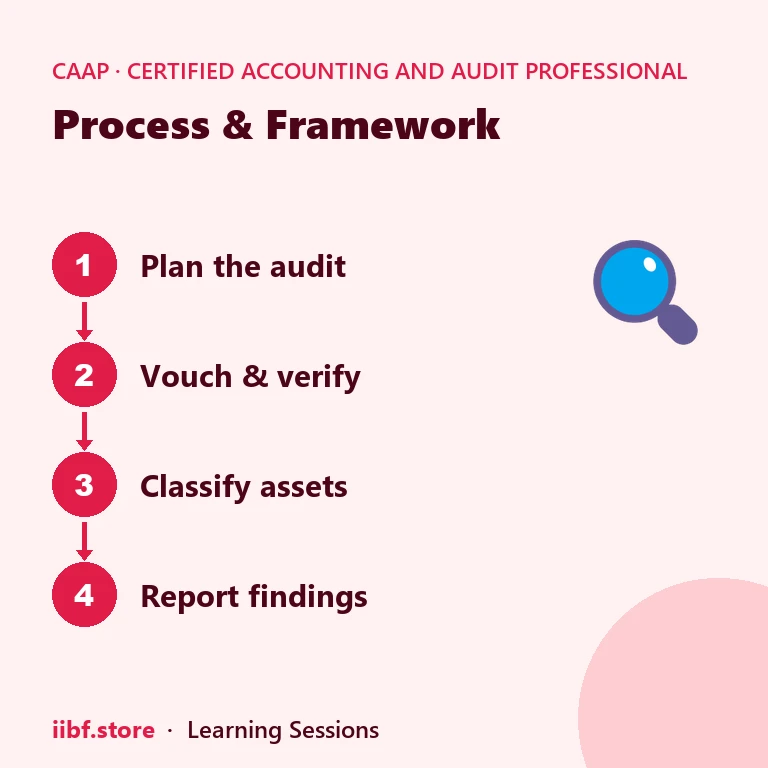
During the statutory audit, the auditor's fixed-asset verification programme for depreciation typically covers: agreeing the opening gross block and accumulated depreciation to the prior year's audited figures, recomputing the current year's charge on a sample of additions and disposals, confirming the depreciation policy note matches what was actually applied, and checking that fully depreciated assets still in active use are appropriately disclosed (even though no further charge is booked). Any change in useful life estimate — as opposed to a change in method — is applied prospectively and simply disclosed, without restating prior years.
These checks sit alongside the broader income-recognition and provisioning review; if you haven't already, revisit the companion guide on income recognition and asset classification norms, since both areas are typically examined by the same statutory audit team in the same audit cycle and often appear together in case-study questions.
Auditors also cross-verify depreciation figures against the bank's own bank reconciliation statement workpapers where fixed-asset-linked suspense entries occasionally surface, particularly around year-end capitalisation cut-offs.
For the accounting standard background and disclosure requirements banks must follow for fixed assets and depreciation policy notes, see the primary regulatory reference at RBI's official circulars and disclosure guidelines, which every CAAP candidate should bookmark alongside the IIBF syllabus documents.

🧠 Practice MCQs: Depreciation Accounting for Banks
Q1. A bank changes its depreciation method from WDV to SLM for furniture. How should this change be accounted for? (a) Prospectively, over remaining useful life (b) Retrospectively, with cumulative effect disclosed (c) Ignored until the next audit (d) Only disclosed in the director's report
Answer: (b) — A change in depreciation method is a change in accounting policy and must be applied retrospectively with the resulting surplus/deficit disclosed.
Q2. Under Schedule 10 of a bank's balance sheet, computer software with enduring benefit is normally: (a) Expensed immediately (b) Capitalised and amortised, typically over 3 years (c) Never depreciated (d) Charged directly to Revaluation Reserve
Answer: (b) — Application software with lasting benefit is capitalised and amortised over its useful life, commonly 3 years given rapid obsolescence.
Q3. When bank premises are revalued upward, depreciation going forward must be charged on: (a) The original historical cost only (b) The revalued carrying amount (c) Neither, revalued assets are exempt (d) An average of cost and revalued amount
Answer: (b) — Once revalued, depreciation is charged on the new (higher) carrying amount, though incremental depreciation may be transferred out of Revaluation Reserve.
Q4. A change in the estimated useful life of an asset (with no change in method) is applied: (a) Retrospectively (b) Prospectively, from the year of change (c) Only at the auditor's discretion (d) Never, useful life is fixed by law
Answer: (b) — Unlike a change in method, a change in useful-life estimate is a change in accounting estimate and is applied prospectively.
Q5. An annual AMC renewal fee for existing banking software should be: (a) Capitalised as a fixed asset addition (b) Expensed as revenue expenditure in the year incurred (c) Added to Revaluation Reserve (d) Deducted from accumulated depreciation
Answer: (b) — Routine AMC/licence renewals do not create an enduring capital asset and must be expensed, not capitalised.
Want chapter-wise mock tests with 100+ MCQs? Start practising free →
❓ Frequently Asked Questions
Does RBI prescribe fixed depreciation rates for banks?
No. RBI does not mandate specific depreciation rates for banks; each bank's board approves its own depreciation policy in line with AS 10 or Ind AS 16, disclosed in the notes to accounts under Schedule 10.
Can a bank use different depreciation methods for different asset classes?
Yes, a bank may use WDV for one asset class (e.g. premises) and SLM for another (e.g. computers), as long as the method is applied consistently within each class and disclosed as an accounting policy.
What happens to depreciation once an asset is fully written down but still in use?
No further depreciation charge is booked once the asset's book value reaches its residual value, but the gross block and accumulated depreciation continue to be disclosed in the fixed-asset schedule as long as the asset remains in use.
How does revaluation of premises affect the depreciation charge?
After revaluation, depreciation is charged on the revalued carrying amount, and the incremental depreciation attributable to the revaluation may be transferred from the Revaluation Reserve to the profit and loss account, per board policy.
Depreciation accounting for banks looks simple on the surface but rewards candidates who can connect the accounting policy note, the Schedule 10 disclosure, and the audit verification steps into one coherent picture. Browse more topics on the CAAP exam guide hub, then lock in the concepts with a full-length practice test →
Prefer revising from a printed book?
Chapter-wise books with MCQs after every chapter — minimal pages, complete coverage, delivered anywhere in India. Every book has a free sample to read first.
334 pages · 936 MCQs
Learning Sessions · Ashish Sir
132 pages · 225 MCQs
Learning Sessions · Ashish Sir
188 pages · 435 MCQs
Learning Sessions · Ashish Sir
117 pages · 236 MCQs
Learning Sessions · Ashish Sir
Learning Sessions · Ashish Sir
118 pages · 299 MCQs
Learning Sessions · Ashish Sir
Learning Sessions · Ashish Sir
Learning Sessions · Ashish Sir
Learning Sessions · Ashish Sir
115 pages · 255 MCQs
Learning Sessions · Ashish Sir
Learning Sessions · Ashish Sir
Learning Sessions · Ashish Sir
115 pages · 344 MCQs
Learning Sessions · Ashish Sir
107 pages · 240 MCQs
Learning Sessions · Ashish Sir
90 pages · 150 MCQs
Learning Sessions · Ashish Sir
Learning Sessions · Ashish Sir
131 pages · 672 MCQs
Learning Sessions · Ashish Sir
221 pages · 831 MCQs
Learning Sessions · Ashish Sir
128 pages · 524 MCQs
Learning Sessions · Ashish Sir
107 pages · 445 MCQs
Learning Sessions · Ashish Sir
148 pages · 478 MCQs
Learning Sessions · Ashish Sir
151 pages · 465 MCQs
Learning Sessions · Ashish Sir
148 pages · 375 MCQs
Learning Sessions · Ashish Sir
216 pages · 895 MCQs
Learning Sessions · Ashish Sir
109 pages · 300 MCQs
Learning Sessions · Ashish Sir
104 pages · 360 MCQs
Learning Sessions · Ashish Sir
82 pages · 297 MCQs
Learning Sessions · Ashish Sir
151 pages · 600 MCQs
Learning Sessions · Ashish Sir
98 pages · 282 MCQs
Learning Sessions · Ashish Sir
Practice this topic
Take a free mock test, download chapter PDFs, or watch a video class — all included on iibf.store.