Depreciation Accounting Methods for Bankers: SLM vs WDV (JAIIB AFM)
Depreciation accounting methods decide how much of a fixed asset's cost hits the profit and loss account each year, and JAIIB AFM tests this from three angles at once: the arithmetic, the accounting standard, and the effect on reported profit. A bank branch that capitalises an ATM, a note-sorting machine or a set of servers must spread that cost over the years the asset actually serves the business. Choose straight line and the charge is flat; choose written down value and the early years carry the burden. The numbers differ, the closing book value differs, and so does the tax computation. This guide works through the methods, the standards behind them, and the entries you will be asked to pass.
🧮 What Depreciation Means in Bank Books
Depreciation is the systematic allocation of the depreciable amount of an asset over its useful life. It is an allocation exercise, not a valuation exercise — the objective is matching cost against the revenue the asset helps earn, not tracking what the asset would fetch if sold today. Three inputs drive every calculation: the cost of the asset (purchase price plus all directly attributable costs of bringing it to working condition), the estimated residual value, and the estimated useful life. Depreciable amount is simply cost minus residual value.
For banks, the assets in question are premises, furniture and fixtures, safe deposit lockers and strong-room fittings, computers and networking equipment, ATMs and cash recyclers, vehicles and electrical installations. These sit in the fixed asset schedule, and the branch-level records feeding into it are covered when you study basic accountancy procedures. Depreciation is charged from the date the asset is ready for use, not from the date it is paid for, and it continues even in a year the asset lies idle — unless it has been fully depreciated or classified as held for sale.
Two accounting standards govern the area. AS 10 (Revised), Property, Plant and Equipment, applies to entities following the older Indian GAAP, while Ind AS 16 applies to entities on the converged standards. Both take substantially the same position on the mechanics: depreciate each significant part separately, review the method and estimates at least at each financial year end, and recognise the charge in profit or loss unless it is capitalised into another asset. The dedicated chapter on depreciation builds this base before the numerical work begins.
📊 SLM vs WDV vs Units of Production
The straight line method spreads the depreciable amount evenly. Annual depreciation equals (cost minus residual value) divided by useful life. A cash-counting machine costing ₹3,00,000 with a residual value of ₹15,000 and a six-year life carries a charge of ₹47,500 every year. The rate as a percentage of original cost stays constant, and at the end of the life the book value lands exactly on the residual value.
The written down value method applies a fixed percentage to the opening book value each year, so the charge falls as the asset ages. The rate can be derived as one minus the nth root of residual value divided by cost, expressed as a percentage. Because a percentage of a shrinking base never reaches zero, WDV never writes the asset down to nil arithmetically — the balance is squared off on disposal.
The units of production method ignores time and keys the charge to output. Depreciation for a period equals the depreciable amount multiplied by units produced in the period divided by total estimated units over the life. For a bank, "units" translate into transaction counts or machine hours — useful for an ATM rated for a fixed number of dispense cycles.
| Basis | Straight Line (SLM) | Written Down Value (WDV) | Units of Production |
|---|---|---|---|
| Base on which charge is computed | Cost less residual value | Opening written down value | Depreciable amount × usage ratio |
| Pattern of charge over life | Equal every year | Heavy early, light later | Moves with actual usage |
| Book value at end of useful life | Equals residual value | Small balance, never exactly nil | Equals residual value |
| Suits assets with even service pattern | ✅ | ❌ | ❌ |
| Basis used for income tax blocks under Section 32 | ❌ | ✅ | ❌ |
💡 Exam Tip: When a question gives you cost, residual value and life but no rate, it wants SLM. When it gives you a percentage and says "on reducing balance" or "on written down value", apply the rate to the opening book value, never to original cost.
🔄 Change in Method vs Change in Estimate
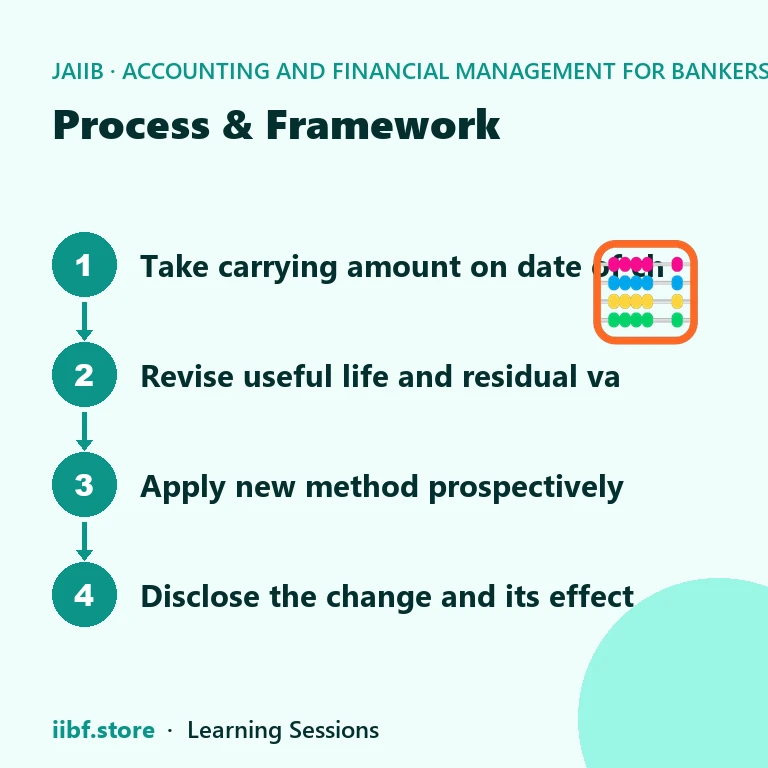
This is the single most examinable rule in the topic, and it changed with the revision of the standard. Under AS 10 (Revised) and Ind AS 16, the method of depreciation is treated as an accounting estimate, not an accounting policy. A shift from SLM to WDV, or the reverse, is therefore applied prospectively — you take the carrying amount as it stands on the date of change and depreciate it over the remaining useful life under the new method. There is no retrospective recomputation and no lump-sum adjustment of past years' depreciation through the profit and loss account, which was the treatment under the earlier standard.
Revisions to useful life and residual value work the same way. If a bank originally estimated an eight-year life for a set of branch servers and after three years concludes that only two years of service remain, the current carrying amount less revised residual value is spread over those two remaining years. The change is disclosed, along with its effect, but earlier reported figures are left untouched.
The method should be reviewed at least at each financial year end and altered only when there is a genuine change in the expected pattern of consumption of economic benefits. A change made merely to smooth profit fails that test and will attract audit comment — the sort of scrutiny explained in the chapter on bank audit and inspection. Broader standard-setting context, including the Ind AS transition, is covered in definition, scope and accounting standards including Ind AS.
⚠️ Common Mistake: Candidates still apply the old retrospective treatment and compute a "deficiency of depreciation" for past years when the method changes. Under the revised standard that entry does not arise — the change is prospective.
🏗️ Component Accounting and Revaluation
Component accounting requires that each part of an asset whose cost is significant in relation to the total cost be depreciated separately over its own useful life. A bank building is not one asset for this purpose. The structure may serve for decades, while the lifts, the air-conditioning plant, the generator set and the electrical wiring have far shorter lives and get replaced several times over. Depreciating them at the building's rate understates the charge in early years and leaves an unwritten-off balance when the component is scrapped. Under the component approach, the carrying amount of the replaced part is derecognised and the new part capitalised.
The residual value, the useful life and the method are reviewed for each component independently. Where a company follows Schedule II of the Companies Act, useful lives are indicative and residual value is ordinarily not taken above five per cent of original cost; a different estimate is permitted if it is disclosed and justified. Nationalised banks follow the formats and directions applicable to banking companies, so always answer with the framework the question specifies.
Both AS 10 (Revised) and Ind AS 16 allow an entity to choose either the cost model or the revaluation model for an entire class of assets — you cannot revalue one branch premises and carry the rest at cost. Under the revaluation model the asset is carried at fair value less subsequent depreciation, the increase is credited to a revaluation surplus rather than to profit, and a decrease is charged to profit except to the extent it reverses an earlier surplus on the same asset. Crucially, depreciation after revaluation is computed on the revalued amount over the remaining useful life, so the charge rises.
📒 Journal Entries, Branch Profit and the Tax Angle
Two presentation routes exist. In the direct method the entry is Depreciation A/c Dr., To Asset A/c, and the asset appears in the balance sheet net. In the provision method the credit goes to Provision for Depreciation A/c (or Accumulated Depreciation A/c), and the asset stays at cost with the accumulated balance shown as a deduction. Banks generally use the second route because it preserves the original cost record needed for insurance, physical verification and fixed asset register reconciliation. The depreciation account is closed by transfer to Profit and Loss A/c at the year end.
On disposal, transfer the cost to an Asset Disposal A/c, transfer the accumulated depreciation to the same account, credit it with the sale proceeds, and take the balancing figure as profit or loss on sale. If a revaluation surplus exists on that asset, it is transferred to general reserve or retained earnings and never routed through the profit and loss account as a gain. Branch-level capital expenditure normally flows to a central premises or asset department, so the branch books carry an inter-office entry rather than the asset itself — a control point that ties into back office functions.
For tax, book depreciation and allowable depreciation almost never agree. Section 32 of the Income Tax Act works on the block of assets concept: assets of the same class and same rate are pooled, additions and sale consideration adjust the block, and depreciation is computed on the block's written down value. An asset put to use for less than 180 days in the year of acquisition attracts half the normal depreciation. The gap between the book charge and the tax charge is a timing difference and gives rise to deferred tax. That difference in reported profit is also why depreciation policy features in variance reviews under budgetary control in banks.
📌 Remember: Depreciation is a non-cash charge. It reduces book profit and taxable profit but never moves cash, which is why it is added back when you convert profit into cash generated from operations.
Related AFM topics that examiners often pair with this one include the reconciliation discipline behind a bank reconciliation statement and the valuation logic in accounting for goodwill in partnership firms. If you want the full set of notes for this paper, the Accounting and Financial Management for Bankers tag hub lists every article in sequence. On the customer-facing side, the same idea of a shrinking balance being charged period after period appears in the minimum amount due on a credit card, a favourite in Retail Banking papers.

🧠 Practice MCQs: Depreciation Accounting Methods
Q1. Under AS 10 (Revised) and Ind AS 16, a change in the method of depreciation is treated as: (a) a change in accounting policy applied retrospectively (b) a change in accounting estimate applied prospectively (c) a prior period item (d) an error requiring restatement of earlier years
Answer: (b) — The method is an estimate; the carrying amount is depreciated over the remaining useful life under the new method, with no recomputation of past years.
Q2. A machine costs ₹5,00,000, has an estimated residual value of ₹50,000 and a useful life of 5 years. Annual depreciation under the straight line method is: (a) ₹1,00,000 (b) ₹1,10,000 (c) ₹85,000 (d) ₹90,000
Answer: (d) — Depreciable amount is ₹5,00,000 minus ₹50,000, that is ₹4,50,000, divided by 5 years equals ₹90,000 a year.
Q3. Under the written down value method, the annual depreciation charge is computed on: (a) the opening written down value of the asset (b) original cost less residual value (c) the market value at the year end (d) the revalued amount only
Answer: (a) — A fixed percentage is applied to the opening book value, so the charge declines every year.
Q4. Which method links the depreciation charge directly to actual output or machine usage? (a) Straight line method (b) Written down value method (c) Units of production method (d) Sum of years digits method
Answer: (c) — Depreciable amount is multiplied by units of the period divided by total estimated units over the asset's life.
Q5. Under Section 32 of the Income Tax Act, an asset acquired and put to use for less than 180 days during the year is eligible for: (a) full depreciation for the year (b) fifty per cent of the normal depreciation (c) no depreciation at all (d) depreciation at twice the block rate
Answer: (b) — The half-year rule restricts the allowance to fifty per cent of the rate applicable to that block for the year of acquisition.
Want chapter-wise mock tests with 100+ MCQs? Start practising free →
Which depreciation accounting method is best for a bank's computers and ATMs?
Assets with rapid obsolescence and heavy early utility, such as computers, networking gear and ATMs, are usually depreciated on the written down value method or on a short straight line life, because the pattern of benefit is front-loaded. The standard requires the method to reflect the expected pattern of consumption of economic benefits, so the choice must be justified rather than copied from another bank.
Is depreciation charged in the year an asset is bought but not used?
Depreciation begins when the asset is available for use, that is, when it is in the location and condition needed to operate as management intends. If a machine is delivered and installed but idle, the charge still runs. If it is delivered but installation is incomplete, it is not yet ready for use and no charge arises until it is.
Why do book depreciation and income tax depreciation differ?
Book depreciation follows AS 10 (Revised) or Ind AS 16 and uses the entity's own estimates of life, residual value and pattern of use. Tax depreciation follows Section 32, which pools assets into blocks at prescribed rates on the written down value basis and applies rules such as the half-year restriction. The difference is a timing difference and produces deferred tax assets or liabilities.
Does depreciation on a revalued asset change?
Yes. After revaluation the asset is carried at the revalued amount, and depreciation for later periods is computed on that amount over the remaining useful life. The charge therefore increases when the asset is revalued upward, which reduces reported profit even though no additional cash has been spent.
✅ Conclusion and Next Step
Depreciation questions in JAIIB AFM reward candidates who can do three things quickly: identify the method from the wording of the sum, apply the correct base (cost less residual value for SLM, opening book value for WDV, usage ratio for units of production), and remember that a change in method or estimate is prospective under AS 10 (Revised) and Ind AS 16. Layer on component accounting, the revaluation model and the Section 32 block concept, and you have covered every angle the paper takes. Work the numericals until the arithmetic is automatic, then test yourself under time pressure with the chapter-wise question bank in the JAIIB course or jump straight into a timed set at iibf.store mock tests.
Source and further reading: Ministry of Corporate Affairs (Ind AS) and the Indian Institute of Banking & Finance.
Quick quiz on this topic
5 exam-style questions from our free test bank — check yourself before you move on.
Practice this topic
Take a free mock test, download chapter PDFs, or watch a video class — all included on iibf.store.
Keep reading