Is the Customer Service in Banks Book Right for You? An Honest Guide
It is 9 pm. The branch closed late, the day-end balancing took longer than it should have, and you still have a certificate paper on your list. You open the syllabus and it looks endless. You have probably been sold a few "complete packages" before, and some of them are still sitting unopened.
So before anything else, here is a plain answer to a plain question: is the Customer Service in Banks book right for you? For some readers it is a very good fit. For others it is only half of what they need. This guide tells you which is which, so you can decide without being pushed.
First, what kind of paper is this?
Customer service papers fool a lot of people. They look easy because every banker deals with customers daily. Then the exam asks about fair practices, grievance redress, product suitability and ethics, and everyday experience is not enough. You need the framework and the right vocabulary, and you need to recognise it when a question is written as a small situation.
That is the first thing to understand about this paper: it rewards structure. A reader who knows the six areas of the syllabus and can slot any question into one of them will feel calm in the hall. A reader who has "a general idea" will lose marks on options that all sound sensible.
A simple self-check before you read further
- Can you explain, in two lines, how a complaint travels from the branch to the internal ombudsman?
- Can you tell mis-selling from a genuine product-suitability gap?
- Can you name the KYC and AML expectations a front-line employee must handle without making the customer feel interrogated?
If you hesitated on two of three, you need a structured source, not more scattered reading. If you answered all three confidently, you may only need practice questions, and that changes what you should buy.
What the printed book actually contains
Here are the facts, without adjectives. The Customer Service in Banks book is a 145-page printed book, 2026 edition, with 33 chapters arranged in six modules and 300 questions. In addition, it lists 30 case studies (120 questions) and 5 mega tests (500 questions).
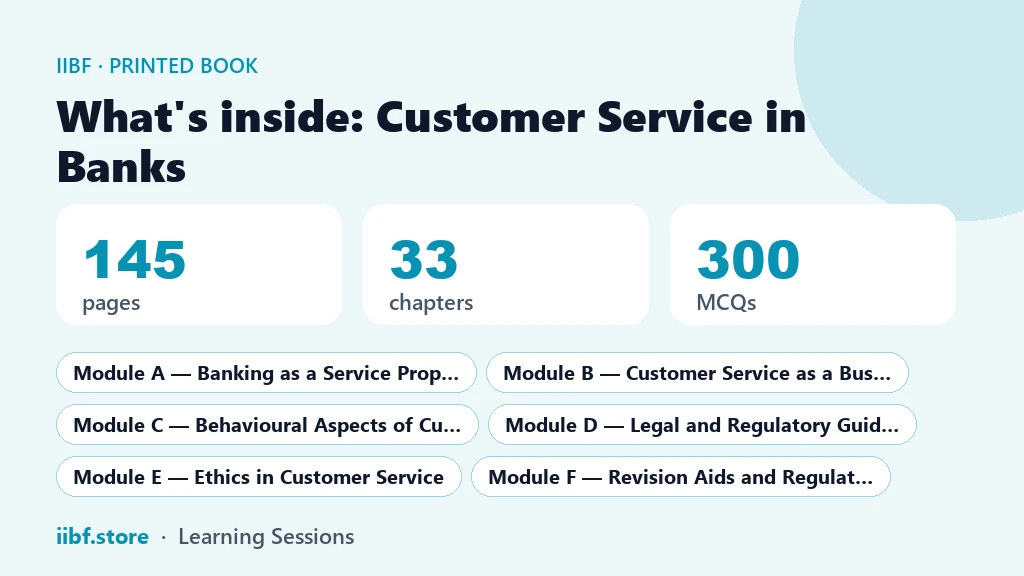
- Module A: Banking as a Service Proposition (5 chapters, from products and channels to EASE 7.0).
- Module B: Customer Service as a Business Strategy (10 chapters, covering relationships, CRM, feedback, grievances, digital fraud and financial inclusion).
- Module C: Behavioural Aspects of Customer Service (7 chapters on etiquette, soft skills, communication and difficult customers).
- Module D: Legal and Regulatory Guidelines (6 chapters, including KYC and AML, consumer protection and grievance redress).
- Module E: Ethics in Customer Service (2 chapters on reputation risk, suitability and mis-selling).
- Module F: Revision Aids and Regulatory Updates (3 chapters of comparisons, checklists and regulatory dates).
You can read the first pages before paying: a free sample is available on the book page. Prices change, so treat the book page as the current source. At the time of writing it is listed at ₹700 against an MRP of ₹2,398.
Reader profile 1: your first attempt
If this is your first time at a certificate paper, your biggest risk is not difficulty. It is drifting. You read a chapter, skip two days, lose the thread, and by the third week the book feels heavy.
How to use the book
Treat the six modules as six small projects, not one big syllabus. Finish one module, then close the book and write down five things you remember. Start with Module A so the language of service comes back, and leave Module F for the final week, because it is built for revision.
When it is not enough alone
A first-timer often believes that reading everything once means being ready. It does not. Reading builds recognition; the exam tests recall under time. Plan to attempt questions from the very first week. The free mock tests on iibf.store are a sensible companion because they show you which modules you only think you know.
Reader profile 2: you have attempted before
If you have missed the paper once, you probably do not need a new explanation of everything. You need to find out where you lost marks. Most repeat candidates fail on a few specific areas, not on the whole syllabus, and those areas are usually the regulatory and ethics chapters where options are closely worded.
How to use the book
Do not start at page one. Go straight to the questions and case studies, mark every one you got wrong or guessed, and then read only the chapters those questions belong to. In the Customer Service in Banks book, Module D and Module E are the usual places to look first, because they are about rules and judgement rather than common sense.
When it is not enough alone
If you have failed twice for the same reason, the problem may be exam technique rather than knowledge: spending too long on early questions, changing correct answers, or running out of time. No book fixes that. Timed full-length mocks do, and you should sit at least a few before the next attempt.
Reader profile 3: you are very short on time
Some of you will find the exam is close and you have only a few weeks of tired evenings. Be honest with yourself about this. A compact book helps, but it cannot make a month look like three.
How to use the book
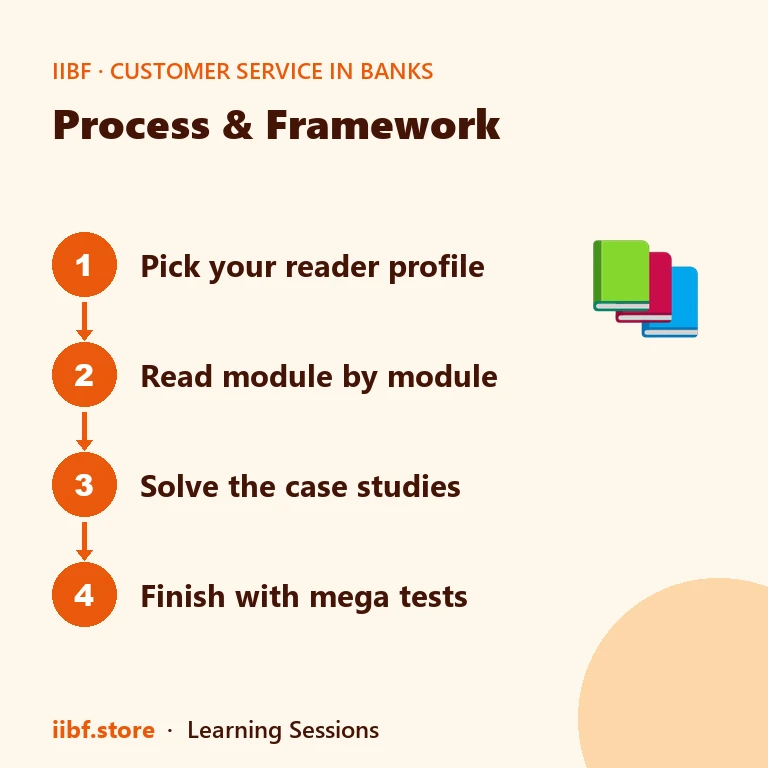
With limited time, order matters more than completeness. Use this sequence:
- Read Module F first, for the checklists and comparisons that give you the overall map.
- Go through Module D and Module E carefully; these carry rules and ethical judgement.
- Skim Modules A to C for vocabulary and the customer-first approach.
- Spend the last week only on questions and mega tests.
When it is not enough alone
A short timeline carries a real risk of skimming everything and retaining nothing. If you cannot give at least a few focused hours a week, consider whether the upcoming exam cycle is the right one for you. Check the official schedule on the IIBF website and decide calmly rather than in panic.
Reader profile 4: you simply prefer paper
Many bankers spend all day on screens and do not want to study on one at night. If that is you, a printed book is not a luxury. It is how you will actually study. You can underline, fold a page, carry it in your bag and read ten minutes in a queue without notifications interrupting you.
How to use the book
Make the margins work. Use one colour for definitions, another for regulatory points, and a simple star for anything you got wrong in a question. By the final fortnight your book becomes your own revision note, and that is more valuable than any highlighted PDF.
When it is not enough alone
Paper does not give you instant feedback. You still need a way to check answers and track scores, which is where online mocks and the free study material help. Treat the book as your reading base and the screen as your scoreboard.
Quick comparison: which profile are you?
| Reader | Start with | Add alongside |
|---|---|---|
| First attempt | Modules A to F in order, one at a time | Free mock tests from week one |
| Repeat attempt | Questions first, then only the weak chapters | Timed full-length mocks |
| Short on time | Module F, then D and E | Mega tests in the last week |
| Prefers paper | Page one, with colour-coded margins | Online mocks for scoring |
When this book is not the right purchase
It is fair to say this plainly. You may not need it if you already have a good source and only want practice, because then a set of mock tests is the better spend. You may also be disappointed if you expect a book alone to carry you through. It will not give you exam-hall speed. That comes from practice under a timer.
If you are comparing options, look at the whole books list, read the free sample, and decide from the pages rather than from any claim, including ours.
Conclusion
The Customer Service in Banks book suits you best if you want one structured, printed source with questions and case studies built in, and you are willing to pair it with mocks. It suits you less if you only need practice or have no weekly study time at all. Pick your profile from the table, follow the plan for it, and check the current price on the book page. Small, steady evenings beat one heroic weekend.
Frequently asked questions
Can I pass using only the printed book?
Many candidates combine reading with practice, and we would advise the same. The book gives you the structure and questions; timed mock tests give you speed and show weak areas. Use both.
Where do I find exam dates and rules?
Always use the official site at www.iibf.org.in. We do not quote dates, fees or attempt rules here because they can change.
Can I look inside before buying?
Yes. The book page has a free sample, so you can judge the writing and layout first. The price shown there is the current one.
Which module should I read first?
It depends on your profile. First-timers start with Module A, repeat candidates start from the questions, and anyone short on time should begin with Module F and then Modules D and E.
Prefer revising from a printed book?
Chapter-wise books with MCQs after every chapter — minimal pages, complete coverage, delivered anywhere in India. Every book has a free sample to read first.


















































Practice this topic
Take a free mock test, download chapter PDFs, or watch a video class — all included on iibf.store.