Is the CISB exam preparation book right for you? An honest guide
It is 10 pm. The branch closed late, the cash did not tally till eight, and now you are sitting with a certificate syllabus that mixes hardware, networks, audit, legal rules and security standards. You are a banker, not an IT engineer. The honest question is not "which book is the best" but "which book will I actually finish?"
This guide is about exactly that. We will look at who the CISB exam preparation book suits, who it does not, and how to use it if you decide it is for you. You will get something usable here even if you never buy it: a way to judge any book before you spend money.
Start with your real constraint, not the syllabus
Most candidates who fail or postpone a certificate do not fail because the content is too hard. They fail because the study plan assumed free evenings that never came. Before choosing any material, answer three questions honestly:
- How many hours a week can you really protect? Not ideal hours, real ones.
- Is this your first attempt, or have you already seen the paper once?
- Do you retain better from paper, or from a screen after a full day of looking at a screen?
Your answers matter more than any book's marketing. A 143-page book you finish beats a 600-page one you carry around for three months. Keep that in mind as we go through the profiles below.
One more practical point: confirm the current syllabus and schedule on the official site, www.iibf.org.in, before you plan anything. We do not quote dates or rules here because they change, and you should never plan around a second-hand date.
What is actually inside the book
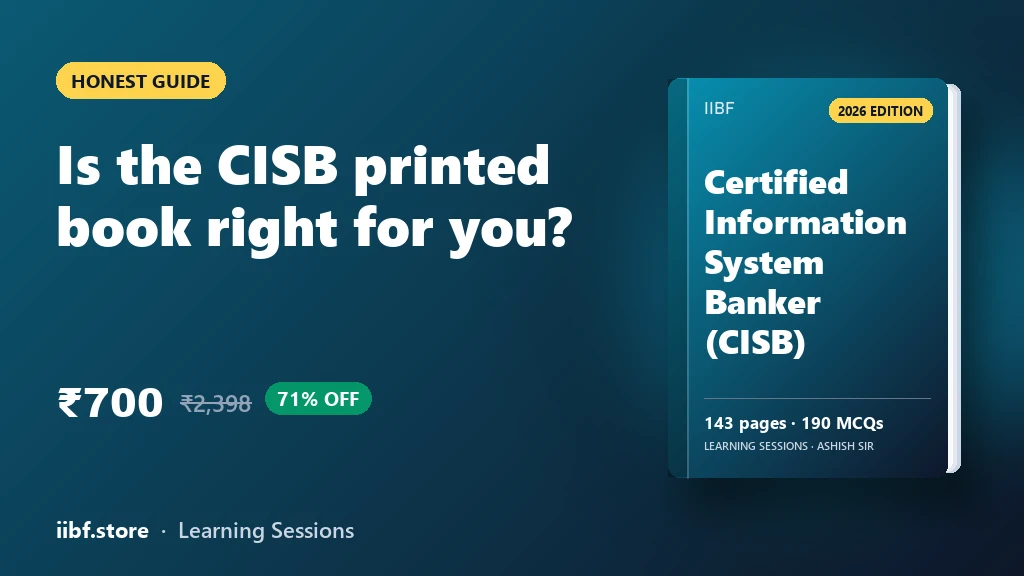
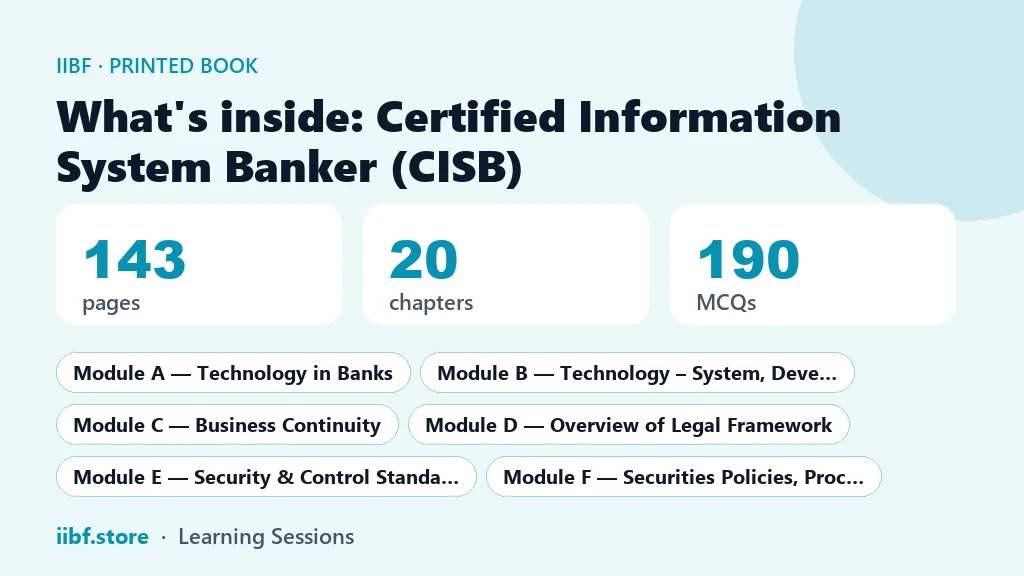
Let us stick to facts. The Certified Information System Banker (CISB) printed book is a 2026 edition running to 143 pages, split into 20 chapters across eight modules, with 190 questions. Alongside the chapters you get 30 case studies (120 questions) and 5 mega tests (500 questions).
The modules run in a logical order, which helps if technology is not your home ground:
- Module A covers technology in banks: the banking environment, processing infrastructure, accounting information systems, data organisation, technology risk and the audit function (6 chapters).
- Module B covers hardware architecture, software platforms, the system development life cycle and computer networks (4 chapters).
- Module C is business continuity and disaster recovery planning.
- Module D is the legal framework for online transactions.
- Module E covers security risk and architecture, plus controls and standards.
- Module F covers security policies, compliance, incident management and network security.
- Module G covers information security administration and information systems audit.
- Module H collects post-cutoff dated updates.
A short book like this is a tool for revision and first-pass understanding. It is not a substitute for reading the official material when a topic puzzles you. Use it to get the shape of the subject quickly, then go deeper where you are weak.
Profile 1: the first-attempt candidate
If this is your first try, your biggest risk is not the difficulty. It is vocabulary shock. Terms like SDLC, RAID, disaster recovery site and IS audit sound frightening until you have seen each one explained in a banking context.
How to use the book
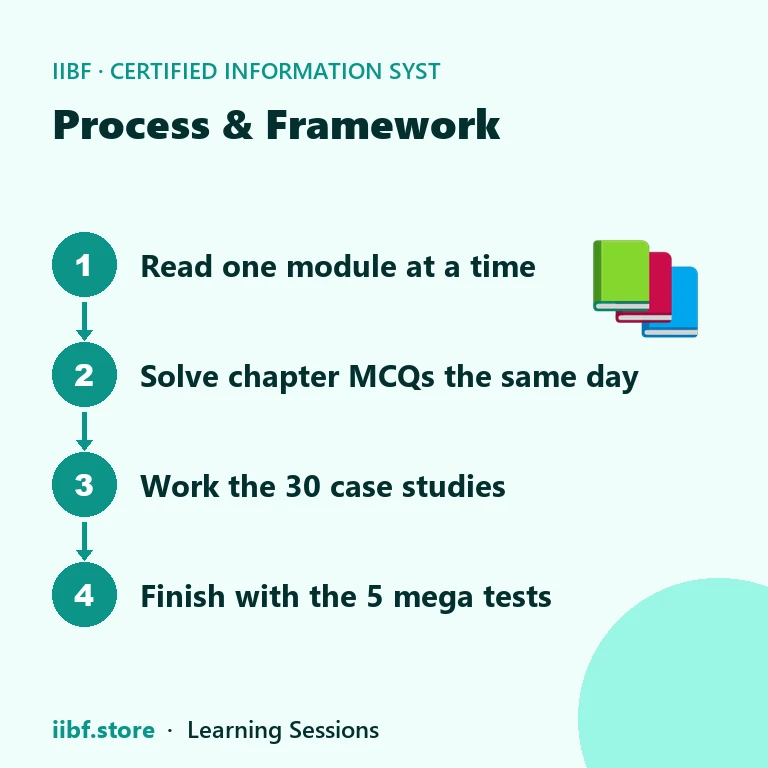
Read module by module, in order. Do not skip Module A even if it feels basic, because the later technical chapters assume its vocabulary. After each chapter, close the book and write three lines in your own words. Then attempt that chapter's questions the same day.
When it is not enough on its own
A first-timer has never felt exam-hall pressure. Reading 20 chapters will not give you speed. Add timed practice from the free mock tests as soon as you finish Module B, not after the whole syllabus.
Profile 2: the repeat-attempt candidate
You have been here before. You studied, you sat the paper, and the result was not what you wanted. Bad memory is rarely the cause. More often you studied by reading, but the exam tests by recognising and applying.
How to use the book
Do not re-read from page one. Start from the questions. Attempt the 30 case studies first and mark every question you get wrong or guess right. Those marks tell you which modules to reread. A compact CISB exam preparation book suits this style well, because you can go back to a single chapter in twenty minutes.
When it is not enough on its own
If you failed last time on time management rather than knowledge, no book fixes that. You need full-length practice under a timer. The 5 mega tests (500 questions) in the pack are built for this, and you should treat them as real papers: no phone, no pausing.
Profile 3: short on time with the CISB exam preparation book
Some of you will read this with the exam cycle already close and a branch that will not let you take leave. For you, a short syllabus-aligned book can be a rescue, but only with a disciplined plan.
Here is a method that works with a full-time job:
- Spend the first week on Modules A and B. They hold 10 of the 20 chapters, so they carry the most weight in your preparation time.
- Cover Modules C, D and E in the second week. These are shorter and more conceptual.
- Take Modules F, G and H in the third week, then attempt the case studies.
- Keep the last days for mega tests and error review only. No new reading.
The honest limit here: if you have only a few days left, no single book will make up for lost weeks. Prioritise the questions, rely on understanding, and be realistic about whether to sit this cycle or the next. There is no shame in choosing a better-prepared attempt.
Profile 4: the reader who prefers paper
You spend nine hours a day on a screen already. Reading a PDF at night makes your eyes ache and your attention drift. If that is you, a printed copy is not a luxury, it is a method. You can underline, fold a page, write a margin note and carry it in a bag without a charger.
How to use the book
Keep a pencil with it and treat it as a working document. Mark every term you could not define aloud. Revisit only the marked pages in your last week. By exam week the book itself becomes your list of weak areas.
When it is not enough on its own
Paper cannot time you or shuffle questions. Pair it with online practice from the mock test section, and browse the free material library for extra notes before you decide whether you need anything more.
Who should skip this CISB exam preparation book
Trust is built by saying no when it is the right answer. This book may not suit you if:
- You want a thick reference to read for deep technical expertise. This is an exam-oriented companion, not a textbook for IT professionals.
- You are not willing to attempt questions. Reading alone passes very few papers.
- You already have material you trust and finish. Switching books late is usually a mistake.
If you are unsure, read the free sample first. It exists so you can judge the writing style and depth before spending anything.
Price, and how to decide
At the time of writing, the CISB printed book is listed at ₹700 against an MRP of ₹2,398, which is 71% off. Prices may change, so treat the book page as the current source. You can also compare other titles on the books page.
| Your situation | Start with | Add alongside |
|---|---|---|
| First attempt | Modules A to H in order | Free mock tests after Module B |
| Repeat attempt | Case studies first, then weak modules | 5 mega tests under a timer |
| Short on time | Three-week module plan | Error review, no new reading |
| Prefers paper | Printed copy with pencil marks | Online mocks for speed |
For more study-method articles like this one, visit the iibf.store blog.
The bottom line
A book is only as good as the plan around it. The CISB exam preparation book gives you a compact, module-wise structure with questions, case studies and mega tests. It will not give you exam-hall speed on its own, and it will not replace the official syllabus on the IIBF site. Used with a realistic schedule and regular mock practice, it can be the one resource you actually finish. Pick the profile above that sounds most like you, follow its plan, and judge the book by what you retain, not by its price.
Frequently asked questions
Is one book enough to pass the CISB exam?
For most candidates, a book alone is not enough. Pair it with timed mock tests so you build speed and learn where you lose marks. Check the official IIBF site for the latest syllabus.
How many chapters and questions does the book have?
It has 20 chapters across eight modules in 143 pages, with 190 questions. The pack also includes 30 case studies (120 questions) and 5 mega tests (500 questions).
I come from a non-technical background. Will I cope?
Yes, if you go in order. Module A builds the vocabulary that later technical chapters assume, so do not skip it. Take the chapters in small daily portions and write short notes in your own words.
Can I check the book before buying?
Yes, a free sample is available on the book page. Read it to judge the depth and style, and remember that prices may change, so the book page is always the current reference.
Prefer revising from a printed book?
Chapter-wise books with MCQs after every chapter — minimal pages, complete coverage, delivered anywhere in India. Every book has a free sample to read first.


















































Practice this topic
Take a free mock test, download chapter PDFs, or watch a video class — all included on iibf.store.
Keep reading