Code of Conduct for Bankers: IIBF Ethics Exam Guide 2026
Every bank employee signs up to more than a job description — they accept a code of conduct for bankers that governs how they treat customers, handle money and represent the institution. For the IIBF Ethics exam, this code is not a side topic; it is the backbone that links work ethics, ethical dilemmas and disciplinary policy into one testable framework. This guide breaks down what the code covers, how it compares with related governance frameworks, and where aspirants most often lose marks.
📜 What Is a Code of Conduct for Bankers?
A code of conduct for bankers is a written set of behavioural standards that every officer and employee of a bank is expected to follow, irrespective of rank or department. It typically draws on the IBA's model code, RBI supervisory expectations and each bank's own HR and vigilance manuals. Unlike a law or regulation that binds the institution as a whole, the code speaks to individual conduct: how you handle a customer's confidential information, whether you disclose a personal interest before processing a loan, and how promptly you report a suspicious transaction.
The IIBF syllabus treats this as the practical, day-to-day layer of ethics — distinct from board-level governance. The Work Ethics and the Workplace chapter is the natural starting point, since most exam questions on the code test how a stated principle applies to a specific workplace scenario rather than asking for a bare definition.
🤝 Core Principles Bank Employees Must Follow
Most codes converge on the same handful of principles: integrity in every transaction, confidentiality of customer and bank data, fair and non-discriminatory dealing with all customers, avoiding conflicts between personal interest and official duty, maintaining professional competence, and promptly escalating suspected misconduct through proper channels. Employees are also expected to avoid outside activities — moonlighting, unauthorised investments, or accepting favours — that could compromise their judgment.
💡 Exam Tip: Questions often present a scenario (a relative applying for a loan, a vendor offering a gift) and ask which principle is violated — read for the underlying conflict, not just the surface act.
These principles are meant to be lived, not merely filed away, which is why the Building an Ethical Organization chapter pairs the code with induction training, periodic refreshers and visible leadership commitment. A code that exists only on paper rarely survives contact with real pressure — from a demanding customer, a target-driven manager, or a colleague cutting corners.
⚖️ Code of Conduct vs Other Ethics Frameworks
Aspirants frequently confuse the individual code of conduct with the board-level and institutional frameworks that sit alongside it. The table below separates them by scope and disclosure requirement.
| Framework | Primary Focus | Applies To | Publicly Disclosed? |
|---|---|---|---|
| Code of Conduct for Bankers | Individual integrity, confidentiality, fair dealing | Every officer and employee | ❌ Internal HR/vigilance document |
| Corporate Governance in Banking | Board oversight, strategy, accountability | Board of directors, senior management | ✅ Disclosed in annual report |
| Whistle-Blower Policy | Safe channel to report suspected wrongdoing | All employees and stakeholders | RBI-mandated disclosure |
| ESG / Sustainability Framework | Environmental and social impact of banking activity | The bank as an institution | BRSR / ESG reporting |
Notice the pattern: the code of conduct is the only one of the four that is enforced against a named individual rather than the institution, which is exactly why IIBF questions test it through personal-scenario framing.
🚨 Common Violations and Disciplinary Consequences
Typical breaches include accepting gifts or favours beyond the permitted threshold, sharing confidential customer data, trading on non-public information about the bank's own securities, processing a transaction for a relative without disclosure, and failing to escalate a red flag noticed during KYC verification. Harassment, discrimination and unauthorised absence also fall squarely within the code's ambit.
⚠️ Common Mistake: Candidates often assume every violation triggers dismissal. In practice, disciplinary action is graded — an oral or written warning for a first minor lapse, censure or increment stoppage for repeated lapses, and suspension or dismissal only for serious or repeated violations.
Where a violation also amounts to a criminal act — bribery, forgery, embezzlement — the matter is referred beyond internal discipline to law enforcement and vigilance authorities. The Ethical Issues of Corruption, Bribery and White-Collar Crime chapter is the reference point IIBF draws on for this graded-response logic, and it repays a close read before the exam.
🌱 Building an Ethical Culture Beyond the Rulebook
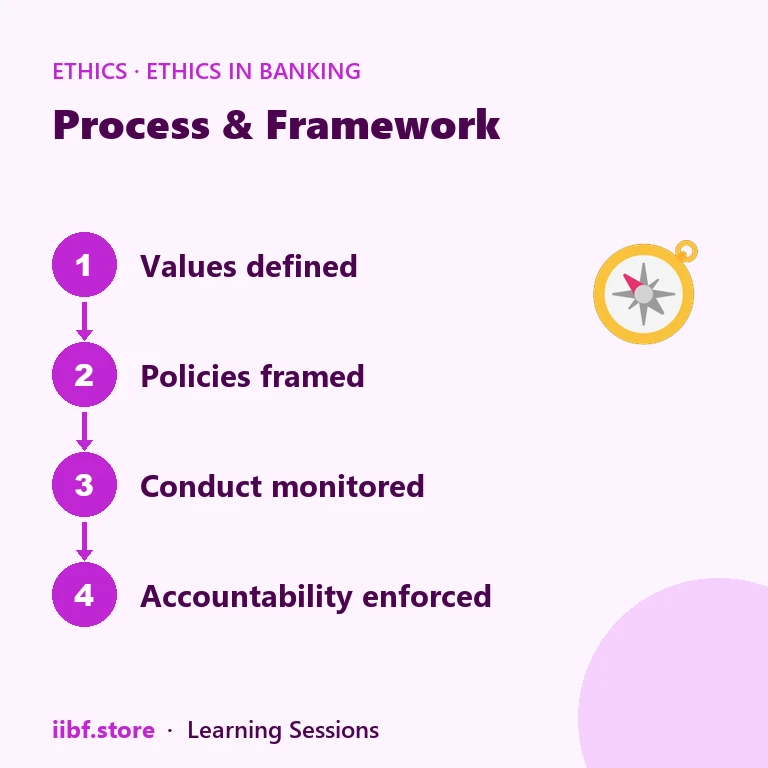
A code of conduct only works when it is reinforced by culture: visible commitment from leadership, case-based ethics training rather than one-time declarations, an accessible reporting channel, and consistent enforcement regardless of an employee's seniority or performance numbers. Banks that treat the code as a compliance checkbox tend to see the same violations recur; banks that discuss real dilemmas in team meetings tend to catch problems earlier.
📌 Remember: The code of conduct and KYC/AML obligations overlap wherever personal ethics meets due diligence — for example, verifying a customer's true beneficial ownership is as much an ethical duty as a regulatory one.
This overlap is explored further in the guide on beneficial ownership identification, and the syllabus ties both back to the broader question of institutional values covered in Ethics: A Holistic Approach. For a deeper library of related topics, browse more Ethics in Banking articles.
Official sources: cross-check the latest syllabus, circulars and rates on the IIBF official website and the Reserve Bank of India.
🧠 Practice MCQs: Code of Conduct for Bankers
Q1. A bank employee accepts a gift from a loan applicant whose file the employee is currently processing. This is primarily a breach of which principle? (a) Professional competence (b) Conflict of interest (c) Data confidentiality (d) Fair dealing with competitors
Answer: (b) — accepting a gift from a party you are deciding on creates a direct conflict between personal benefit and official duty.
Q2. Under a typical code of conduct for bankers, who is expected to comply with the code? (a) Only the board of directors (b) Only branch managers (c) Every officer and employee of the bank (d) Only employees in the credit department
Answer: (c) — the code applies uniformly across ranks and departments, unlike governance frameworks aimed at the board.
Q3. Which of the following is the MOST appropriate first disciplinary response to a first-time, minor code violation? (a) Immediate dismissal (b) Referral to the police (c) Oral or written warning (d) Suspension without pay
Answer: (c) — disciplinary action is graded, with warnings reserved for minor first lapses and suspension/dismissal for serious or repeated ones.
Q4. A violation of the code of conduct that also amounts to bribery should be handled by: (a) The branch manager alone, informally (b) Internal HR action plus referral to law enforcement/vigilance where warranted (c) No action, since bribery is a personal matter (d) A verbal reminder only
Answer: (b) — criminal conduct such as bribery goes beyond internal discipline and is escalated to vigilance and law-enforcement channels.
Q5. Which factor most strengthens an ethical culture beyond a written code of conduct? (a) A longer rulebook (b) Visible leadership commitment and case-based training (c) Stricter dress code (d) Reducing the number of reporting channels
Answer: (b) — culture is reinforced through leadership example and practical, scenario-based training, not merely documentation.
Want chapter-wise mock tests with 100+ MCQs? Start practising free →
Is the code of conduct for bankers a legal requirement or an internal policy?
It is primarily an internal HR and vigilance policy, though it draws on IBA model guidelines and RBI supervisory expectations, and serious breaches can also attract legal consequences.
Does the code of conduct apply differently to senior management?
No — the core principles apply uniformly to every employee, though senior staff often face additional disclosure obligations given their decision-making authority.
What is the difference between the code of conduct and corporate governance in banking?
The code of conduct governs individual employee behaviour, while corporate governance concerns board-level oversight, strategy and accountability to shareholders and regulators.
How does the IIBF Ethics exam test the code of conduct?
Mostly through scenario-based questions that ask candidates to identify which principle is breached and what disciplinary response is appropriate, rather than testing rote definitions.
🎯 Ace the IIBF Ethics Exam
The code of conduct for bankers ties together nearly every other topic in this subject — from workplace ethics to disciplinary process — so a solid grip on it pays off across the paper. Reinforce these concepts with timed practice at iibf.store/tests before exam day.
Quick quiz on this topic
5 exam-style questions from our free test bank — check yourself before you move on.
Practice this topic
Take a free mock test, download chapter PDFs, or watch a video class — all included on iibf.store.