Ethical Decision-Making Framework for Bankers: IIBF Ethics Guide (2026)
Every branch manager eventually faces a moment where the compliance manual runs out of answers — a valued customer wants a rule bent, a colleague hints at a shortcut, or two policies point in opposite directions. This is exactly where an ethical decision-making framework for bankers earns its keep: a repeatable method for reasoning through grey areas instead of guessing under pressure. For IIBF's Ethics in Banking paper, examiners increasingly frame questions as branch-level scenarios rather than definitions, so candidates who can walk through a structured framework — not just recite values — score higher on application-based questions.
🧭 Why Bankers Need a Structured Ethical Decision-Making Framework
Banking decisions rarely fail because staff don't know right from wrong in the abstract — they fail because pressure, incomplete information, and competing loyalties cloud judgment in the moment. A loan officer under monthly target pressure, a teller asked to waive a KYC step for a "regular" customer, or a manager told to look past a director's related-party transaction — each situation has a textbook right answer, but the textbook isn't open when the phone rings. A structured framework closes that gap by giving staff a fixed sequence of questions to run through regardless of how much time or seniority they have.
This is also why the topic sits inside the Work Ethics and the Workplace chapter rather than being treated as a standalone concept — the framework only has value when it is applied at the desk, not in a training-room discussion. Banks that embed a shared decision model reduce the variance between how a junior clerk and a zonal head handle the same dilemma, which is precisely the consistency regulators look for during governance reviews.
💡 Exam Tip: When IIBF gives you a scenario question, look for which stage of the framework the "wrong" option skips — most distractor answers jump straight from noticing a problem to acting, skipping the evaluation step entirely.
⚖️ The Four-Step Model: Identify, Evaluate, Decide, Review
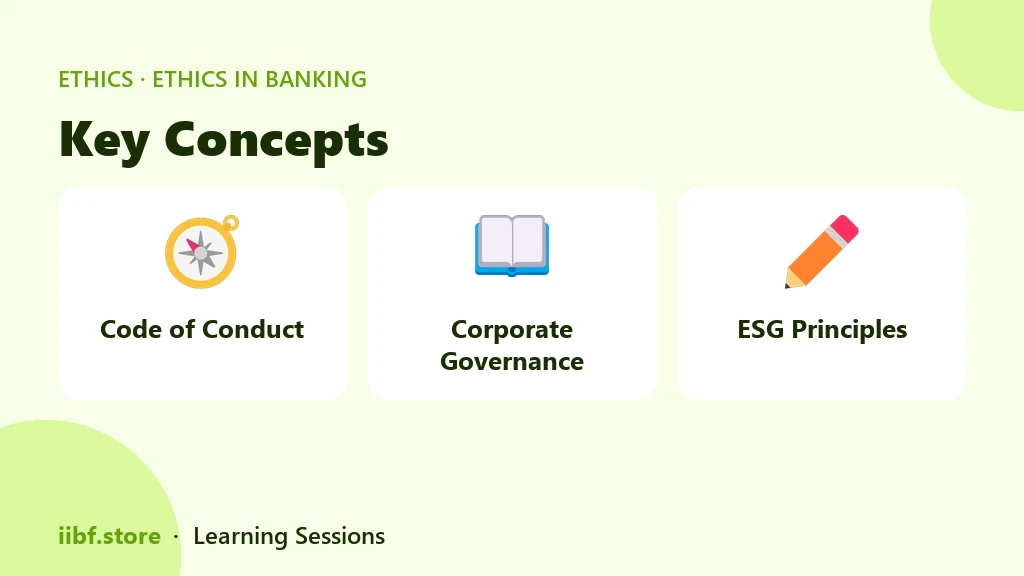
Most ethical decision-making frameworks taught in banking ethics courses collapse into four practical stages. Identify means naming the actual conflict — is it a conflict of interest, a regulatory breach, or simply an uncomfortable customer request? Many staff skip this and jump to a solution for the wrong problem. Evaluate means weighing the decision against the bank's code, the law, and the impact on each stakeholder — customer, bank, colleague, and regulator — rather than against personal comfort alone.
Decide is the step where the framework earns its name: choose the option that survives disclosure, meaning it would still look defensible if written up in an internal audit note or reported to the board. Review closes the loop — document what was decided and why, and flag it upward if the situation is likely to repeat, since a one-off exception that isn't escalated quietly becomes an informal policy.
This sequence maps closely onto the reasoning developed in Ethics, Business Ethics and Banking, which frames banking decisions as tests against both business ethics principles and sector-specific regulation simultaneously — a dual check that pure business-ethics theory doesn't require.
⚠️ Common Mistake: Candidates often treat "evaluate" and "decide" as one step and pick the first option that feels reasonable. IIBF questions are built to catch this — read all four options before choosing, since the trap answer is usually the one that "feels right" but skips a stakeholder.
🏦 Applying the Framework to Real Branch Dilemmas
Consider three situations examiners like to test. First, a long-standing customer offers a small gift after a loan is sanctioned — the framework asks whether accepting it, even informally, creates a perception problem for the next similar customer, not just whether the value crosses a rupee threshold. Second, a staff member suspects a colleague is manipulating account opening documents to hit onboarding targets — the framework requires escalation through the proper internal channel rather than a private warning, because silence here becomes complicity if discovered later. Third, a branch is asked to push a product that technically suits the customer but pays the staff a disproportionately high incentive — the review stage forces the question of whether the sale would still happen if the incentive were removed.
These scenarios are exactly why Building an Ethical Organization matters as a companion chapter — a framework only works reliably when the organization around the individual supports escalation instead of punishing it. An employee who applies the four steps correctly but works in a culture that penalizes flagged issues will quietly stop using the framework within a few months.
📌 Remember: The framework protects the employee too — a documented, step-by-step rationale is far stronger evidence of good faith during an internal inquiry than "I thought it seemed fine."
📋 How IIBF Exams Test Ethical Decision-Making
IIBF's Ethics in Banking paper leans heavily on situational and case-based questions in its later sections, and framework-style questions specifically test whether a candidate can sequence their reasoning rather than just identify the "correct value." Expect questions that give you a scenario and four possible first actions, where the distractors are ordered correctly-sounding but skip a stage — for instance, an option that goes straight to reporting a colleague to HR without first verifying facts internally, or one that resolves a conflict of interest by simply disclosing it without recusing from the decision.
According to the Reserve Bank of India's broader governance expectations for regulated entities, individual decision-making processes are expected to be documented and auditable rather than left to informal judgment — a principle that reinforces why IIBF tests the sequencing of a framework rather than just its existence. You can review RBI's public guidance on governance standards at rbi.org.in for the regulatory backdrop behind these expectations.
The table below contrasts the two dominant approaches candidates are expected to distinguish between in exam scenarios.
| Dimension | Rules-Based Approach | Values-Based (Framework) Approach |
|---|---|---|
| Handles grey-area scenarios well | ❌ Struggles when no rule exists | ✅ Built for ambiguity |
| Decision speed | ✅ Fast, checklist-driven | ❌ Slower, requires reasoning |
| Consistency across branches | ✅ High if rules are followed | ✅ High if framework is trained well |
| IIBF exam emphasis (situational Qs) | ❌ Lower weight | ✅ Higher weight |
| Requires ongoing staff training | ❌ Minimal | ✅ Significant |
Notice that a rules-based approach isn't wrong — it's simply insufficient on its own, which is the exact point IIBF scenario questions are designed to test. A well-prepared candidate treats the two approaches as complementary rather than competing, since rules cover the majority of routine transactions while the framework exists precisely for the minority of cases rules don't anticipate.
For the surrounding governance context that shapes how banks formalize these frameworks internally, revisit our guide on conflict of interest in banking alongside this piece — the two topics are frequently tested together in the same case-study block.
🧠 Practice MCQs: Ethical Decision-Making Framework
Q1. In a structured ethical decision-making framework, which stage is most commonly skipped by employees acting under time pressure? (a) Identify (b) Evaluate (c) Decide (d) Review
Answer: (b) — Under pressure, staff tend to jump from noticing a problem straight to a decision, skipping the evaluation of stakeholders and regulatory impact.
Q2. A teller accepts a small gift from a customer after loan disbursal without reporting it. Which stage of the framework was violated? (a) Identify (b) Evaluate (c) Decide (d) Review
Answer: (d) — Failing to document and escalate the incident breaks the review stage, even if the initial acceptance seemed minor.
Q3. Which of the following best describes a "values-based" ethical framework as opposed to a pure rules-based approach? (a) Faster decisions in all cases (b) Reliance only on the compliance manual (c) Reasoning applied to situations rules do not explicitly cover (d) Ignoring regulatory guidance
Answer: (c) — A values-based framework is designed specifically for scenarios where no explicit rule applies.
Q4. An employee suspects a colleague is falsifying onboarding documents but decides to privately warn them instead of escalating. This choice fails the framework at which stage? (a) Identify (b) Evaluate (c) Decide (d) Review
Answer: (c) — The correct decision requires escalation through proper internal channels; a private warning does not survive the "would it look defensible if disclosed" test.
Q5. Why does IIBF favor scenario-based questions over definitional ones for testing ethical decision-making? (a) Scenarios are easier to grade (b) Scenarios test sequencing and application of reasoning, not just recall (c) Definitions are outdated (d) Scenarios require no regulatory knowledge
Answer: (b) — Scenario questions test whether a candidate can correctly sequence a decision process under realistic ambiguity, not merely recall a definition.
Want chapter-wise mock tests with 100+ MCQs? Start practising free →
❓ Frequently Asked Questions
What is an ethical decision-making framework in banking?
It is a structured, repeatable sequence — typically identify, evaluate, decide, and review — that employees use to reason through situations where no explicit rule provides a clear answer.
How is this topic tested in the IIBF Ethics in Banking exam?
Mostly through scenario-based questions where candidates must choose the correct first action or identify which stage of the framework a given response skips.
Is a rules-based approach enough on its own?
No — rules-based approaches handle routine, well-defined situations efficiently but cannot cover every grey area, which is why banks pair them with a values-based framework for ambiguous cases.
Why does documentation matter in the "review" stage?
A documented rationale protects both the bank and the employee during internal audits or inquiries, and prevents informal exceptions from silently becoming unwritten policy.
Mastering this framework isn't just exam prep — it's the reasoning tool you'll actually reach for at the counter. Sharpen it further with full-length chapter tests on iibf.store/tests, or explore the complete CAIIB course for structured, chapter-wise coverage of every ethics topic. For more on related exam themes, browse the Ethics in Banking tag hub, including our guides on whistle-blower policy and code of conduct for bankers.
Prefer revising from a printed book?
Chapter-wise books with MCQs after every chapter — minimal pages, complete coverage, delivered anywhere in India. Every book has a free sample to read first.
132 pages · 225 MCQs
Learning Sessions · Ashish Sir
188 pages · 435 MCQs
Learning Sessions · Ashish Sir
117 pages · 236 MCQs
Learning Sessions · Ashish Sir
Learning Sessions · Ashish Sir
118 pages · 299 MCQs
Learning Sessions · Ashish Sir
Learning Sessions · Ashish Sir
Learning Sessions · Ashish Sir
Learning Sessions · Ashish Sir
115 pages · 255 MCQs
Learning Sessions · Ashish Sir
Learning Sessions · Ashish Sir
334 pages · 936 MCQs
Learning Sessions · Ashish Sir
Learning Sessions · Ashish Sir
115 pages · 344 MCQs
Learning Sessions · Ashish Sir
107 pages · 240 MCQs
Learning Sessions · Ashish Sir
90 pages · 150 MCQs
Learning Sessions · Ashish Sir
Learning Sessions · Ashish Sir
131 pages · 672 MCQs
Learning Sessions · Ashish Sir
221 pages · 831 MCQs
Learning Sessions · Ashish Sir
128 pages · 524 MCQs
Learning Sessions · Ashish Sir
107 pages · 445 MCQs
Learning Sessions · Ashish Sir
148 pages · 478 MCQs
Learning Sessions · Ashish Sir
151 pages · 465 MCQs
Learning Sessions · Ashish Sir
148 pages · 375 MCQs
Learning Sessions · Ashish Sir
216 pages · 895 MCQs
Learning Sessions · Ashish Sir
109 pages · 300 MCQs
Learning Sessions · Ashish Sir
104 pages · 360 MCQs
Learning Sessions · Ashish Sir
82 pages · 297 MCQs
Learning Sessions · Ashish Sir
151 pages · 600 MCQs
Learning Sessions · Ashish Sir
98 pages · 282 MCQs
Learning Sessions · Ashish Sir
Quick quiz on this topic
5 exam-style questions from our free test bank — check yourself before you move on.
Practice this topic
Take a free mock test, download chapter PDFs, or watch a video class — all included on iibf.store.