
Five Functions of Management for CAIIB ABFM Explained
The five functions of management — Planning, Organising, Staffing, Directing and Controlling — form one of the most consistently tested topics in CAIIB Advanced Business and Financial Management (ABFM). Every year, candidates lose easy marks by mixing up Organising with Staffing, or by forgetting that Controlling closes the loop back to Planning. This guide breaks down the five functions of management the way IIBF actually frames them in the CAIIB ABFM syllabus, with the distinctions examiners like to test and a quick-reference table you can revise the night before the exam.
📋 Planning: Where the Five Functions of Management Begin
Planning is the starting point of the entire management process, and it is almost always the first of the five functions of management that CAIIB ABFM candidates encounter. It is the intellectual, forward-looking function — deciding in advance what is to be done, when it is to be done, and who will do it. A bank branch manager setting a quarterly deposit-mobilisation target, or a treasury team building a liquidity forecast, is exercising the planning function. Planning is not a one-time event; it is a continuous process of setting objectives, forecasting the environment, evaluating alternatives, and choosing the most efficient course of action.
CAIIB examiners frequently test the characteristics of planning: it is pervasive (done at every level), it is futuristic, and it is the basis on which the remaining four functions rest — you cannot organise resources or direct people toward a goal that was never planned. The detailed chapter on Planning covers the types of plans (strategic, tactical, operational), the steps in the planning process, and common barriers such as rigid policies or inadequate information. Read it alongside the basic of management chapter, which sets up the vocabulary — objectives, policies, procedures and standards — that recurs across every other function.
💡 Exam Tip: If a CAIIB question describes an activity as "deciding in advance," the answer is almost always Planning — even if the scenario is dressed up in a banking context like credit appraisal or budget preparation.
🗂️ Organising and Staffing: Building the Structure
Once a plan exists, management has to build the structure that will carry it out — that is the Organising function. Organising means identifying the activities required to achieve the objective, grouping them into departments or roles, assigning authority, and establishing relationships so people know who reports to whom. Concepts like span of control, delegation, departmentation and the scalar chain all live inside this function. In a bank, deciding whether credit processing sits centrally at a hub or is delegated to branch-level officers is a classic organising decision. The chapter on Organising works through formal versus informal organisation structures and the principles of sound organisational design.
Staffing is the function candidates most often confuse with Organising, and it is a favourite CAIIB trap. Organising creates the positions on the chart; Staffing fills them with the right people. Staffing covers manpower planning, recruitment, selection, training, placement and performance appraisal — essentially, matching the right person to the right role and keeping that match current through career development. The dedicated STAFFING chapter walks through the staffing process step by step, from manpower forecasting to separation, and is worth reading immediately after Organising so the boundary between the two stays sharp in your mind.
⚠️ Common Mistake: Candidates often tag recruitment and training questions as "Organising" because both deal with people. Remember — Organising is about structure and roles; Staffing is about the people who occupy them.
🎯 Directing: Turning Plans Into Action
Directing is the function that converts a plan on paper into performance on the ground. It is the executive, people-facing function of management, and CAIIB ABFM groups four elements under it: supervision, motivation, leadership and communication. A manager directing a team is not just issuing instructions — they are guiding, inspiring and communicating with subordinates so that individual effort aligns with organisational objectives. Because Directing happens continuously at every level of the hierarchy, and because it deals directly with human behaviour, it is often described as the function that "actuates" the organisation into movement.
The DIRECTING chapter is where leadership theories, motivation models and communication barriers are covered in detail — this is also the section most likely to overlap with behavioural-finance-adjacent questions in ABFM, so read it carefully rather than skimming. Directing is closely linked to Staffing (you can only lead people once they are in place) and it feeds directly into Controlling, since supervision naturally surfaces the gaps that controlling later measures formally.
📌 Remember: Planning and Organising are largely "thinking and structuring" functions performed before work starts; Directing and Controlling are "doing and checking" functions performed while and after work is in progress.
🔍 Controlling: Closing the Management Loop
Controlling is the fifth and final function, and it is what turns management into a genuine cycle rather than a straight line. Controlling means measuring actual performance against the standards set during planning, identifying deviations, analysing their causes, and taking corrective action. In banking terms, this is exactly what happens when a branch's actual disbursement figures are compared against the budgeted target at month-end, or when a variance in NPA levels triggers a review of the credit process. Because the corrective action from Controlling often feeds straight back into a revised plan, this function is what closes — and restarts — the management cycle.
The Controlling chapter details the control process (setting standards, measuring performance, comparing, correcting) and the common control techniques such as budgetary control, statistical reports, break-even analysis and management information systems (MIS). Candidates should also note that while Planning is essentially forward-looking, Controlling is backward-looking in its measurement but forward-looking in its corrective intent — a nuance CAIIB likes to probe with "which statement is most accurate" style questions.
Once the five functions of management are settled in your head as a connected cycle rather than five isolated topics, related CAIIB ABFM material becomes far easier to place. For instance, capital allocation decisions studied under capital structure theories are ultimately outputs of the Planning function, performance metrics like economic value added EVA are Controlling-function tools used to measure whether value was actually created, and asset-acquisition choices covered under lease versus buy decision analysis are classic Planning-stage evaluations before Organising ever begins. On the risk side, decisions such as the sale of stressed assets to ARCs in CAIIB Risk Management show the same Planning-Organising-Controlling logic applied to balance-sheet clean-up rather than day-to-day operations.
📊 Five Functions of Management at a Glance
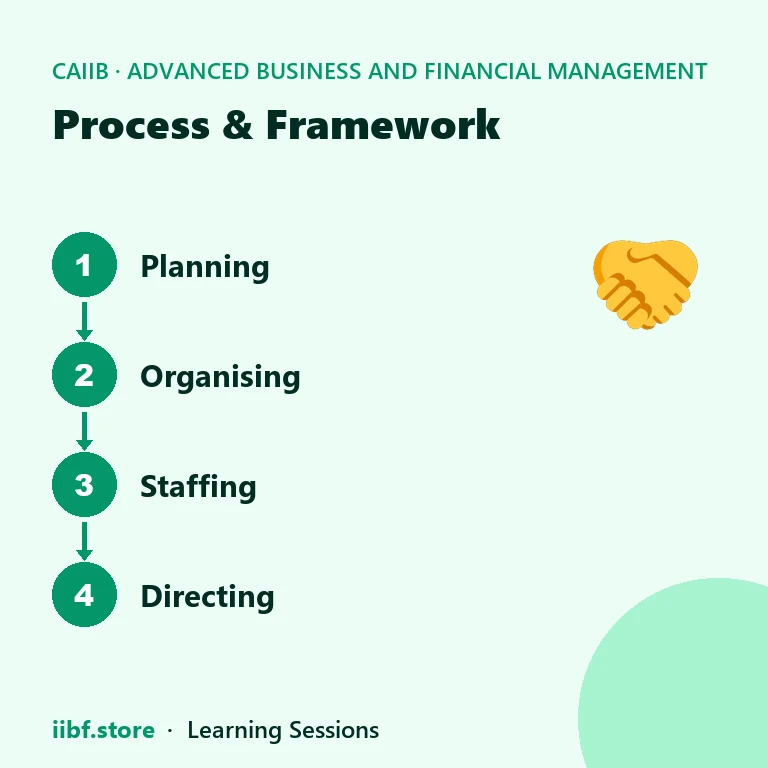
| Function | Core Question It Answers | Key Tools / Activities | Primarily People-Focused? |
|---|---|---|---|
| Planning | What must be done, and how? | Forecasting, objective-setting, budgeting, SWOT analysis | ❌ |
| Organising | Who does what, and who reports to whom? | Org charts, departmentation, delegation, span of control | ❌ |
| Staffing | Who is best suited for each role? | Recruitment, selection, training, appraisal | ✅ |
| Directing | How is action guided day to day? | Leadership, motivation, supervision, communication | ✅ |
| Controlling | Did we achieve what we planned? | Budgetary control, variance analysis, MIS reports | ❌ |
For the official CAIIB examination structure and the current ABFM syllabus weightage, always cross-check against IIBF's own published material at iibf.org.in rather than relying on secondhand notes, since paper structures are revised from time to time.
🧠 Practice MCQs: Five Functions of Management
Q1. Which function of management is described as the "bridge" between organising and controlling because it involves guiding and motivating subordinates? (a) Planning (b) Staffing (c) Directing (d) Controlling
Answer: (c) — Directing actuates the organisation by translating structure and plans into actual performance through leadership and motivation.
Q2. Fixing the span of control and delegating authority among positions falls under which function of management? (a) Planning (b) Organising (c) Staffing (d) Controlling
Answer: (b) — Organising deals with grouping activities, assigning authority, and defining reporting relationships.
Q3. Which management function is essentially forward-looking and involves setting objectives and deciding a course of action in advance? (a) Controlling (b) Directing (c) Planning (d) Staffing
Answer: (c) — Planning is the intellectual, anticipatory function that precedes all other management activity.
Q4. Recruitment, selection, training and performance appraisal are core activities under which function? (a) Organising (b) Staffing (c) Directing (d) Planning
Answer: (b) — Staffing is concerned with matching the right people to the roles created by the organising function.
Q5. Comparing actual performance against planned standards and taking corrective action describes which function? (a) Planning (b) Organising (c) Directing (d) Controlling
Answer: (d) — Controlling measures performance against standards and closes the loop back to planning.
Want chapter-wise mock tests with 100+ MCQs? Start practising free →
❓ Frequently Asked Questions
Are the five functions of management sequential or continuous?
They are best understood as a continuous cycle rather than a strict sequence. Planning and Organising usually come first, but Directing and Controlling run alongside daily operations, and the output of Controlling routinely feeds back into a fresh round of Planning.
Who is credited with first proposing the functions-of-management framework?
The framework traces back to management theorist Henri Fayol, who identified planning, organising, commanding, coordinating and controlling as the core administrative functions. CAIIB ABFM material presents a simplified five-function version built on this foundation.
How is Staffing different from Organising in CAIIB ABFM?
Organising creates the structure — departments, positions and reporting lines. Staffing fills those positions with suitable people through recruitment, training and appraisal. Structure comes first; people come second.
Why is Controlling called the final link in the management cycle?
Controlling measures actual results against the standards fixed during Planning and triggers corrective action where there is a gap. Because that corrective action typically reshapes the next round of plans, Controlling both closes and restarts the cycle.
Mastering the five functions of management gives you a mental map for a large share of the CAIIB ABFM paper, and it makes related topics — from capital budgeting to performance metrics — far easier to slot into place. Reinforce what you have read here with topic-wise mock questions and full-length CAIIB practice papers through the IIBF CAIIB course on iibf.store, and browse more ABFM coverage on the Advanced Business and Financial Management tag hub.
Quick quiz on this topic
5 exam-style questions from our free test bank — check yourself before you move on.
Practice this topic
Take a free mock test, download chapter PDFs, or watch a video class — all included on iibf.store.
Keep reading



