Forex Dealing Room Operations 2026: Treasury Guide

The forex dealing room is the nerve centre of a bank's treasury — the fast-moving trading floor where currencies are bought and sold, positions are taken, and risk is priced by the second. For candidates preparing for the IIBF Treasury Management certification in 2026, the dealing room is a rich, high-yield topic because it ties together market conventions, organisational controls, risk limits and settlement mechanics in one place. This guide explains how a modern forex dealing room is structured, how dealers manage positions, and how the front, middle and back offices interlock to keep trading safe. Master this and you will comfortably handle both the theory and the scenario questions the exam sets.
A dealing room is not just a row of screens. It is a tightly controlled operation where speed must coexist with discipline. The single most important principle — and the most examined — is the strict segregation of duties between those who trade, those who monitor risk, and those who settle.
The Three-Office Structure: Front, Middle and Back
Every well-run forex treasury separates three functions that must never be combined in one person:
- Front office — the dealers who quote prices, execute trades with counterparties and interbank brokers, and run the bank's currency positions within their limits.
- Middle office — the independent risk and control unit that monitors positions against limits in real time, computes profit and loss, checks rates against the market, and flags breaches.
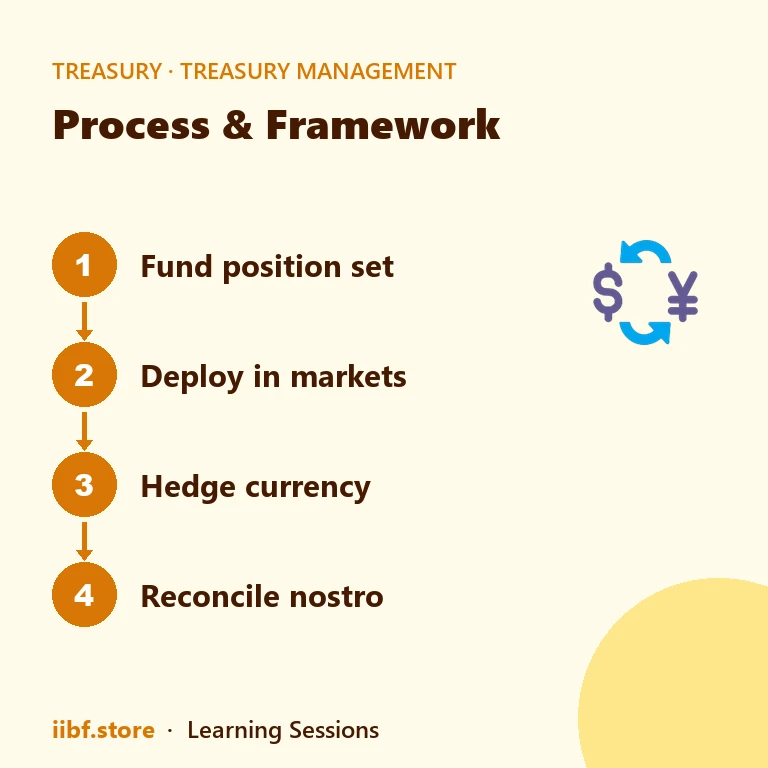
- Back office — the settlement engine that confirms deals, generates payment instructions, reconciles nostro accounts, and completes the accounting.
This separation exists precisely because combining trading and settlement in one desk is how rogue-trading and large hidden losses have historically occurred. The middle office reports independently of the front office, usually into the risk function rather than the trading head, so that no dealer can mark their own homework. Examiners love a question that tests whether you know which task belongs to which office.
Positions, Nostro Accounts and Settlement
A dealer's job is to manage the bank's net open position in each currency. A long position means the bank owns more of a currency than it owes; a short position is the reverse. Both carry exchange-rate risk, so the bank sets an overnight open-position limit and an aggregate gap limit across currencies.
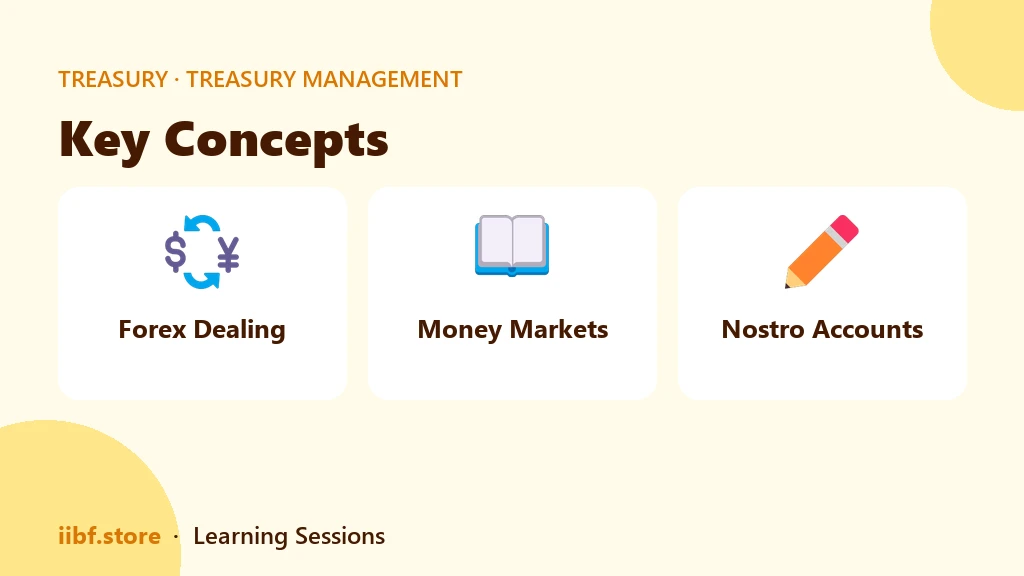
Settlement flows through nostro accounts — the bank's own foreign-currency accounts held with correspondent banks abroad ("our account with you"). Every forex deal must ultimately move money through a nostro, so daily nostro reconciliation by the back office is critical; an unreconciled nostro is an early warning of fraud or error. Understanding the nostro/vostro/loro terminology and the T+2 spot settlement convention is core exam material.
Risk Limits and Dealer Controls
Discipline in the dealing room is enforced through a hierarchy of limits, and the exam frequently asks you to name and define them:
- Open position limits — daylight and overnight caps on how large a net position a dealer or the desk may hold in each currency.
- Aggregate gap limit (AGL) — a ceiling on the sum of mismatches across all maturity buckets, controlling interest-rate and rollover risk.
- Stop-loss limits — the maximum loss a dealer may run before being forced to square the position.
- Counterparty and settlement limits — caps on exposure to each counterparty to control credit and Herstatt (settlement timing) risk.
- Deal-size and tenor limits — caps on individual ticket size and how far forward a dealer may transact.
These limits are set by the board and the Asset Liability Committee, monitored by the middle office, and mapped to the bank's overall risk appetite. The regulatory backdrop — FEDAI market conventions and RBI's master directions on risk management and interbank dealings — is published on rbi.org.in. Candidates strengthening their broader treasury base should pair this with our CAIIB treasury material.
Products, Conventions and Integrated Treasury
A forex dealing room trades far more than simple spot deals. Dealers run forwards to hedge future cash flows, swaps to roll positions and manage liquidity across currencies, and increasingly currency options and futures for clients hedging trade exposures. Market conventions — the two-way quote with bid and offer, pips, the spread that is the dealer's margin, and cross rates derived through a common currency — must be second nature.
In 2026, most banks run an integrated treasury where the forex desk, the money-market desk and the securities desk share a single dealing room and a common view of liquidity and funding. This integration lets the bank arbitrage between rupee and foreign-currency funding and manage its overall balance sheet efficiently. Practise the numerical side — cross rates, forward premia, swap points — with our treasury mock tests, drill the jargon with the terminology matching game, and follow rate movements on the RBI rates page.
Frequently Asked Questions
Related study material
Go deeper with the full chapter notes and the complete article hub for this subject:
Why must front and back office be segregated in a dealing room?
To prevent fraud and hidden losses. If the person who trades also confirms and settles the deal, they can conceal losing positions. Independent settlement and independent middle-office monitoring ensure no dealer can approve or hide their own trades.
What is a nostro account?
A nostro account is a bank's own foreign-currency account held with a correspondent bank abroad — literally "our account with you". All forex settlements flow through nostro accounts, so the back office reconciles them daily to catch errors or fraud early.
What is the aggregate gap limit?
The aggregate gap limit caps the total of maturity mismatches across all time buckets in the forex and funding book. It controls the interest-rate and rollover risk that arises when assets and liabilities in a currency mature on different dates.
What does an integrated treasury mean?
An integrated treasury combines the forex, money-market and securities desks into one dealing room with a shared view of liquidity and funding. It lets the bank arbitrage between rupee and foreign-currency funding and manage its whole balance sheet from a single risk vantage point.
Conclusion: Trade Your Way to Exam Success
The forex dealing room rewards candidates who can map every task to the right office, name the full ladder of risk limits, and explain how positions settle through nostro accounts. Combine that structural clarity with the market conventions and integrated-treasury framing, and the Treasury Management paper becomes far more approachable. Test your command of it now with a full Treasury Management mock test on iibf.store.
Practice this topic
Take a free mock test, download chapter PDFs, or watch a video class — all included on iibf.store.