Integrated Treasury Management: The Complete IIBF Exam Guide
Integrated treasury management is the discipline of running a bank's rupee (domestic) and foreign-exchange treasuries as a single, unified desk rather than as two isolated silos. For candidates preparing for the IIBF Treasury Management examination, this is the central idea that ties together money markets, forex, fixed-income securities and derivatives. In the traditional model, the domestic treasury handled CRR/SLR maintenance and call money, while a separate forex desk managed merchant and interbank currency flows. Integrated treasury management dismantles that wall, placing both books under one dealing room so that liquidity, interest-rate risk and currency risk are viewed together. This article explains why integration matters, how the desk is organised, and what an exam candidate must know cold about instruments, controls and the ALM interface.
Why Banks Moved to Integrated Treasury Management
Before liberalisation, a bank's domestic and forex operations rarely spoke to each other. The rupee desk parked surplus funds in call money, government securities and treasury bills to meet Statutory Liquidity Ratio and Cash Reserve Ratio obligations, while the forex desk squared merchant positions and quoted interbank rates in a world of its own. The problem was obvious: a bank could be borrowing rupees at a high call rate on one floor while holding an idle foreign-currency surplus on another, with no mechanism to swap between the two. Integrated treasury management solves this by merging the two books so that arbitrage between domestic and international markets becomes a deliberate, priced activity rather than an accident.
The trigger was the opening of the capital account and the growth of the rupee-dollar swap market. Once banks could convert foreign-currency funds into rupees (and vice versa) through the swap market, the cost of funds in one currency directly influenced the other. A dealer running an integrated book can raise dollars offshore, swap them into rupees, and deploy the proceeds in the domestic financial market if that is cheaper than borrowing rupees outright. Integration also concentrates risk measurement: a single mid-office can compute the bank's aggregate value-at-risk across rupee and currency exposures, which is impossible when the books are fragmented. This unified view is precisely why the Reserve Bank of India encouraged banks to set up integrated treasuries, and why the topic anchors the IIBF syllabus.
Structure of the Dealing Room: Front, Mid and Back Office
The operational backbone of integrated treasury management is the three-way separation of duties across the front office, mid office and back office. This segregation is not bureaucratic overhead; it is the primary control that prevents the kind of rogue-trading losses that have felled banks worldwide. Understanding the scope and function of treasury management begins with knowing who does what and, crucially, who is forbidden from doing what.
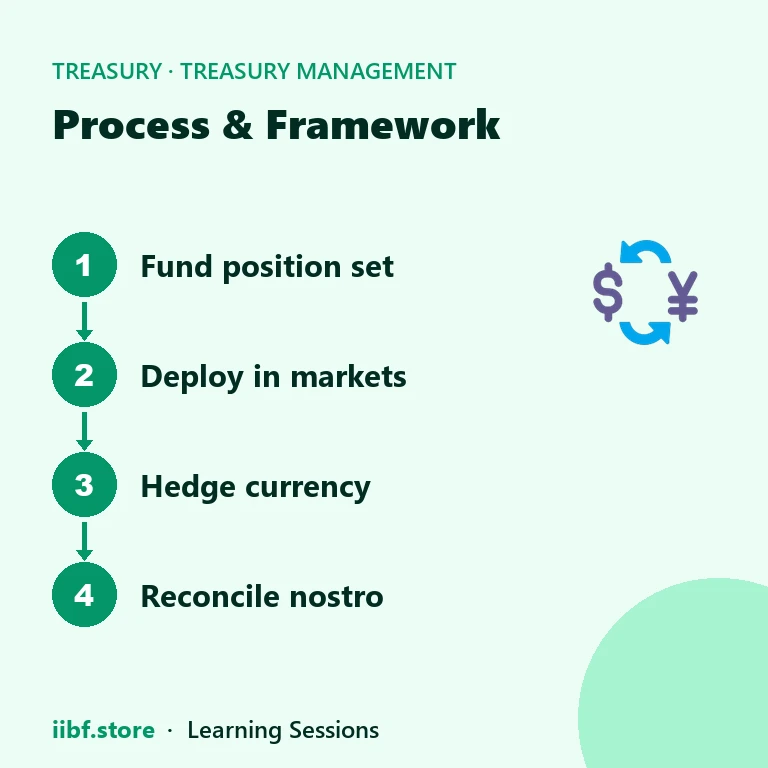
The front office is the dealing room proper. Dealers quote prices, take positions in forex, money market and securities, and execute trades within board-approved limits. The mid office is the risk-and-compliance nerve centre: it independently marks positions to market, monitors exposure against limits, computes value-at-risk, and reports breaches to management. The back office confirms, settles and reconciles every deal, generates accounting entries, and handles nostro/vostro reconciliation. The cardinal rule is that a dealer must never settle their own trade — the front office and back office report through entirely separate lines, often up to different senior executives, so that no single person can both create and hide a position. Deal slips, time-stamped conversations and straight-through processing all exist to enforce this separation. In the exam, expect direct questions on which office performs mark-to-market (mid), which confirms deals (back), and which takes positions (front).
Instruments Across Money, Forex and Debt Markets
An integrated treasury deals across a wide instrument set, and the exam rewards candidates who can slot each instrument into the right market. The money market covers short-term rupee liquidity: call and notice money (overnight to 14 days), treasury bills issued by the government in 91, 182 and 364-day tenors, commercial paper issued by corporates, certificates of deposit issued by banks, and collateralised borrowing through the tri-party repo (TREPS) and market repo. These instruments let the treasury fine-tune its Cash Reserve Ratio and Statutory Liquidity Ratio position day to day.
The forex market handles spot, forward and swap transactions in currency pairs, with merchant deals (customer-driven) squared in the interbank market. The debt market covers government securities and corporate bonds, where the treasury must manage price risk using duration and convexity — a bond's price sensitivity to yield changes rises with duration and is refined by convexity. The table below maps the major instruments to their markets and typical tenors. Note that specific ratios such as CRR and SLR are set by the RBI and revised from time to time, so a candidate should quote the framework and consult the current figures rather than memorise a stale number.
| Instrument | Market Segment | Typical Tenor | Primary Purpose |
|---|---|---|---|
| Call / Notice Money | Money Market | Overnight to 14 days | Very short-term liquidity, CRR management |
| Treasury Bills | Money Market | 91 / 182 / 364 days | Risk-free short-term parking, SLR |
| Certificate of Deposit | Money Market | 7 days to 1 year | Bank short-term funding |
| Government Securities (G-Secs) | Debt Market | 1 to 40 years | SLR holdings, duration play |
| FX Spot / Forward / Swap | Forex Market | Spot to multi-year | Currency risk, arbitrage |
| Interest Rate Swap / FRA | Derivative Market | Months to years | Hedging interest-rate risk |
The ALM Interface and Risk Control
Integrated treasury management does not operate in isolation from the rest of the bank — it sits at the sharp end of Asset-Liability Management (ALM). The treasury is where the bank's aggregate mismatch in interest rates, liquidity and currency is warehoused and hedged, which makes the interface between the treasury and the Asset-Liability Committee (ALCO) one of the most examinable areas of the syllabus. The ALCO sets the tolerance limits — duration gaps, liquidity gap ceilings, aggregate gap limits and net open position limits in forex — and the treasury executes within them.
Risk in the treasury falls into a few clear buckets. Market risk is the danger that prices move against open positions and is controlled through stop-loss limits, position limits and daily mark-to-market. Liquidity risk is the inability to fund positions or meet obligations, managed through the structural liquidity statement and the Liquidity Coverage Ratio framework prescribed under Basel III. Credit risk in treasury arises from counterparty default on interbank and derivative deals, mitigated by counterparty limits and, increasingly, central clearing. The mid office aggregates all of this into value-at-risk numbers and feeds them to ALCO. For a deeper walk-through of how the treasury connects to the wider balance sheet, candidates should also study the mechanics of the derivative market, since swaps and options are the primary tools used to reshape the bank's gap profile. This is the point at which "treasury" stops being a trading desk and becomes a genuine strategic function. You can track the latest policy rates that drive these decisions on the RBI rates resource.
Exam Focus and Common Pitfalls
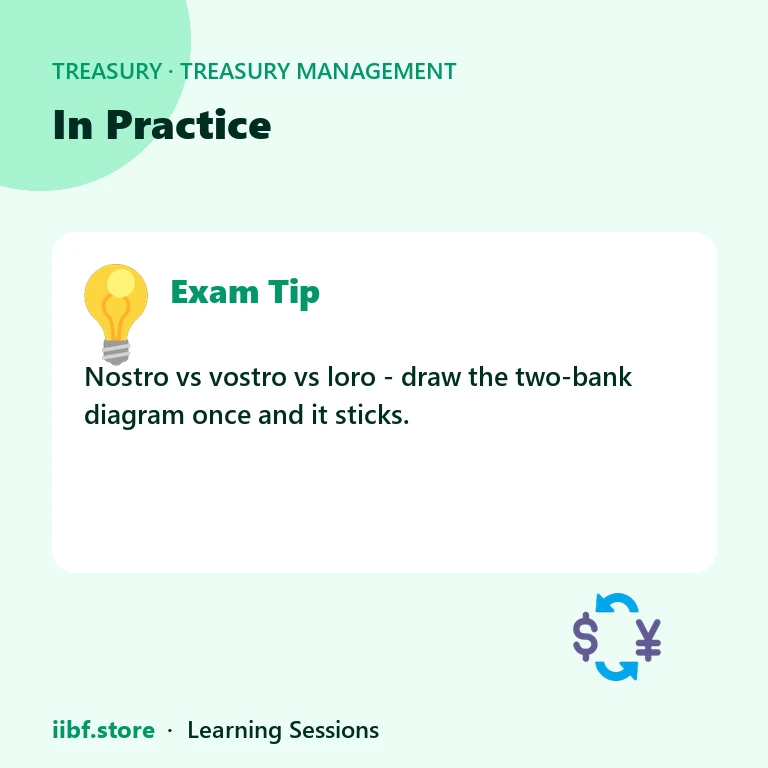
When you sit the IIBF Treasury Management paper, integrated treasury management questions tend to cluster around three themes: organisational controls, instrument classification, and the ALM linkage. The most frequent trap is confusing the roles of the three offices — remember that the mid office, not the back office, performs independent risk measurement and mark-to-market. A second common error is treating nostro and vostro accounts loosely; a nostro is "our account with them" held abroad in foreign currency, while a vostro is "their account with us" held in rupees, and reconciliation of these accounts is a back-office function.
A third pitfall is quoting outdated statutory ratios. The Reserve Bank of India adjusts the Cash Reserve Ratio, Statutory Liquidity Ratio and policy repo rate through its monetary policy reviews, so in an exam it is safer to explain the mechanism — how a CRR change drains or injects rupee liquidity that the treasury must then manage — than to gamble on a specific percentage. Read the framework directly on the regulator's site; the Reserve Bank of India publishes the current operative rates and the master directions on treasury and risk management. Rounding out your preparation, the treatment of fixed-income price risk through duration and convexity, and the integration logic covered in the chapter on treasury management topics, will cover the bulk of the marks. Practising numerical problems on gap analysis and forward-rate calculation is what separates a pass from a distinction.
What is integrated treasury management in a bank?
Integrated treasury management is the practice of running a bank's domestic (rupee) treasury and its foreign-exchange treasury as a single, unified dealing room. It merges money-market, forex, debt and derivative operations so that liquidity, interest-rate risk and currency risk are measured and managed together, enabling arbitrage between domestic and international markets and a single aggregate view of risk.
What is the difference between the front, mid and back office in a treasury?
The front office (dealing room) takes positions and executes trades within limits. The mid office independently measures risk, marks positions to market and reports limit breaches. The back office confirms, settles and reconciles deals, including nostro/vostro reconciliation. Segregating these functions is the key control that prevents a dealer from both creating and concealing a position.
What is the difference between a nostro and a vostro account?
A nostro account is "our account with you" — an account a domestic bank holds with a foreign correspondent bank, denominated in foreign currency. A vostro account is "your account with us" — an account a foreign bank holds with the domestic bank, typically denominated in rupees. Both are reconciled by the treasury back office.
How does integrated treasury connect to ALM?
The Asset-Liability Committee (ALCO) sets the bank's risk tolerances — duration gaps, liquidity gap limits and net open position limits — and the integrated treasury executes within them. The treasury warehouses and hedges the bank's aggregate interest-rate, liquidity and currency mismatches, using instruments like interest-rate swaps and forwards to reshape the gap profile, making it the operational arm of Asset-Liability Management.
Conclusion
Integrated treasury management is the connective tissue of the IIBF Treasury Management syllabus: master the unified dealing-room concept, the front/mid/back-office controls, the instrument set across money, forex and debt markets, and the ALM interface, and most exam questions become straightforward. Keep your regulatory figures current, reason from mechanisms rather than memorised numbers, and practise the numerical problems until they are automatic. Ready to test yourself? Take a free IIBF practice test to benchmark your Treasury Management readiness, or sharpen recall with the concept match game before your exam.
Practice this topic
Take a free mock test, download chapter PDFs, or watch a video class — all included on iibf.store.