Gold Loan LTV 2026: When You Get 85%, 80% or 75%
Walk into any branch and ask what a gold loan will fetch, and you will get three different answers on the same day. That is not the officer improvising — it is the rulebook. From 1 April 2026 the gold loan LTV a bank may sanction on a consumption loan is fixed in three bands: 85%, 80% and 75%. Which band you land in has nothing to do with how good your jewellery is. It depends entirely on how big the loan is. Get that one idea right and the whole chapter falls into place.
85% LTV, Rs 2.5 lakh and the maximum ratio on a consumption gold loan · Watch on YouTube
What loan-to-value really measures
Loan-to-value is the simplest ratio in secured lending: the amount lent divided by the value of the security, expressed as a percentage. Lend Rs 80,000 against gold worth Rs 1,00,000 and the ratio is 80%. The gap between the two — that 20% — is the cushion. It absorbs a fall in gold prices, the accrued interest that piles up if the borrower stops paying, and the cost of eventually auctioning the ornaments.
Because the cushion is the whole point, a regulator that wants lending to stay safe does not cap the loan in rupees. It caps the ratio. That is why the gold loan LTV number is the single most examinable figure in this topic, and why the Reserve Bank rewrote it rather than simply issuing a circular on interest rates.
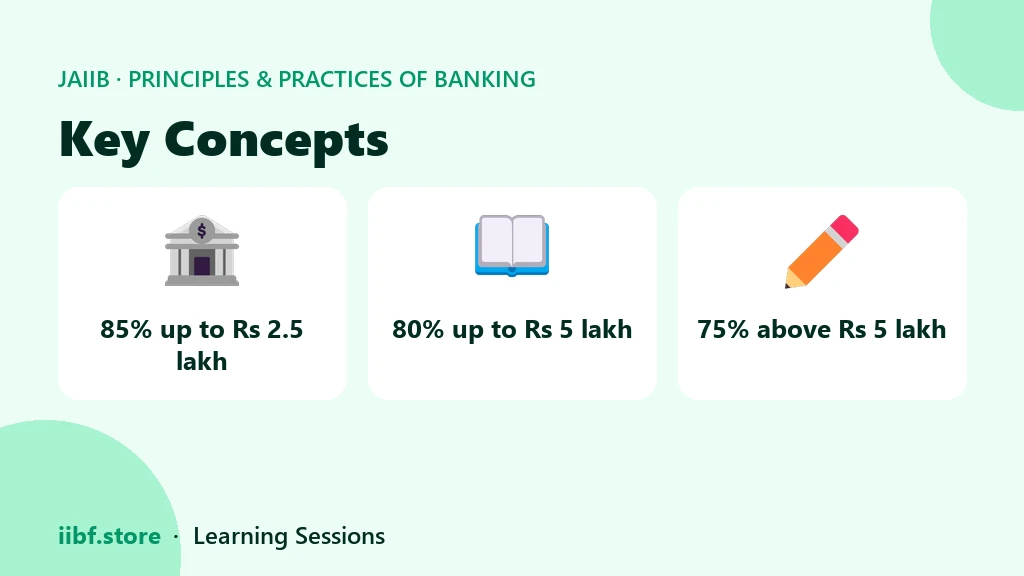
The three slabs, exactly as the Reserve Bank wrote them
The governing document is the Reserve Bank of India (Lending Against Gold and Silver Collateral) Directions, 2025, circular RBI/2025-26/47, issued on 6 June 2025 and brought into force from 1 April 2026. For loans taken for consumption purposes against eligible gold or silver collateral, the ceiling works like this:
| Loan amount sanctioned | Maximum LTV | Minimum margin retained |
|---|---|---|
| Up to Rs 2.5 lakh | 85% | 15% |
| Above Rs 2.5 lakh and up to Rs 5 lakh | 80% | 20% |
| Above Rs 5 lakh | 75% | 25% |
Read the middle column downwards and the logic is obvious: the bigger the exposure, the thicker the cushion the lender must keep. Small-ticket borrowers — the farmer bridging a season, the household covering a hospital bill — get the most generous treatment, because that is exactly the segment the relaxation was designed to help.
The slab follows the loan, not the jewellery
This is where most candidates lose the mark. The slab is chosen by the size of the loan, not by the weight or purity of the ornaments. Two people can pledge identical chains and walk out with different ratios simply because one asked for more money.
Work through it. Suppose gold worth Rs 3,00,000 is pledged. If the borrower wants Rs 2,40,000, that is 80% of the value — and since the loan exceeds Rs 2.5 lakh, the applicable ceiling is 80%. The request just fits. If the same borrower asks for Rs 2,50,000 instead, the loan is within the first slab, so the 85% ceiling applies and there is headroom to spare. Ask for Rs 2,55,000 and you have crossed into the second slab, where the ceiling drops to 80% — and 80% of Rs 3,00,000 is Rs 2,40,000, which is less than what was asked. The extra Rs 5,000 of ambition costs Rs 15,000 of sanction. That counter-intuitive result is precisely the sort of thing an examiner enjoys setting.
The limits that sit alongside the ratio
The ratio is not the only cap the 2025 Directions introduce. There are also hard ceilings on how much metal a single borrower can pledge across all loans. Gold ornaments are capped at an aggregate one kilogram per borrower; silver ornaments at ten kilograms. Coins are treated more tightly still — 50 grams for gold coins and 500 grams for silver coins.
These weight caps matter because they close the obvious loophole. Without them, a borrower could split one large exposure into a series of small loans, each comfortably inside the 85% band, and end up far more leveraged than the 75% slab ever intended. The weight ceiling makes the gold loan LTV ladder work as a system rather than as three separate rules.
Note also the timing. The Directions were issued in June 2025 but come into force from 1 April 2026, with an update dated 29 September 2025. Questions that mention the effective date are testing whether you read the notification or only the headline.
How this shows up in the JAIIB paper
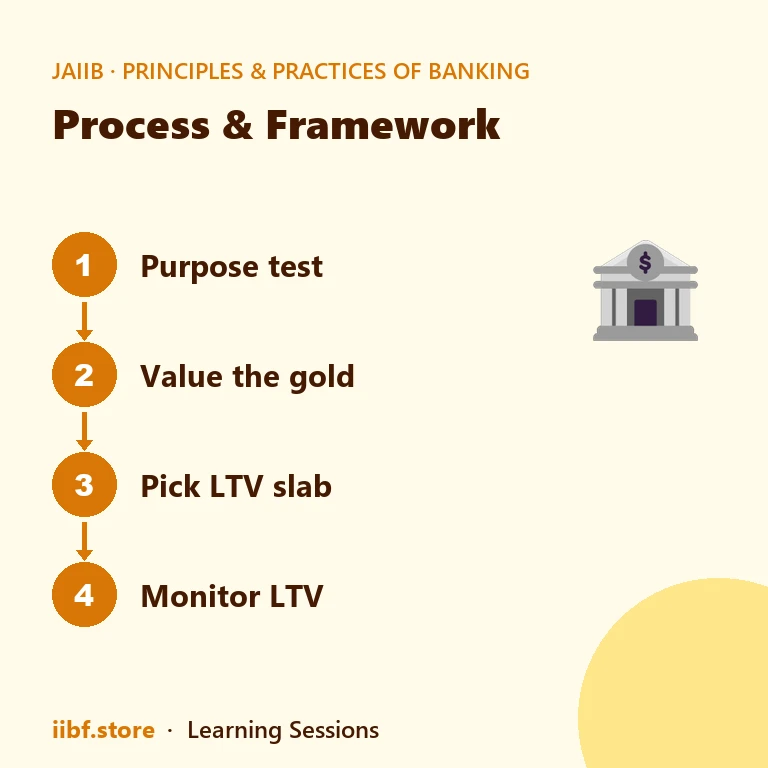
Retail lending against gold sits in the advances portion of Principles and Practices of Banking, and the examiner has three reliable angles. The first is straight recall: name the ceiling for a stated slab. The second is the numerical shown above — give a valuation and a requested amount, and ask what can actually be sanctioned. The third is the trap: a question that varies the purity or the weight of the ornaments while keeping the loan amount constant, to see whether you wrongly move the slab.
The defence against all three is the same. Read the loan amount first, fix the slab, and only then do the arithmetic. If you drill this with a few dozen variations in the practice tests, the pattern becomes automatic and you stop losing marks to a rule you already knew. Keeping an eye on the current policy numbers through the RBI rates page helps too, since gold loan questions often travel in the company of other rate-based items. For the wider syllabus map, the blog archive tracks each regulatory change as it lands.
One last habit worth building: never quote a gold loan LTV figure from memory in an interview or a promotion test without naming the purpose. The 85/80/75 ladder described here is the consumption-loan ladder. Say "for consumption loans" before you say the number, and you will sound like someone who has read the Directions rather than someone who has read a summary of them.
What is the maximum gold loan LTV allowed in 2026?
For a consumption loan against eligible gold collateral, the maximum is 85%, and it applies only where the loan sanctioned is up to Rs 2.5 lakh. Above that the ceiling steps down to 80%, and beyond Rs 5 lakh it is 75%.
Does purer or heavier gold get me a higher ratio?
No. Purity and weight decide the valuation of the security, not the percentage applied to it. A heavier pledge raises the value and therefore the rupee amount you can borrow, but the applicable ratio is fixed by the size of the loan alone.
From when do these slabs apply?
The Reserve Bank of India (Lending Against Gold and Silver Collateral) Directions, 2025 were issued on 6 June 2025 under circular RBI/2025-26/47 and come into force from 1 April 2026, with an update dated 29 September 2025.
How much gold can one borrower pledge in total?
Across all loans to a single borrower, gold ornaments are capped at one kilogram in aggregate and silver ornaments at ten kilograms. Coins are capped separately at 50 grams for gold and 500 grams for silver.
Prefer revising from a printed book?
Chapter-wise books with MCQs after every chapter — minimal pages, complete coverage, delivered anywhere in India. Every book has a free sample to read first.
221 pages · 831 MCQs
Learning Sessions · Ashish Sir
131 pages · 672 MCQs
Learning Sessions · Ashish Sir
128 pages · 524 MCQs
Learning Sessions · Ashish Sir
107 pages · 445 MCQs
Learning Sessions · Ashish Sir
148 pages · 478 MCQs
Learning Sessions · Ashish Sir
151 pages · 465 MCQs
Learning Sessions · Ashish Sir
148 pages · 375 MCQs
Learning Sessions · Ashish Sir
216 pages · 895 MCQs
Learning Sessions · Ashish Sir
109 pages · 300 MCQs
Learning Sessions · Ashish Sir
104 pages · 360 MCQs
Learning Sessions · Ashish Sir
82 pages · 297 MCQs
Learning Sessions · Ashish Sir
151 pages · 600 MCQs
Learning Sessions · Ashish Sir
98 pages · 282 MCQs
Learning Sessions · Ashish Sir
132 pages · 225 MCQs
Learning Sessions · Ashish Sir
188 pages · 435 MCQs
Learning Sessions · Ashish Sir
117 pages · 236 MCQs
Learning Sessions · Ashish Sir
Learning Sessions · Ashish Sir
118 pages · 299 MCQs
Learning Sessions · Ashish Sir
Learning Sessions · Ashish Sir
Learning Sessions · Ashish Sir
Learning Sessions · Ashish Sir
115 pages · 255 MCQs
Learning Sessions · Ashish Sir
Learning Sessions · Ashish Sir
334 pages · 936 MCQs
Learning Sessions · Ashish Sir
Learning Sessions · Ashish Sir
115 pages · 344 MCQs
Learning Sessions · Ashish Sir
107 pages · 240 MCQs
Learning Sessions · Ashish Sir
90 pages · 150 MCQs
Learning Sessions · Ashish Sir
Learning Sessions · Ashish Sir
Quick quiz on this topic
5 exam-style questions from our free test bank — check yourself before you move on.
Practice this topic
Take a free mock test, download chapter PDFs, or watch a video class — all included on iibf.store.