Types of Charge on Securities: Pledge, Hypothecation, Mortgage
When a bank sanctions a loan, it rarely lends on trust alone — it secures the advance by creating a charge on the borrower's assets. Understanding the types of charge on securities is one of the most exam-heavy areas of JAIIB PPB, because every advance — from a gold loan to a home loan — is backed by one of a handful of legal charge structures. This article walks through pledge, hypothecation, mortgage, assignment and lien.
📜 What Is a Charge on Security in Bank Lending?
A charge is the right a lender acquires over a borrower's specific property as security for a debt, without necessarily becoming its owner. It gives the bank a preferential claim if the borrower defaults, while the borrower usually retains some rights over the asset. Charges are broadly classified as fixed (attached to one identified asset, such as a building) or floating (attached to a changing class of assets, like stock-in-trade).
Banks choose the type of charge based on the nature of the security offered — movable or immovable, tangible or intangible — and on how much control they need over the asset. A deeper breakdown of acceptable security is covered in the Types of Collaterals and Their Characteristics chapter.
The five recognised modes of creating a charge in Indian banking practice are pledge, hypothecation, mortgage, assignment and lien. Each has a distinct legal basis, a different answer to "who holds possession," and a different remedy on default. Getting these five straight is where most candidates lose easy marks.
| Type of Charge | Possession With Bank? | Governing Law | Typical Security |
|---|---|---|---|
| Pledge | ✅ Yes | Indian Contract Act, 1872 (Sec. 172) | Gold ornaments, warehouse receipts |
| Hypothecation | ❌ No | SARFAESI Act, 2002 | Stock-in-trade, vehicles, machinery |
| Mortgage | ❌ No (usually) | Transfer of Property Act, 1882 (Sec. 58) | Land, building, flat |
| Assignment | ❌ No (right transferred) | Indian Contract Act / TP Act | Life insurance policy, book debts |
| Lien | ✅ Yes (already held) | Indian Contract Act, 1872 (Sec. 171) | Fixed deposits, cheques, documents |
🤝 Pledge — Bailment With Transfer of Possession
A pledge is defined under Section 172 of the Indian Contract Act, 1872, as the bailment of goods as security for payment of a debt. The essential feature is that possession of the goods moves from the pledgor (borrower) to the pledgee (bank), while ownership stays with the borrower throughout. This is why gold loans are structured as a pledge — the bank physically holds the ornaments in its custody and returns them only on full repayment.
💡 Exam Tip: Possession without ownership is the pledgee's position — the reverse of what a mortgagee typically holds.
On default, a pledgee's remedy is to sell the pledged goods after giving the pledgor reasonable notice — no court approval is needed first, which makes pledge one of the most lender-friendly charges. Margin discipline still applies here, and candidates should also study how loan-to-value works in practice, covered in the gold loan LTV framework. Pledge works only where the security is movable and can be physically or constructively delivered.
📦 Hypothecation — Charge Without Possession
Unlike pledge, hypothecation creates a charge on movable property while the borrower keeps both ownership and possession. The Indian Contract Act does not define hypothecation; it is the SARFAESI Act, 2002, Section 2(1)(n), that gives it statutory recognition as a charge on movable property created without delivery of possession, to secure repayment of a debt.
Hypothecation is the default structure for cash credit against stock-in-trade, book debts, and most vehicle and equipment loans, because the borrower needs continued use of the asset. Since the bank has no physical control, it compensates with periodic stock statements, inspections and, for corporate borrowers, mandatory registration of the charge with the Registrar of Companies and with CERSAI to protect its priority.
⚠️ Common Mistake: Writing "hypothecation" when a question describes possession moving to the bank — that scenario is pledge, not hypothecation.
Because the bank's grip on a hypothecated asset is weaker than on a pledged one, loan agreements typically let the bank convert the charge into a pledge and take possession the moment default occurs — a clause examiners frequently test.
🏠 Mortgage — Charge on Immovable Property
A mortgage is the transfer of an interest in specific immovable property to secure repayment of a debt, defined under Section 58 of the Transfer of Property Act, 1882, whose full text is maintained on India's official legislative database. The Act recognises six kinds: simple mortgage, mortgage by conditional sale, usufructuary mortgage, English mortgage, mortgage by deposit of title deeds, and anomalous mortgage.
In routine home-loan and loan-against-property lending, banks almost always use the equitable mortgage route — deposit of title deeds — because it needs no registration in the notified jurisdictions, unlike a registered (legal) mortgage executed under the Registration Act. A registered mortgage is reserved for cases where title deeds are unavailable or a stronger, court-recorded charge is needed.
📌 Remember: Mortgage always deals with immovable property; pledge and hypothecation always deal with movable property. That single distinction resolves most confusion here.
A variant worth knowing is the reverse mortgage, which lets senior citizens unlock the value of an owned house without giving up residence — explained in the reverse mortgage for senior citizens article. Where a payment obligation is deferred and independently guaranteed rather than secured by a mortgage, banks instead study the deferred payment guarantee structure as a related but distinct arrangement.
🔗 Assignment and Banker's Lien — Other Forms of Charge
Assignment is the transfer of an existing or future debt, right or claim (an "actionable claim") by the assignor to the bank as security. Life insurance policies, book debts and contract receivables are typically secured this way; the bank sends a notice of assignment to the party who owes the money, so payment is made directly to the bank rather than the borrower. Receivables secured through an escrow account in banking arrangement achieve a similar effect — payments are ring-fenced before the borrower can access them.
Lien, by contrast, needs no separate agreement in most cases. A banker's general lien under Section 171 of the Indian Contract Act lets a bank retain — but not sell — any goods, securities or documents of a customer that reach its possession in the ordinary course of business, as security for the general balance due. It is often called an "implied pledge." Articles left purely for safe custody, or held under contrary instructions, are exceptions where lien does not apply.
How a bank exercises lien, set-off and other rights against a customer's balances flows from the legal relationship between the two, covered in depth in the BANKER's CUSTOMER RELATIONSHIP chapter.
🧠 Practice MCQs: Types of Charge on Securities
Q1. In a pledge, the pledgee (bank) obtains ______ of the goods while ownership remains with the pledgor. (a) possession (b) ownership (c) absolute title (d) equity of redemption
Answer: (a) — Section 172 of the Indian Contract Act defines pledge as bailment; possession transfers, ownership does not.
Q2. Hypothecation as a charge on movable property without transfer of possession is statutorily recognised under which law? (a) Indian Contract Act, Section 172 (b) Transfer of Property Act, Section 58 (c) SARFAESI Act, Section 2(1)(n) (d) Negotiable Instruments Act, Section 137
Answer: (c) — The Contract Act does not define hypothecation; it is the SARFAESI Act, 2002 that gives it a statutory definition.
Q3. A mortgage created by depositing title deeds with the lender, without registration, is known as: (a) English mortgage (b) equitable mortgage (c) usufructuary mortgage (d) anomalous mortgage
Answer: (b) — Mortgage by deposit of title deeds is commonly called an equitable mortgage and is widely used for housing and property loans.
Q4. Under Section 171 of the Indian Contract Act, a banker's general lien entitles the bank to: (a) sell pledged goods without any notice (b) retain a customer's goods/securities in its possession as security for the general balance due (c) automatically transfer ownership on default (d) register the charge with the Registrar of Companies
Answer: (b) — General lien is a right to retain, not to sell; it is often called an implied pledge.
Q5. A charge created by transferring an actionable claim — such as a life insurance policy or book debts — to the bank as security is called: (a) pledge (b) hypothecation (c) assignment (d) lien
Answer: (c) — Assignment transfers the underlying right or claim itself, with notice given to the party liable to pay.
Want chapter-wise mock tests with 100+ MCQs? Start practising free →
❓ Frequently Asked Questions
What is the main difference between pledge and hypothecation?
In a pledge, possession of the goods transfers to the bank while ownership stays with the borrower. In hypothecation, the borrower keeps both possession and ownership, and the bank relies on documentation, stock statements and registration to protect its charge.
Which law governs the mortgage of immovable property in India?
Mortgages are governed by Section 58 of the Transfer of Property Act, 1882, which recognises six types including simple mortgage, English mortgage, usufructuary mortgage and mortgage by deposit of title deeds (equitable mortgage), the last being the most common in retail housing finance.
Can a bank exercise lien on a customer's fixed deposit to recover another loan?
Yes, under a banker's general lien the bank can retain securities or balances in its possession, including a fixed deposit, as cover for the customer's overall outstanding dues, subject to any specific agreement that excludes this right.
Why do banks often combine more than one type of charge on a single loan?
Combining charges — for example hypothecation of stock plus a mortgage on factory land — gives the bank both a floating charge over changing business assets and a fixed charge over a stable, high-value asset, reducing overall credit risk on larger exposures.
Getting the charge right protects both banker and borrower
Every JAIIB PPB question on securities comes back to one test: who holds possession, and under which law. Master that lens across pledge, hypothecation, mortgage, assignment and lien, and the loans-documentation syllabus falls into place. Explore more from this subject on the Principles and Practices of Banking tag, or the full JAIIB course.
Prefer revising from a printed book?
Chapter-wise books with MCQs after every chapter — minimal pages, complete coverage, delivered anywhere in India. Every book has a free sample to read first.
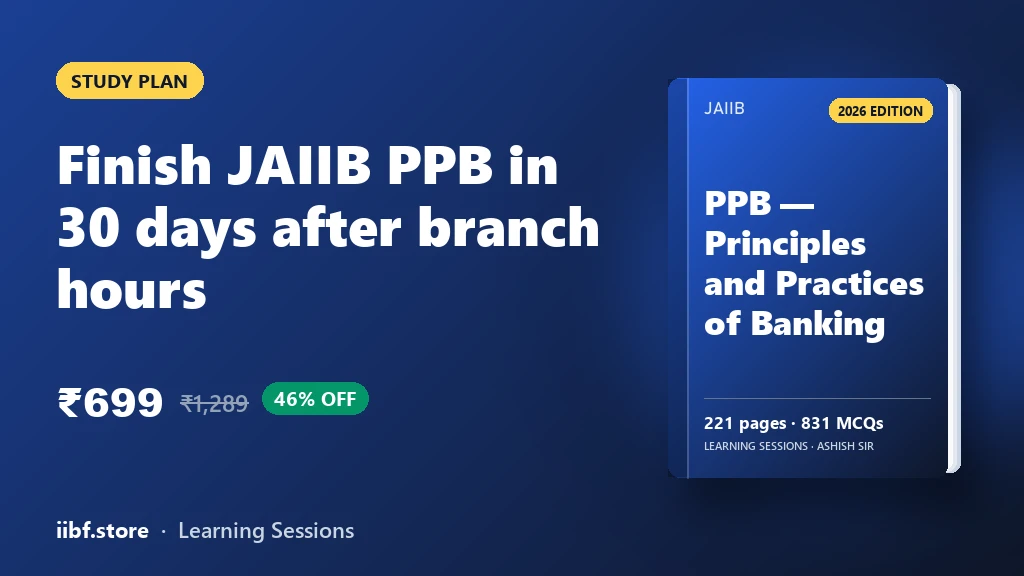
221 pages · 831 MCQs
Learning Sessions · Ashish Sir
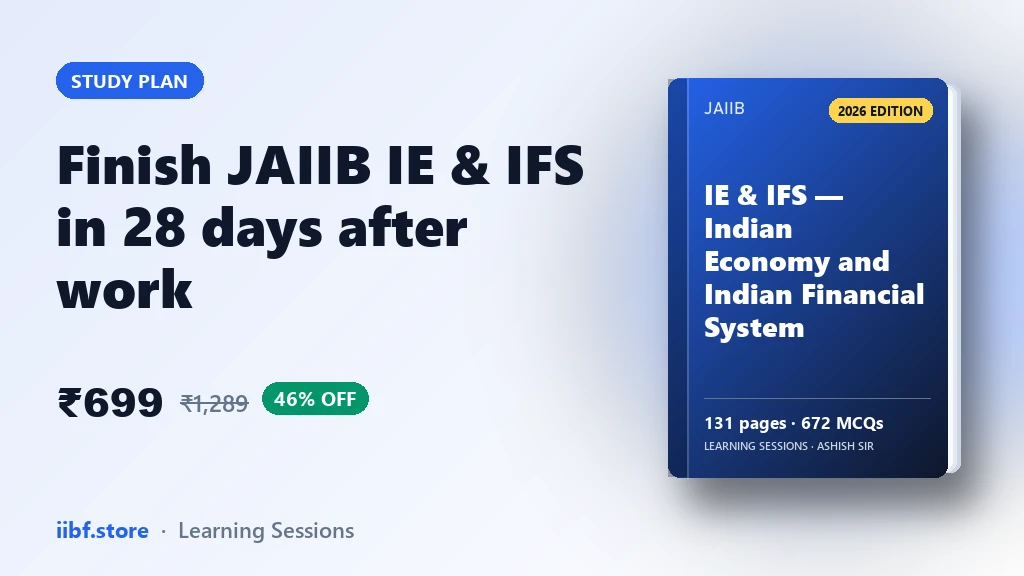
131 pages · 672 MCQs
Learning Sessions · Ashish Sir
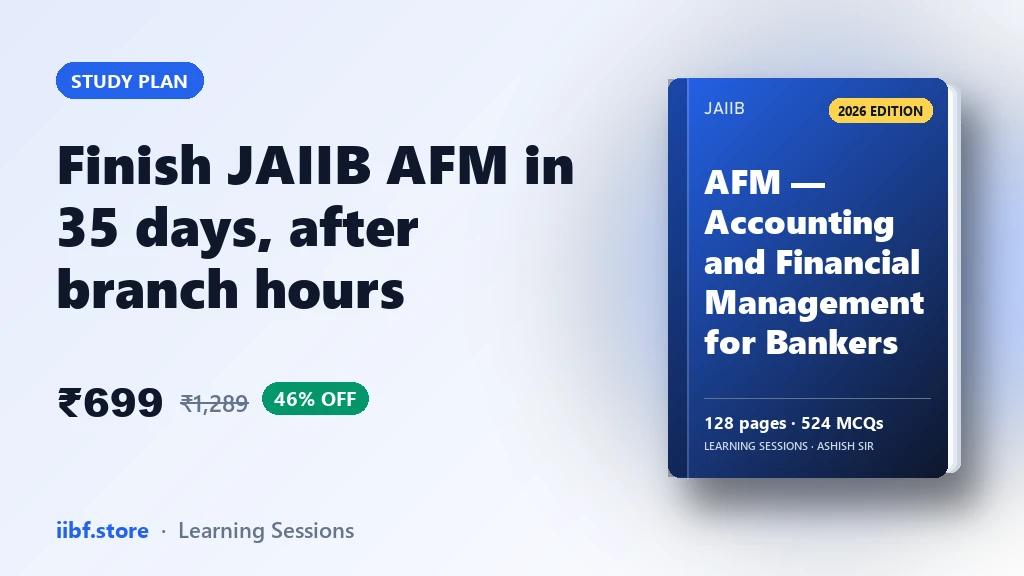
128 pages · 524 MCQs
Learning Sessions · Ashish Sir
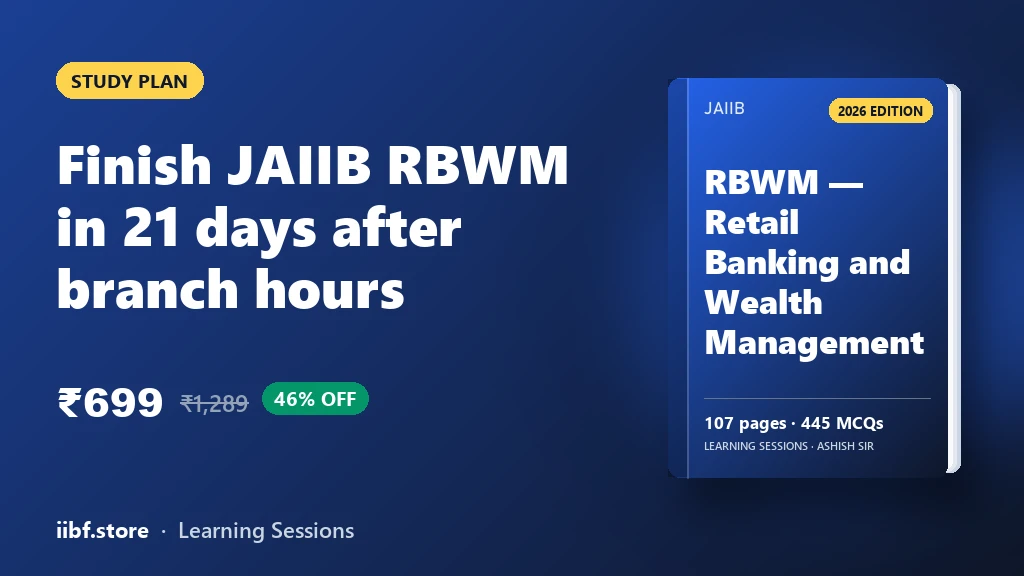
107 pages · 445 MCQs
Learning Sessions · Ashish Sir
148 pages · 478 MCQs
Learning Sessions · Ashish Sir
151 pages · 465 MCQs
Learning Sessions · Ashish Sir
148 pages · 375 MCQs
Learning Sessions · Ashish Sir
216 pages · 895 MCQs
Learning Sessions · Ashish Sir
109 pages · 300 MCQs
Learning Sessions · Ashish Sir
104 pages · 360 MCQs
Learning Sessions · Ashish Sir
82 pages · 297 MCQs
Learning Sessions · Ashish Sir
151 pages · 600 MCQs
Learning Sessions · Ashish Sir
98 pages · 282 MCQs
Learning Sessions · Ashish Sir
132 pages · 225 MCQs
Learning Sessions · Ashish Sir
188 pages · 435 MCQs
Learning Sessions · Ashish Sir
117 pages · 236 MCQs
Learning Sessions · Ashish Sir
Learning Sessions · Ashish Sir
118 pages · 299 MCQs
Learning Sessions · Ashish Sir
Learning Sessions · Ashish Sir
Learning Sessions · Ashish Sir
Learning Sessions · Ashish Sir
115 pages · 255 MCQs
Learning Sessions · Ashish Sir
Learning Sessions · Ashish Sir
334 pages · 936 MCQs
Learning Sessions · Ashish Sir
Learning Sessions · Ashish Sir
115 pages · 344 MCQs
Learning Sessions · Ashish Sir
107 pages · 240 MCQs
Learning Sessions · Ashish Sir
90 pages · 150 MCQs
Learning Sessions · Ashish Sir
Learning Sessions · Ashish Sir
Quick quiz on this topic
5 exam-style questions from our free test bank — check yourself before you move on.
Practice this topic
Take a free mock test, download chapter PDFs, or watch a video class — all included on iibf.store.