Hedge Accounting for Banks: Types, Testing and Ind AS 109 Rules
Hedge accounting for banks is the rule set that lets a bank line up the profit-and-loss timing of a derivative with the timing of the exposure that derivative is protecting. Without it, a treasury desk can run an economically perfect hedge and still report violent swings in the income statement, simply because the swap is marked to market every quarter while the loan or security it protects is not. For CAIIB BFM candidates, this is a high-yield area: examiners like it because it sits exactly where risk management, valuation and accounting meet, and because most candidates memorise the three hedge types without understanding why each one parks gains in a different place.
🎯 Why Hedge Accounting for Banks Exists
Start with the problem, not the solution. A bank's balance sheet carries items on very different measurement bases. A fixed-rate government security in the available-for-sale book is carried at fair value; a floating-rate borrowing is carried at amortised cost; a forecast foreign currency payment is not on the books at all until it happens. Derivatives, by contrast, are almost always fair-valued through the profit and loss account. The result is an accounting mismatch — the hedge moves through P&L today, the hedged exposure moves later or never.
Hedge accounting is an optional relief that removes this mismatch. It does one of two things: either it pulls the hedged item forward (fair value hedge, where the hedged item is remeasured for the hedged risk) or it pushes the derivative back (cash flow hedge, where the effective portion is parked in other comprehensive income until the hedged cash flow lands). Nothing about the economics changes; only the reporting path changes.
Because it is a relief and not a right, it comes with conditions — formal designation, written documentation, and an ongoing demonstration that the relationship works. That conditionality is the exam's favourite hook. Candidates should also connect this to intent-based classification, because whether a position sits in the trading book vs banking book already decides much of the valuation treatment before hedge accounting is even considered.
💡 Exam Tip: Hedge accounting is elective. A bank may run an economic hedge and consciously choose not to apply hedge accounting because the documentation and testing burden outweighs the P&L smoothing benefit. That sentence alone answers several two-mark questions.
🔀 Fair Value, Cash Flow and Net Investment Hedges
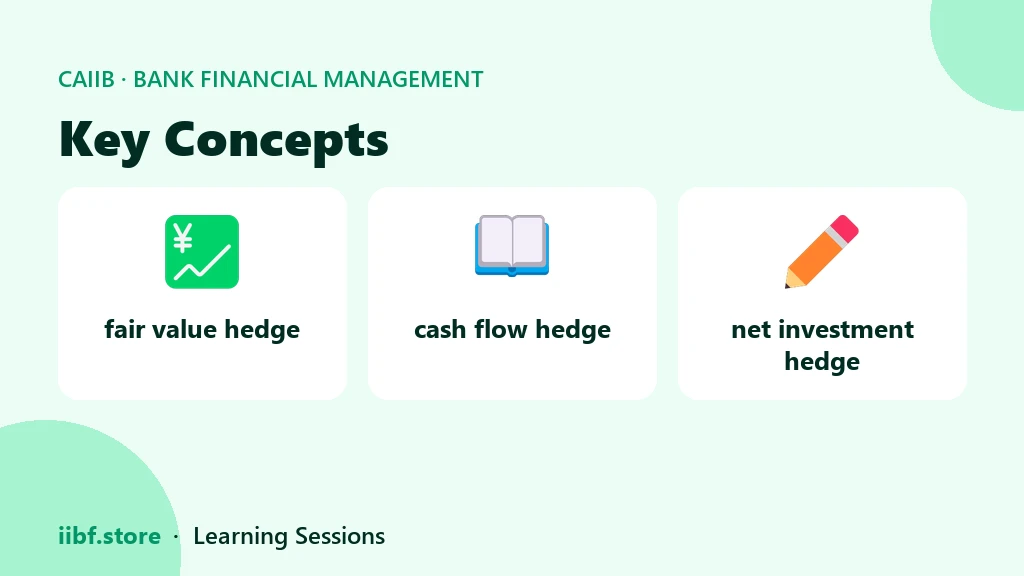
Three hedge relationships are recognised. A fair value hedge protects against changes in the fair value of a recognised asset, liability or firm commitment attributable to a particular risk — for example, a fixed-rate bond losing value as yields rise. A cash flow hedge protects against variability in future cash flows — a floating-rate borrowing whose interest outgo rises, or a highly probable forecast foreign currency payment. A net investment hedge protects the rupee value of a bank's net investment in a foreign operation, such as an overseas branch or subsidiary, against exchange rate movement.
The distinction is not academic. It decides where the effective portion of the derivative gain or loss is recognised, whether the hedged item's carrying amount is touched, and whether amounts sitting in reserves ever get recycled into P&L. The table below is the version worth memorising.
| Feature | Fair value hedge | Cash flow hedge | Net investment hedge |
|---|---|---|---|
| What is hedged | Change in fair value of a recognised item or firm commitment | Variability in future cash flows | FX exposure on net assets of a foreign operation |
| Effective portion goes to | Profit and loss account | Other comprehensive income (hedge reserve) | Other comprehensive income (translation reserve) |
| Hedged item remeasured for the hedged risk | ✅ Yes, carrying amount adjusted | ❌ No | ❌ No |
| Ineffectiveness to P&L immediately | ✅ Yes (automatic, as a residual) | ✅ Yes (excess over the lower-of amount) | ✅ Yes |
| Amounts recycled to P&L later | ❌ No recycling; amortisation of any basis adjustment instead | ✅ Yes, when the hedged cash flow affects P&L | ✅ Yes, on disposal of the foreign operation |
| Typical bank example | Fixed-rate SLR security hedged with a pay-fixed interest rate swap | Floating-rate borrowing hedged with a pay-fixed swap; forecast USD outflow hedged with a forward | Overseas branch net assets hedged with an FX forward or foreign currency borrowing |
Note the mirror image in the first two columns: the fair value hedge fixes the mismatch by moving the hedged item, the cash flow hedge fixes it by delaying the derivative. Understanding the exposure being managed first — as covered under types of foreign exchange exposure — tells you which of the three you are in before you look at a single accounting entry.
📝 Designation, Documentation and the Hedge Ratio
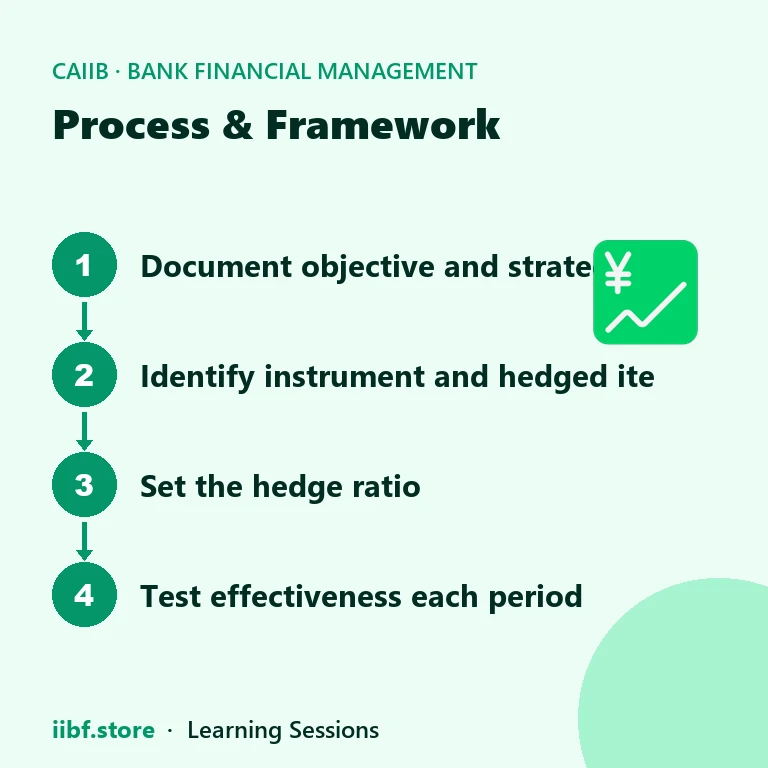
Hedge accounting starts on the day the relationship is formally designated, never retrospectively. At inception the bank must put in writing the risk management objective and strategy for undertaking the hedge, identify the hedging instrument, identify the hedged item, specify the nature of the risk being hedged, and state how hedge effectiveness will be assessed. A missing or vague document is the single most common audit finding in this area, and the consequence is severe — the entire relationship fails and the derivative goes straight to P&L.
Under the Ind AS 109 model, three qualifying criteria must hold. First, there must be an economic relationship between hedged item and hedging instrument, meaning their values move in opposite directions for the same risk. Second, the effect of credit risk must not dominate the value changes arising from that economic relationship — a swap with a badly deteriorating counterparty can fail here. Third, the hedge ratio designated must be the same as the ratio of quantities the bank actually uses, so a bank cannot deliberately under-hedge or over-hedge on paper to manufacture a convenient accounting outcome.
Eligible hedged items include recognised assets and liabilities, unrecognised firm commitments, highly probable forecast transactions, net investments in foreign operations, and — importantly for treasuries — risk components of an item, such as only the benchmark interest rate component of a bond, provided that component is separately identifiable and reliably measurable. Groups and net positions can be designated, subject to conditions. Written options generally cannot be hedging instruments on their own. The forex plumbing that sits behind many of these designations is worth revising alongside exchange rates and forex business, since the quoted rate convention decides how the hedged risk is even defined.
⚠️ Common Mistake: Assuming a bank can de-designate a hedge whenever the P&L would look better. Voluntary discontinuation is not permitted while the risk management objective is unchanged and the qualifying criteria continue to be met.
📊 Effectiveness Testing, Rebalancing and Ineffectiveness
Older standards demanded a retrospective bright-line test — the hedge had to fall within a numerical corridor each period or it failed outright. The Ind AS 109 model replaced that mechanical test with a forward-looking assessment of whether the qualifying criteria still hold, performed at inception and at each reporting date, or whenever circumstances change significantly. Candidates should know both, because legacy questions still quote the old corridor while current practice does not rely on it.
Effectiveness can be assessed qualitatively where the critical terms of the derivative and the hedged item match — same notional, same currency, same reset dates, same maturity. Where terms differ, a quantitative method is needed, commonly a regression or a dollar-offset style comparison of cumulative value changes. Rebalancing is the adjustment of the designated quantities of hedged item or hedging instrument when the hedge ratio no longer reflects the actual economic relationship; crucially, rebalancing continues the existing relationship rather than terminating it, and any ineffectiveness is recognised before the ratio is changed.
Ineffectiveness must always hit the profit and loss account. Common sources in a bank treasury are timing mismatches between the derivative's reset dates and the hedged item's cash flows, basis differences between the benchmark used in the swap and the benchmark embedded in the exposure, credit valuation and debit valuation adjustments on the derivative, a derivative that is off-market at designation, and currency basis spreads on cross-currency swaps. The forward element of a forward contract and the currency basis spread may be excluded from the designation and accounted for as a cost of hedging, which reduces reported volatility. Movements in the underlying benchmark rates that drive all of this can be tracked from the current RBI rates page.
📌 Remember: Discontinuation is prospective only. When a hedge is discontinued, amounts already accumulated in the cash flow hedge reserve stay there and are recycled as the forecast cash flows occur — unless those cash flows are no longer expected, in which case the balance goes to P&L immediately.
💹 Worked Examples: Forwards and Interest Rate Swaps
Take an illustrative fair value hedge. A bank holds a fixed-rate security of ₹100 crore carried at fair value and designates a pay-fixed, receive-floating interest rate swap of matching notional and tenor to hedge the benchmark rate component. Rates rise. The security's fair value attributable to the hedged risk falls by ₹2.50 crore, and that loss is booked to P&L with the carrying amount of the security reduced accordingly. The swap gains ₹2.40 crore, also booked to P&L. Net impact is a ₹0.10 crore charge, which is exactly the ineffectiveness — arising here from a small tenor and reset mismatch. Without designation, the ₹2.40 crore swap gain would have appeared alone, flattering the quarter.
Now an illustrative cash flow hedge. The bank has a floating-rate borrowing and swaps it to fixed. The cumulative gain on the swap is ₹5.00 crore while the cumulative change in the present value of the hedged future cash flows is ₹4.80 crore. The lower-of rule sends ₹4.80 crore to the cash flow hedge reserve in OCI and the residual ₹0.20 crore straight to P&L. As each interest payment occurs, the corresponding slice of the reserve is recycled to interest expense, so reported cost of funds behaves as though the borrowing had been fixed-rate all along.
Forwards work the same way for currency exposure: a highly probable USD payment three months out, hedged with a matching forward, is a textbook cash flow hedge, while a hedge of an already-booked USD receivable is more naturally a fair value hedge of a recognised monetary item. Practise the mechanics against a forex case study, and note that foreign currency borrowings raised as external commercial borrowings are frequently the hedged item in cross-currency swap designations. Option-based protection such as interest rate caps and floors can also be designated, though the time value is usually excluded and deferred as a cost of hedging.

🏁 Conclusion and Next Steps
For the exam, hold on to four anchors: hedge accounting is optional but conditional; the three hedge types differ mainly in where the effective portion lands and whether it is ever recycled; ineffectiveness always goes to P&L; and discontinuation is prospective, never a retrospective clean-up. Indian banks apply hedge accounting within the framework RBI prescribes for the investment and derivatives portfolios, with the treatment for the investment book set out in the current Master Direction on classification, valuation and operation of the investment portfolio — always read the latest version, since the framework has been revised in recent years. Where a bank reports under Ind AS, the Ind AS 109 model above applies in full.
Revise this alongside the wider CAIIB syllabus — the credit-side counterpart on supply chain finance for banks uses similar documentation discipline — and work through more topics on the Bank Financial Management blog hub. When the theory is clear, move to application: explore the full CAIIB course and attempt chapter-wise mocks until the three hedge types are automatic.
🧠 Practice MCQs: Hedge Accounting for Banks
Q1. In a fair value hedge, the gain or loss on the hedging instrument is recognised in: (a) profit and loss account (b) other comprehensive income only (c) the foreign currency translation reserve (d) directly in general reserves
Answer: (a) — In a fair value hedge both the derivative gain or loss and the hedged item's remeasurement for the hedged risk go through P&L, so they offset.
Q2. In a cash flow hedge, the amount recognised in the hedge reserve within OCI is: (a) the full change in fair value of the derivative (b) the change in fair value of the hedged item only (c) the lower of the cumulative gain or loss on the hedging instrument and the cumulative change in fair value of the hedged item (d) the higher of the two cumulative amounts
Answer: (c) — The lower-of test caps the OCI amount; any excess on the hedging instrument is ineffectiveness charged to P&L.
Q3. Adjusting the designated quantity of the hedged item or the hedging instrument so that the hedge ratio again reflects the economic relationship, without terminating the relationship, is called: (a) discontinuation (b) rebalancing (c) recycling (d) basis adjustment
Answer: (b) — Rebalancing continues the existing hedge relationship; ineffectiveness is measured and recognised before the ratio is changed.
Q4. Amounts accumulated in reserves from an effective net investment hedge are reclassified to the profit and loss account: (a) every reporting date (b) when the hedge ratio changes (c) when the derivative expires (d) on disposal of the foreign operation
Answer: (d) — Like the translation reserve it sits in, the net investment hedge reserve is recycled only when the foreign operation is disposed of.
Q5. Which of the following is NOT a qualifying criterion for hedge accounting under the Ind AS 109 model? (a) an economic relationship exists between hedged item and hedging instrument (b) credit risk does not dominate the value changes from that relationship (c) the retrospective offset must fall within a fixed numerical corridor every period (d) the designated hedge ratio equals the ratio actually used for risk management
Answer: (c) — The mechanical retrospective corridor test belonged to the earlier standard; the current model uses a forward-looking assessment of the three stated criteria.
Want chapter-wise mock tests with 100+ MCQs? Start practising free →
Frequently asked questions
Is hedge accounting compulsory for a bank that runs a hedge?
No. It is an elective treatment. A bank may hold a perfectly effective economic hedge and still choose not to designate it, in which case the derivative is fair valued through P&L and the reported earnings carry the mismatch.
What happens to ineffectiveness in a hedge relationship?
It is recognised immediately in the profit and loss account in every hedge type. In a fair value hedge it emerges automatically as the residual between the two offsetting entries; in a cash flow hedge it is the excess of the cumulative derivative gain over the lower-of amount taken to OCI.
Can a bank designate only part of an exposure or only one risk component?
Yes. A proportion of an item, a specified time period of its cash flows, or a separately identifiable and reliably measurable risk component such as the benchmark interest rate element can be designated, provided the documentation is precise.
How is hedge accounting treated for Indian banks that are not yet on Ind AS?
They follow the framework prescribed by RBI for the investment and derivatives portfolios, which for the investment book is set out in the current Master Direction on classification, valuation and operation of the investment portfolio. Candidates should read the latest master direction, as the treatment has been revised in recent years and broadly moves towards the Ind AS 109 principles.
Source and further reading: Reserve Bank of India and the Indian Institute of Banking & Finance.
Quick quiz on this topic
5 exam-style questions from our free test bank — check yourself before you move on.
Practice this topic
Take a free mock test, download chapter PDFs, or watch a video class — all included on iibf.store.
Keep reading