ICAAP in Banks: Pillar 2 Capital Adequacy Explained for IIBF Risk Management
The ICAAP in banks — the Internal Capital Adequacy Assessment Process — is one of the most heavily examined topics in the IIBF Risk Management course, and for good reason. It sits at the intersection of Pillar 2 of the Basel framework, board-level governance, and the everyday capital planning that keeps a bank solvent through a downturn. If you can explain how ICAAP works, why the Reserve Bank of India insists on it, and how it links to stress testing and the Supervisory Review Process, you already understand most of Module E of the syllabus. This guide breaks down the concept the way an examiner expects you to reproduce it, with a worked comparison table, the key regulatory anchors, and study links to reinforce each idea.
What ICAAP in Banks Actually Means
ICAAP is a bank's own internal, forward-looking assessment of whether it holds enough capital to cover all the material risks it faces — not just the credit, market and operational risks captured under Pillar 1, but also the risks that Pillar 1 ignores. Think of concentration risk, interest rate risk in the banking book (IRRBB), liquidity risk, reputational risk, strategic risk and residual risk from credit-risk mitigation. Pillar 1 uses standardised regulatory formulas that produce a minimum capital number. ICAAP asks a harder, bank-specific question: given our business model, our risk appetite and our concentrations, is that regulatory minimum genuinely sufficient?
The process is owned by the Board and senior management, not by a spreadsheet. Under the RBI's Master Circular on Basel III Capital Regulations, every scheduled commercial bank must run a documented ICAAP, review it at least annually, and submit the outcome to the RBI, which then conducts its Supervisory Review and Evaluation Process (SREP) — the two together forming Pillar 2. A robust ICAAP identifies all material risks, measures the capital needed against each, and demonstrates that available capital comfortably exceeds that requirement across normal and stressed conditions. For exam purposes, remember the phrase examiners love: ICAAP is "the bank's own view of its capital adequacy," and it must be commensurate with the bank's risk profile, size and complexity.
ICAAP vs Regulatory Minimum Capital: The Core Distinction
The single most testable idea is the difference between the Pillar 1 regulatory minimum and the internal capital the bank concludes it actually needs. The table below lays out the contrast that repeatedly appears in objective questions and case-lets. Notice how ICAAP is broader in risk coverage, internally driven, and explicitly forward-looking, whereas Pillar 1 is a floor computed with prescribed weights.
| Feature | Pillar 1 Regulatory Minimum | ICAAP (Pillar 2) |
|---|---|---|
| Pillar | Pillar 1 — Minimum Capital | Pillar 2 — Supervisory Review |
| Risks covered | Credit, market, operational only | All material risks incl. concentration, IRRBB, liquidity, reputational, strategic |
| Who drives it | Regulator (prescribed formulas) | Bank's own Board & senior management |
| Time horizon | Point-in-time / current | Forward-looking, multi-year, stress-tested |
| Output | Minimum CRAR floor | Bank-specific "internal capital" target |
| Review by | Automatic (rule-based) | RBI via SREP |
Keep in mind the Basel III minimum ratios that anchor the Pillar 1 side of this table: a total minimum Capital to Risk-weighted Assets Ratio (CRAR) of 9% for Indian banks (higher than the 8% Basel floor), a minimum Common Equity Tier 1 (CET1) of 5.5%, plus a Capital Conservation Buffer of 2.5% built entirely from CET1. ICAAP begins where these floors end — it asks whether they are enough for the specific bank.
Stress Testing, Risk Appetite and the ICAAP Document
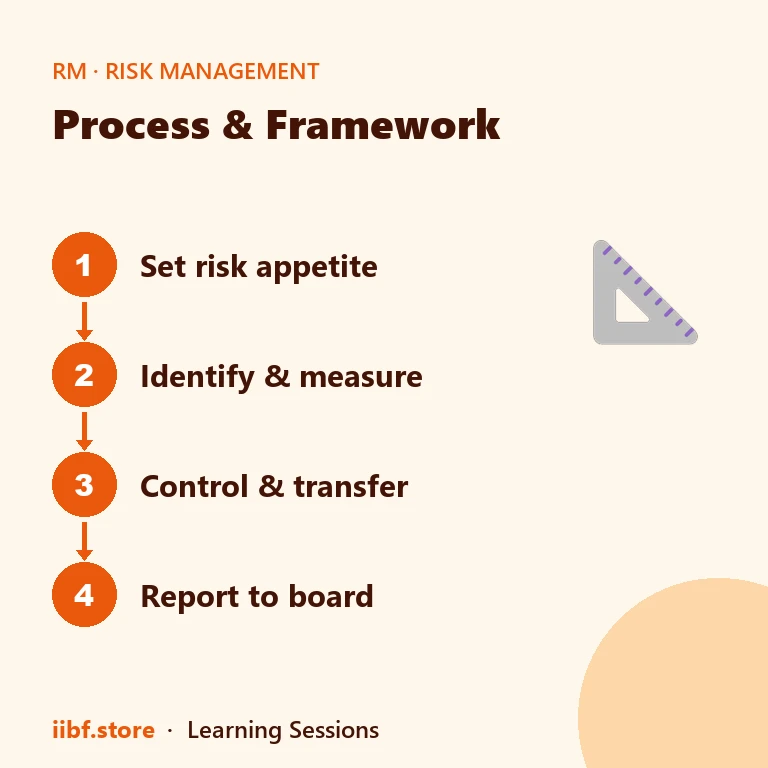
An ICAAP is only credible if it is stress-tested. The bank must model how its capital position behaves under adverse but plausible scenarios — a sharp rise in NPAs, a market shock, a liquidity squeeze, or a combination. Stress testing feeds directly into the capital planning conclusion: if a severe scenario would push CRAR below the regulatory floor plus buffers, the bank must plan corrective capital actions in advance. This is why examiners link ICAAP tightly with the stress-testing and risk-appetite framework. The Board sets a formal risk-appetite statement, management translates it into limits, and the ICAAP document evidences that capital is held consistently with that appetite.
The quality of the underlying risk data matters enormously here, especially for operational risk. Sound loss-event capture and indicator monitoring are what make the operational-risk capital estimate defensible. If you want to see how banks build that data foundation, study the chapter on Collection of Loss Data, and pair it with RCSA and Key Risk Indicators, which explains how Risk Control Self-Assessment and KRIs translate raw events into forward-looking risk signals that ICAAP relies on. A well-run ICAAP is essentially a synthesis of these bottom-up risk assessments rolled up into a single capital adequacy verdict that the Board can defend to the supervisor.
How ICAAP Fits the Supervisory Review Process (SREP)
ICAAP does not exist in isolation — it is one half of Pillar 2. The bank produces its ICAAP; the RBI then evaluates it through the SREP. Under SREP, supervisors examine whether the bank's own capital assessment is sound, whether its risk management and internal controls are adequate, and whether it should be required to hold capital above the Pillar 1 minimum. If the RBI is not satisfied, it can mandate a higher capital requirement, restrict activities, or demand strengthened controls. This dialogue between the bank's internal view and the supervisor's independent judgement is the heart of Pillar 2.
To ground your revision, always trace ICAAP back to first principles: why banks are regulated at all, and what regulatory capital is meant to absorb. The study notes on Why Do Banks Need Regulation and Regulatory Capital and Capital Adequacy give you the framing that examiners expect around ICAAP answers. You can verify the binding numbers yourself from the primary source: the RBI's Basel III capital norms are published on the regulator's site at rbi.org.in. For broader revision across the syllabus, browse the full Risk Management article hub, and when you are ready to test recall under time pressure, work through practice questions on the platform's mock tests. Consistent proportionality is the theme to carry into the exam hall: the depth of a bank's ICAAP must match the size and complexity of its risk profile.
Frequently Asked Questions
What is ICAAP in banks in one line?
ICAAP (Internal Capital Adequacy Assessment Process) is a bank's own forward-looking assessment, owned by its Board, of whether it holds enough capital to cover all material risks — including risks not captured under Pillar 1 — across normal and stressed conditions.
Which Basel pillar does ICAAP belong to?
ICAAP is the bank's side of Pillar 2 (Supervisory Review). The regulator's side is the Supervisory Review and Evaluation Process (SREP), through which the RBI evaluates the bank's ICAAP and may require capital above the Pillar 1 minimum.
How is ICAAP different from the Pillar 1 minimum capital requirement?
Pillar 1 gives a rule-based minimum CRAR using prescribed formulas covering credit, market and operational risk. ICAAP is bank-specific, forward-looking, stress-tested, and covers all material risks — so the internal capital it concludes is often higher than the Pillar 1 floor.
How often must a bank conduct its ICAAP?
Under RBI's Basel III capital regulations, a bank must carry out its ICAAP at least annually, keep it commensurate with its risk profile and complexity, have it reviewed by the Board and senior management, and submit the outcome to the RBI for supervisory review.
Conclusion and Next Step
ICAAP in banks is where governance, risk measurement and capital planning meet — master the Pillar 1 versus Pillar 2 distinction, the role of stress testing, and the ICAAP–SREP dialogue, and you can answer almost any Module E question on capital adequacy. The best way to lock it in is active recall: put the numbers and the concept under exam conditions. Attempt a focused Risk Management mock now on the IIBF Risk Management practice tests and turn this reading into marks.
Practice this topic
Take a free mock test, download chapter PDFs, or watch a video class — all included on iibf.store.
Keep reading