RCSA and Key Risk Indicators: IIBF Risk Management 2026
For IIBF Risk Management (CAIIB) candidates, RCSA and Key Risk Indicators sit at the heart of every bank's Operational Risk Management Framework (ORMF). Risk and Control Self-Assessment gives business units a structured lens to rate inherent risk and control quality, while Key Risk Indicators track that risk continuously between assessments. Together they feed the loss database, the risk appetite statement, and board reporting. This guide breaks down how RCSA and KRIs work, how they connect, and the exam angles examiners favour most in 2026.
🔍 What Is RCSA (Risk and Control Self-Assessment)?
Risk and Control Self-Assessment (RCSA) is a bottom-up exercise where each business unit — retail banking, treasury, IT, operations — identifies the risks inherent in its processes and rates how well existing controls mitigate them. A facilitator, usually from the risk function, runs workshops where process owners score likelihood, impact, and control effectiveness for each risk event. The gap between inherent risk and residual risk after controls is the number that matters most to regulators and to the board.
RCSA is not a one-time audit; the RCSA and Key Risk Indicators module treats it as a recurring cycle, typically annual or half-yearly, that feeds directly into the operational risk loss database. Findings from loss-event collection are compared against RCSA ratings to check whether self-assessed risk levels match actual experience. A business line that rates itself "low risk" but reports frequent losses is a classic red flag examiners like to test.
The output of an RCSA cycle is usually a heat map — risks plotted by likelihood and impact — plus an action plan for any control gap rated below the bank's risk appetite threshold.
📊 Key Risk Indicators: Design and Thresholds
Where RCSA is periodic and qualitative, Key Risk Indicators (KRIs) are continuous and quantitative. A KRI is a measurable metric — staff attrition rate, system downtime hours, number of unauthorised access attempts, average transaction processing delay — that moves ahead of an actual loss event and warns risk owners that exposure is rising.
Good KRI design follows a simple discipline: pick metrics that are directly linked to a risk in the RCSA register, available on a reliable and repeatable data feed, and sensitive enough to move before losses spike. Each KRI is assigned green/amber/red thresholds calibrated to the bank's risk appetite, reviewed under the Operational Risk and Management Framework.
💡 Exam Tip: Remember Residual Risk = Inherent Risk − Control Effectiveness — IIBF loves testing this formula inside RCSA numericals.
Thresholds aren't static: a bank recalibrates them whenever its loss experience, business volume, or regulatory expectations shift, keeping the KRI dashboard aligned with the current risk appetite statement rather than last year's numbers.
🚦 From RCSA Findings to KRI Escalation
RCSA and KRIs are two ends of the same monitoring loop. RCSA identifies where controls are weak; KRIs watch those exact weak points day to day. When a KRI breaches its amber threshold, the risk owner investigates; a red breach triggers a defined escalation path — typically risk owner to business head, to the Operational Risk Management Committee, and in severe cases to the board risk committee.
Technology risk is one of the richest sources of exam questions here: metrics like system downtime, failed patch deployments, or phishing-click rates are classic KRIs because technology incidents move faster than annual RCSA workshops can catch.
⚠️ Common Mistake: Candidates often confuse a KRI with a KPI. A KPI measures performance against a target; a KRI is an early-warning signal of rising risk exposure — the two serve different purposes even when the underlying metric looks similar.
A well-designed escalation matrix names the threshold, the owner, the timeline for response, and the closure criteria — precisely the sequence IIBF case-study questions test.
🏢 Governance, Ownership and the Three Lines Model
RCSA and KRI ownership follows the three-lines model. The first line — business units — owns the risks, executes RCSA, and responds to KRI breaches. The second line — the risk management function — sets methodology, challenges self-assessments, and maintains the KRI library and thresholds. The third line, internal audit, periodically tests whether both are working as designed.
This structure sits under the bank's broader corporate governance arrangements: the board and its risk committee receive a consolidated RCSA heat map and a KRI dashboard at each cycle, and material breaches or repeated control failures must be reported up that chain without dilution.
📌 Remember: RCSA workshops feed the loss database and risk register; KRI dashboards feed the risk appetite statement — both ultimately roll up into the same Operational Risk Management Framework reported to the board.
Weak governance — for example, a first-line team that both owns and audits its own RCSA — is a common case-study trap in IIBF Risk Management papers.
🌐 RCSA, KRI and the Wider Risk Framework
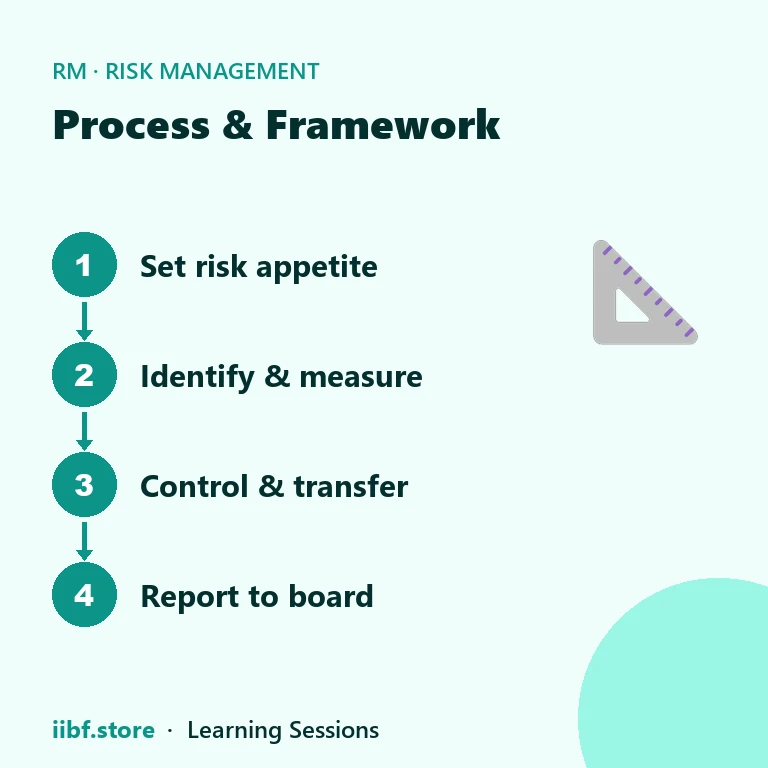
RCSA and KRI outputs don't stay siloed inside operational risk — they feed the bank's wider capital and risk framework. Elevated KRI trends and weak RCSA ratings raise the operational risk capital charge considered under ICAAP in banks, alongside credit and market risk inputs such as Value at Risk methods for the trading book. The overall capital buffer sits within the Basel III Framework, a point examiners often combine with a capital-adequacy numerical.
The same self-assessment discipline extends across risk types — a bank running a stressed asset resolution framework for weak credit exposures uses comparable escalation logic once early-warning signals cross defined thresholds, echoing the RCSA/KRI escalation matrix described above.
For the underlying regulatory expectations on operational risk governance and self-assessment, the RBI's master circulars on risk management remain the primary source — always cross-check the latest circular before an exam sitting, since supervisory guidance is updated periodically.
Browse more Risk Management study articles to connect RCSA and KRI with the rest of the ORMF syllabus.
| Dimension | RCSA | Key Risk Indicators (KRI) |
|---|---|---|
| Nature | Qualitative self-assessment | Quantitative metric |
| Frequency | Periodic (annual/half-yearly) | Continuous (monthly/real-time) |
| Real-time monitoring? | ❌ No | ✅ Yes |
| Primary owner | Business unit (1st line) | Risk management function (2nd line) |
| Output | Heat map, risk register | Threshold breach / escalation alert |
🧠 Practice MCQs: RCSA and Key Risk Indicators
Q1. What does RCSA stand for in operational risk management? (a) Risk and Control Self-Assessment (b) Regulatory Capital Self-Audit (c) Risk Committee Self-Appraisal (d) Reserve Capital Stress Analysis
Answer: (a) — RCSA is the structured process where business units identify risks and rate control effectiveness.
Q2. A Key Risk Indicator (KRI) is best described as: (a) A lagging measure of past financial performance (b) A leading metric that signals rising risk exposure (c) A capital adequacy ratio (d) A credit rating scale
Answer: (b) — KRIs are forward-looking monitoring metrics, not performance or capital ratios.
Q3. In an RCSA heat map, residual risk is calculated as: (a) Inherent risk plus control effectiveness (b) Inherent risk minus control effectiveness (c) Expected loss minus unexpected loss (d) Gross income multiplied by a beta factor
Answer: (b) — Residual risk equals inherent risk reduced by the mitigating effect of control effectiveness.
Q4. Under the three lines of defense model, who typically owns day-to-day RCSA execution? (a) Internal audit (third line) (b) The business unit (first line) (c) The board risk committee (d) External regulators
Answer: (b) — The first line owns and executes RCSA; the second line challenges it and the third line tests it.
Q5. When a KRI breaches its "red" threshold, the standard next step is: (a) Ignore it until the next annual review (b) Escalate per the defined trigger/action matrix (c) Automatically downgrade the bank's credit rating (d) Suspend all lending immediately
Answer: (b) — A red breach triggers the predefined escalation path, not an automatic external action.
Want chapter-wise mock tests with 100+ MCQs? Start practising free →
What is the difference between RCSA and KRI?
RCSA is a periodic qualitative self-assessment of risks and controls, while KRIs are continuous quantitative metrics that provide early-warning signals between assessment cycles.
Who owns RCSA in a bank?
The first line of defense (business units) typically owns and executes RCSA, with the risk management function (second line) providing challenge and methodology support.
How often should KRIs be reviewed?
Most banks review KRIs monthly or quarterly, with thresholds recalibrated periodically based on changing risk appetite, business volume, and loss experience.
Why are RCSA and KRI important for IIBF Risk Management exams?
They form a core part of the Operational Risk Management Framework syllabus and are frequently tested alongside loss data collection, governance, and capital-adequacy topics.
RCSA and Key Risk Indicators aren't separate topics — they're one continuous monitoring cycle that every IIBF Risk Management candidate must be able to describe end-to-end, from workshop rating to board-level escalation. Put the theory into practice with full-length Risk Management mock tests or explore the complete CAIIB course on iibf.store.
Practice this topic
Take a free mock test, download chapter PDFs, or watch a video class — all included on iibf.store.
Keep reading