Inside the CAIIB BRBL book: 62 chapters, 4 modules, 895 MCQs
It is 10:40 at night. The branch closed hours ago, your tiffin box is still in the bag, and the Banking Regulations and Business Laws syllabus on your desk looks like a legal library. Acts, sections, tribunals, doctrines with Latin-sounding names. If this is your situation, you are not slow. BRBL is simply a paper where the volume is the enemy, and the right study material is the one that cuts the volume down without cutting the substance.
This article is a guided tour of the CAIIB BRBL book from iibf.store: how it is organised, what a single chapter looks like, and how to picture using it on a tired weeknight. Even if you never buy it, you will leave with a way to break BRBL into pieces you can actually finish.
Why BRBL feels heavier than it is
Most candidates struggle with BRBL for one reason: it mixes four different kinds of reading. Banking regulation reads like RBI circulars. The important Acts read like statutes. Commercial law reads like a law-college textbook. And the case-based questions ask you to apply all of it to a story about a borrower, a guarantor and a mortgage.
When everything arrives as one undifferentiated pile, the brain files it all under "too much" and you start avoiding the paper. The fix is structure. Once you know that the paper is really four modules, and each module is a list of short, self-contained chapters, the pile turns into a checklist.
Three habits that help with any BRBL material
- Study by Act, not by page. Finish one Act or one contract type before you open the next. Mixed-up Acts are where confusion lives.
- Keep a one-line purpose for each law. What does this Act let a bank do, or stop a bank from doing? If you cannot say it in a line, you have not understood it yet.
- Test the same day. Reading without questions feels productive and fades by the weekend.
How the CAIIB BRBL book is organised
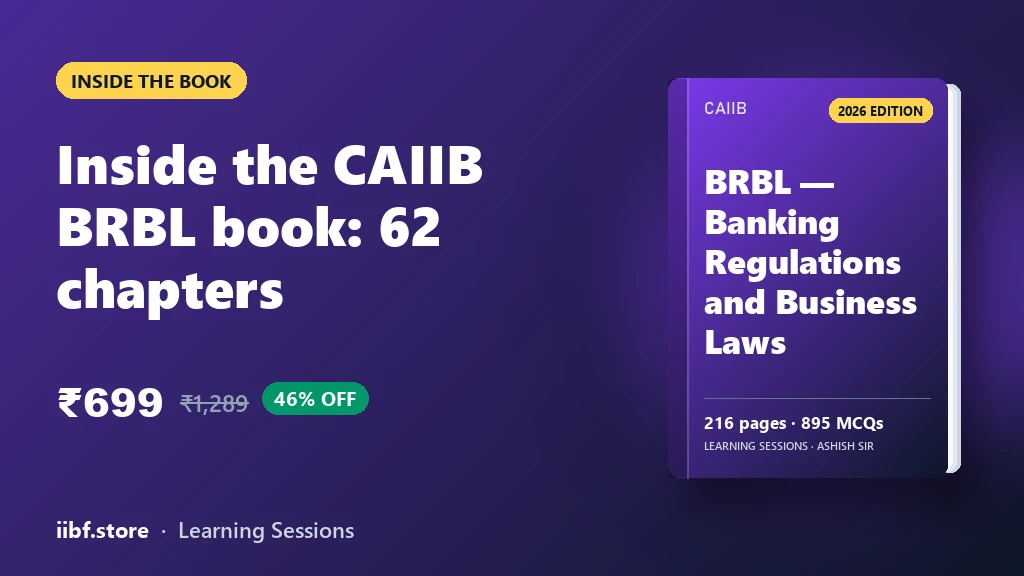
The book runs to 216 pages and 62 chapters, grouped into four modules that follow the paper's own structure. It is the 2026 edition, and it carries 895 MCQs across the chapters. Here is the layout, with the chapter counts taken straight from the contents.
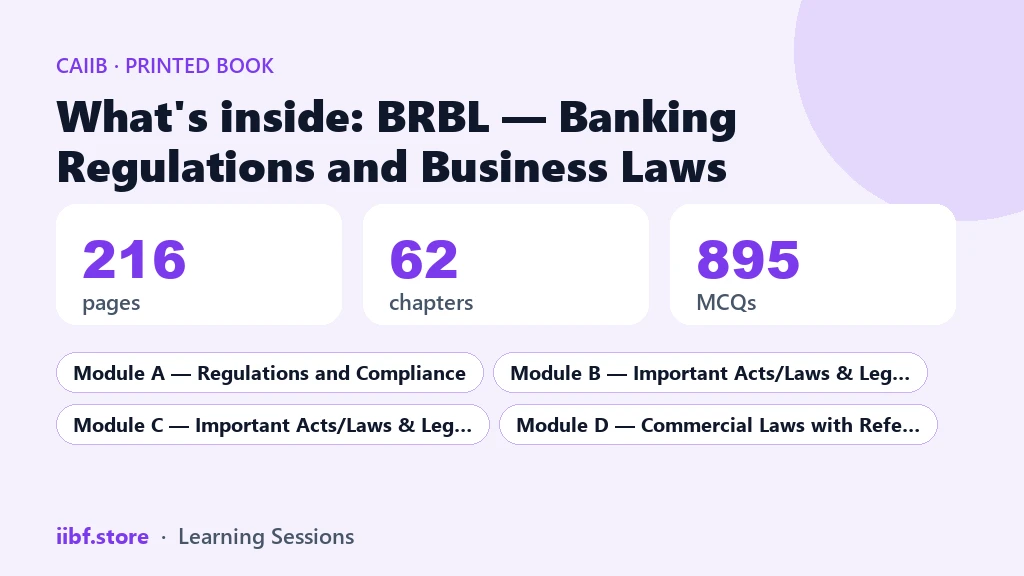
| Module | Theme | Chapters |
|---|---|---|
| Module A | Regulations and Compliance | 7 |
| Module B | Important Acts/Laws and Legal Aspects of Banking Operations | 6 |
| Module C | Important Acts/Laws and Legal Aspects of Banking Operations, Part B | 21 |
| Module D | Commercial Laws with Reference to Banking Operations | 28 |
Notice the shape. Modules C and D hold 49 of the 62 chapters. That is where most of your reading hours will go, and it is also where short chapters help you most.
Module A: the regulator's rulebook (7 chapters)
This module starts with the legal framework of regulation of banks, then moves through control over the organisation of banks, regulation of banking business, and returns, inspection, winding up, mergers and acquisitions. It then covers the different bank types, which are public sector, private sector, regional rural, differentiated, co-operative and local area banks. It closes with NBFCs and financial sector legislative reforms, including the Financial Stability and Development Council. Since you live inside this world at work, Module A is usually the comfortable one.
Module B: the Acts you meet every week (6 chapters)
Money laundering, negotiable instruments, FEMA, payment and settlement systems, the law relating to securities and modes of charge, and creation, registration and satisfaction of charges. Cheque dishonour and charge registration are things many of you have handled at the counter or in the credit department, so this module rewards the experience you already have.
One chapter, start to finish
Here is the part most buyers want to see before paying: what happens when you open a chapter. Each chapter follows the same three-beat rhythm, so after the first one you stop wondering how to approach the next.
- Concise notes. The Act or concept explained in plain language, trimmed to what the exam can ask.
- Key points. The definitions, conditions and exceptions you should be able to repeat without looking.
- MCQs. Questions on that chapter alone, so you find out immediately whether the reading stuck.
Take "Contracts of Guarantee" from Module D as an example. You read the notes to see who the surety, principal debtor and creditor are, scan the key points on the surety's liability, and then answer the chapter questions. Twenty or thirty minutes, one topic closed. That is a unit of study you can complete on a Tuesday night.
Modules C and D: where the volume sits
Module C: statutes with teeth (21 chapters)
This module opens with the Reserve Bank Integrated Ombudsman Scheme and the MSME Development Act. It then gives the SARFAESI Act a long run of chapters: introduction, definitions, regulation of securitisation and reconstruction, enforcement of security interest, the Central Registry, offences and penalties, and miscellaneous provisions. After that come the Recovery of Debts and Bankruptcy Act, with its tribunals, jurisdiction, procedure and recovery, and an introduction to the Insolvency and Bankruptcy Code. The module ends with the Bankers Books Evidence Act, Lok Adalats under the Legal Services Authorities Act, the Consumer Protection Act, 2019, the Law of Limitation and Tax Laws.
Splitting SARFAESI and the recovery Act across many small chapters is a real help. You do not have to face a whole statute at once; you finish one chapter and tick it off.
Module D: commercial law, one concept at a time (28 chapters)
Contract basics, indemnity, guarantee, bailment, pledge and agency come first. Then the sale of goods: essentials, conditions and warranties, and the unpaid seller. Partnership gets its own run, from nature and relations among partners to dissolution and the effect of non-registration. The company law block covers features, types, Memorandum and Articles of Association, the doctrines of ultra vires, constructive notice and indoor management, membership, prospectus and directors. The module ends with the LLP Act, Transfer of Property Act, the Right to Information Act, the Information Technology Act and the Prevention of Corruption Act.
If you come from a non-law background, Module D is usually the hardest to start. Plan to take it slowly and to repeat the key points more than once.
The extras: 100 case studies
Beyond the chapter MCQs, the book includes 100 case studies carrying 400 questions. Case-based questions are where a candidate who has only memorised definitions gets stuck, because the facts of a story must be matched to the right provision. Working through cases after you finish a module forces you to use the law rather than recite it.
A sensible way to use them: finish a module, wait a day, then attempt a handful of cases from memory before you re-read the notes. Wrong answers tell you exactly which chapter to reopen.
A simple plan for using the CAIIB BRBL book
You do not need a heroic schedule. You need a repeatable one that survives a heavy week at the branch. Here is a four-step loop you can run on any chapter.
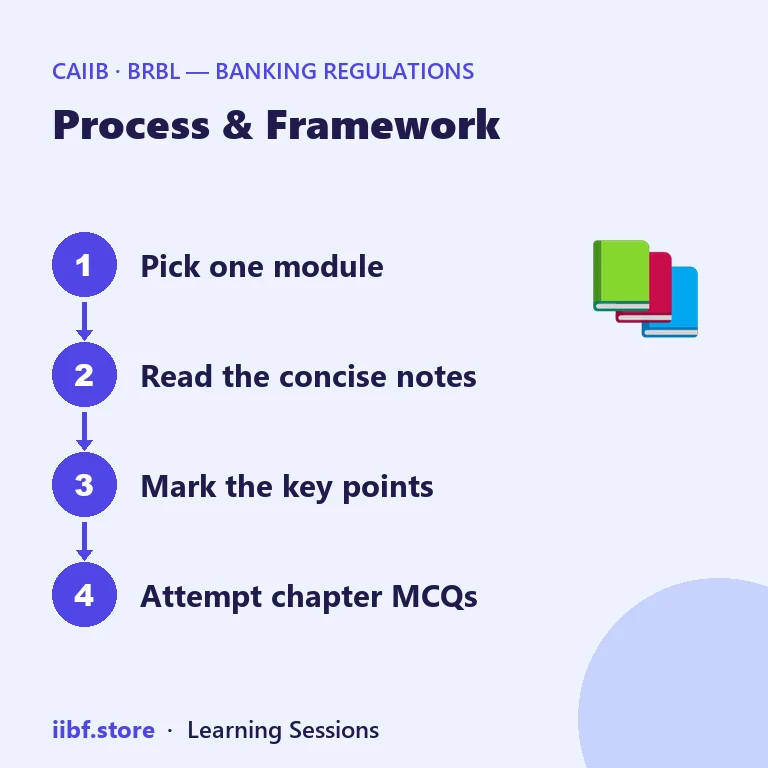
- Pick one module and one chapter. Decide the night before, so you do not waste your first fresh minutes choosing.
- Read the concise notes once, without highlighting. Just understand the purpose of the law.
- Mark the key points. Write the three or four most testable ones on a sheet of your own.
- Attempt the chapter MCQs the same day. Note every miss and revisit it at the weekend.
On weekends, switch to revision: re-attempt last week's misses, then do a block of case studies. Add timed practice through the free mock tests on iibf.store, and pick up supporting PDFs from the free material library.
One honest limit: a printed book builds understanding, but it does not give you exam-hall speed. For that you need timed mocks. Use the book to learn, and the mocks to rehearse. The official syllabus and schedule for the upcoming exam cycle are always on the IIBF website, so check them there before you finalise your plan.
Who gets the most out of this book
- Working bankers with limited hours. Short chapters mean you can close a topic in one sitting.
- Candidates from a non-law background. Plain-language notes make Module D less intimidating.
- People who prefer paper. If screens tire you after a day of CBS work, a printed book is easier on the eyes.
- Repeat attempters. The per-chapter MCQs and case studies show you precisely which Act let you down last time.
It is less suited to someone who wants a full-length reference with every section number and amendment history. This is exam-focused study material, not a law library.
The CAIIB BRBL book is listed at ₹699 against an MRP of ₹1,289 as of now. Prices can change, so the book page always has the current figure. Browse the rest of the range at iibf.store/books, or read more preparation guides on the iibf.store blog.
Frequently asked questions
How many chapters and questions does the book have?
It has 216 pages and 62 chapters in four modules, with 895 MCQs. It also includes 100 case studies carrying 400 questions.
Can I see a sample before ordering?
Yes, a free sample is available on the book page, so you can judge the notes, key points and MCQ style yourself.
Is one book enough to clear BRBL?
It covers the whole paper in structured form, but you should still practise timed mock tests for speed and accuracy, and check the official IIBF syllabus for the upcoming exam cycle.
Which module should I start with?
Start with Module A, because it matches your daily work, and build confidence there. Save the heavier Module D for when you have a steady routine.
Prefer revising from a printed book?
Chapter-wise books with MCQs after every chapter — minimal pages, complete coverage, delivered anywhere in India. Every book has a free sample to read first.
216 pages · 895 MCQs
Learning Sessions · Ashish Sir
148 pages · 478 MCQs
Learning Sessions · Ashish Sir
151 pages · 465 MCQs
Learning Sessions · Ashish Sir
148 pages · 375 MCQs
Learning Sessions · Ashish Sir
109 pages · 300 MCQs
Learning Sessions · Ashish Sir
104 pages · 360 MCQs
Learning Sessions · Ashish Sir
82 pages · 297 MCQs
Learning Sessions · Ashish Sir
151 pages · 600 MCQs
Learning Sessions · Ashish Sir
98 pages · 282 MCQs
Learning Sessions · Ashish Sir
131 pages · 672 MCQs
Learning Sessions · Ashish Sir
221 pages · 831 MCQs
Learning Sessions · Ashish Sir
128 pages · 524 MCQs
Learning Sessions · Ashish Sir
107 pages · 445 MCQs
Learning Sessions · Ashish Sir
132 pages · 225 MCQs
Learning Sessions · Ashish Sir
188 pages · 435 MCQs
Learning Sessions · Ashish Sir
117 pages · 236 MCQs
Learning Sessions · Ashish Sir
Learning Sessions · Ashish Sir
118 pages · 299 MCQs
Learning Sessions · Ashish Sir
Learning Sessions · Ashish Sir
Learning Sessions · Ashish Sir
Learning Sessions · Ashish Sir
115 pages · 255 MCQs
Learning Sessions · Ashish Sir
Learning Sessions · Ashish Sir
334 pages · 936 MCQs
Learning Sessions · Ashish Sir
Learning Sessions · Ashish Sir
115 pages · 344 MCQs
Learning Sessions · Ashish Sir
107 pages · 240 MCQs
Learning Sessions · Ashish Sir
90 pages · 150 MCQs
Learning Sessions · Ashish Sir
Learning Sessions · Ashish Sir
Quick quiz on this topic
5 exam-style questions from our free test bank — check yourself before you move on.
Practice this topic
Take a free mock test, download chapter PDFs, or watch a video class — all included on iibf.store.