Inside the CAIIB BFM book: 31 chapters, 4 modules, 465 MCQs
It is 10:40 pm. You have been at the branch since morning, the day-end tallying took longer than usual, and the CAIIB Bank Financial Management syllabus is sitting on the table looking endless: forex, Basel, treasury, ALM, derivatives. If that is your week, you do not need another thick reference. You need to know exactly what you will be reading, in what order, and how long each piece will take. This guided tour of the CAIIB BFM book is written for that situation.
Even if you never buy it, the way we break BFM down below is a method you can copy onto any material you already own. Use it, and then decide whether a printed book fits how you study.
Why BFM feels heavier than it is
BFM is not hard because each idea is difficult. It is hard because four very different subjects are packed into one paper, and they do not share a vocabulary. Letters of credit talk about documents. Risk talks about capital and probability. Treasury talks about yields and instruments. Balance sheet management talks about gaps and ratios.
When you study all four with the same mindset, your head gets crowded. The fix is simple: treat BFM as four short papers, finish them one at a time, and keep a separate page of formulas and definitions for each. That is also how the book below is organised, which is why it is easy to follow when you are tired.
What tired preparation really needs
- Small units. A chapter you can finish in one sitting, not a block you have to carry over three nights.
- A clear start and end. You should know when a chapter is done, so you can stop without guilt.
- Immediate testing. Questions right after reading, while the idea is still fresh.
How the CAIIB BFM book is organised
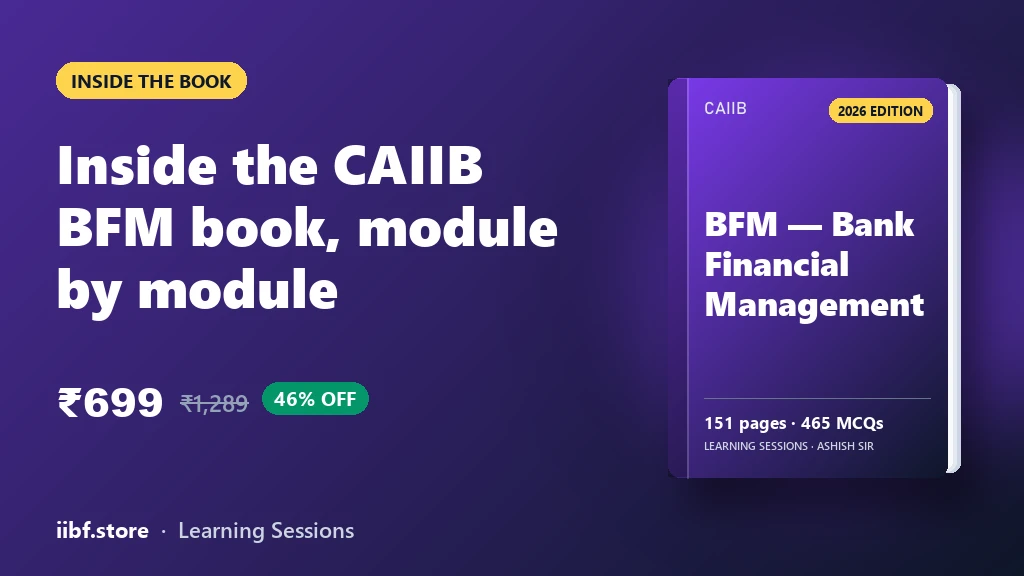
The BFM printed book runs to 151 pages across 31 chapters, grouped into four modules. The 2026 edition keeps the same module order you will see on the paper, so there is no mental translation between your study material and the question paper.
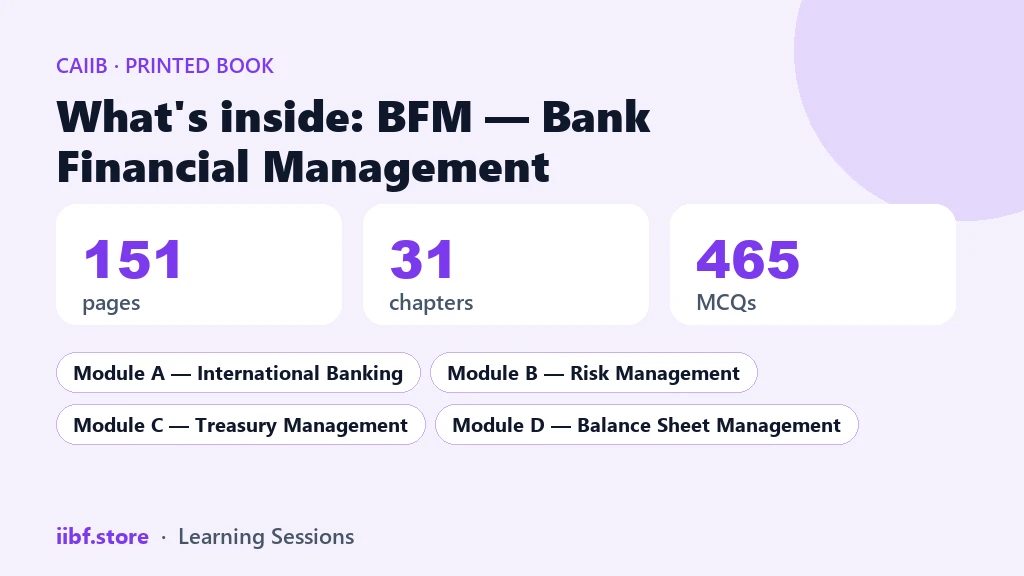
Module A: International Banking (10 chapters)
This is the largest module by chapter count. It begins with exchange rates and forex business, then moves through the Liberalised Remittance Scheme and other remittance facilities for residents, correspondent banking and NRI accounts, documentary letters of credit, and facilities for exporters and importers. The later chapters cover external commercial borrowings and foreign investments, risks in foreign trade and the role of ECGC, the role of EXIM Bank, RBI, FEMA and FEDAI, IFSC and GIFT City, and technology in international banking.
Module B: Risk Management (8 chapters)
Here you start from the basics: risk and the basic risk management framework, then risks in banking business and risk regulations. After that come market risk, credit risk, operational risk with integrated risk management, liquidity risk management, and the Basel III framework on liquidity standards.
Module C: Treasury Management (7 chapters)
This module opens with an introduction to treasury and treasury products, then international equity and debt products, funding and regulatory aspects, treasury risk management, derivative products, and finally treasury and asset-liability management.
Module D: Balance Sheet Management (6 chapters)
The shortest module in chapter count, but one that ties the paper together. It covers the components of assets and liabilities and their management, capital adequacy and Basel norms, asset classification and provisioning norms, liquidity management, interest rate risk management, and RAROC with profit planning.
| Module | Subject | Chapters |
|---|---|---|
| A | International Banking | 10 |
| B | Risk Management | 8 |
| C | Treasury Management | 7 |
| D | Balance Sheet Management | 6 |
Notice how the modules lean on each other. Liquidity shows up in Module B and again in Module D. Treasury risk in Module C is easier once you have met market risk in Module B. If you read in the printed order, these repeats feel like revision, not new work.
What one chapter looks like
Every chapter follows the same rhythm, so after the first one you stop wondering what comes next and just read. You get concise notes first, written to be read in a single sitting. Then come the key points, the things you would want to glance at again on the morning of the exam. Then come the MCQs on that chapter.
Across the book there are 465 questions. Because they sit at the end of each chapter, you find out immediately whether what you just read has stayed. A wrong answer at 11 pm is much cheaper than a wrong answer in the exam hall.
A realistic 45-minute sitting
- 20 minutes: read the concise notes once, pencil in hand, marking only what surprises you.
- 5 minutes: go over the key points and say them back without looking.
- 15 minutes: attempt the MCQs, then go back to the notes for every one you missed.
- 5 minutes: write one line on your formula or definition page.
These numbers are a guide, not a promise. A dense chapter such as capital adequacy will take longer than a light one, and that is fine.
The 100 case studies
Beyond the chapters, the book includes 100 case studies carrying 400 questions. This is the part that matters when the paper stops asking "what is" and starts asking "what would you do". Numerical and scenario questions in BFM, such as a forex quote, a gap statement or a provisioning computation, are rarely solved by reading alone. You need to have done a few by hand.
Our advice is to keep the case studies for the second pass. First finish the chapters and their MCQs, then use the case studies to find out which modules you only think you know.
A study plan that uses the book the CAIIB BFM way
Here is a plan that works with a full-time job. It does not need heroic evenings; it needs the same small habit repeated.
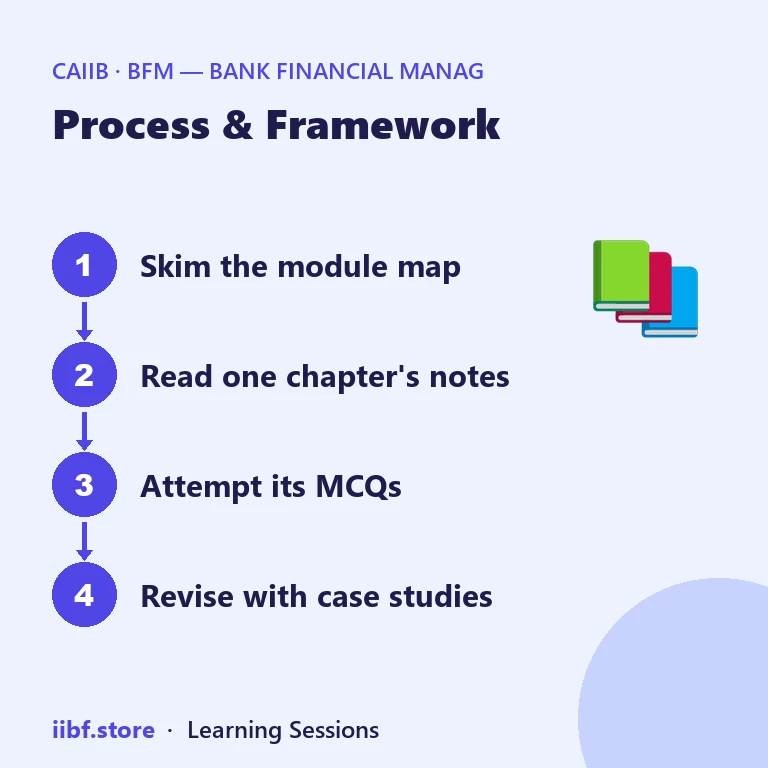
- Map first. Spend one evening skimming the chapter titles of all four modules. You are not learning, only knowing where things live.
- One chapter per sitting. Notes, key points, then MCQs. On busy weekdays, do half a chapter and stop at a natural break.
- Finish a module before starting the next. Close each one with a quick pass over its key points.
- Second pass with case studies. Use them to practise the numerical and scenario questions, and note every error.
With 31 chapters, even a modest pace of three chapters a week gives you a first pass in about ten weeks, leaving time for revision. Your own pace may be faster or slower; the point is to have a number on the wall.
Pair it with free practice
A book gives you understanding, but exam-hall speed comes from timed practice. Use the free mock tests to check your speed, and browse the free material for extra revision sheets. For the full set of titles, see the books page.
Who gets the most out of it
The CAIIB BFM book suits you best if:
- you are a working banker who studies in short, tired bursts and wants chapters that fit them;
- you prefer to read on paper and mark up pages instead of scrolling a screen;
- you have a first-time or repeat attempt coming up and want one structured pass through all four modules;
- you learn by testing yourself, and want questions right after each chapter.
It will help you less if you want a very detailed reference with every circular reproduced. At 151 pages, it is built to be finished, not to be consulted like an encyclopedia. For rules that change, always check the official site at www.iibf.org.in, along with the schedule for the upcoming exam cycle.
The price at the time of writing is ₹699 against an MRP of ₹1,289, but prices may change, so the book page is always the current word. You can also read the free sample there before deciding.
The short version
BFM becomes manageable once you cut it into four modules, 31 chapters and a repeatable routine. The CAIIB BFM book gives you that structure in a printed form: concise notes, key points, MCQs, and 100 case studies for the second pass. A book alone will not give you speed, so pair it with mocks, and start with the module map this week. If you are still deciding, our CAIIB course page shows the other papers too.
Frequently asked questions
How many chapters and questions does the BFM book have?
It has 31 chapters in four modules, 465 questions in total, and 100 case studies carrying 400 questions as an extra. The book runs to 151 pages in the 2026 edition.
Is there a free sample I can read first?
Yes. The book page has a free sample, so you can judge the style and layout before ordering.
Can I clear BFM with only one book?
A book gives you structured coverage, but exam-hall speed comes from timed practice. Combine it with mock tests, and check the official IIBF site for the latest syllabus and notices.
Which module should I start with?
Follow the printed order, A to D, so the overlaps in liquidity and risk read as revision. If one module is a real weakness at your branch, begin there instead, but finish whichever module you start.
Prefer revising from a printed book?
Chapter-wise books with MCQs after every chapter — minimal pages, complete coverage, delivered anywhere in India. Every book has a free sample to read first.
151 pages · 465 MCQs
Learning Sessions · Ashish Sir
148 pages · 478 MCQs
Learning Sessions · Ashish Sir
148 pages · 375 MCQs
Learning Sessions · Ashish Sir
216 pages · 895 MCQs
Learning Sessions · Ashish Sir
109 pages · 300 MCQs
Learning Sessions · Ashish Sir
104 pages · 360 MCQs
Learning Sessions · Ashish Sir
82 pages · 297 MCQs
Learning Sessions · Ashish Sir
151 pages · 600 MCQs
Learning Sessions · Ashish Sir
98 pages · 282 MCQs
Learning Sessions · Ashish Sir
131 pages · 672 MCQs
Learning Sessions · Ashish Sir
221 pages · 831 MCQs
Learning Sessions · Ashish Sir
128 pages · 524 MCQs
Learning Sessions · Ashish Sir
107 pages · 445 MCQs
Learning Sessions · Ashish Sir
132 pages · 225 MCQs
Learning Sessions · Ashish Sir
188 pages · 435 MCQs
Learning Sessions · Ashish Sir
117 pages · 236 MCQs
Learning Sessions · Ashish Sir
Learning Sessions · Ashish Sir
118 pages · 299 MCQs
Learning Sessions · Ashish Sir
Learning Sessions · Ashish Sir
Learning Sessions · Ashish Sir
Learning Sessions · Ashish Sir
115 pages · 255 MCQs
Learning Sessions · Ashish Sir
Learning Sessions · Ashish Sir
334 pages · 936 MCQs
Learning Sessions · Ashish Sir
Learning Sessions · Ashish Sir
115 pages · 344 MCQs
Learning Sessions · Ashish Sir
107 pages · 240 MCQs
Learning Sessions · Ashish Sir
90 pages · 150 MCQs
Learning Sessions · Ashish Sir
Learning Sessions · Ashish Sir
Quick quiz on this topic
5 exam-style questions from our free test bank — check yourself before you move on.
Practice this topic
Take a free mock test, download chapter PDFs, or watch a video class — all included on iibf.store.
Keep reading