Inside the CAIIB HRM Book: Modules, Chapters and MCQs
It is 10 pm. You have been at the counter, the loan file and the review meeting since morning, and now you have an elective to prepare. Human Resources Management does not look scary the way a numerical paper does, but it is wide: organisational behaviour, industrial relations, motivation, ethics, AI in HR. When a syllabus is wide and your evenings are short, the real question is not how much to read but what to read first. This tour of the CAIIB HRM book is meant to help you picture that, whether or not you ever order it.
We will walk through how the book is organised, what a single chapter looks like, how to use the extras, and who is likely to get the most from it. Along the way you will pick up a study method you can use with any material.
Why HRM feels harder than it looks
Most bankers who pick this elective say the same thing: the concepts are familiar from daily work, so the paper should be easy. Then the options in a question all sound sensible, and the wrong ones sound just as sensible as the right one. HRM questions test whether you know the textbook distinction, not whether you have lived the situation.
That has two consequences for how you prepare:
- Vocabulary matters. Terms such as grievance redressal, discipline management and workers participation sound alike. You need crisp, separate definitions.
- Breadth beats depth. With 24 chapters across five modules, one weak module can cost you more than one hard chapter.
- Practice has to be in the exam format. Reading alone gives a false sense of readiness. You must attempt questions and check why you went wrong.
So the ideal material is compact enough to finish, organised the way the syllabus is, and paired with questions. That is the design brief behind the CAIIB HRM book, and the rest of this article shows how it plays out.
The book in numbers
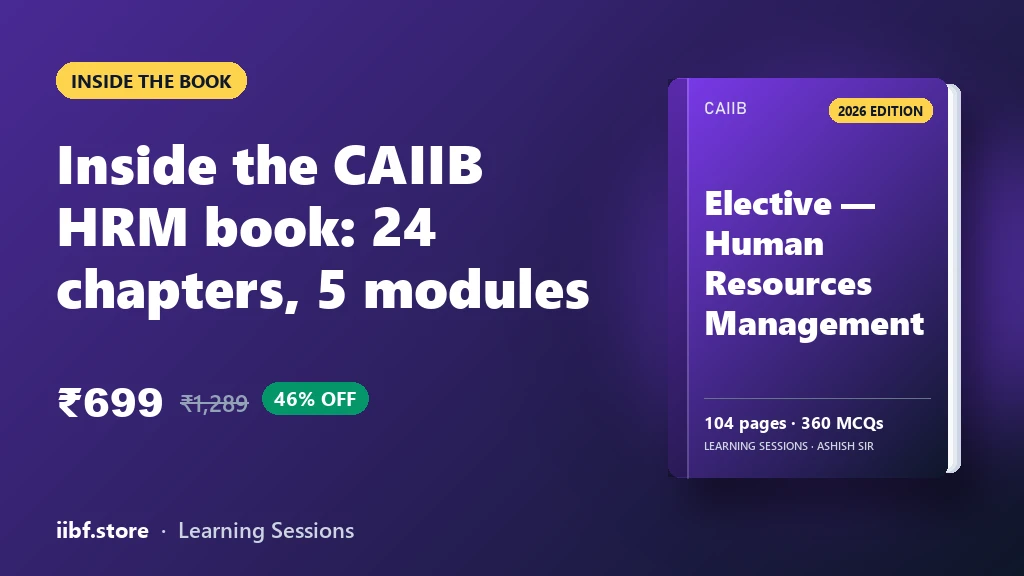
Start with the facts, because a printed book you can finish is better than a shelf of ones you cannot. The CAIIB Elective Human Resources Management book (2026 edition) runs to 104 pages and covers 24 chapters in five modules. It carries 360 questions, plus an extra set of 60 case studies that come with 240 questions.
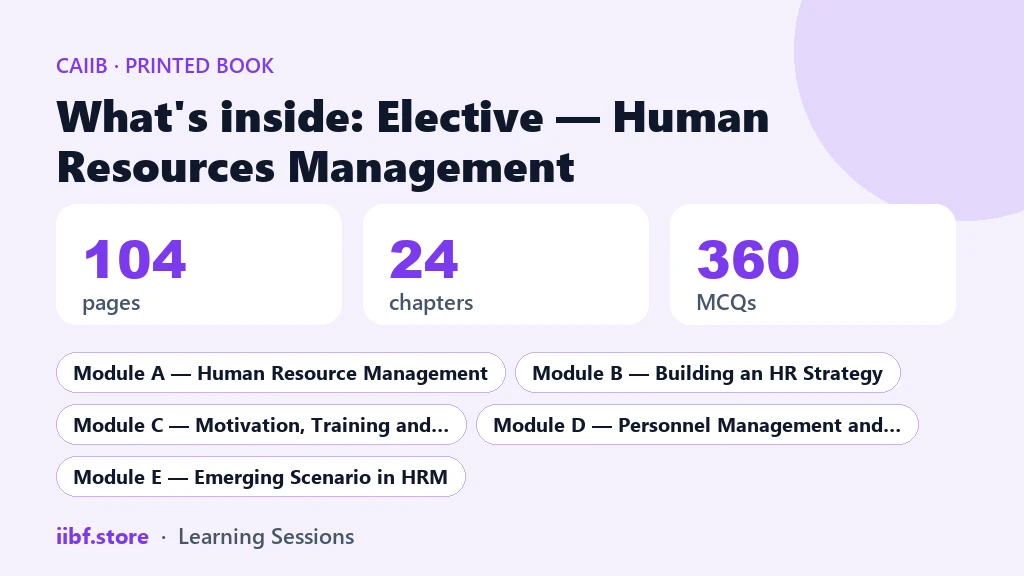
Do the arithmetic on your own time. Twenty-four chapters in 104 pages means each chapter is short, a few pages at most. That is deliberate: it is a revision-oriented book, built so that one chapter fits in a single sitting after office hours. It is not a replacement for the full IIBF course material if you want every detail, and it is not trying to be.
The price at the time of writing is ₹699 against an MRP of ₹1,289 (46% off). Prices can change, so the book page is always the current word.
The five modules, one by one
The book follows the syllabus modules, so you can map your study calendar straight onto it. Here is the layout.
Module A: Human Resource Management (5 chapters)
This is the foundation: Fundamentals of HRM, Organisational Behaviour, Organisational Change, HRM in Indian Banks and Knowledge Management. If you are short of time, do not skip it. The definitions here come back in every later module.
Module B: Building an HR Strategy (5 chapters)
HR as a Strategic Player, CEO and his-her Team, Communication, HR Functions and Performance Management. This module reads closest to what you see in your own bank, which makes it easier to remember but also easier to get lazy about. Test yourself on the terminology anyway.
Module C: Motivation, Training and Skill Development (4 chapters)
The Learning Process, Employee Motivation, Employee Development and Training Methodology. Motivation theories are classic MCQ territory, because the options differ by a single name or concept.
Module D: Personnel Management and Industrial Relations (4 chapters)
Industrial Relations, Employee Discipline (Grievance Redressal and Discipline), Workers Participation in Management (WPM) and Employee Discipline (Discipline Management). Two chapters on discipline sit side by side, so study them together and note exactly where they differ.
Module E: Emerging Scenario in HRM (6 chapters)
The largest module, and the one most candidates leave for the last night. It covers contemporary practices in employee engagement, organisational culture and creativity, corporate sustainability and Green HRM, HR analytics with AI-based HR solutions, leading in VUCA and BANI scenarios, and business ethics with corporate governance and CSR. These are newer topics, and they do not feel like "textbook" subjects, so give them early attention rather than a last-minute skim.
| Module | Chapters | What to focus on |
|---|---|---|
| A: Human Resource Management | 5 | Core definitions, OB, change, HRM in banks |
| B: Building an HR Strategy | 5 | HR functions, communication, performance management |
| C: Motivation, Training and Skill Development | 4 | Motivation theories, learning, training methods |
| D: Personnel Management and Industrial Relations | 4 | IR, grievance and discipline, WPM |
| E: Emerging Scenario in HRM | 6 | Engagement, Green HRM, HR analytics, VUCA and BANI, ethics |
What one chapter looks like
Each chapter follows the same rhythm: concise notes, then key points, then MCQs. The sameness is a feature. After the second chapter you stop thinking about how to read the page and just read it.
- Concise notes: the concept explained in a few pages, in plain language, so you get the idea before you worry about the exam.
- Key points: the facts you would write on a revision card. These are what you re-read in the metro or the last ten minutes before a mock.
- MCQs: questions in exam style, so you find out straight away whether the chapter actually stuck.
The order matters. Notes give understanding, key points give recall, and MCQs give exam practice. Skip the last step and you only know that you read the chapter, not that you can answer questions from it.
A simple way to use a chapter in one evening
You do not need a complicated schedule. Here is a four-step routine that fits a 60 to 90 minute slot and works with any study material, including the CAIIB HRM book.
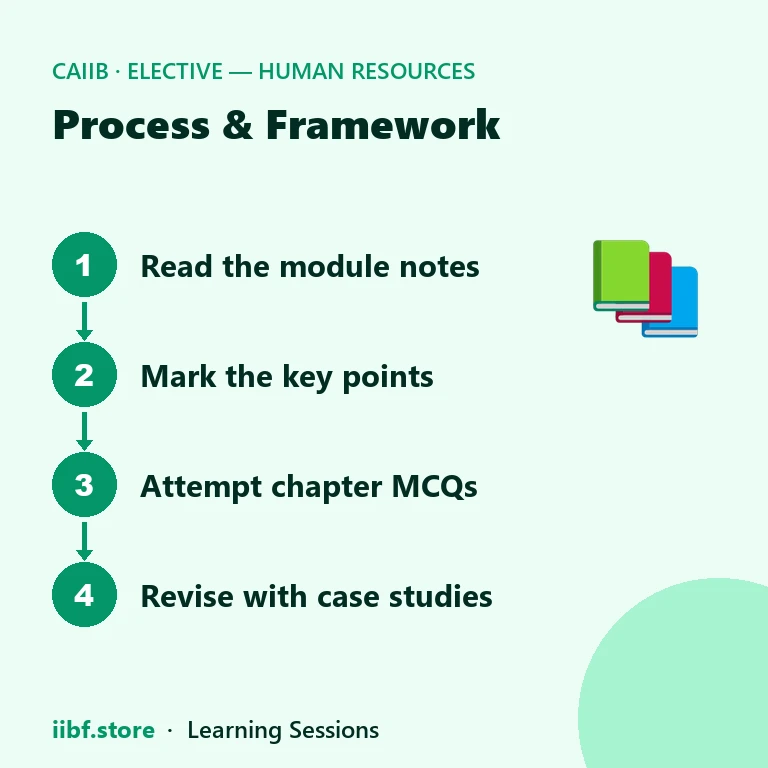
- Read the notes once, without highlighting. Just understand. Highlighting on a first read marks everything.
- Go back and mark the key points. Now you know what matters, so your marks mean something.
- Attempt the chapter MCQs cold. Do not look back at the notes. Write down what you got wrong and why.
- Revise the errors the next day. Two or three missed questions re-read the following evening do more than another full read-through.
Treat the weak chapters differently from the strong ones. If you score well on Module B in a first attempt, move on. If Module D keeps tripping you, go back to it twice more before the exam rather than reading everything evenly.
A realistic schedule
With 24 chapters, a pace of one chapter a day gets you through the whole book in under four weeks, leaving a week for revision. If your branch is busy, two chapters on a weekend day and one on weekday evenings is more honest than a plan you will abandon on day four. Choose a pace you can repeat after a bad day at work.
The extras: 60 case studies
Beyond the chapter MCQs, the book includes 60 case studies with 240 questions. Case-based questions are different from direct recall. You read a short situation, say about discipline, change or an engagement problem, and answer several questions based on it. They are where the exam checks if you can apply a concept, not only name it.
Save them for after you have finished a module. Used too early, they feel like a wall. Used after the chapters, they become the test that tells you which module deserves a second pass.
Who gets the most out of it
Every book suits some candidates better than others, so here is an honest sorting.
- You will likely get the most value if you work full time, want a compact, organised revision book, and prefer paper to a screen after a day of screens.
- You will likely get the most value if you have already skimmed the official course material once and now need something to consolidate and drill.
- You may need more if you want every detail and example from the full syllabus. A 104-page book is a revision and practice tool, not a complete library.
One more honest line: a book on its own will not give you exam-hall speed. Pair it with timed practice. The free mock tests on iibf.store and the free study material are a sensible place to begin, and you can browse the full books shelf for other papers. For the CAIIB overall, see the CAIIB course page.
Before you decide
Check what the book looks like before you spend anything. There is a free sample on the book page, and reading one chapter is the fastest way to judge the style, the language and the question level. If it matches the way you like to study, good. If it does not, no harm done.
For exam dates, eligibility and the official syllabus, always go to the source: the IIBF website. Plan against the upcoming exam cycle as published there, not against anything you read on a forum.
Summing up
The CAIIB HRM book is a compact, module-by-module revision tool: 104 pages, 24 chapters, 360 questions and 60 case studies with 240 questions. Its value is not in any one page but in the routine it gives you: notes, key points, MCQs, then cases. If you are fitting this elective around a full-time branch job, that routine is the thing to take away, even if you build it from other material. You can view the book and its sample here and decide at your own pace. Keep reading our blog for more study plans.
Frequently asked questions
How many chapters and modules does the book cover?
It covers 24 chapters across five modules, A to E, in 104 pages. The module names and chapter titles are listed above, so you can match them against the syllabus before you buy.
Does the book have practice questions?
Yes. It carries 360 questions, and the extras include 60 case studies with 240 questions. Use the chapter MCQs for recall and the case studies for application.
Can I read a sample first?
Yes, a free sample is available on the book page. It is worth reading one chapter to judge the style and level before you decide.
Is this enough on its own for the exam?
It is a revision and practice tool, not a guarantee. Pair it with timed mock tests and the official material for the upcoming exam cycle, and check the IIBF website for current details.
Prefer revising from a printed book?
Chapter-wise books with MCQs after every chapter — minimal pages, complete coverage, delivered anywhere in India. Every book has a free sample to read first.
104 pages · 360 MCQs
Learning Sessions · Ashish Sir
148 pages · 478 MCQs
Learning Sessions · Ashish Sir
151 pages · 465 MCQs
Learning Sessions · Ashish Sir
148 pages · 375 MCQs
Learning Sessions · Ashish Sir
216 pages · 895 MCQs
Learning Sessions · Ashish Sir
109 pages · 300 MCQs
Learning Sessions · Ashish Sir
82 pages · 297 MCQs
Learning Sessions · Ashish Sir
151 pages · 600 MCQs
Learning Sessions · Ashish Sir
98 pages · 282 MCQs
Learning Sessions · Ashish Sir
131 pages · 672 MCQs
Learning Sessions · Ashish Sir
221 pages · 831 MCQs
Learning Sessions · Ashish Sir
128 pages · 524 MCQs
Learning Sessions · Ashish Sir
107 pages · 445 MCQs
Learning Sessions · Ashish Sir
132 pages · 225 MCQs
Learning Sessions · Ashish Sir
188 pages · 435 MCQs
Learning Sessions · Ashish Sir
117 pages · 236 MCQs
Learning Sessions · Ashish Sir
Learning Sessions · Ashish Sir
118 pages · 299 MCQs
Learning Sessions · Ashish Sir
Learning Sessions · Ashish Sir
Learning Sessions · Ashish Sir
Learning Sessions · Ashish Sir
115 pages · 255 MCQs
Learning Sessions · Ashish Sir
Learning Sessions · Ashish Sir
334 pages · 936 MCQs
Learning Sessions · Ashish Sir
Learning Sessions · Ashish Sir
115 pages · 344 MCQs
Learning Sessions · Ashish Sir
107 pages · 240 MCQs
Learning Sessions · Ashish Sir
90 pages · 150 MCQs
Learning Sessions · Ashish Sir
Learning Sessions · Ashish Sir
Quick quiz on this topic
5 exam-style questions from our free test bank — check yourself before you move on.
Practice this topic
Take a free mock test, download chapter PDFs, or watch a video class — all included on iibf.store.