Inside the DRA Exam Preparation Book: 16 Chapters, 4 Modules
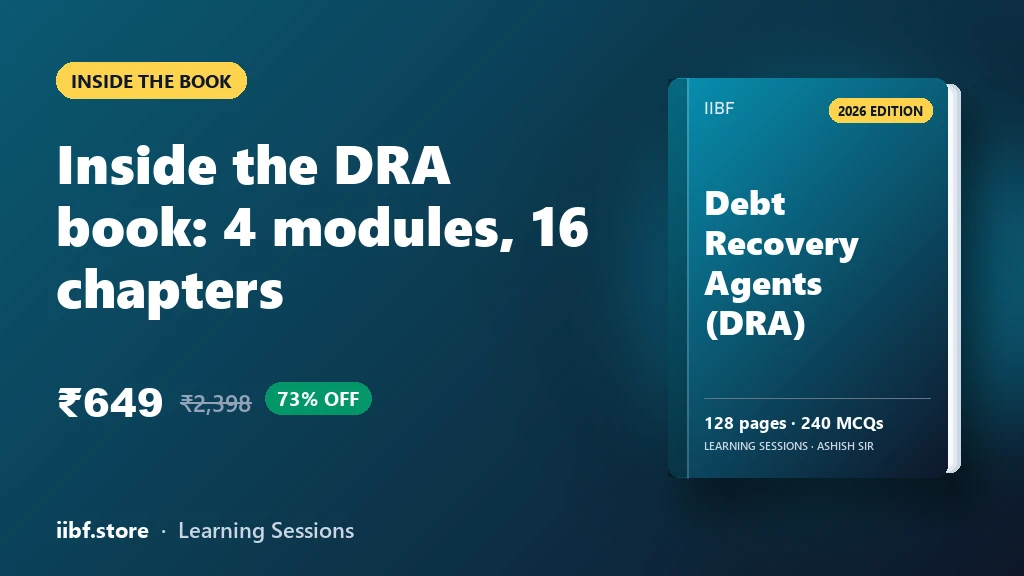
You finish a long day at the branch, the last customer has left, and the thought of opening a thick textbook feels heavy. If you are preparing for the Debt Recovery Agents certificate, that tiredness is real, and the syllabus does not look friendlier from far away: banking basics, loans, law, recovery practice, soft skills and even NBFCs. This article walks through a DRA exam preparation book page by page, so you can picture how a 128-page book can be studied in short evening sittings.
Even if you never buy it, the way the syllabus is split below is a useful map for any study material you pick. Read it as a planning guide first and a book tour second.
Why the DRA syllabus feels bigger than it is
The Debt Recovery Agents certificate asks you to hold two kinds of knowledge together. One is plain banking: accounts, deposits, cheques, cards, loans and securities. The other is recovery work itself: what an agent may and may not do, how to speak to a defaulting borrower, and what the law expects. Most candidates already know part of the first kind from daily work, which is exactly why they underestimate it and then lose marks on the details.
Here is what usually goes wrong for people studying alongside a job:
- They start from the first page of a large book and run out of energy by the fourth chapter.
- They read passively, nod along, and never test themselves until the exam hall.
- They skip the soft-skills and best-practice chapters because they look 'easy', and then meet scenario questions on them.
The fix is not more hours. It is a smaller unit of study and a clear order. A compact book organised into modules gives you both, because every sitting has a defined start and finish.
How the book is organised: four modules, sixteen chapters
The Debt Recovery Agents (DRA) book, a DRA exam preparation book in its 2026 edition running to 128 pages. It covers 16 chapters grouped into four modules, and carries 240 MCQs along with additional case-study and mega-test material. The grouping follows the way a recovery agent actually thinks: first the banking ground you stand on, then the loans you are recovering, then your own role, and finally the NBFC world you may also meet.
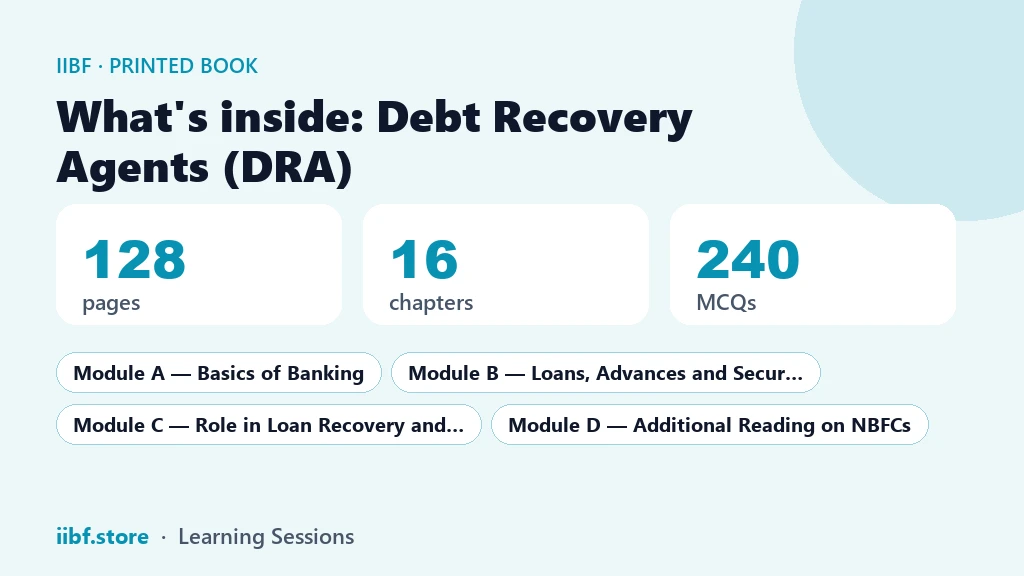
Module A: Basics of Banking (5 chapters)
This module covers General Banking, the Banker Customer Relationship, Accounts Opening and Operations in Accounts, Various Deposit Schemes and Other Services, and the Provisions of the NI Act for Payment and Collection of Cheques. If you work in a branch, you will move through much of this quickly. Use it to catch the technical corners, such as cheque rules, that daily routine rarely tests.
Module B: Loans, Advances and Securities (5 chapters)
Here you meet Debit Card and Credit Card, Various Types of Loans and Advances, Securities and Modes of Charging Them, Loan Documentation and Asset Classification, and Legal Aspects of Loan Recovery. For a recovery agent this is the core: you cannot talk sensibly about recovering a loan without knowing how it was secured, documented and classified.
Module C: Role in Loan Recovery and Soft Skills (4 chapters)
The four chapters are Debt Recovery Agent, Functions and Procedures of Debt Recovery Agent, International Best Practices on Debt Recovery, and Soft Skills and Strategies for Debt Recovery. This is the part that is specific to the certificate, so give it your fresh evenings rather than your last-minute ones.
Module D: Additional Reading on NBFCs (2 chapters)
The last module has NBFCs: Types, Framework and Loans, and the Fair Practices Code for NBFCs. It is labelled additional reading, but treat it as part of the paper when you are planning.
One chapter, start to finish
Knowing the table of contents is one thing. What matters on a tired Tuesday is what a single sitting looks like. Each chapter is built in the same three layers, which is what lets you study without deciding anything each evening:
- Concise notes. The chapter is boiled down to what you need to read, not a textbook-style essay.
- Key points. The facts you are likely to be asked, pulled out so you can revise them in a few minutes the night before.
- MCQs. Questions at the end of the chapter to check whether it actually stuck. Across the whole book there are 240 of them.
Because the structure never changes, you can open the book on page one of any chapter and know exactly what the next 30 to 40 minutes will be. That predictability is worth more than it sounds when you are exhausted, because the hardest part of studying after work is starting.
A simple method to use this DRA exam preparation book after work
You do not need a heroic timetable. Here is a method that fits one chapter into one evening, and it works with any well-organised material, not only this one.
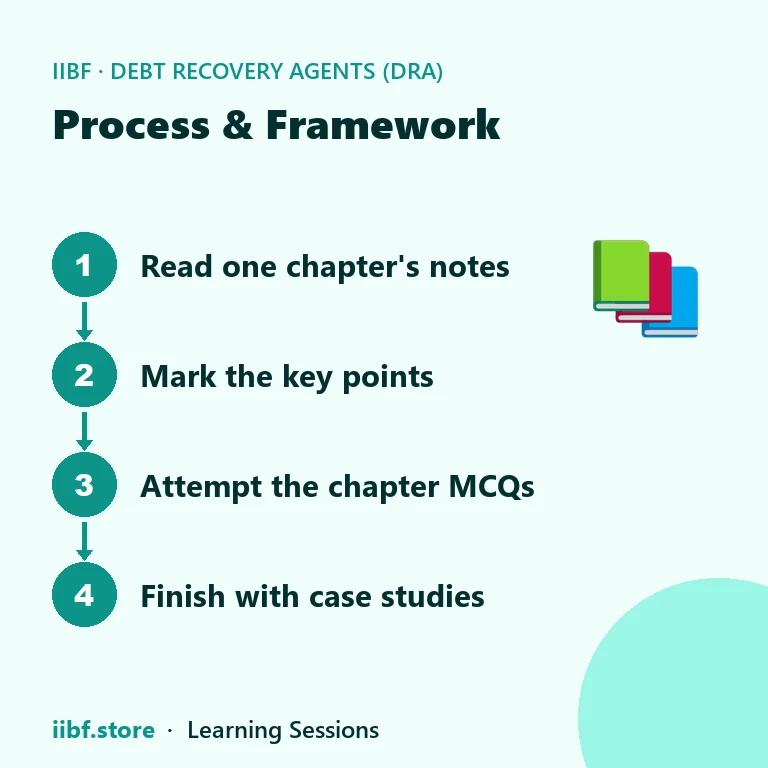
Step 1: Read the notes once, without highlighting
Resist the urge to colour every line. Read the concise notes straight through to get the shape of the chapter. If a term is new, circle it and keep going.
Step 2: Go back for the key points
Now return to the key points and mark only the items you could not have said from memory. These marked items become your revision list for the week.
Step 3: Attempt the chapter MCQs cold
Do the questions before checking any answer. A wrong answer here costs nothing and shows you precisely which paragraph to reread. This is where learning happens, so do not skip it because you are tired.
Step 4: Add case studies as you go
The book comes with 40 case studies carrying 160 questions in all. Recovery questions are often scenario-based, so attach them to the matching module instead of leaving them all for the end.
Finish a module and you have a natural checkpoint. At 16 chapters, even one chapter a night gets you through the whole syllabus in a little over two weeks, leaving the remaining time for revision and practice papers. Adjust to your own pace; this is only an illustration of how small the daily unit can be.
What the extras add to a DRA exam preparation book: case studies and mega tests
Two extras sit alongside the main text:
- 40 Case Studies (160 questions): short scenarios that make you apply a rule instead of recalling it.
- 5 Mega Tests (500 questions): full-length practice for the last stretch, when you need to test stamina and timing across all four modules.
| Part | Chapters | What you get |
|---|---|---|
| Module A: Basics of Banking | 5 | Accounts, deposits, cheques and the NI Act |
| Module B: Loans, Advances and Securities | 5 | Cards, loans, securities, documentation, recovery law |
| Module C: Role in Loan Recovery and Soft Skills | 4 | The agent's role, procedures, best practices, soft skills |
| Module D: Additional Reading on NBFCs | 2 | NBFC framework and Fair Practices Code |
| Extras | - | 40 case studies (160 questions), 5 mega tests (500 questions) |
A word of honesty: a book on its own will not give you exam-hall speed. Reading builds knowledge, but speed comes from timed practice, so plan to use the mega tests and some free mock papers as well. You can try the free mock tests and download notes from the free material library before deciding anything.
Who gets the most out of it
A DRA exam preparation book like this suits a particular reader. You will probably get the most from it if you:
- work full time and can give 30 to 45 minutes on weekday evenings;
- have banking exposure but want the recovery, soft-skills and NBFC parts organised in one place;
- prefer a compact printed book you can carry and mark up over a long set of lecture notes;
- like to test yourself chapter by chapter rather than save all practice for the end.
It is less suited to someone who wants video lectures for every topic, since this is a reading-and-practice resource. If that is you, look at the wider books collection and the free material first.
The DRA book page has the current price, which at the time of writing is ₹649 against an MRP of ₹2,398. Prices may change, so treat the book page as the final word. There is also a free sample on that page, and reading it is the best way to judge whether the writing style and layout work for you. For exam schedules and eligibility, always rely on the official IIBF website for the upcoming exam cycle rather than any third-party page.
The takeaway
Whatever you study from, the pattern holds: small chapters, a fixed routine, self-testing early, and timed practice near the end. A 16-chapter, four-module DRA exam preparation book is one way to make that pattern easy to follow when your energy is low. Start with Module C while you are fresh, use the other modules to fill gaps, and keep the mega tests for the final stretch.
Frequently asked questions
How many chapters and questions are in the DRA book?
The 2026 edition runs to 128 pages with 16 chapters in four modules and 240 MCQs. It also includes 40 case studies with 160 questions and 5 mega tests with 500 questions.
Can I read a sample before buying?
Yes. The book page offers a free sample so you can check the layout and style first. Open the DRA book page and look for the sample link.
Is one book enough for the exam?
It covers the syllabus in a structured way, but speed and accuracy come from timed practice. Use the included mega tests and the free mock tests on the store alongside your reading.
Where do I find the official exam dates?
Please check the IIBF website at iibf.org.in for the schedule of the upcoming exam cycle. Dates and rules can change, so the official site is the only reliable source.
Prefer revising from a printed book?
Chapter-wise books with MCQs after every chapter — minimal pages, complete coverage, delivered anywhere in India. Every book has a free sample to read first.




Practice this topic
Take a free mock test, download chapter PDFs, or watch a video class — all included on iibf.store.
Keep reading