Inside the Ethics in Banking Book: Modules, Chapters and MCQs
It is 10:30 at night. The branch closed late, the reconciliation took longer than planned, and you have one hour of energy left. A certificate paper on ethics looks easy from a distance, which is exactly why many candidates postpone it, and then find that the syllabus is wider than they expected. If you are in that spot, a clear map of what you are about to study matters more than another motivational speech. This guide is a tour of the Ethics in Banking book: how it is organised, what a single chapter looks like, and how to use it when your time is limited.
Even if you never buy it, the way we break the subject down below works with any material you pick. Read it as a method first and a product description second.
Why a map of the syllabus comes before the first page
Most tired candidates fail to finish a paper not because the content is hard, but because they never see the whole shape of it. Without a map, every chapter feels like the start of a new mountain. With a map, you can say, tonight I do two chapters of Module 2, and stop with a clear conscience.
Ethics papers have one more trap. The ideas sound familiar from daily life, so candidates read lightly, and then meet MCQs that test precise terms, frameworks and the regulatory setting. Familiar is not the same as examined. Plan to read it as carefully as you would read any other paper.
Three questions to ask of any study book
- Can I see all the chapters grouped into modules, so I know how much is left?
- Is each chapter short enough to finish in a single evening?
- Are there practice questions attached, so I find gaps while the chapter is fresh?
Use these three questions to judge the book described below, and to judge any other source you are considering.
How the Ethics in Banking book is organised
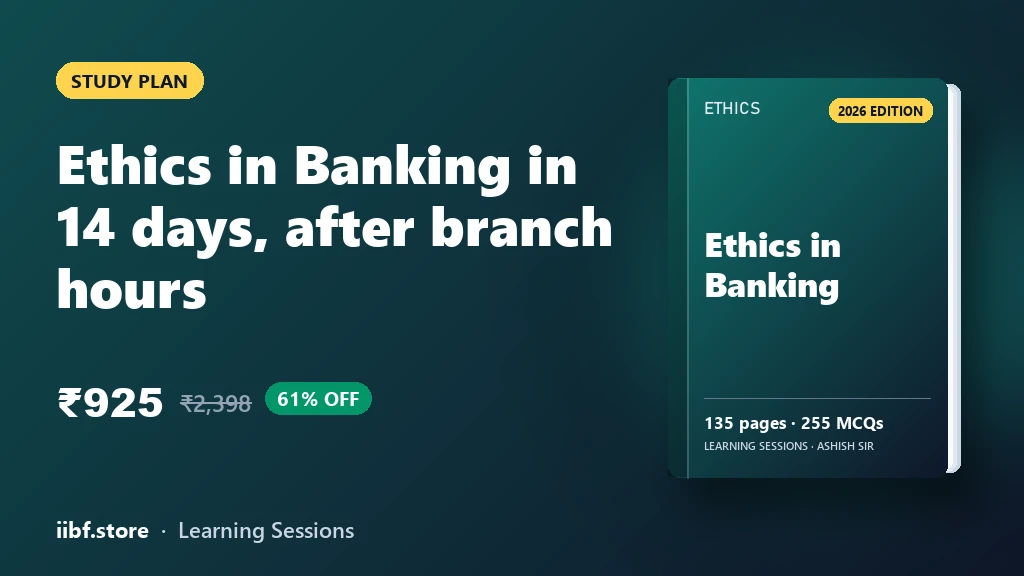
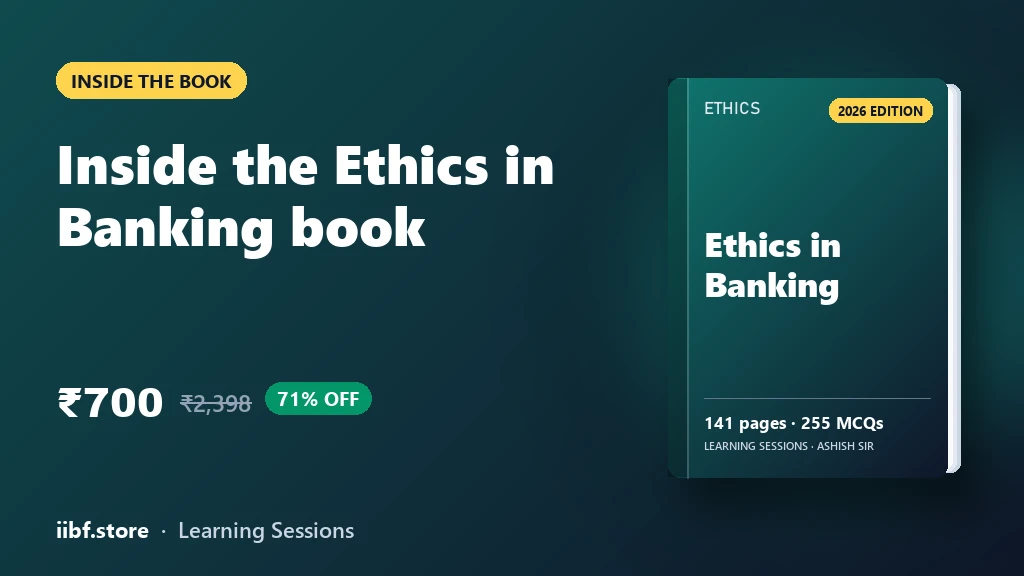
The Ethics in Banking book runs to 141 pages, split into four modules and 17 chapters, with 255 MCQs. The edition is 2026. At about 141 pages for the whole subject, it is built to be finished, not just owned.
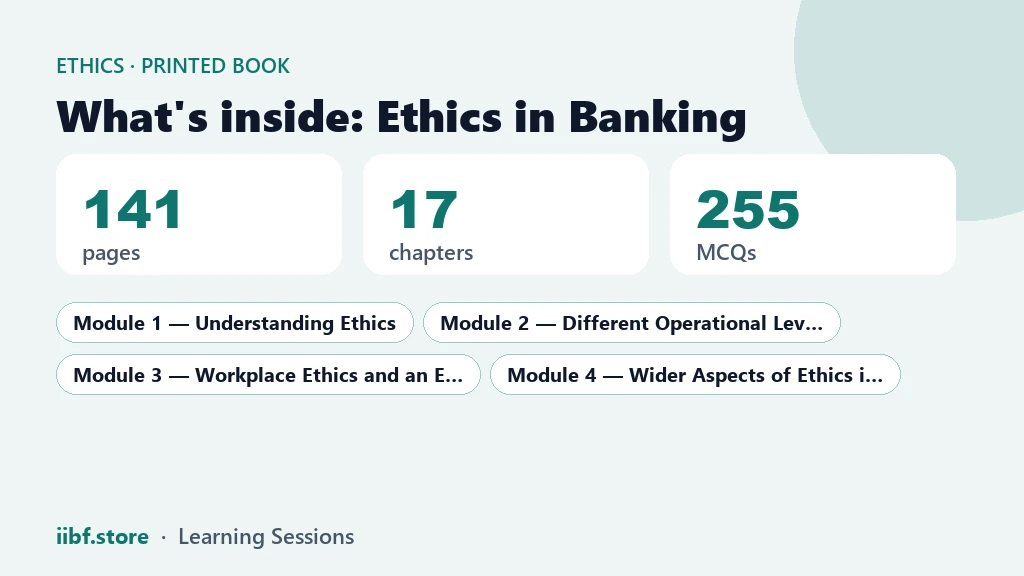
Module 1: Understanding Ethics (4 chapters)
This is the foundation. The chapters are Introduction to Ethics; Ethics, Business Ethics and Banking: An Integrated View; Normative Ethics and Management Decisions; and Ethics in Financial Services and the Regulatory Framework. Treat this module as vocabulary. If the terms are clear here, the later modules read faster.
Module 2: Different Operational Levels of Ethics in Banking (5 chapters)
Here the subject moves from ideas to the places where ethics actually shows up: Ethics at the Individual Level, Ethics at the Organisational Level, Ethical Dimensions – Marketing, Ethical Dimensions – Employees, and Ethics, Corporate Social Responsibility and ESG. For a working banker, this module is the closest to daily life, so it is also the easiest to connect to real situations you have seen at the counter or in the cabin.
Module 3: Workplace Ethics and an Ethical Organisation (3 chapters)
Work Ethic and the Workplace, Building an Ethical Organisation, and Changing Dynamics of Banking Ethics. It is the shortest module by chapter count, which makes it a good place to rebuild momentum if you have fallen behind.
Module 4: Wider Aspects of Ethics in Practice (5 chapters)
Corporate Governance: Its Ethical Dimensions; Environmental Ethics in Banking; Ethics and Globalisation; Corruption, Bribery and White-Collar Crime; and Ethics: A Holistic Approach. This module widens the lens and also closes the book, so the last chapter doubles as a revision bridge.
| Module | Chapters | What it does for you |
|---|---|---|
| 1. Understanding Ethics | 4 | Builds vocabulary and the regulatory frame |
| 2. Operational Levels of Ethics | 5 | Connects ethics to individuals, marketing and employees |
| 3. Workplace Ethics | 3 | Covers workplace conduct and the ethical organisation |
| 4. Wider Aspects in Practice | 5 | Governance, environment, globalisation, corruption |
Count it up: 4 + 5 + 3 + 5 gives 17 chapters. If you study one chapter on a weeknight and two on a weekend day, the whole text is within reach of a few weeks, and you decide the pace after seeing your own roster.
What one chapter looks like
Every chapter follows the same pattern, which is a real advantage when you are tired: you never have to work out how to study, only whether to continue. The pattern is concise notes, then key points, then MCQs.
- Concise notes. The chapter is written as short, exam-oriented notes rather than long academic prose, so you can read a whole chapter without losing the thread.
- Key points. The points to remember are pulled out, so your revision before the paper is a quick re-read and not a second full read.
- MCQs. Each chapter ends with questions, so you test yourself straight after reading. With 255 MCQs across 17 chapters, that works out to roughly fifteen questions a chapter on average.
The Ethics in Banking book is therefore a reading-then-testing loop, repeated 17 times. That repetition is the point: by chapter five you stop thinking about the format and start thinking only about the content.
An evening with one chapter
Suppose tonight is Ethics at the Organisational Level. Read the notes slowly once, with a pencil. Close the book and write down three things you remember. Open it again and check them against the key points. Only then attempt the MCQs. The three-line recall step feels slow, but it is the part that moves information into long-term memory.
The extras: case studies and mega tests
Beyond the chapters, the book lists two extras: 40 Case Studies with 160 questions, and 5 Mega Tests with 500 questions. They matter because ethics papers often reward judgement. A case study asks you to apply a principle to a situation, which is a different skill from recalling a definition.
Use them in this order. Do the case studies after you finish each module, to see whether you can apply what you read. Keep the mega tests for the last stage, and attempt them under timed conditions, without notes. A mega test taken too early only tells you what you already know, that you have not finished yet.
A four-step way to use it when time is short
Here is a simple routine that fits around a full-time branch job. It does not depend on any particular book, though it fits the chapter pattern above well.
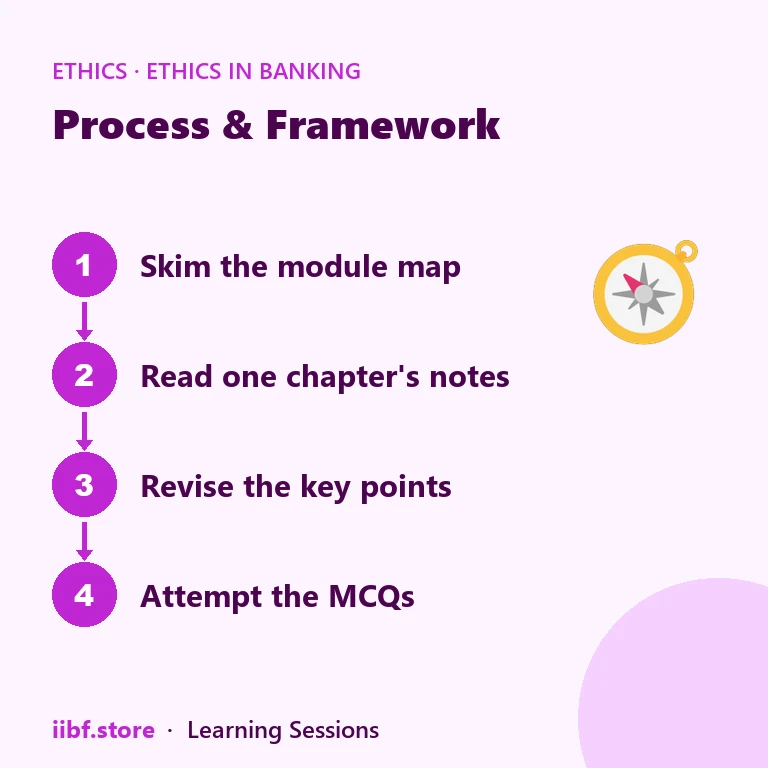
- Skim the module map. Spend five minutes on the table of chapters so you know where tonight fits.
- Read one chapter's notes. One chapter, one sitting. Do not start a second until the first is closed properly.
- Revise the key points. Re-read only the key points the next morning, on the commute if you can.
- Attempt the MCQs. Note every wrong answer and the reason you got it wrong, not just the right option.
If you follow this for the Ethics in Banking book, your wrong-answer notes become your personal revision sheet. In the final week, you revise that sheet instead of re-reading 141 pages.
Pair it with free practice
A book gives you structure, but exam-hall speed comes from practice under time pressure. Add the free mock tests at iibf.store/tests once you finish a module, and browse the free PDFs at iibf.store/free-material for extra reading. For other papers, see all titles at iibf.store/books. Always confirm the syllabus and the schedule for the upcoming exam cycle on the official site, www.iibf.org.in.
Who gets the most out of this book
Being honest about fit saves you money and time.
- Working bankers with fixed, short study windows. A 141-page text in 17 chapters is easier to schedule than a thick reference volume.
- Candidates who have postponed this paper. A visible module map and an end point reduce the feeling of an endless syllabus.
- Learners who need to test themselves. If you remember better by answering questions than by re-reading, the 255 MCQs and the extras give you plenty of material.
It is less suited to anyone who wants a long, philosophical treatment of the subject. These are exam-oriented notes. One more honest line: a book alone will not give you exam-hall speed, so pair it with timed mocks.
The price is ₹700 against an MRP of ₹2,398 at the time of writing, an advertised discount of 71 per cent. Prices may change, so the book page is always the current reference. If you want to look before you decide, the book page also has a free sample you can read first.
Conclusion
You do not need more hours; you need a clearer plan for the hours you have. Four modules, 17 chapters, and one repeatable routine are a plan you can start tonight. Whether or not you choose the Ethics in Banking book, apply the same loop: map, read, revise, test. Then check the official schedule at the IIBF site and book your slot with a realistic timeline.
Frequently asked questions
How many chapters and MCQs does the book have?
It has 17 chapters in four modules, 141 pages and 255 MCQs in the 2026 edition. It also lists 40 case studies (160 questions) and 5 mega tests (500 questions) as extras.
Can I read a sample before buying?
Yes. The book page offers a free sample, so you can judge the writing style and chapter format before you order.
How long will one chapter take?
That depends on you. Most candidates plan one chapter per evening, with the MCQs on the next day. Adjust the pace after your first two chapters.
Is the book enough on its own?
It gives you structured notes and practice, but exam-hall speed needs timed mock tests too. Use the free mocks on the site and check the official IIBF website for the current syllabus and exam schedule.
Prefer revising from a printed book?
Chapter-wise books with MCQs after every chapter — minimal pages, complete coverage, delivered anywhere in India. Every book has a free sample to read first.





Quick quiz on this topic
5 exam-style questions from our free test bank — check yourself before you move on.
Practice this topic
Take a free mock test, download chapter PDFs, or watch a video class — all included on iibf.store.