Earnings at Risk in Banks: CAIIB BFM Guide to Interest Rate Risk
For a bank treasury team sitting down to plan next year's balance sheet, the biggest unknown is rarely credit loss — it is what happens to the interest margin if rates move. Earnings at risk in banks is the technique that turns that uncertainty into a number: it estimates how much net interest income could fall over the coming year under a defined rate shock, so ALCO can decide how much of that exposure to hedge, reprice, or simply accept. This article walks through what EaR measures, how it is built, where it sits inside the RBI's interest rate risk in the banking book (IRRBB) expectations, and how the concept is tested in CAIIB Bank Financial Management.
📊 What Is Earnings at Risk in Bank ALM
Earnings at Risk (EaR) is an income-based measure of interest rate risk. Instead of asking what a rate shock does to the present value of the balance sheet, it asks a more operational question: how much will net interest income (NII) change over the next twelve months if rates move by a defined amount? Because it speaks the language of the profit and loss account, EaR is usually the number that a bank's board and ALCO pay closest attention to — it maps directly onto the budget.
EaR belongs to the earnings-perspective family of interest rate risk measures, alongside simple gap-based NII sensitivity analysis. It is distinct from the economic-value perspective, which looks at the change in the present value of assets, liabilities and off-balance-sheet items when the discount rate shifts. A bank with a comfortable EaR number can still carry a large economic-value exposure, which is exactly why regulators expect both perspectives to be tracked side by side rather than one substituting for the other.
The horizon matters too. EaR is typically computed over a rolling twelve-month or two-year window, matched to assets and liabilities that reprice within that period. Anything repricing beyond the horizon is treated as insulated from the immediate shock for EaR purposes, even though it still carries longer-term rate risk that other tools must capture.
🧮 How Earnings at Risk Is Calculated
The starting point is the same repricing schedule used for traditional gap analysis: assets and liabilities are bucketed by the date on which their interest rate next resets, not by their final maturity. Within each time bucket, the bank nets rate-sensitive assets against rate-sensitive liabilities to get a repricing gap.
EaR then layers a rate-shock scenario onto that schedule. A standard shock — commonly a parallel 100 or 200 basis point move — is applied to each bucket's gap, weighted by how much of the period remains before the next reset date. The sum of these bucket-level impacts gives the estimated change in NII over the horizon, expressed both in absolute currency terms and as a percentage of projected net interest income.
Most banks run this exercise as a simulation rather than a single static calculation, because real balance sheets are not static. Simulation models layer in assumed new business volumes, prepayment behaviour on loans, withdrawal behaviour on non-maturity deposits, and management's pricing response, then re-run the NII projection under both a base rate path and one or more shocked paths. The difference between the shocked and base outcomes is the earnings at risk figure that ALCO reviews.
Because the result is only as good as its assumptions, banks typically test more than one scenario — a parallel shift, a steepening, and a flattening — rather than relying on a single shock size to represent the full range of plausible outcomes.
💡 Exam Tip: If a question gives you a repricing gap and a basis-point shock and asks for the NII impact, you are being asked to compute an EaR-style figure — multiply the gap by the shock, weighted for the period remaining to the next reset date.

🏦 EaR Inside RBI's IRRBB Expectations
Interest rate risk in the banking book sits within the RBI's broader supervisory framework for asset-liability management, which expects banks to measure and report rate risk from both the earnings and the economic-value perspectives rather than pick just one. Earnings at risk is the natural home for the earnings side of that requirement, feeding into the same ALCO reporting pack that carries the structural liquidity and interest rate sensitivity statements.
Where the economic-value calculation typically drives the regulatory outlier test — flagging banks whose economic value of equity would fall sharply under a defined shock — the EaR number is the one that speaks most directly to near-term profitability and dividend capacity, which is why supervisors and rating agencies both track it as a forward-looking earnings quality signal.
Banks are expected to set board-approved tolerance limits on EaR, expressed as a percentage of budgeted NII or of capital, and to escalate breaches through ALCO. The exact shock sizes and limit thresholds are calibrated by each bank's own board policy rather than fixed centrally, so candidates should treat any specific limit percentage quoted in a question as illustrative unless the question states it is drawn from a named bank's policy.
Internal audit and the risk management department also play a role here: periodic review of the assumptions feeding the EaR model — reset dates, behavioural runoff on deposits, prepayment speeds — is itself a supervisory expectation, since an EaR figure built on stale assumptions can understate the bank's real exposure well before any limit breach shows up on paper.
⚖️ Earnings at Risk vs Other Interest Rate Risk Measures
EaR is one tool among several in a bank's IRR toolkit, and CAIIB questions frequently test whether a candidate can tell them apart by what each one actually measures, not just by name recognition.
Traditional repricing gap analysis is the simplest earnings-perspective tool: it shows the net rate-sensitive position in each bucket but stops short of translating that gap into a rupee NII impact under a specific shock — EaR is essentially gap analysis carried one step further, with a shock size and a horizon attached.
Economic-value measures move to a completely different question: the sensitivity of the present value of equity to a rate shock, which captures long-duration exposures that a twelve-month EaR window would miss entirely. A trading-book risk measure looks at potential loss over a very short holding period under normal market conditions, which makes it unsuitable, on its own, for banking-book balance sheet decisions that play out over quarters and years.
Simulation-based EaR sits above all of these in sophistication because it can incorporate behavioural assumptions — prepayments, deposit stickiness, new business mix — that static bucket-based methods cannot. The trade-off is model risk: the richer the assumption set, the more the output depends on getting those assumptions right, which is exactly why model validation and periodic backtesting of EaR forecasts against actual NII outcomes matter.
⚠️ Common Mistake: Candidates often assume EaR and economic-value sensitivity will always move in the same direction. They can diverge sharply — a bank can show a comfortable one-year EaR while still carrying a large long-duration economic-value exposure that only a present-value calculation would reveal.
| Measure | Perspective | Typical Horizon | Captures Long-Duration Risk |
|---|---|---|---|
| Repricing Gap Analysis | Earnings | Per bucket, near-term | ❌ |
| Earnings at Risk (EaR) | Earnings | 12–24 months | ❌ |
| Economic Value Sensitivity | Economic value | Full remaining life | ✅ |
| Trading Book VaR | Market risk | 1–10 days | ❌ |
🎯 Using EaR in Balance Sheet Decisions
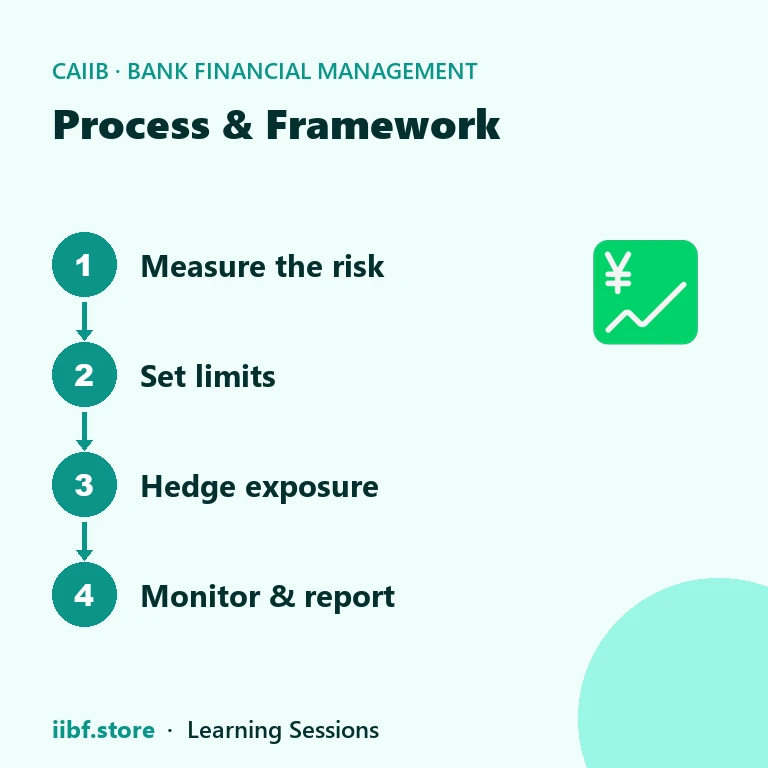
Once ALCO has an EaR number, the real work is deciding what to do with it. A bank whose EaR shows NII falling sharply in a rising-rate scenario typically has a liability-sensitive balance sheet — more liabilities than assets reprice within the horizon — and can respond by lengthening liability tenors, shortening asset tenors, or layering on interest rate derivatives such as swaps to convert floating exposures to fixed, or vice versa.
EaR also feeds pricing strategy. If the simulation shows deposit costs re-pricing faster than loan yields in a rate-hike scenario, treasury and the business units can pre-emptively adjust spreads on new originations, or push more of the book toward benchmark-linked pricing so that asset yields move in step with funding costs.
Finally, EaR is a live input to capital and budget planning. A materially negative EaR under a plausible shock is a signal to the board that budgeted profitability carries real interest rate risk, which in turn can influence decisions on dividend payout guidance and the size of the trading versus banking book split for new business.
📌 Remember: EaR tells you whether next year's budget is exposed to rate moves; it does not tell you whether the bank's long-term net worth is exposed. Always pair the two perspectives before drawing a conclusion in an exam scenario question.

🧠 Practice MCQs: Earnings at Risk in Banks
Q1. Earnings at Risk (EaR) primarily measures the impact of a rate shock on which of the following? (a) The present value of equity (b) Net interest income over a defined horizon (c) The trading book's daily loss potential (d) The bank's capital adequacy ratio
Answer: (b) — EaR is an earnings-perspective measure focused on the change in net interest income, not the present value of the balance sheet.
Q2. Which perspective of interest rate risk does EaR belong to, as distinct from the economic-value perspective? (a) Capital perspective (b) Liquidity perspective (c) Earnings perspective (d) Credit perspective
Answer: (c) — EaR sits in the earnings-perspective family, alongside gap-based NII sensitivity analysis, while economic value measures the present-value impact.
Q3. In an EaR calculation, assets and liabilities are bucketed by which date? (a) Their final contractual maturity date (b) Their next interest rate repricing date (c) Their origination date (d) Their settlement date
Answer: (b) — EaR uses repricing gap buckets based on when each item's interest rate next resets, the same base schedule used for traditional gap analysis.
Q4. A bank's EaR simulation shows NII falling sharply if rates rise. This most likely indicates the balance sheet is: (a) Asset-sensitive (b) Liability-sensitive (c) Duration-neutral (d) Fully hedged
Answer: (b) — When more liabilities than assets reprice within the horizon, a rate rise pushes funding costs up faster than asset yields, cutting NII — the hallmark of a liability-sensitive position.
Q5. Why do banks typically run EaR as a simulation rather than a single static calculation? (a) Regulators mandate only simulation models (b) Static models cannot incorporate behavioural assumptions like prepayments and deposit stickiness (c) Simulation is required for capital adequacy reporting (d) Static models overstate liquidity risk
Answer: (b) — Simulation lets banks layer in new business volumes, prepayment behaviour and deposit behaviour, which static bucket-based methods cannot capture.
Want chapter-wise mock tests with 100+ MCQs? Start practising free →
❓ Frequently Asked Questions
Is Earnings at Risk the same as Value at Risk?
No. EaR measures the change in net interest income over a horizon such as one year under a rate shock, while Value at Risk measures potential loss in the market value of a trading position over a much shorter holding period. They answer different questions for different parts of the balance sheet.
What time horizon does EaR normally use?
Most banks compute EaR over a rolling twelve-month or two-year window, matched to the repricing schedule of rate-sensitive assets and liabilities. Exposures repricing well beyond that horizon are instead captured by economic-value measures.
How is EaR different from ordinary gap analysis?
Traditional gap analysis shows the net rate-sensitive position in each time bucket without converting it into a rupee earnings impact. EaR takes that same gap schedule and applies a specific rate shock and horizon to estimate the actual change in net interest income.
Why do CAIIB BFM questions test EaR alongside duration and VaR?
Because exam questions often ask candidates to match each interest rate risk measure to what it actually captures — earnings, economic value, or trading-book loss. Understanding EaR's earnings-perspective role helps distinguish it clearly from present-value and short-horizon market risk tools.
Earnings at risk turns a rate forecast into a budget line item, which is exactly why it sits at the centre of ALCO discussions covered in Risk Regulations in Banking Industry and reinforced by the Case Study on Liquidity Risk Management. It works hand in hand with the bank's structural view of interest rate exposure — candidates who have revised gap analysis in banks and the role of the asset liability committee will find EaR a natural next step, and it pairs closely with hedging instruments such as the forward rate agreement. Since ALM discipline draws on skills taught across CAIIB electives — including how labour laws applicable to banks shape treasury staffing and accountability — it's worth revising governance topics as a set rather than in isolation. For the current repo-linked benchmark rates banks use in these scenarios, check RBI rates, browse more Bank Financial Management articles, and see the RBI's own supervisory expectations on interest rate risk in the banking book at rbi.org.in.
Ready to test yourself on IRRBB and ALM? Explore the full CAIIB course and practice with chapter-wise mocks today.
Prefer revising from a printed book?
Chapter-wise books with MCQs after every chapter — minimal pages, complete coverage, delivered anywhere in India. Every book has a free sample to read first.
151 pages · 465 MCQs
Learning Sessions · Ashish Sir
148 pages · 478 MCQs
Learning Sessions · Ashish Sir
148 pages · 375 MCQs
Learning Sessions · Ashish Sir
216 pages · 895 MCQs
Learning Sessions · Ashish Sir
109 pages · 300 MCQs
Learning Sessions · Ashish Sir
104 pages · 360 MCQs
Learning Sessions · Ashish Sir
82 pages · 297 MCQs
Learning Sessions · Ashish Sir
151 pages · 600 MCQs
Learning Sessions · Ashish Sir
98 pages · 282 MCQs
Learning Sessions · Ashish Sir
131 pages · 672 MCQs
Learning Sessions · Ashish Sir
221 pages · 831 MCQs
Learning Sessions · Ashish Sir
128 pages · 524 MCQs
Learning Sessions · Ashish Sir
107 pages · 445 MCQs
Learning Sessions · Ashish Sir
132 pages · 225 MCQs
Learning Sessions · Ashish Sir
188 pages · 435 MCQs
Learning Sessions · Ashish Sir
117 pages · 236 MCQs
Learning Sessions · Ashish Sir
Learning Sessions · Ashish Sir
118 pages · 299 MCQs
Learning Sessions · Ashish Sir
Learning Sessions · Ashish Sir
Learning Sessions · Ashish Sir
Learning Sessions · Ashish Sir
115 pages · 255 MCQs
Learning Sessions · Ashish Sir
Learning Sessions · Ashish Sir
334 pages · 936 MCQs
Learning Sessions · Ashish Sir
Learning Sessions · Ashish Sir
115 pages · 344 MCQs
Learning Sessions · Ashish Sir
107 pages · 240 MCQs
Learning Sessions · Ashish Sir
90 pages · 150 MCQs
Learning Sessions · Ashish Sir
Learning Sessions · Ashish Sir
Quick quiz on this topic
5 exam-style questions from our free test bank — check yourself before you move on.
Practice this topic
Take a free mock test, download chapter PDFs, or watch a video class — all included on iibf.store.