Basis Point Value in Bond Portfolios: CAIIB BFM Guide
Every CAIIB BFM candidate runs into the same treasury desk question: how much does the bank actually lose in rupees if yields move by just 0.01%? The answer starts with basis point value in bond portfolios, the single number that turns an abstract rate move into a figure a dealer or risk manager can act on immediately. Unlike duration, which is expressed as a percentage, basis point value (BPV, also called PVBP) is quoted in real money — which is exactly why treasury desks use it to hedge a bond book, set dealer limits, and size derivative cover. This article builds the formula from first principles, works a full numerical example, and places BPV inside a bank's wider ALM and hedging toolkit the way it is actually tested in CAIIB BFM.
📐 What Is Basis Point Value (BPV) in a Bond Portfolio?
Basis point value is the change in the rupee price of a bond or a portfolio of bonds for a one basis point (0.01%) move in yield. It is derived directly from modified duration but expresses the result in currency terms rather than as a percentage change, which is what makes it usable on a trading desk.
The working formula treasury desks use is:
BPV = Modified Duration × Price × 0.0001
Because it is a rupee figure, BPV can be added across positions of different maturities, coupons, and face values — something duration alone cannot do cleanly. A dealer holding ten different government securities can sum their individual BPVs into one portfolio BPV and know, in one number, exactly how much the whole book will gain or lose for a one basis point parallel shift in yields.
BPV is a first-order, linear approximation. It works well for small rate moves but understates the true price change for larger moves, which is where convexity comes back into the picture later in this article.
🧮 How to Calculate BPV — A Worked Example
Take a government security priced at Rs 100 (per Rs 100 face value) with a modified duration of 6.5 years. Applying the formula:
BPV = 6.5 × 100 × 0.0001 = Rs 0.065 per Rs 100 face value.
Scale that to a real treasury position: for a holding of Rs 1 crore face value, the BPV works out to roughly Rs 6,500 per basis point. That means a 25 basis point move in yield changes the mark-to-market value of that single holding by close to Rs 1.6 lakh — a number the ALCO and the dealing room both watch closely.
💡 Exam Tip: CAIIB BFM numericals on BPV almost always give you price and modified duration and expect the Rs 0.0001 multiplier — don't confuse it with the 0.01 used for percentage yield changes.
Portfolio BPV is simply the sum of each position's BPV, with sign convention mattering: a long bond position has positive BPV (price falls when yields rise), while a short position or a payer swap used as a hedge carries a negative BPV. This additive property is what lets treasury desks manage an entire book — spanning holdings referenced in chapters like Exchange rates and Forex Business for foreign currency bonds — through one consolidated risk number.

📊 BPV vs Modified Duration vs Convexity
These three measures are often mixed up in CAIIB BFM answers, but each answers a different question. The table below separates what each one actually captures.
| Measure | What It Captures | Unit | Additive Across Positions |
|---|---|---|---|
| Modified Duration | % price change per 1% yield change | Percentage / years | No (needs weighting) |
| Basis Point Value (BPV/PVBP) | Rupee price change per 0.01% yield change | Rupees | ✅ Directly additive |
| Convexity | Curvature — correction to duration's linear estimate for large moves | Dimensionless | No (needs weighting) |
Because BPV is rupee-denominated and additive, it is the practical, desk-level version of the same interest rate sensitivity that duration measures conceptually. Convexity, meanwhile, is only material when a rate move is large — for the small parallel shifts that dominate day-to-day treasury risk management, BPV alone is usually sufficient.
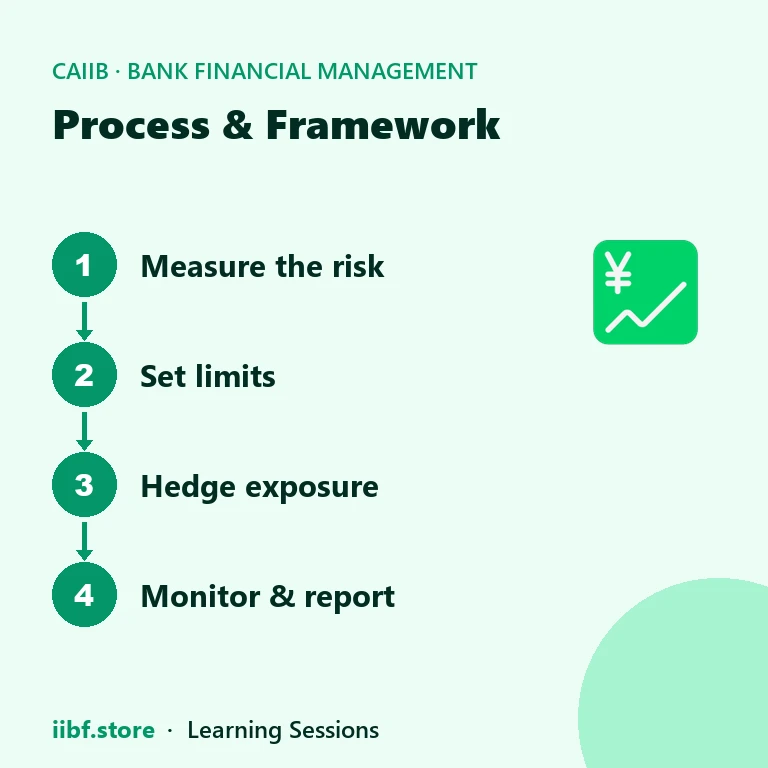
🛡️ Using BPV to Size Hedge Ratios in Treasury
The real value of BPV shows up when a desk needs to hedge a bond position rather than just measure its risk. Instead of matching notional amounts — which ignores maturity and coupon differences — treasury desks calculate a hedge ratio:
Hedge Ratio = BPV of Position ÷ BPV of Hedging Instrument
This tells the dealer exactly how many units of the hedge — a bond future, an interest rate swap, or a forward rate agreement — are needed to neutralise the BPV of the underlying bond book. A well-hedged position has a near-zero net portfolio BPV, meaning small parallel yield moves barely move the book's value.
This is the same quantitative discipline that shows up in project finance appraisal techniques in ABFM, where sensitivity analysis converts an assumption change into a rupee impact on project viability — the underlying logic of "translate a small input move into a rupee number" repeats across BFM and ABFM.
Desks operating out of an International Financial Service Centre (IFSC), GIFT City unit run the identical BPV-based hedge sizing on foreign currency bond books, since the mechanics of duration and BPV are currency-agnostic.

🏦 BPV in ALM, IRRBB Monitoring, and Board Limits
Individual bond BPVs feed straight into a bank's asset-liability management framework. The asset liability committee typically sets board-approved BPV limits per desk and per book, alongside duration gap limits and Value at Risk limits, as part of the bank's overall interest rate risk governance.
BPV also complements the periodic-gap approach used in gap analysis in banks: gap analysis buckets assets and liabilities by repricing date, while BPV gives a continuous, instrument-level view of rate sensitivity that treasury can aggregate into the bank's overall interest rate risk in the banking book position. RBI expects banks to maintain board-approved limits and periodic reporting on such interest rate sensitivity measures as part of sound risk management practice — see the Reserve Bank of India's published Master Directions for the current regulatory expectations.
In practice, a bank's treasury MIS reports portfolio BPV daily, alongside duration and VaR, so that any breach of the board-approved limit triggers an immediate hedging or rebalancing action rather than waiting for the next ALCO meeting.
⚠️ Common Mistakes Bankers Make With BPV
The most frequent CAIIB BFM error is plugging in Macaulay duration instead of modified duration into the BPV formula — the two are close in value for low-yield bonds but produce a materially wrong answer at higher yields.
⚠️ Common Mistake: Forgetting the sign convention when netting a hedge — a payer swap or short bond position must be entered as negative BPV, otherwise the "hedged" portfolio BPV is actually doubled instead of neutralised.
Another common slip is treating BPV as a fixed number. Because BPV depends on both price and modified duration, and both change as yields move, a bond's BPV must be recalculated after any meaningful rate shift — a hedge sized correctly this morning can be under- or over-hedged by the afternoon if yields have moved sharply.
📌 Remember: BPV is portfolio-additive, duration is not — always sum position-level BPVs to get a book's total interest rate risk, never sum durations directly.
Finally, candidates often forget that BPV is a linear approximation. For large rate shocks — the kind stress-tested in IRRBB scenarios — the convexity correction becomes material and BPV alone will understate the true loss.
🧠 Practice MCQs: Basis Point Value in Bond Portfolios
Q1. Basis point value (BPV) measures the change in a bond's price for a yield move of: (a) 1% (b) 0.1% (c) 0.01% (d) 10%
Answer: (c) — BPV, or PVBP, measures the rupee price change for a one basis point (0.01%) move in yield.
Q2. The standard formula for BPV is: (a) Duration × Price × 0.01 (b) Modified Duration × Price × 0.0001 (c) Convexity × Price × 0.0001 (d) Macaulay Duration ÷ Price
Answer: (b) — BPV = Modified Duration × Price × 0.0001, giving the rupee price change per basis point.
Q3. Why is BPV preferred over duration alone when aggregating a bond portfolio's risk? (a) BPV is a percentage (b) BPV is directly additive across positions in rupee terms (c) BPV ignores maturity (d) BPV never changes
Answer: (b) — Because BPV is expressed in currency, individual position BPVs can simply be summed into a portfolio BPV; duration percentages cannot be added this way without weighting.
Q4. A treasury desk calculates a hedge ratio as: (a) Notional of position ÷ Notional of hedge (b) BPV of position ÷ BPV of hedging instrument (c) Duration of position × Duration of hedge (d) Price of position ÷ Price of hedge
Answer: (b) — The hedge ratio is BPV of the position divided by the BPV of the hedging instrument, telling the desk how many units of the hedge are needed.
Q5. BPV is described as a "first-order, linear" risk measure because: (a) It ignores price entirely (b) It only applies to first-year bonds (c) It approximates price change linearly and understates large moves, unlike convexity (d) It is calculated only once a year
Answer: (c) — BPV, like duration, is a linear approximation; for large yield moves the convexity correction is needed to capture the true, curved price-yield relationship.
Want chapter-wise mock tests with 100+ MCQs? Start practising free →
Frequently Asked Questions
Is BPV the same as PVBP?
Yes. Basis Point Value (BPV) and Price Value of a Basis Point (PVBP) are two names for the same measure — the rupee change in a bond's price for a one basis point move in yield.
How is BPV different from modified duration?
Modified duration expresses interest rate sensitivity as a percentage of price, while BPV converts that same sensitivity into a rupee amount. BPV is derived from duration but is what treasury desks actually use for limits and hedge sizing because it is additive across a portfolio.
Does BPV change as yields move?
Yes. Because BPV depends on both price and modified duration, and both shift as market yields change, a bond's or portfolio's BPV must be recalculated periodically, especially after a sharp rate move, to keep hedge ratios accurate.
Why do banks set BPV limits at the ALCO level?
BPV limits give the asset liability committee a concrete, rupee-denominated cap on how much the bank's bond and treasury book can lose for a small parallel shift in yields, complementing duration gap and Value at Risk limits as part of the bank's overall interest rate risk framework.
Basis point value turns an abstract yield move into a number a treasury desk can act on the same day — which is exactly why it sits at the centre of hedge sizing, ALCO limits, and CAIIB BFM numericals alike. Build on this with the full CAIIB course material and more topics on the Bank Financial Management blog tag, then test yourself with chapter-wise mocks to lock in the formula before exam day.
Quick quiz on this topic
5 exam-style questions from our free test bank — check yourself before you move on.
Practice this topic
Take a free mock test, download chapter PDFs, or watch a video class — all included on iibf.store.
Keep reading