Inter-Creditor Agreement in Banks: ICA Rules for Stressed Accounts
Picture this. A manufacturing company has a cash credit limit with your branch, a term loan with another public sector bank and a working capital line with a private bank. The account turns SMA-1 in your books. Your Chief Manager calls a meeting, and within a week all three banks are sitting in one room arguing about what to do. Who decides? Does the smallest lender get a veto? What if one bank wants to sell and another wants to wait? The tool that answers these questions is the inter-creditor agreement in banks, usually called the ICA.
For CAIIB Advanced Bank Management (ABM), this is a favourite area because it joins three things the examiner loves: a time limit, a voting percentage and a provisioning consequence. In this article you will learn what the ICA is, when it must be signed, how decisions are taken, what happens to a lender who disagrees, and how IIBF frames questions around it.
What is an inter-creditor agreement in banks?
When a borrower has taken credit from more than one lender, each lender has its own security, its own priorities and its own view of recovery. If everyone acts alone, the borrower's assets get stripped and everyone recovers less. The inter-creditor agreement in banks is a written agreement among the lenders to the same borrower that lays down how they will jointly decide on, finalise and implement a resolution plan for the stressed account.
The legal basis for this sits in the RBI's Directions on resolution of stressed assets. The current text is the Reserve Bank of India (Commercial Banks - Resolution of Stressed Assets) Directions, 2025, which carries forward the principles of the earlier 2019 Prudential Framework. You can read the full text on the RBI Master Direction page. Before your exam, always read the version the RBI currently hosts, because the page carries an updated-as-on date.
Key terms you must know first
- Specified lenders: the lenders the Directions cover. These include commercial banks (other than payments banks, local area banks and regional rural banks), All India Financial Institutions, deposit-taking NBFCs (other than housing finance companies) and non-deposit-taking NBFCs (other than housing finance companies) with an asset size of Rs 500 crore and above.
- Default: non-payment of a debt once any part or instalment becomes due and unpaid. For cash credit, it also includes balances staying above the sanctioned limit or drawing power for more than 30 days.
- Review period: a period of thirty days from the date of default or a credit event.
- Resolution plan: a mutually agreed, legally binding, feasible and time-bound plan to resolve the stress.
- SMA: special mention accounts, used to recognise stress early. SMA-0 is up to 30 days overdue, SMA-1 is 31 to 60 days and SMA-2 is 61 to 90 days.
When must the ICA be signed?
The ICA is not a routine document signed for every loan. It comes into play when a resolution plan is to be implemented for a borrower that has facilities from more than one specified lender. In that case, the Directions say all specified lenders must enter into an inter-creditor agreement during the review period. The review period is only 30 days, so the ICA has to be ready quickly.
Two points here are easy to miss. First, the ICA is limited to the specified lenders. A lender outside the definition is not bound by the same framework. Second, the framework is meant to be proactive. The Directions expect banks to begin implementing a resolution plan even before a default, because default is a lagging indicator of stress. So do not think the ICA waits for an NPA tag. It can be triggered by early signs of stress and by SMA recognition.
If you want to revise the surrounding concepts such as SMA stages, asset classification and recovery routes, the full CAIIB Advanced Bank Management course covers the credit and stressed-asset modules in sequence.
How the inter-creditor agreement works step by step
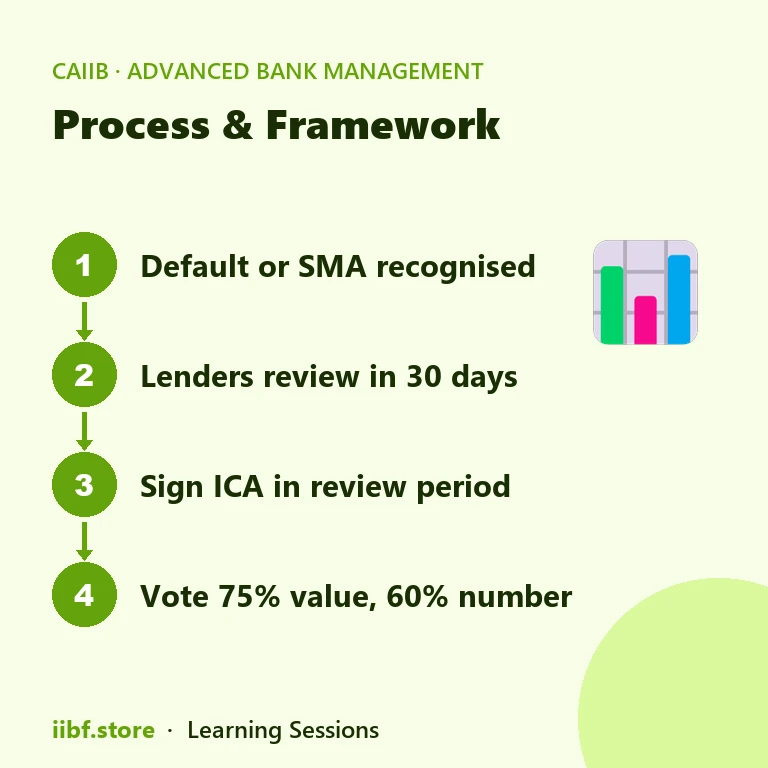
Think of the process as a short, tightly timed sequence. Each step feeds the next, and the exam often asks you to place the events in the right order.
Step 1: Recognise the stress
The Directions require stress to be recognised immediately on default by classifying the account as a special mention account. Concealing the true status of an account or evergreening a stressed loan invites stringent supervisory action, including higher provisioning and penalties.
Step 2: Review within 30 days
Once a default is reported by a specified lender, the specified lenders jointly conduct a prima facie review of the borrower account within the review period. During the same window, they decide the resolution strategy and the nature of the resolution plan, for example payment of overdues, sale of the exposure to another entity, change of ownership or restructuring. A lender can also choose to start insolvency or recovery proceedings.
Step 3: Sign the ICA
Where a plan is to be implemented, all specified lenders sign the ICA during the review period. The ICA must deal with the rights and duties of majority signatories, protection for dissenting signatories and the treatment of signatories who have priority in cash flows or differential security. This is why the ICA is more than a formality: it is the rulebook for the lenders themselves.
Step 4: Decide by the prescribed majority
Any decision taken under the ICA, if agreed by lenders holding 75 per cent of the outstanding credit facilities by value and 60 per cent of the signatories by number, binds all signatories. Both conditions must be met together. We will test this in the worked example below.
Step 5: Document and implement
The resolution plan must be clearly documented by the bank, even if no term of the facility changes. A plan that involves no restructuring and no change in ownership is treated as implemented only if the borrower is not in default on the 180th day after the review period ends. A plan involving restructuring or a change in ownership is implemented only when documentation is complete, the new capital structure is reflected in the books and the borrower is not in default. A plan involving assignment or recovery counts as implemented only when the exposure is fully extinguished.
The double majority rule: a worked example
The double test is where students lose marks, so let us work through it. Suppose a borrower has total outstanding credit facilities of Rs 1,000 crore from five specified lenders.
| Lender | Exposure (Rs crore) | Share by value | Votes for the plan? |
|---|---|---|---|
| Bank A | 400 | 40% | Yes |
| Bank B | 200 | 20% | Yes |
| Bank C | 150 | 15% | Yes |
| Bank D | 150 | 15% | No |
| Bank E | 100 | 10% | No |
Banks A, B and C together hold 400 + 200 + 150 = Rs 750 crore, which is 75 per cent by value. They are also 3 of 5 lenders, which is 60 per cent by number. Both thresholds are met, so the decision binds Banks D and E as well.
Now change one thing. Suppose Bank A (40 per cent) and Bank B (20 per cent) vote yes, and Bank C votes no. Value in favour is 60 per cent, which fails the 75 per cent test, and only 2 of 5 lenders (40 per cent by number) agree, which fails the 60 per cent test as well. The plan does not bind the others. The lesson: a large lender cannot force a plan alone, and a group of many small lenders cannot force it without enough exposure.
What do dissenting lenders get?
The majority cannot simply crush a minority. The Directions state that resolution plans must provide for payment of not less than the liquidation value to the dissenting signatories. The ICA is also expected to protect dissenting creditors and creditors with differential security. In exam language, remember the phrase: dissent is protected by a floor of liquidation value.
What if the plan is not implemented on time?
The Directions use provisioning as the stick. Under the additional provisioning provisions, if a viable resolution plan is not implemented within 180 days after the review period ends, an additional specific provision of 20 per cent of the total outstanding applies. If it is still not implemented within 365 days from the commencement of the review period, a further 15 per cent applies, taking the additional provision to 35 per cent. These additional provisions sit on top of the higher of the existing provisions or the provisions required by the asset classification, and total provisions are capped at 100 per cent.
Reversal is also defined. For example, where the plan involves restructuring or change in ownership outside the Insolvency and Bankruptcy Code, the additional provisions can be reversed on implementation. Where the plan ends in insolvency proceedings, half is reversed on filing and the balance on admission. The additional provisioning and the 180-day timeline are tied to the borrower-wise exposure thresholds set out in the Directions, so always check the threshold paragraph when a question gives a specific exposure.
Independent credit evaluation
For restructuring or change of ownership where the aggregate exposure of the specified lenders is Rs 100 crore or more, the residual debt needs an independent credit evaluation by a credit rating agency authorised by the RBI. Larger accounts need more than one such evaluation. This is a separate safeguard from the ICA, but the two often appear together in the same case study.
Summary table: inter-creditor agreement in banks at a glance
| Feature | Rule |
|---|---|
| Who signs | All specified lenders to the borrower, when a resolution plan is to be implemented |
| When | During the review period of 30 days from default or credit event |
| Binding decision | 75% by value of outstanding credit facilities and 60% of signatories by number |
| Dissenting lenders | Not less than the liquidation value |
| Implementation check | Borrower not in default on the 180th day after the review period (for plans without restructuring) |
| Penalty for delay | Additional provisions of 20% and a further 15% (total 35%) |
| Independent credit evaluation | Where restructuring or change in ownership and aggregate exposure is Rs 100 crore or more |
How IIBF tests the inter-creditor agreement in banks
IIBF questions on this area are usually direct and fact-based, with a few predictable traps. Expect the following patterns.
- Numbers swap: the options will interchange 75 and 60, or by value and by number. Remember: 75 goes with value, 60 goes with number.
- Timing: the ICA is signed during the review period of 30 days, not after the account turns NPA and not within 180 days.
- Dissenting lenders: the protection is the liquidation value, not full repayment and not a right to veto.
- Scope: the ICA is for borrowers with facilities from more than one specified lender, only when a resolution plan is to be implemented.
- Consequence of delay: additional provisioning of 20 per cent and 15 per cent, capped overall at 100 per cent of the outstanding.
To get used to this style, attempt timed questions from the CAIIB mock tests after finishing the credit and stressed-asset chapters, and keep the printed ABM book beside you for chapter-wise MCQs.
Practice question 1
Under the RBI Directions on resolution of stressed assets, a decision under the inter-creditor agreement binds all lenders if it is agreed by lenders representing: (a) 50% by value and 50% by number, (b) 75% by value and 60% by number, (c) 60% by value and 75% by number, (d) 66% by value only. The correct answer is (b). Option (c) is the classic reversal trap, and option (d) ignores the second condition.
Practice question 2
The inter-creditor agreement among specified lenders must be entered into: (a) within 180 days after the review period, (b) during the review period, (c) only after the account is classified as doubtful, (d) at the time of first sanction. The correct answer is (b). The review period is 30 days from default or a credit event, and the ICA is signed within it.
Practice question 3
What must a resolution plan offer to dissenting signatories to the ICA? (a) Nothing, they are bound, (b) Full outstanding dues, (c) Not less than the liquidation value, (d) A right to exit at book value. The correct answer is (c). The majority binds the minority, but the minority has a floor of liquidation value.
Quick revision points
- The ICA is for multi-lender borrowers and applies to the specified lenders when a plan is to be implemented.
- Review period is 30 days from default or a credit event, and the ICA is signed inside it.
- Binding decision needs 75% by value and 60% by number, both together.
- Dissenting signatories receive not less than the liquidation value.
- 180 days after the review period is the checkpoint for implementation.
- Additional provisions are 20% and then a further 15%, with total provisions capped at 100%.
- The ICA works alongside independent credit evaluation, not in place of it.
If you are short on time, the CAIIB offer page shows the current bundle that combines the course, book and tests. You can also use the free study resources at iibf.store/free-material for extra revision.
Frequently asked questions
What is an inter-creditor agreement in banks?
It is a written agreement among the lenders to the same borrower that sets out how they will jointly decide on, finalise and implement a resolution plan for a stressed account, including how voting works and how dissenting lenders are protected.
Within what time must the ICA be signed?
The ICA must be signed by all specified lenders during the review period, which is thirty days from the date of default or a credit event.
What majority is needed for a binding decision under the ICA?
Lenders holding 75 per cent of the outstanding credit facilities by value and 60 per cent of the signatories by number must agree. Both tests have to be met, and then the decision binds all signatories.
What protection do dissenting lenders get?
The resolution plan must provide for payment of not less than the liquidation value to dissenting signatories, and the ICA also covers creditors with priority in cash flows or differential security.
What happens if the resolution plan is not implemented in time?
Additional specific provisions apply: 20 per cent if a viable plan is not implemented within 180 days after the review period ends, and a further 15 per cent if it is still not implemented within 365 days from the start of the review period. Total provisions are capped at 100 per cent.
Conclusion
The inter-creditor agreement in banks turns a messy multi-lender argument into a time-bound, rule-based decision. Remember the anchors: 30 days to review and sign, 75 per cent by value together with 60 per cent by number to bind everyone, liquidation value as the floor for dissenters, and a 180-day checkpoint backed by additional provisioning. Read the current RBI Directions once yourself, and check the official IIBF website for the schedule of the upcoming exam cycle. Do that, and the ICA questions in CAIIB ABM become some of the easiest marks in the paper.
Prefer revising from a printed book?
Chapter-wise books with MCQs after every chapter — minimal pages, complete coverage, delivered anywhere in India. Every book has a free sample to read first.


















































Quick quiz on this topic
5 exam-style questions from our free test bank — check yourself before you move on.
Practice this topic
Take a free mock test, download chapter PDFs, or watch a video class — all included on iibf.store.