Bank Profit and Loss Account Format: Form B Explained for JAIIB AFM
You are at your desk after branch hours with the JAIIB Accounting and Financial Management book open, and the question in front of you asks: under which schedule does a bank show commission and exchange income? You know a company's profit and loss account well enough from school commerce, yet a bank's version looks different, and the exam punishes you for mixing the two. This article walks you through the bank profit and loss account format in a way that you can reproduce on paper and also recognise in MCQs.
We will cover the legal basis, the layout of Form B, the four supporting schedules (13 to 16), a worked example with simple numbers, the usual exam traps and quick revision points. If you prefer to learn the whole paper in a structured order, the JAIIB Accounting and Financial Management course takes you through every module step by step.
Why banks have a separate profit and loss format
An ordinary company follows the Companies Act for its financial statements. A bank is a different animal. Its raw material is money, so its main income is interest and its main cost is also interest. A format designed for a manufacturer, where sales sit at the top and cost of goods sold comes next, would hide what a banker actually wants to see: how much was earned on loans and investments, how much was paid to depositors, and what was left after running costs and provisions.
For this reason the Banking Regulation Act, 1949 prescribes its own forms. Section 29 requires every banking company incorporated in India to prepare its balance sheet and profit and loss account as on the last working day of the year, in the forms set out in the Third Schedule, or as near to them as circumstances admit. The Third Schedule contains Form A for the balance sheet and Form B for the profit and loss account. The Central Government can amend these forms by notification in the Official Gazette after giving at least three months' notice, and the Reserve Bank of India issues the detailed presentation and disclosure requirements for different categories of banks. You can read the section text on this bare-act page for Section 29 and the current circulars on rbi.org.in.
Who signs it
Under Section 29, the manager or principal officer of the bank signs the statements along with the directors (all directors where there are not more than three, otherwise at least three). This small point is a favourite for statement-type questions because candidates assume the auditor signs the accounts. The auditor reports on them; the signing is by the management.
The bank profit and loss account format at a glance
Form B is divided into four blocks. Read them in this order and you will never lose your way.
- I. Income - Interest earned (Schedule 13) and Other income (Schedule 14).
- II. Expenditure - Interest expended (Schedule 15), Operating expenses (Schedule 16) and Provisions and contingencies.
- III. Profit / Loss - Net profit for the year, plus the profit or loss brought forward from the previous year.
- IV. Appropriations - Transfer to statutory reserves, transfer to other reserves, proposed dividend or transfer to the Government, and the balance carried over to the balance sheet.
Notice what is missing: there is no 'sales', no 'cost of goods sold' and no 'gross profit'. The bank profit and loss account format moves straight from income to expenditure to profit, and that is also why the 'interest spread' (interest earned minus interest expended) becomes the number every analyst talks about.
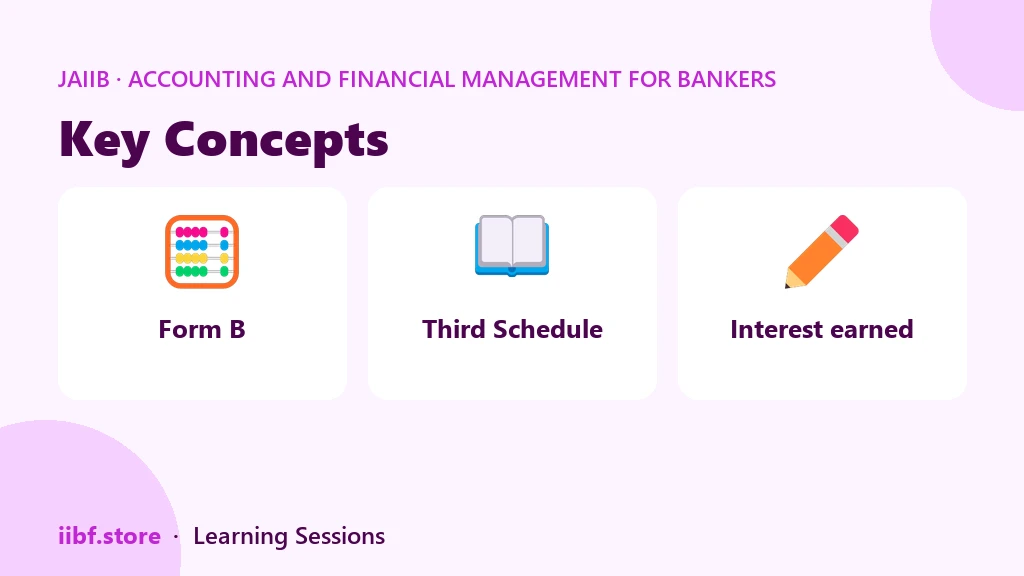
Schedules 13 to 16 explained
Each main heading in Form B has a schedule number against it. The schedule breaks the figure into its components. In the exam you are often given a list of items and asked to match them to the right schedule, so learn these four properly.
Schedule 13 - Interest earned
- Interest and discount on advances and bills.
- Income on investments.
- Interest on balances with the Reserve Bank of India and other inter-bank funds.
- Others.
Think of this as the income from the bank's assets: loans, bills discounted, the investment portfolio and money placed with RBI or other banks.
Schedule 14 - Other income
- Commission, exchange and brokerage.
- Profit or loss on sale of investments.
- Profit or loss on revaluation of investments.
- Profit or loss on sale of land, buildings and other assets.
- Profit or loss on exchange transactions.
- Dividends and similar income from subsidiaries, companies or joint ventures in India or abroad.
- Miscellaneous income.
Under the items covering sale or revaluation of investments, sale of assets and exchange transactions, the loss is deducted from the profit and may be shown in brackets. Remember that commission on guarantees, locker rent-type fee income and remittance charges fall in the first line, not under interest.
Schedule 15 - Interest expended
- Interest on deposits.
- Interest on Reserve Bank of India and inter-bank borrowings.
- Others.
Schedule 16 - Operating expenses
- Payments to and provisions for employees.
- Rent, taxes and lighting.
- Printing and stationery.
- Advertisement and publicity.
- Depreciation on the bank's property.
- Directors' fees, allowances and expenses.
- Auditors' fees and expenses, including branch auditors.
- Law charges.
- Postages, telegrams, telephones and the like.
- Repairs and maintenance.
- Insurance.
- Other expenditure.
Pay attention to one point: provisions and contingencies (for example provision for loan losses or tax) do not sit inside Schedule 16. They appear as a separate line under Expenditure, directly in Form B. Many candidates wrongly put provisions for bad loans into operating expenses.
Before the next section, a short pause for the bigger picture. If you want chapter-wise practice on these formats, the printed AFM book with chapter-wise MCQs gives you the layouts to revise from, and the current JAIIB offer page lists the bundles available for the paper.
How the profit is built, step by step
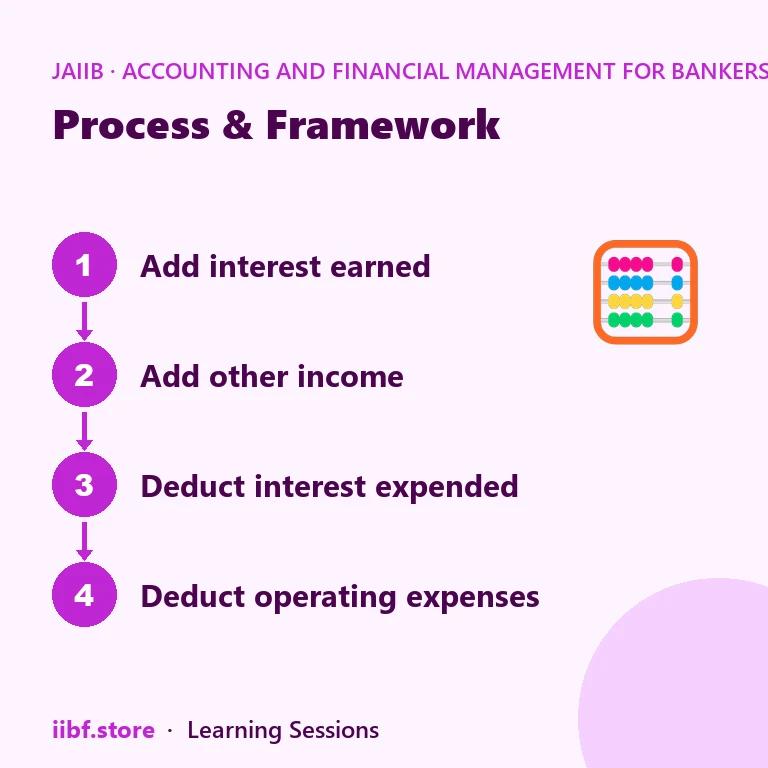
The easiest way to remember how a bank arrives at its bottom line is to follow the sequence below. Each step corresponds to a line of Form B.
- Add interest earned. Total Schedule 13 from loans, investments and inter-bank balances.
- Add other income. Total Schedule 14, remembering that losses are netted off within the items.
- Deduct interest expended. Total Schedule 15, mostly interest paid on deposits.
- Deduct operating expenses. Total Schedule 16: staff cost, rent, depreciation and so on.
- Deduct provisions and contingencies. Provision for NPAs, depreciation on investments where applicable, tax and other contingencies.
- Arrive at net profit and appropriate it. Add the balance brought forward, then transfer to statutory and other reserves, dividend, and carry the rest to the balance sheet.
Two profit measures bankers use
From the same statement you can read two intermediate figures that appear regularly in questions. Net interest income is interest earned minus interest expended. Operating profit is total income minus interest expended and operating expenses, that is, the profit before provisions and contingencies. Neither is a separate line printed in Form B, so the question will usually give you the schedule totals and ask you to compute them.
Worked example with simple numbers
The figures below are purely illustrative and are chosen so that the arithmetic is easy. They are not taken from any actual bank.
| Item | Schedule | Amount |
|---|---|---|
| Interest earned | 13 | 1,000 |
| Other income | 14 | 200 |
| Total income | 1,200 | |
| Interest expended | 15 | 600 |
| Operating expenses | 16 | 300 |
| Provisions and contingencies | - | 100 |
| Total expenditure | 1,000 | |
| Net profit for the year | 200 |
From this table you can derive the following. Net interest income is 1,000 minus 600, which equals 400. Operating profit is 1,200 minus 600 minus 300, which equals 300. Net profit is operating profit of 300 minus provisions of 100, which equals 200. Suppose the profit brought forward from last year is 20, so the total available for appropriation is 220. If 50 goes to the statutory reserve, 30 to other reserves and 40 is proposed as dividend, the balance carried to the balance sheet is 220 minus 120, which equals 100.
The appropriation block is where the profit and loss account joins the balance sheet: the balance carried over becomes part of Reserves and Surplus on the liabilities side of Form A. If you see a question about why the two statements are linked, this is the answer.
Bank format versus company format
| Point | Bank (Form B) | Trading or manufacturing company |
|---|---|---|
| Legal basis | Section 29 and Third Schedule, Banking Regulation Act, 1949 | Companies Act schedule for financial statements |
| Main income | Interest earned | Revenue from sale of goods or services |
| Main expense | Interest expended | Cost of materials and employee cost |
| Gross profit | Not shown | Commonly derived |
| Provisions | Separate line under Expenditure | Depends on the nature of the provision |
| Appropriations | Shown at the end of the statement | Usually shown in notes or equity statement |
How IIBF tests the bank profit and loss account format
JAIIB AFM questions on this topic tend to follow four patterns. First, matching: an item such as 'interest on deposits' or 'rent, taxes and lighting' is given and you must pick the schedule. Second, classification: is provisions for NPAs part of operating expenses or a separate line? Third, computation: given schedule totals, work out net interest income, operating profit or net profit. Fourth, statements: which of the following about Section 29 is correct?
Common traps
- Provisions inside Schedule 16. Provisions and contingencies are a separate head, not an operating expense.
- Interest on RBI borrowings. This belongs to Interest expended (Schedule 15), not to operating expenses.
- Income on investments. The regular income (interest, discount) goes to Interest earned; profit on sale of investments goes to Other income.
- Depreciation. Depreciation on the bank's own property belongs to Schedule 16, whereas depreciation or revaluation on investments is a different matter shown elsewhere.
- Auditor's signature. The principal officer and directors sign; the auditor reports.
Practice MCQs
Q1. Commission, exchange and brokerage is shown in which schedule of Form B? Options: (a) Schedule 13, (b) Schedule 14, (c) Schedule 15, (d) Schedule 16. The answer is (b). Commission, exchange and brokerage is the first item under Other income, which is Schedule 14.
Q2. Interest paid on deposits is part of: (a) Schedule 13, (b) Schedule 14, (c) Schedule 15, (d) Schedule 16. The answer is (c). It is the first item of Interest expended.
Q3. A bank has interest earned of 800, other income of 150, interest expended of 500, operating expenses of 250 and provisions of 60. Its net profit for the year is: (a) 140, (b) 200, (c) 340, (d) 400. The answer is (a). Total income is 950; deduct 500, 250 and 60 (together 810), and you get 140. If you picked 200, you forgot to deduct provisions.
To test yourself under exam conditions, attempt the JAIIB mock tests after finishing this chapter and note which schedule-matching questions you miss.
Quick revision points
- Section 29 of the Banking Regulation Act, 1949 and the Third Schedule govern the bank profit and loss account format; Form B is the profit and loss account, Form A the balance sheet.
- Four blocks: Income, Expenditure, Profit/Loss, Appropriations.
- Schedule 13 = Interest earned; 14 = Other income; 15 = Interest expended; 16 = Operating expenses.
- Provisions and contingencies are a separate line under Expenditure.
- Net interest income = Schedule 13 minus Schedule 15.
- Operating profit = total income minus interest expended minus operating expenses.
- The balance carried over in appropriations flows into Reserves and Surplus in the balance sheet.
- The Government can amend the forms by notification with at least three months' notice, and RBI prescribes the detailed disclosure requirements; always check the latest on the RBI website before an exam cycle and see iibf.org.in for the official schedule.
Frequently asked questions
Which Form of the Third Schedule is the bank profit and loss account?
Form B of the Third Schedule to the Banking Regulation Act, 1949 is the profit and loss account. Form A is the balance sheet.
What do Schedules 13 to 16 cover in Form B?
Schedule 13 is Interest earned, Schedule 14 is Other income, Schedule 15 is Interest expended and Schedule 16 is Operating expenses.
Where are provisions for bad loans shown in the bank profit and loss account?
They appear under Provisions and contingencies, a separate line under Expenditure in Form B. They are not part of Schedule 16 Operating expenses.
Is there a gross profit in a bank's profit and loss account?
No. Form B moves from income to expenditure to net profit. Bankers instead look at net interest income and operating profit, which you compute from the schedule totals.
Does the bank profit and loss account link to the balance sheet?
Yes. After appropriations, the balance carried over is added to Reserves and Surplus on the liabilities side of the balance sheet.
Conclusion
The bank profit and loss account format is a small topic with a high return in the JAIIB AFM paper: learn the four blocks of Form B, memorise Schedules 13 to 16, remember that provisions stand on their own line and practise two or three computation questions. Once you can redraw Table 1 from memory without looking, you can handle almost any question the examiner builds on it. Revise it along with the balance sheet in Form A, since the two are tested together, and then move on to ratio analysis, where these same figures are put to work.
Prefer revising from a printed book?
Chapter-wise books with MCQs after every chapter — minimal pages, complete coverage, delivered anywhere in India. Every book has a free sample to read first.


















































Quick quiz on this topic
5 exam-style questions from our free test bank — check yourself before you move on.
Practice this topic
Take a free mock test, download chapter PDFs, or watch a video class — all included on iibf.store.