Interest Rate Swaps: A CAIIB BFM Hedging Guide
When a bank's assets reprice at a different pace than its liabilities, earnings and economic value swing with every move in market rates. Interest rate swaps are the workhorse instrument the treasury desk reaches for to tame that mismatch — and for CAIIB Bank Financial Management (BFM) candidates, they sit right at the crossroads of ALM, derivatives and the Basel hedging framework. This guide explains how interest rate swaps work, how banks in India price, value and account for them, and exactly what the exam wants you to remember. Master this and a whole cluster of BFM questions on hedging, ALM and treasury products becomes easy marks.
🔄 What Interest Rate Swaps Are and How They Work
An interest rate swap (IRS) is an over-the-counter contract in which two counterparties agree to exchange streams of interest payments on an agreed notional principal over a fixed tenor. In the classic "plain vanilla" swap, one party pays a fixed rate and receives a floating rate, while the other does the mirror image. The single most tested fact is this: the notional principal is never exchanged — it exists only to calculate the periodic interest amounts. On each reset date the two legs are netted, and only the difference changes hands.
The floating leg is tied to a reference benchmark. After the global move away from LIBOR, rupee swaps in India are anchored to indigenous benchmarks such as the overnight MIBOR (giving rise to the widely quoted Overnight Index Swap, or OIS) and MIFOR for the currency-plus-rate combination. The fixed leg is agreed at inception as the "swap rate" that makes the contract's initial value zero to both sides.
💡 Exam Tip: Remember the phrase "notional is notional" — principal is only a reference for computing coupons and is never swapped. Many candidates lose an easy mark here.
Because swaps convert the character of a cash flow — fixed into floating or vice versa — without disturbing the underlying loan or deposit, they are the cleanest tool a bank has to reshape its interest-rate profile. To see how these instruments interact with cross-border desks, review the fundamentals in exchange rates and forex business, where currency swaps extend the same logic across two currencies.
🏦 Why Banks Use Swaps in Asset-Liability Management
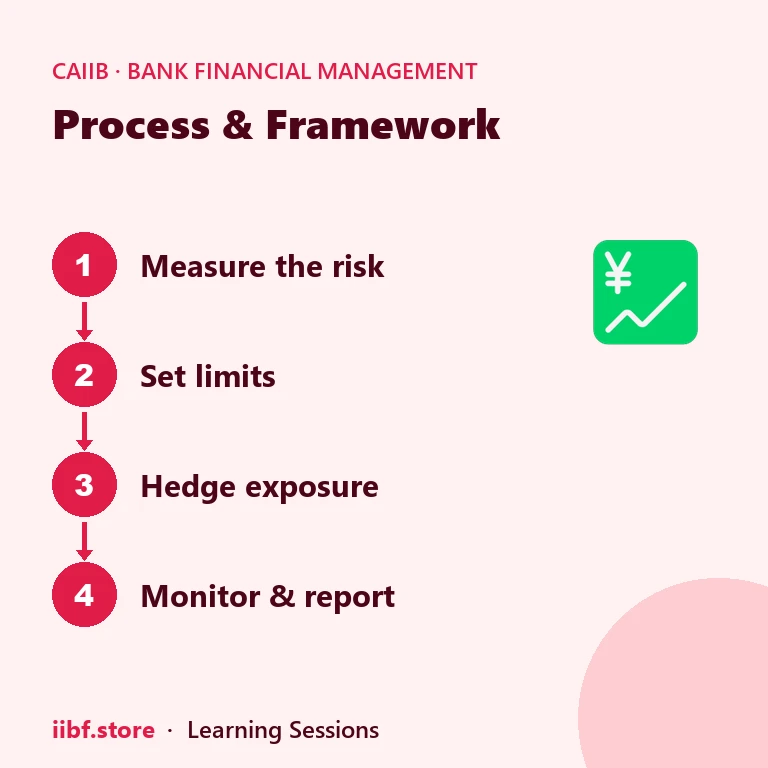
A bank's balance sheet is a giant collection of repricing mismatches. Suppose a bank has funded a book of long-tenor, fixed-rate home loans with short-tenor floating-rate deposits. Its interest income is locked, but its funding cost floats upward every time the RBI tightens. When rates rise, the net interest margin (NIM) gets squeezed. This is precisely the interest-rate risk that the ALM committee is charged with managing.
To hedge, the bank enters a pay-fixed, receive-floating swap. As market rates climb, the floating leg it receives rises while the fixed leg it pays stays flat, generating a gain that offsets the higher deposit cost. The swap thus synthetically converts fixed-rate assets into floating, realigning the two sides of the book. This is why swaps sit at the heart of the duration-gap and repricing-gap toolkit examined in BFM.
📌 Remember: To hedge a rising-rate exposure (fixed assets, floating liabilities), the bank should pay fixed and receive floating. Reverse the exposure and you reverse the swap.
Swaps are also cheaper and more flexible than restructuring the actual loan and deposit book, and they free up the balance sheet. Candidates should connect this directly with the broader repricing and duration mechanics covered in asset liability management in banks and the deeper gap-versus-value discussion in IRRBB in banking book. Together they form the ALM triangle: measure the gap, quantify the value impact, then hedge it with derivatives.
💰 Pricing and Valuing a Swap
At inception a swap is priced so that the present value of the fixed leg exactly equals the present value of the expected floating leg — making the net value zero. The fixed rate that achieves this is the swap rate, derived from the current zero-coupon (spot) yield curve. Once the deal is live, however, the market curve moves, and the swap acquires a positive or negative mark-to-market (MTM) value.
The valuation logic is straightforward: value the two legs separately by discounting their cash flows on today's curve, then take the difference. For a receive-fixed party, the swap gains value when rates fall (the fixed inflow becomes more attractive and its PV rises); for a pay-fixed party, the swap gains when rates rise. This sensitivity to the discount curve is why a swap behaves, in risk terms, like a leveraged position in bonds — its price sensitivity can be described using the same duration and convexity ideas explored in bond duration and convexity.
⚠️ Common Mistake: Don't confuse the swap rate (fixed at inception, makes value zero) with the swap's MTM value (changes daily as the curve moves). The exam often frames a trap around exactly this distinction.
In India, rupee OTC rate derivatives are regulated by the RBI, and the Clearing Corporation of India Ltd (CCIL) provides guaranteed central clearing and settlement for a large share of the interbank swap market, sharply reducing counterparty credit risk. You can cross-check prevailing benchmark levels on the RBI rates reference page before attempting numerical questions.
📊 Swaps Versus Other Hedging Instruments
Interest rate swaps are one tool in a family of derivatives, and BFM loves side-by-side comparisons. A forward rate agreement (FRA) locks a single future rate for one period; an interest rate future is an exchange-traded, standardised contract; and a currency swap exchanges both principal and interest across two currencies. The table below summarises what each instrument does and whether it trades on an exchange.
| Instrument | What it hedges | Exchange-traded? | Principal exchanged? |
|---|---|---|---|
| Interest Rate Swap (IRS) | Multi-period fixed↔floating mismatch | ❌ (OTC, CCIL-cleared) | ❌ Notional only |
| Forward Rate Agreement (FRA) | A single future interest period | ❌ (OTC) | ❌ Notional only |
| Interest Rate Future | Standardised rate exposure | ✅ (exchange) | ❌ Margined |
| Currency Swap | Cross-currency rate + FX exposure | ❌ (OTC) | ✅ Principal exchanged |
The key contrast the examiner probes: swaps and FRAs are customisable OTC instruments carrying counterparty risk (mitigated by CCIL clearing), while futures are standardised, margined and virtually free of counterparty risk but less flexible on tenor and notional. Currency swaps add an FX dimension — a natural bridge to the trade-finance material in case study forex, which shows how these hedges appear in real client transactions.
⚖️ Accounting, Basel Treatment and Exam Traps
Where a swap is booked matters enormously. A swap held to hedge a banking-book exposure is treated under hedge accounting, with gains and losses matched against the hedged item; a swap held for trading is marked to market through the profit and loss account. Getting this classification wrong distorts both reported earnings and regulatory capital, which is why BFM ties it to the trading-book versus banking-book boundary.
Under the Basel framework, derivative exposures attract a counterparty credit risk charge computed on the current exposure plus a potential future exposure add-on, and market-risk capital applies to trading positions. Central clearing through CCIL lowers this charge because a qualifying central counterparty carries a preferential risk weight. Operational resilience of the treasury and clearing infrastructure also matters — a theme candidates will recognise from business continuity planning in the ITDB paper.
💡 Exam Tip: Link three ideas — hedge classification, MTM accounting and the counterparty-credit-risk capital charge. Questions frequently bundle all three into one scenario.
For structured revision, keep a one-page cheat sheet: notional never exchanged, pay-fixed hedges rising rates, value = PV(fixed) − PV(floating), OIS references overnight MIBOR, and CCIL clears rupee rate derivatives. Practise the full derivatives cluster and related ALM chapters through the Bank Financial Management article hub and the structured lessons under the CAIIB course.
📚 Official reference: Always verify the latest rules, circulars and thresholds on the Reserve Bank of India (RBI) website before your exam — regulations change and only primary sources are authoritative.
🧠 Practice MCQs: Interest Rate Swaps
Q1. In a plain vanilla interest rate swap, which item is NOT actually exchanged between the counterparties? (a) Fixed interest payments (b) Floating interest payments (c) The notional principal (d) The net settlement amount
Answer: (c) — The notional principal is only a reference for computing coupons; it is never exchanged in a single-currency IRS.
Q2. A bank funds long-tenor fixed-rate loans with short-tenor floating-rate deposits. To hedge the rising-rate risk it should enter a swap in which it: (a) pays fixed and receives floating (b) receives fixed and pays floating (c) buys a fixed-rate bond (d) sells an interest rate future short only
Answer: (a) — Paying fixed and receiving floating gains value as rates rise, offsetting the higher cost on floating deposits.
Q3. The floating leg of a rupee Overnight Index Swap (OIS) is typically benchmarked to: (a) the 10-year G-sec yield (b) overnight MIBOR (c) the bank's MCLR (d) SOFR
Answer: (b) — A rupee OIS references the overnight MIBOR benchmark compounded over the period.
Q4. Which entity provides guaranteed central clearing and settlement for rupee interest rate derivatives in India? (a) SEBI (b) NABARD (c) CCIL (d) NPCI
Answer: (c) — The Clearing Corporation of India Ltd (CCIL) acts as the central counterparty for interbank rupee rate derivatives.
Q5. The mark-to-market value of a receive-fixed, pay-floating swap to the fixed receiver will INCREASE when: (a) market interest rates rise (b) market interest rates fall (c) the notional is amortised (d) the floating benchmark is reset upward
Answer: (b) — A receive-fixed position benefits when rates fall because the present value of its fixed inflows rises relative to the cheaper floating leg.
Want chapter-wise mock tests with 100+ MCQs? Start practising free →
❓ Frequently Asked Questions
Is the notional principal ever exchanged in an interest rate swap?
No. In a single-currency interest rate swap the notional is only used to calculate the interest on each leg; it is never physically exchanged. Only the netted interest difference changes hands on each settlement date.
How is an interest rate swap different from a forward rate agreement?
An FRA locks a rate for a single future interest period, whereas a swap covers many periods over a multi-year tenor. Both are OTC instruments, but a swap is effectively a series of linked forward positions bundled into one contract.
Why do banks prefer swaps over restructuring their loan and deposit book?
Swaps reshape a bank's interest-rate profile synthetically and cheaply without disturbing customer relationships or the underlying assets and liabilities. They are flexible on tenor and notional and can be unwound or offset quickly as the ALM view changes.
What role does CCIL play in the rupee swap market?
The Clearing Corporation of India Ltd acts as the central counterparty, guaranteeing settlement and netting exposures. This sharply reduces counterparty credit risk and, under Basel, earns cleared trades a preferential capital treatment.
🎯 Conclusion
Interest rate swaps convert fixed cash flows into floating (and back), letting a bank's ALM desk neutralise repricing mismatches without touching the underlying book. Nail the five anchors — notional is never exchanged, pay-fixed hedges rising rates, value equals PV(fixed) minus PV(floating), OIS references overnight MIBOR, and CCIL clears the rupee market — and the derivatives questions in CAIIB BFM turn into reliable marks. Put the theory to work now: attempt a free CAIIB BFM mock test or explore the full syllabus in the CAIIB course.
Quick quiz on this topic
5 exam-style questions from our free test bank — check yourself before you move on.
Practice this topic
Take a free mock test, download chapter PDFs, or watch a video class — all included on iibf.store.
Keep reading