IRRBB in Banking Book: The Complete CAIIB BFM Guide

IRRBB in banking book management is one of the most frequently tested — and most misunderstood — areas of the CAIIB Bank Financial Management paper. IRRBB stands for Interest Rate Risk in the Banking Book, and it captures the risk that changes in market interest rates erode a bank's net interest income (NII) and the economic value of its equity (EVE). Unlike traded positions in the trading book that are marked-to-market daily, banking-book assets and liabilities — loans, deposits, and investments held to maturity — reprice slowly and asymmetrically, so a rate shock quietly reshapes future earnings and long-term value. This guide breaks down the sources of IRRBB, the two lenses regulators use to measure it, the standardised interest-rate shocks, and the exam angles you must master to score in the CAIIB BFM paper.
What IRRBB Means and Why It Matters
Interest Rate Risk in the Banking Book is the current or prospective risk to a bank's capital and earnings arising from adverse movements in interest rates that affect banking-book positions. Because deposits, advances, and held-to-maturity investments dominate a typical Indian bank's balance sheet, even a modest, sustained shift in the rate curve can compress margins for years. The Basel Committee on Banking Supervision formalised the modern IRRBB framework in 2016, shifting it from a Pillar 1 capital charge to an enhanced Pillar 2 supervisory approach with strengthened disclosure. The Reserve Bank of India has similarly treated IRRBB as a Pillar 2 risk, requiring banks to identify, measure, monitor, and control it through their Asset-Liability Management (ALM) framework and Internal Capital Adequacy Assessment Process (ICAAP).
For CAIIB candidates, the key insight is that IRRBB is not a single number but a family of exposures. A bank may look profitable today yet be dangerously exposed if a large block of low-cost deposits reprices faster than the long-dated fixed-rate loans they fund. This maturity and repricing mismatch is precisely what the ALM desk exists to manage, and it links directly to the treasury and forex topics you study in chapters such as Exchange Rates and Forex Business. Understanding IRRBB gives you the conceptual backbone for almost every numerical problem in the BFM risk-management module.
The Three Main Sources of IRRBB
The Basel framework decomposes IRRBB into three distinct sources, and the exam loves to test whether you can tell them apart. First is gap or repricing risk, which arises from timing differences in the maturity and repricing of assets versus liabilities. If more liabilities reprice within a bucket than assets, a rate rise squeezes the spread. Second is basis risk, the risk that rates on instruments of similar tenor but different benchmarks (say, an MCLR-linked loan funded by a repo-linked deposit) move by different amounts, so a hedge that looks perfect on paper leaks value. Third is optionality risk, which stems from embedded or behavioural options — borrowers prepaying loans when rates fall, or depositors breaking fixed deposits early when rates rise.
Yield-curve risk is often listed as a fourth, closely related source: it captures the danger that the shape of the curve changes (a steepening or flattening), not just its level, altering the value of positions concentrated at particular maturities. For scoring, remember that gap risk is about timing, basis risk is about benchmark mismatch, and optionality is about customer behaviour. Banks address these through repricing schedules, behavioural modelling of non-maturity deposits, and hedging instruments, a theme that continues into the derivatives and forex material covered in Case Study Forex.

Two Lenses: Earnings Perspective vs Economic-Value Perspective
Regulators require banks to measure IRRBB through two complementary lenses, and confusing them is the single most common CAIIB mistake. The earnings-based measure, usually expressed as the change in Net Interest Income (ΔNII), focuses on the short-to-medium term — typically a one-year horizon — and asks how much annual interest income would fall under a given rate shock. It is intuitive for management because it maps directly to the profit-and-loss statement. The economic-value measure, expressed as the change in Economic Value of Equity (ΔEVE), takes a long-term, present-value view: it discounts all future banking-book cash flows and measures how the net worth of the bank changes when the discount curve shifts.
The two can point in opposite directions. A bank may accept a small near-term NII hit to protect long-term EVE, or vice versa, so supervisors expect both to be reported. The traditional Indian ALM tools map onto these lenses neatly: the Traditional Gap analysis (rate-sensitive assets minus rate-sensitive liabilities per time bucket) supports the earnings view, while Duration Gap analysis — comparing the modified duration of assets and liabilities weighted by their market values — supports the economic-value view. A positive duration gap means EVE falls when rates rise. Mastering both is essential before you attempt the practice sets on iibf.store mock tests.
Standardised Rate Shocks and the Outlier Test
To make IRRBB comparable across banks, the Basel framework prescribes a set of six standardised interest-rate shock scenarios applied to ΔEVE, plus parallel shocks for the earnings measure. These are not arbitrary: they are calibrated per currency and are designed to capture level, steepening, and flattening moves in the curve. The table below summarises the six standardised EVE scenarios that CAIIB candidates should be able to name.
| # | Standardised EVE Shock Scenario | What It Stresses |
|---|---|---|
| 1 | Parallel shock up | Whole curve shifts upward by the same amount |
| 2 | Parallel shock down | Whole curve shifts downward by the same amount |
| 3 | Steepener (short down, long up) | Curve steepens; long-end rates rise relative to short |
| 4 | Flattener (short up, long down) | Curve flattens; short-end rates rise relative to long |
| 5 | Short-rate shock up | Front end of the curve rises sharply |
| 6 | Short-rate shock down | Front end of the curve falls sharply |
The framework also defines a supervisory outlier test: a bank is flagged as an outlier if the maximum decline in EVE under the six shocks exceeds a defined threshold of Tier 1 capital (the Basel standard sets this at 15% of Tier 1 capital). Being flagged does not automatically mean a capital penalty, but it triggers heightened supervisory scrutiny under Pillar 2. Because these thresholds and the exact list of prescribed rates can be revised by regulators, always confirm the current figures from the primary source — the Reserve Bank of India — before relying on a specific number in a professional context. For exam purposes, memorise the names and logic of the six scenarios and the outlier concept rather than chasing a single percentage.
Governance, Behavioural Modelling and Exam Strategy
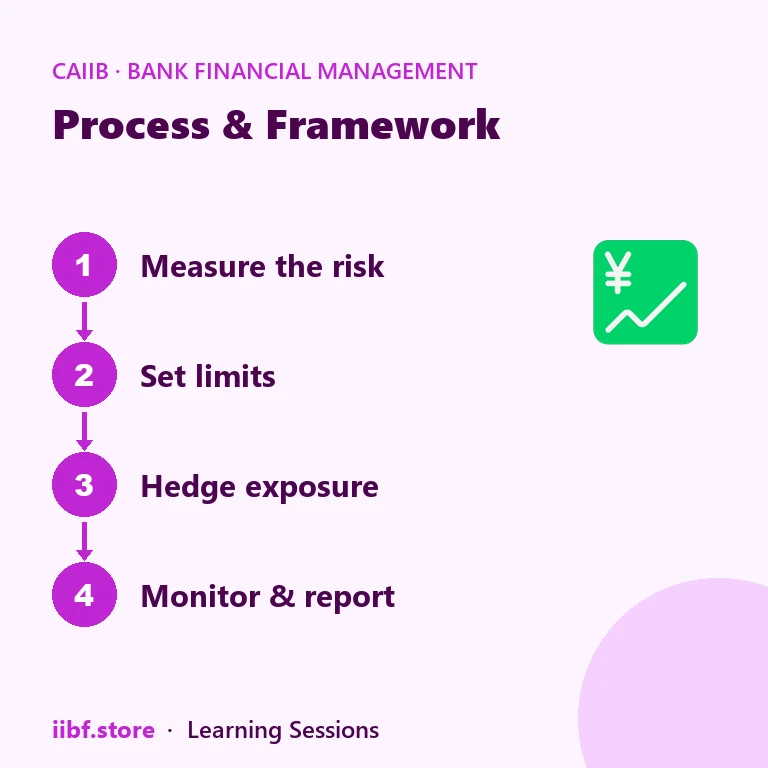
Beyond measurement, IRRBB is a governance discipline. The Board sets the bank's risk appetite for interest-rate risk, the Asset-Liability Committee (ALCO) owns day-to-day monitoring, and the treasury executes hedges within approved limits. A recurring exam theme is the treatment of Non-Maturity Deposits (NMDs) such as savings and current accounts: contractually they can be withdrawn on demand, but behaviourally a large "core" portion is sticky. Banks model this core-versus-volatile split and assign behavioural maturities, which materially changes both gap and duration results. Similarly, prepayment behaviour on retail loans must be modelled rather than assumed to follow the contractual schedule.
When you attempt CAIIB BFM questions, use a simple checklist: identify whether the question asks for an earnings (ΔNII) or economic-value (ΔEVE) answer; determine the sign of the gap or duration gap; and apply the correct rate shock direction. Practise numerical duration-gap problems until the mechanics are automatic, and reinforce the theory with active recall using tools like the concept-matching game and the full Bank Financial Management article hub. Combining conceptual clarity on IRRBB sources, the two measurement lenses, and the standardised shocks will let you confidently clear this high-weightage section of the paper.

Frequently Asked Questions
What does IRRBB stand for in the CAIIB BFM syllabus?
IRRBB stands for Interest Rate Risk in the Banking Book. It is the risk that adverse movements in market interest rates reduce a bank's net interest income (the earnings measure) and the economic value of its equity (the value measure) on positions held in the banking book rather than the trading book.
How is IRRBB different from market risk in the trading book?
Trading-book positions are held for short-term profit, marked-to-market daily, and carry a Pillar 1 capital charge. IRRBB concerns banking-book items such as loans, deposits, and held-to-maturity investments that reprice slowly; it is treated as a Pillar 2 risk managed through the ALM framework, with enhanced disclosure rather than a fixed Pillar 1 charge.
What are the two ways banks measure IRRBB?
Banks use an earnings-based measure — the change in Net Interest Income (ΔNII) over roughly a one-year horizon — and an economic-value measure — the change in Economic Value of Equity (ΔEVE), which discounts all future banking-book cash flows. Traditional Gap analysis supports the earnings view and Duration Gap analysis supports the economic-value view.
What is the supervisory outlier test for IRRBB?
The outlier test flags a bank whose maximum fall in Economic Value of Equity across the six standardised interest-rate shocks exceeds a set share of Tier 1 capital (the Basel standard uses 15%). Being flagged triggers closer Pillar 2 supervisory review rather than an automatic capital penalty. Always verify the current threshold from RBI before quoting it professionally.
Conclusion
IRRBB in banking book management ties together repricing gaps, basis and optionality risk, the earnings and economic-value lenses, and the six standardised Basel shocks — a compact but high-scoring cluster in the CAIIB Bank Financial Management paper. Nail the definitions, learn to read the sign of the gap, and practise duration-gap numericals until they are second nature. Ready to test yourself? Attempt a timed CAIIB BFM mock test or enrol in the structured CAIIB course on iibf.store to convert this theory into exam marks.
Quick quiz on this topic
5 exam-style questions from our free test bank — check yourself before you move on.
Practice this topic
Take a free mock test, download chapter PDFs, or watch a video class — all included on iibf.store.
Keep reading